Alkene Bonding
A concise revision guide to alkene structure, carbon-carbon double bonds, sigma bonds, pi bonds and why alkenes are more reactive than alkanes.
GCSE Recap: Shared Pairs of Electrons
Three quick questions on single and double covalent bonds before you look inside the C=C bond.
What Makes an Alkene Unsaturated?
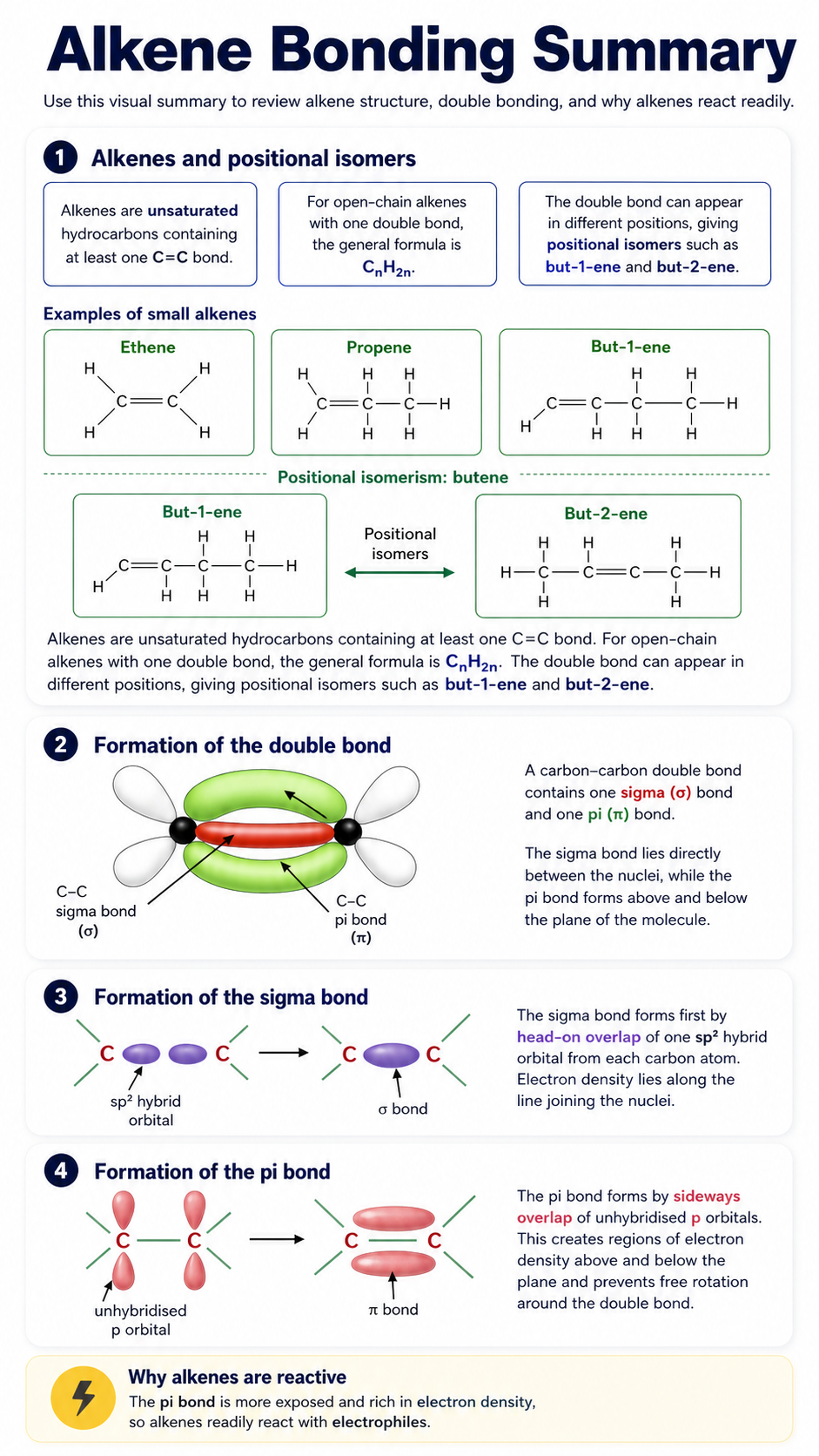
Alkenes are hydrocarbons described as unsaturated. This means they do not contain the maximum possible number of hydrogen atoms.
The key structural feature of an alkene is at least one carbon-carbon double bond, written as C=C. For alkenes with one double bond and no rings, the general formula is CnH2n.
Small alkenes include ethene, propene and butene. In longer alkenes, the position of the double bond can change, producing positional isomers such as but-1-ene and but-2-ene.
Key idea: An alkene must contain a C=C double bond, and this double bond is responsible for the characteristic chemistry of alkenes.
Alkenes and positional isomers
Shows unsaturation, the C=C bond, CnH2n, and how butene can exist as but-1-ene or but-2-ene.
Quick Check: Formulae and Positional Isomers
Apply the general formula to alkenes that are not named on this page.
Quick Check: A Ring as Well as a Double Bond
Work out how the general formula changes when the alkene is cyclic.
The Carbon-Carbon Double Bond
A carbon-carbon double bond is made from two different covalent bonds: one sigma, σ, bond and one pi, π, bond.
The sigma bond forms first and lies directly between the two carbon nuclei. The pi bond forms from sideways overlap of p orbitals, giving electron density above and below the plane of the molecule.
The pi bond is more exposed than the sigma bond. This creates a region of high electron density that can attract electron-deficient species called electrophiles.
Exam focus: When explaining alkene reactivity, link the exposed pi bond to high electron density and attraction to electrophiles.
The C=C double bond contains one sigma bond and one pi bond, with the pi bond forming above and below the molecular plane.
Quick Check: Count the σ and π Bonds
Count every bond in the molecule shown, remembering what each double bond contains.
Formation of the Sigma Bond
When two carbon atoms form a double bond, each carbon uses one sp2 hybrid orbital to overlap directly with the other carbon atom.
This direct head-on overlap produces a strong carbon-carbon sigma bond. The electron density is concentrated between the two nuclei, so the sigma bond lies along the straight line joining the nuclei.
A single sigma bond allows free rotation around the bond axis. However, in a C=C double bond, this rotation is restricted because the pi bond must also be maintained.
Remember: Sigma bonds are formed by direct overlap along the internuclear axis.
Direct head-on overlap places electron density between the nuclei, forming the first bond in the carbon-carbon double bond.
Quick Check: Which Bond Can Rotate?
Decide where rotation is possible in two molecules that are not on this page.
σ Bonding Orbital
A visual model of a sigma (σ) bonding orbital formed by the head-on overlap of two atomic orbitals. Electron density is concentrated along and between the two nuclei.
Formation of the Pi Bond
After the sigma bond forms, each carbon retains one unhybridised p orbital perpendicular to the plane of the molecule.
The pi, π, bond forms when these p orbitals overlap sideways. This produces regions of electron density above and below the line joining the two carbon nuclei.
Because sideways overlap is less direct than sigma overlap, the pi bond is weaker than the sigma bond. The pi bond also prevents free rotation around the C=C bond.
Pi bond: A covalent bond formed by sideways overlap of p orbitals, with electron density above and below the internuclear axis.
Formation of the π bond
Sideways p-orbital overlap produces electron density above and below the C-C bond axis, restricting rotation and increasing reactivity.
Hybridisation of Carbon: sp³, sp² and sp Orbitals
Drag to rotate, scroll or pinch to zoom. Switch between the three states to see how mixing the 2s and 2p orbitals changes the shape around the carbon nucleus, and which 2p orbitals are left unhybridised.
sp³ hybridisation
© Dr. Mohammed Al-Fatah – onlinelearningsystem.net
Quick Check: Explain the Bond Enthalpy Data
Write a short explanation, then compare it with the mark points and the model answer.
π Bonding Orbital
A visual model of a pi (π) bonding orbital formed by the sideways overlap of two p orbitals. Electron density is concentrated in two lobes above and below the internuclear axis. The red plane marks the nodal plane where electron density is zero.
Shape Around the C=C Bond
Each carbon atom in a C=C double bond is surrounded by three regions of electron density: the two single bonds to other atoms and the double bond to the other carbon. The double bond counts as one region because the σ and π bonds occupy the same space between the two nuclei.
These three regions repel one another and move as far apart as possible. The result is a trigonal planar arrangement around each carbon atom, with bond angles of 120°. All six atoms of ethene therefore lie in one plane.
The OCR specification asks for this explanation in terms of electron pair repulsion, the same model used for the shapes of simple molecules in section 2.2.2.
Exam sentence: Around each carbon atom in the C=C bond there are three regions of electron density which repel each other equally and arrange themselves as far apart as possible, giving a trigonal planar shape with a bond angle of 120°.
Quick Check: Shapes and Bond Angles
Give the shape or bond angle in molecules that are not on this page.
Why the π Bond Makes Alkenes Reactive
Alkenes are more reactive than alkanes because the π bond has a relatively low bond enthalpy. Sideways overlap of p orbitals is less effective than the head-on overlap of a σ bond, so less energy is needed to break the π bond.
The π bond also holds its electron density above and below the plane of the molecule, where it is exposed. Electron-deficient species called electrophiles are attracted to this region of high electron density.
In an addition reaction the π bond breaks and two new σ bonds form. Because a σ bond is stronger than a π bond, the products are more stable than the alkene, so addition reactions of alkenes are energetically favourable.
| Bond | How it forms | Bond enthalpy | Consequence |
|---|---|---|---|
| σ bond | Head-on overlap of sp2 orbitals | Higher | Remains intact in addition reactions |
| π bond | Sideways overlap of p orbitals | Relatively low | Breaks in addition reactions and attracts electrophiles |
Exam focus: OCR expects the reactivity of alkenes to be explained in terms of the relatively low bond enthalpy of the π bond, not simply by saying that alkenes have a double bond.
Comparing Sigma and Pi Bonds
Exam questions often test whether you can distinguish sigma bonding from pi bonding and connect this bonding to alkene reactivity.
| Feature | Sigma bond | Pi bond |
|---|---|---|
| How it forms | Direct head-on orbital overlap | Sideways overlap of p orbitals |
| Electron density | Between the two nuclei | Above and below the molecular plane |
| Effect in alkenes | Forms the first bond between the carbon atoms | Creates an exposed electron-rich region that reacts with electrophiles |
Quick Check: σ and π Bonds in Propene
In each round, pick the one statement about propene that is accurate.
Master Alkenes for OCR A Level Chemistry A
Continue from these free revision notes into the full 4.1.3 Alkenes course. The guided video lessons are ready now; the OCR A MCQ bank, teacher-marked short-answer questions and KASP spec-point report are being written, and the course opens for enrolment as soon as they are complete.
Guided video teaching
Learn the chemistry and exam technique through structured video lessons with worked examples and walkthroughs.
Instant MCQ feedback
Auto-marked MCQ quizzes provide immediate diagnostic feedback for every answer choice.
Teacher-marked SAQs
Submit written exam responses and receive chemistry specialist feedback with improvement guidance.
Progress tracking
Identify strengths and weaknesses across the full 4.1.3 specification with targeted reporting.
See how the course works
Click play to start the course preview animation.
Some ionic radii are shown.
| Ion | Ionic radius / nm |
|---|---|
| Na+ | 0.102 |
| K+ | 0.138 |
| F− | 0.133 |
| Cl− | 0.180 |
Which compound has the strongest ionic bonding?
Explain why the metallic bonding in magnesium is much stronger than that in sodium.
Copyright notice: This OLS revision content, including the explanations, layout, diagrams, tables and embedded learning structure, is authored for Online Learning System by Dr. Mohammed Al-Fatah. It may not be copied, reproduced, redistributed or adapted without written permission.
Keep this note — free
Save your progress across every OCR A topic. A free account remembers which topics you have covered, saves your question scores, and syncs across your phone and laptop.
- Track every topic you have finished
- Keep your practice-question scores
- No payment, no card, free forever
Already registered? Log in