Geometric Isomerism
A concise revision guide to stereoisomerism in alkenes, restricted rotation around C=C bonds, E-Z naming, priority groups and the link between E-Z and cis-trans isomerism.
What Are Stereoisomers?
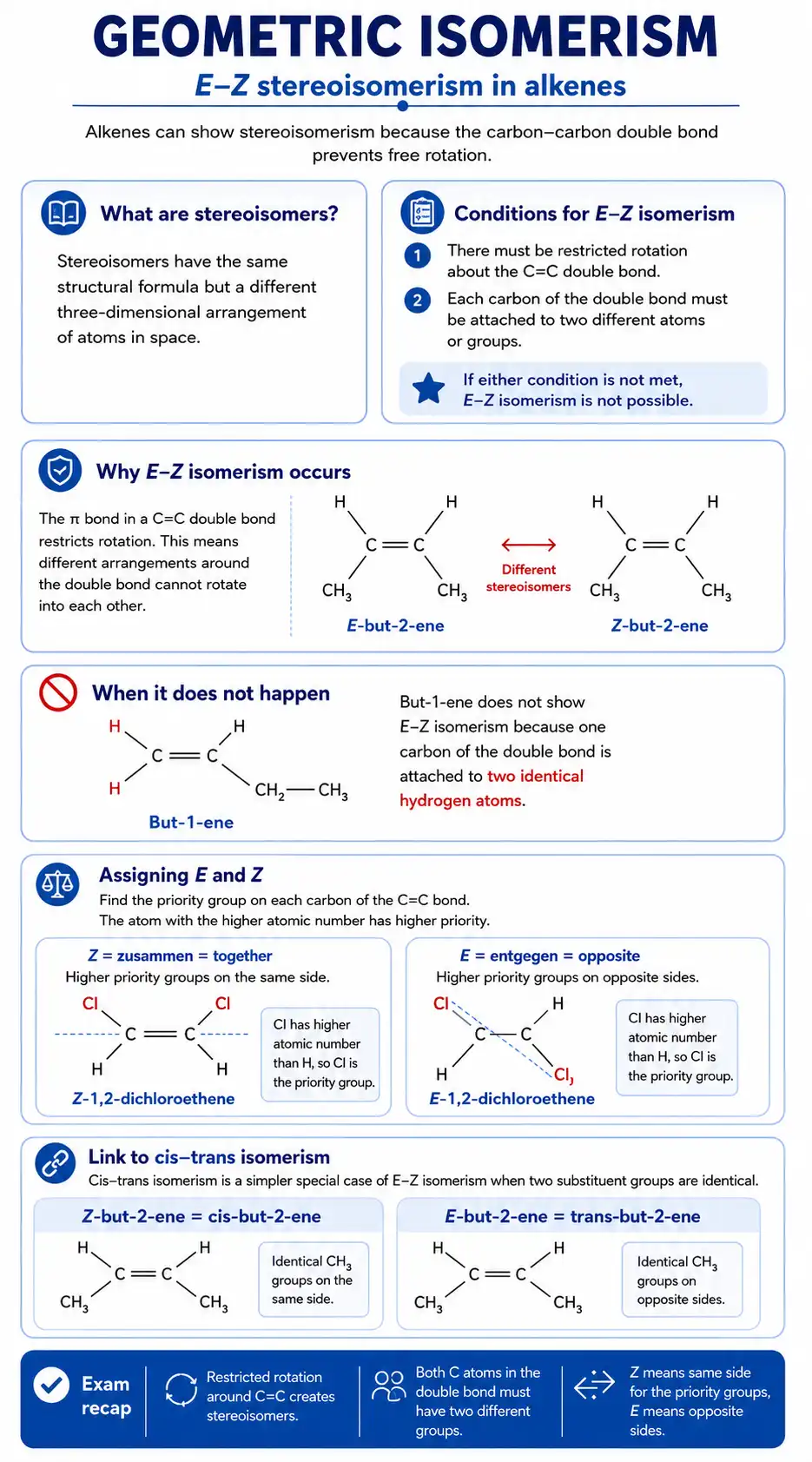
Stereoisomers are compounds with the same structural formula but a different three-dimensional arrangement of atoms in space.
In alkenes, this matters because the C=C double bond restricts rotation. The atoms or groups attached to the double bond cannot freely rotate into a new arrangement without breaking the pi bond.
This produces a type of stereoisomerism called E-Z stereoisomerism, also called geometric isomerism.
Key idea: E-Z isomers are not structural isomers. They have the same connectivity, but different spatial arrangement around the carbon-carbon double bond.
Quick Check: Structural Isomer or Stereoisomer?
Complete a comparison of three alkenes that are not on this page.
Why E-Z Isomerism Occurs
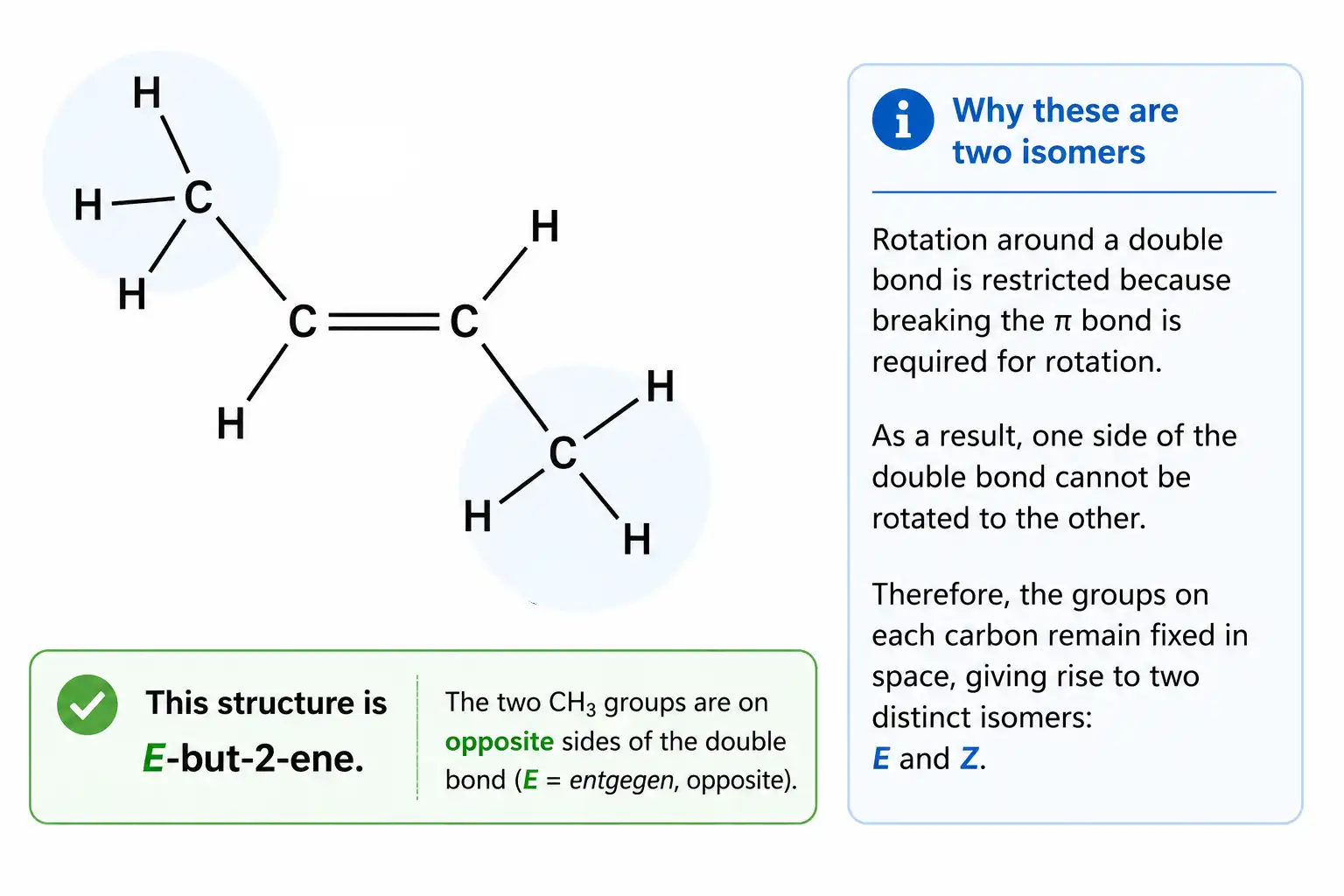
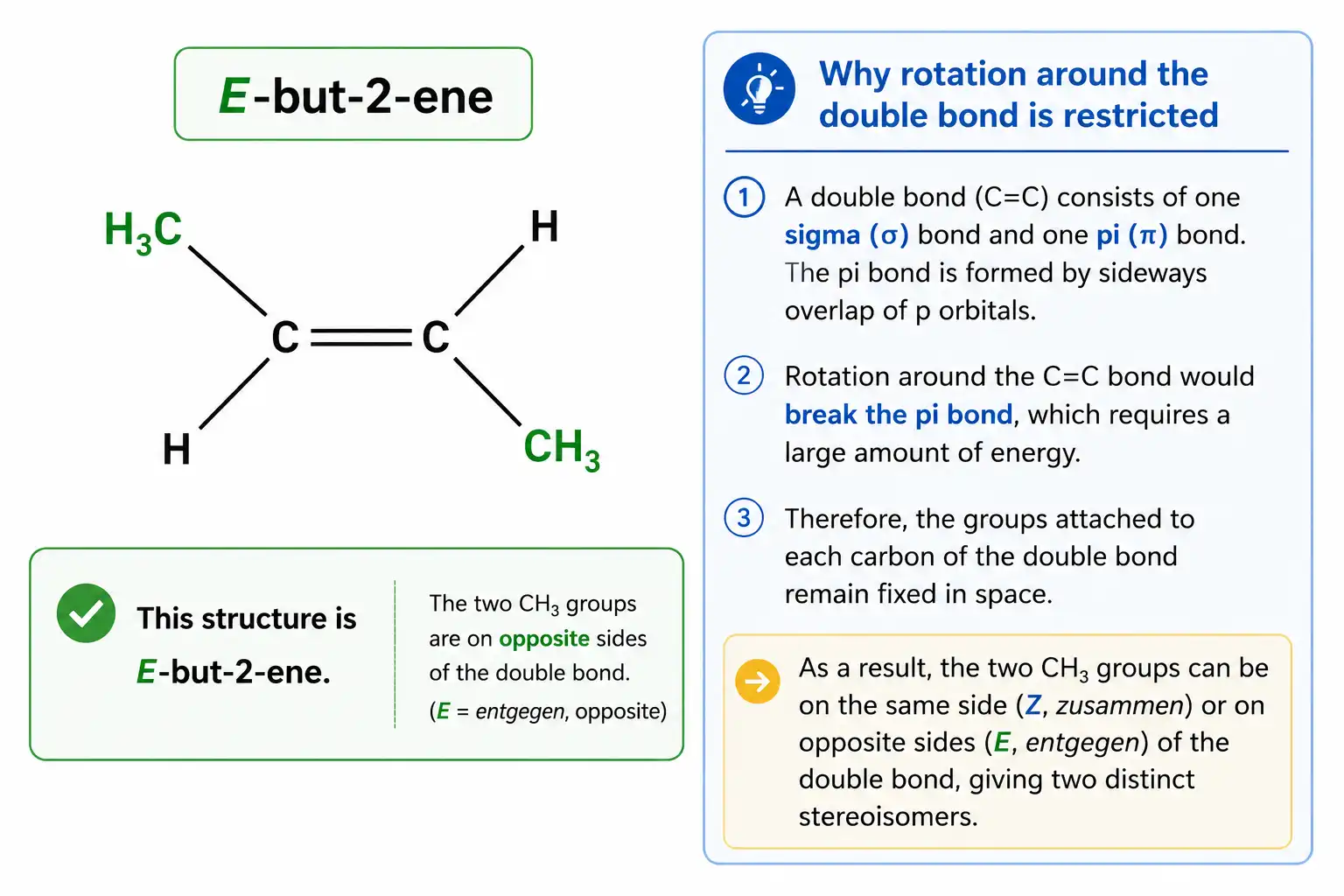
E-Z isomerism occurs because the carbon-carbon double bond contains a pi bond. Rotation around the C=C bond is restricted because rotating one carbon would break the sideways overlap of the p orbitals.
By contrast, a carbon-carbon single bond can rotate freely. This is why simple alkanes do not usually produce this type of fixed geometric arrangement.
Exam focus: Always link E-Z isomerism to restricted rotation around the C=C double bond.
Quick Check: Explain Two Forms Against One
Write a short explanation, then compare it with the mark points and the model answer.
Chloroethane: rotation around the C-C single bond
The C-C single bond is a σ bond. In this model, the CH₃ side remains fixed while the CH₂Cl side rotates slowly around the C-C bond axis.
Conditions for E-Z Stereoisomerism
For an alkene to show E-Z stereoisomerism, two conditions must both be met:
- There must be restricted rotation about the carbon-carbon double bond.
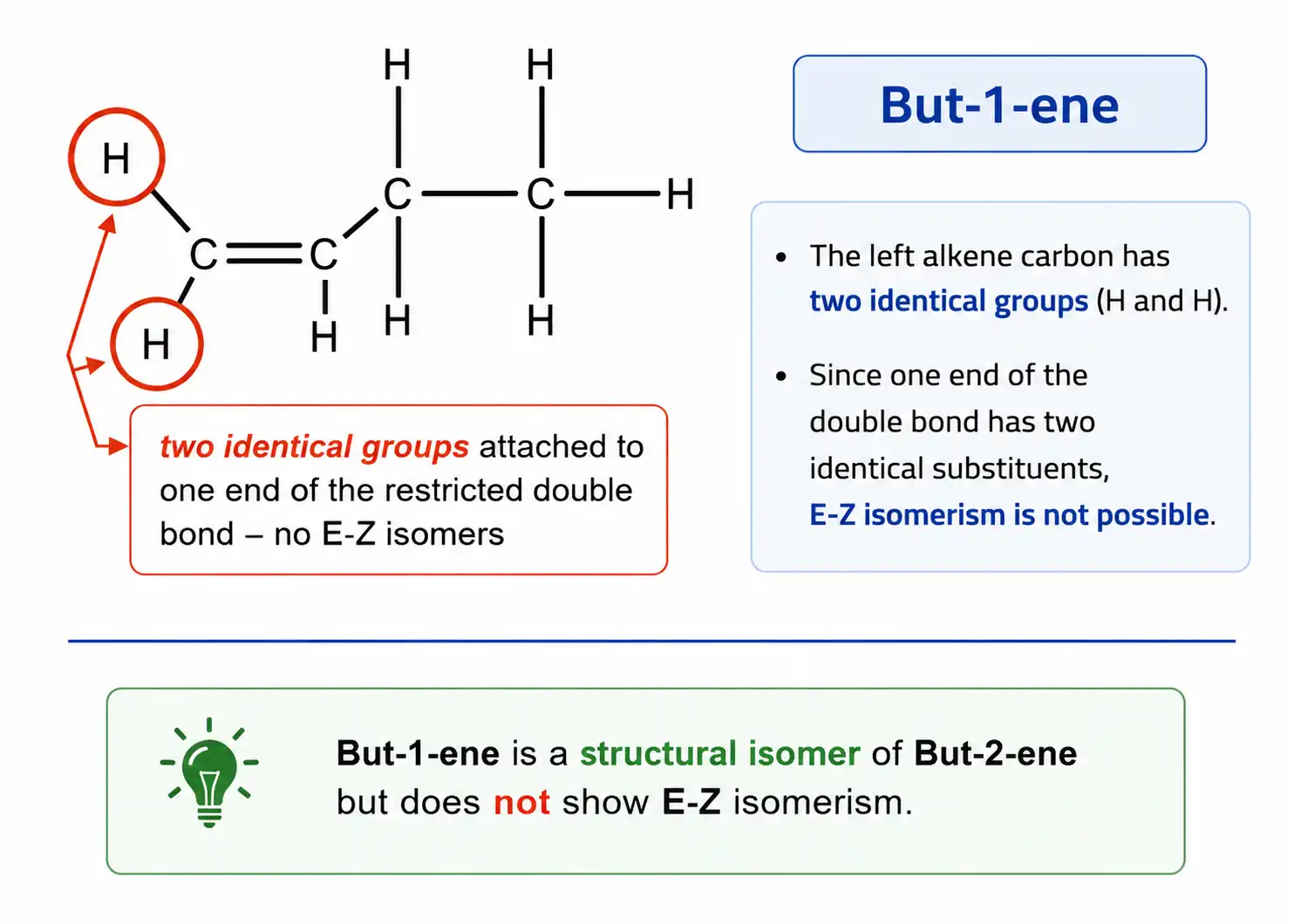
- Each carbon atom of the C=C bond must be attached to two different atoms or groups.
If either carbon in the C=C bond has two identical groups attached, E-Z isomerism is not possible.
Quick Check: Which Alkenes Show E-Z Isomerism?
Sketch each alkene, then click every one that has E and Z isomers.
1,2-Dichloroethene: restricted rotation around the C=C bond
The C=C double bond contains a π bond. When one side tries to rotate, the sideways overlap needed for the π bond would be disrupted, so the molecule is knocked back instead of rotating freely.
Assigning E and Z
To name an alkene with E-Z stereoisomerism, first identify the priority group on each carbon atom of the double bond.
The priority group is found by comparing the atoms directly attached to each double-bond carbon. The atom with the higher atomic number has higher priority.
| Arrangement of priority groups | Name used | Memory aid |
|---|---|---|
| Priority groups on the same side of the C=C bond | Z | Z comes from zusammen, meaning together. |
| Priority groups on opposite sides of the C=C bond | E | E comes from entgegen, meaning opposite. |
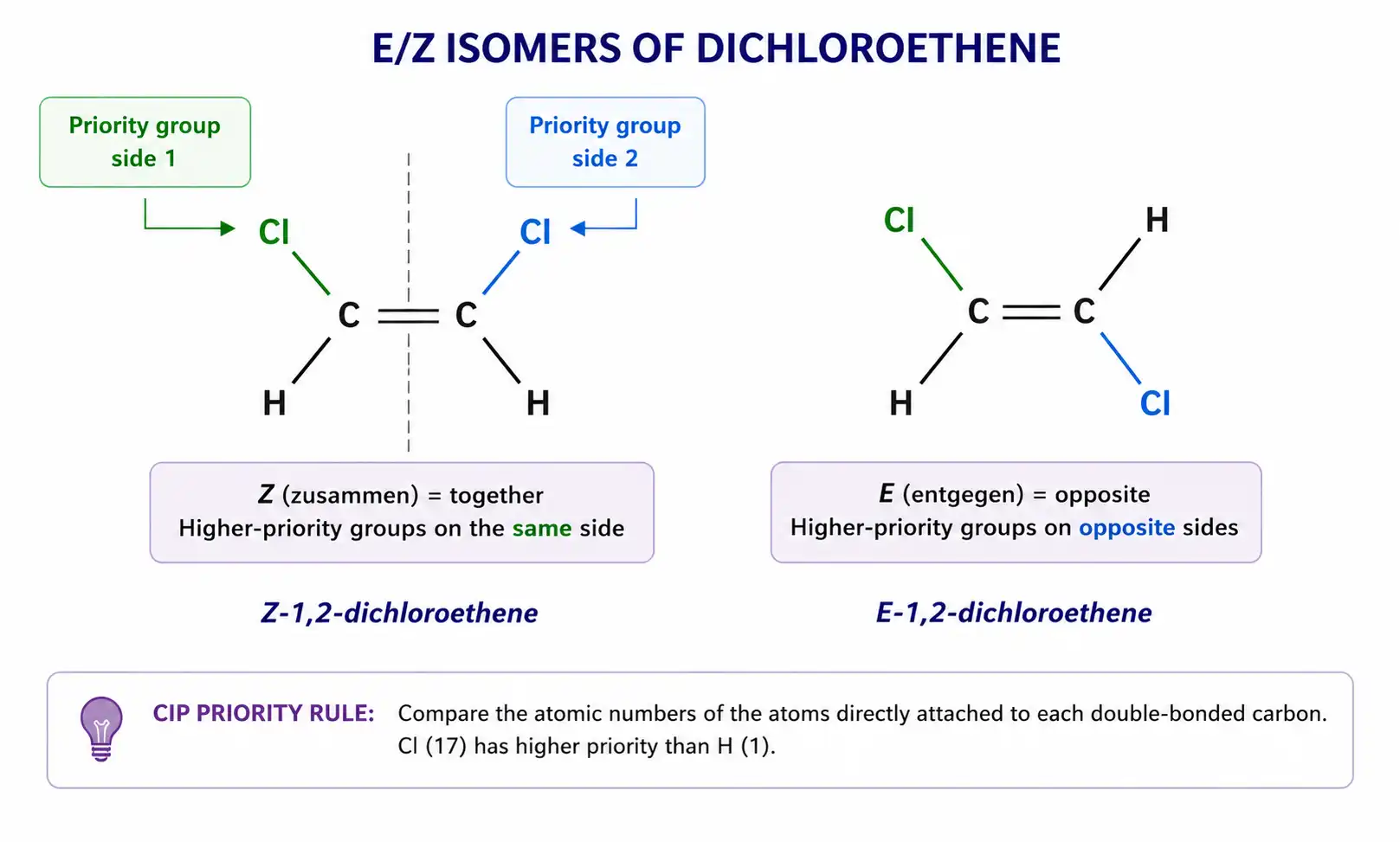
Quick Check: E, Z or Neither?
Find the priority group on each carbon atom, then decide quickly.
Cahn–Ingold–Prelog Priority Rules
When the groups attached to a double-bond carbon are not single atoms, priority is decided using the Cahn–Ingold–Prelog (CIP) rules. OCR requires these rules to identify E and Z stereoisomers.
Rule 1: compare the atoms directly attached
Compare the atomic numbers of the atoms bonded directly to each carbon of the C=C bond. The atom with the higher atomic number has the higher priority. For example, Br (35) outranks Cl (17), and Cl outranks C (6), which outranks H (1).
Rule 2: if the first atoms tie, move outwards
If the directly attached atoms are the same, list the atoms bonded to each of them in order of decreasing atomic number and compare the lists atom by atom. The first point of difference decides the priority.
For example, an ethyl group, CH2CH3, outranks a methyl group, CH3. Both attach through carbon, but the ethyl carbon carries (C, H, H) while the methyl carbon carries (H, H, H). Carbon outranks hydrogen at the first difference, so ethyl has the higher priority.
| Groups being compared | First atom attached | Decision |
|---|---|---|
| Br and Cl | Br (35) and Cl (17) | Br has priority by Rule 1 |
| Cl and CH3 | Cl (17) and C (6) | Cl has priority by Rule 1 |
| CH2CH3 and CH3 | C and C (tie) | Ethyl has priority by Rule 2: (C,H,H) beats (H,H,H) |
| CH(CH3)2 and CH2CH3 | C and C (tie) | Isopropyl has priority by Rule 2: (C,C,H) beats (C,H,H) |
Once the priority group on each carbon is known, the isomer is Z if the two priority groups are on the same side of the C=C bond and E if they are on opposite sides.
Exam focus: State the priority on each carbon separately, then compare the two sides. Do not compare a group on one carbon with a group on the other carbon.
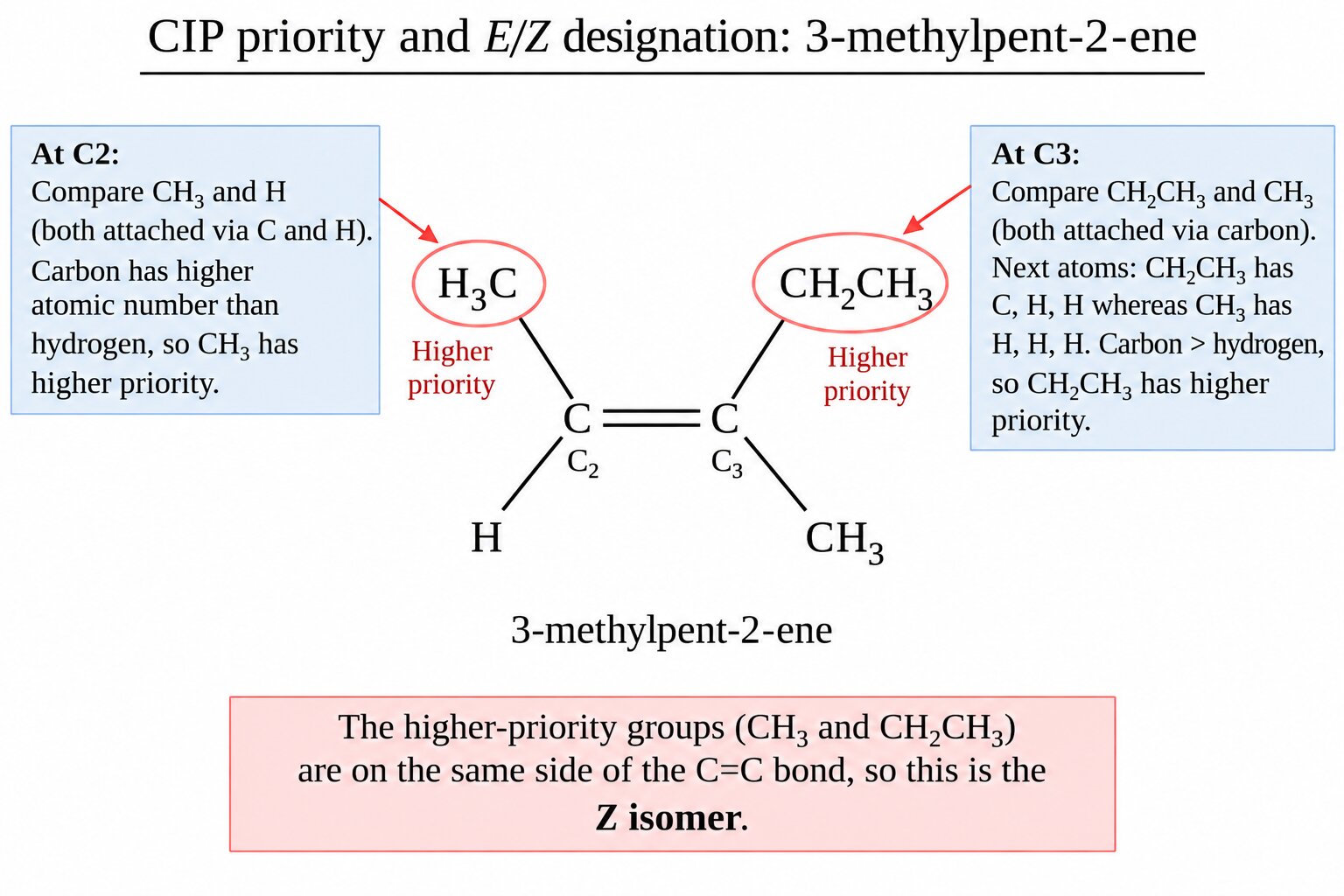
Assign the priority group on each carbon separately, then compare the two sides of the double bond.
Quick Check: When the First Atoms Tie
Use Rule 2 on a pair of groups that the table does not show.
Quick Check: Assign E or Z
Find the priority group on each carbon atom of the isomer shown, then compare sides.
Cis-Trans Isomerism
Cis-trans isomerism is a simpler special case of E-Z isomerism. It can be used when two of the substituent groups attached to the double bond are identical.
For but-2-ene, the two CH3 groups can be on the same side or on opposite sides of the double bond.
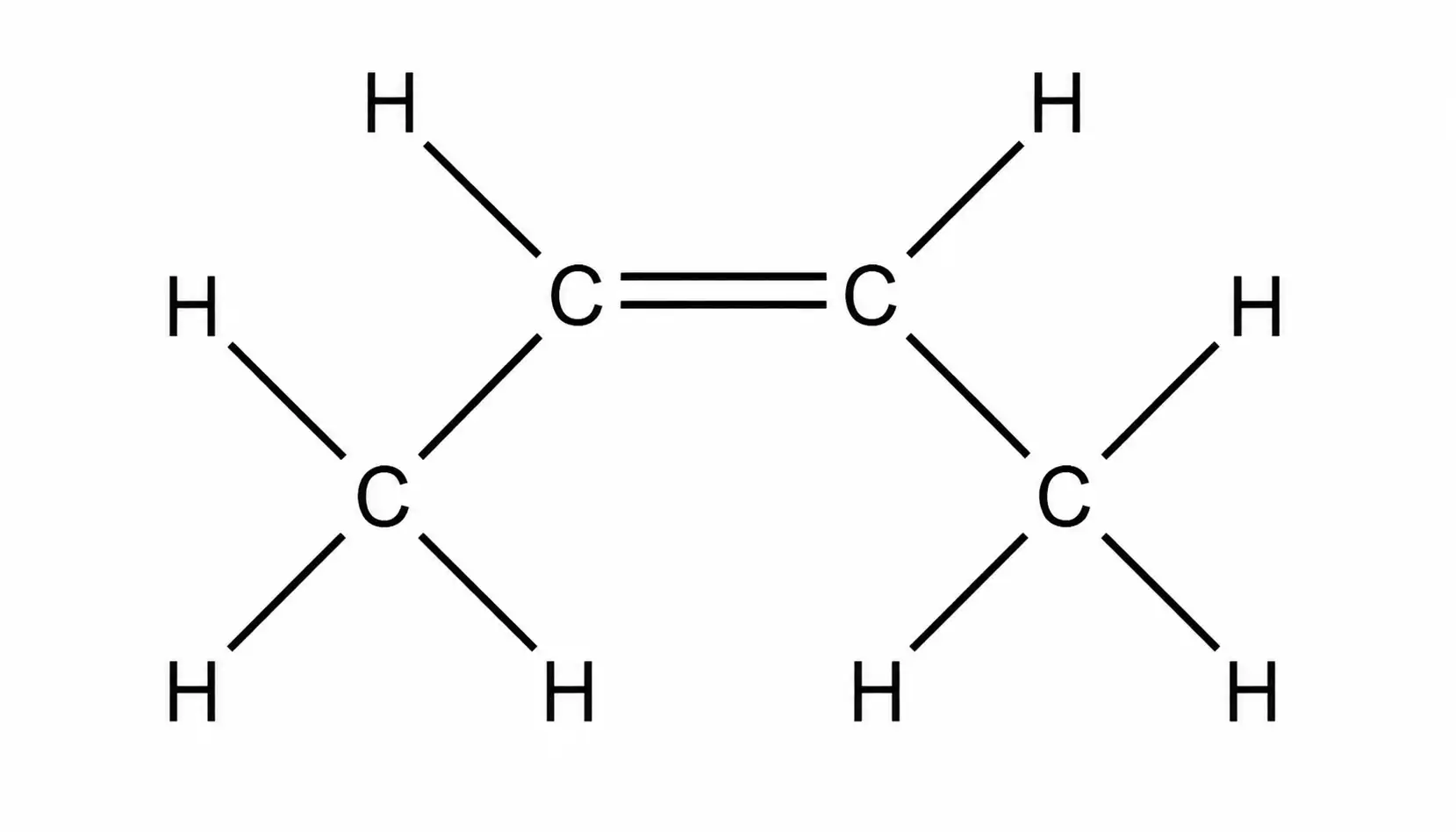
Z-but-2-ene
The two CH3 groups are on the same side, so this can also be called cis-but-2-ene.
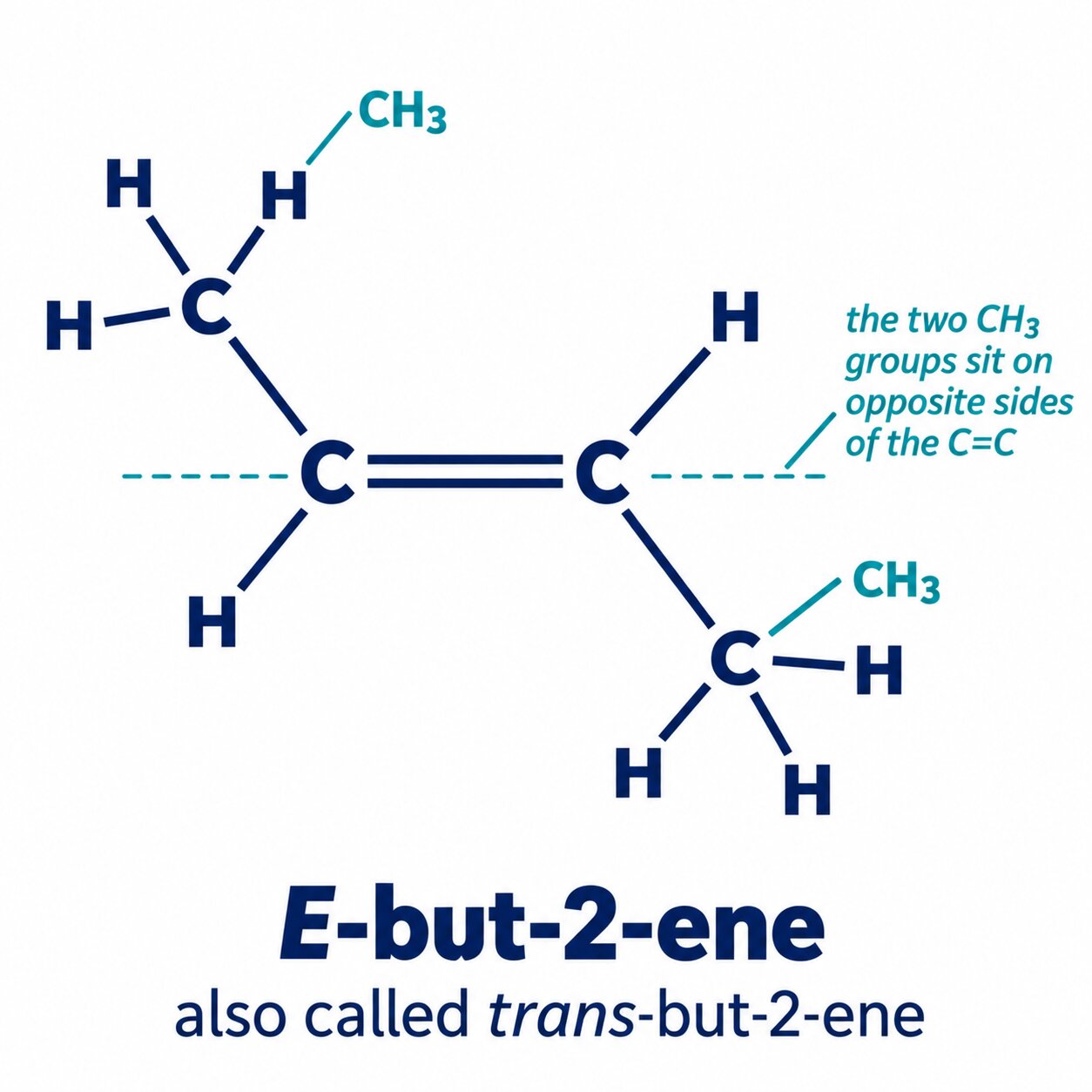
E-but-2-ene
The two CH3 groups are on opposite sides, so this can also be called trans-but-2-ene.
Important: E-Z notation is the more general and accurate naming system, especially when the groups attached to the C=C bond are not identical.
Quick Check: Pick the Accurate Statement
Each round puts a common mistake next to the correct idea, in a molecule you have not met on this page.
Common Exam Mistakes
- Do not call E-Z isomers structural isomers. They have the same structural formula.
- Do not assign E or Z by only looking at the largest group visually. Use atomic number priority and, where the first atoms tie, the Cahn–Ingold–Prelog rules.
- Do not assume every alkene shows E-Z isomerism. Each carbon in the C=C bond must have two different groups attached.
- Do not say the molecule rotates around the double bond. The whole point is that rotation around C=C is restricted.
Master Alkenes for OCR A Level Chemistry A
Continue from these free revision notes into the full 4.1.3 Alkenes course. The guided video lessons are ready now; the OCR A MCQ bank, teacher-marked short-answer questions and KASP spec-point report are being written, and the course opens for enrolment as soon as they are complete.
Guided video teaching
Learn the chemistry and exam technique through structured video lessons with worked examples and walkthroughs.
Instant MCQ feedback
Auto-marked MCQ quizzes provide immediate diagnostic feedback for every answer choice.
Teacher-marked SAQs
Submit written exam responses and receive chemistry specialist feedback with improvement guidance.
Progress tracking
Identify strengths and weaknesses across the full 4.1.3 specification with targeted reporting.
See how the course works
Click play to start the course preview animation.
Some ionic radii are shown.
| Ion | Ionic radius / nm |
|---|---|
| Na+ | 0.102 |
| K+ | 0.138 |
| F− | 0.133 |
| Cl− | 0.180 |
Which compound has the strongest ionic bonding?
Explain why the metallic bonding in magnesium is much stronger than that in sodium.
Copyright notice: This OLS revision content, including the explanations, layout, diagrams, tables and embedded learning structure, is authored for Online Learning System by Dr. Mohammed Al-Fatah. It may not be copied, reproduced, redistributed or adapted without written permission.
Keep this note — free
Save your progress across every OCR A topic. A free account remembers which topics you have covered, saves your question scores, and syncs across your phone and laptop.
- Track every topic you have finished
- Keep your practice-question scores
- No payment, no card, free forever
Already registered? Log in