Reactions of Alkenes with Halogens
A concise revision guide to the addition reaction of alkenes with bromine or chlorine, including the functional group change, reaction conditions and the electrophilic addition mechanism.
The Overall Reaction
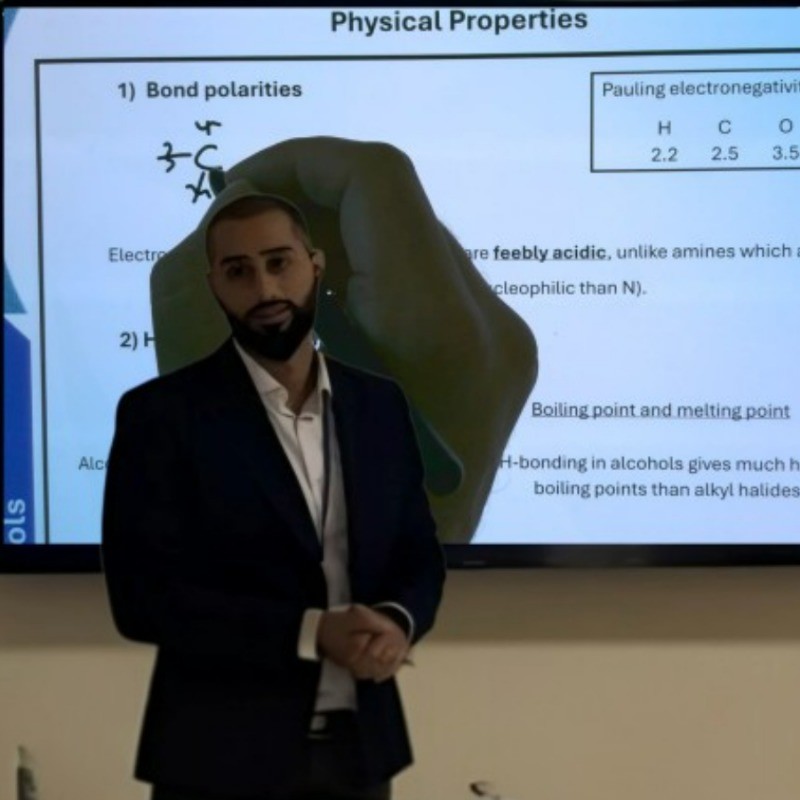
Alkenes react with halogens such as bromine, Br2, or chlorine, Cl2, in an addition reaction. The C=C double bond opens and one halogen atom adds to each carbon from the original double bond.
The functional group changes from an alkene to a dihaloalkane. For example, ethene reacts with bromine to form 1,2-dibromoethane.
Key idea: The reaction is addition because atoms are added across the C=C double bond and only one organic product is formed from the alkene.
Quick Check: Predict the Product
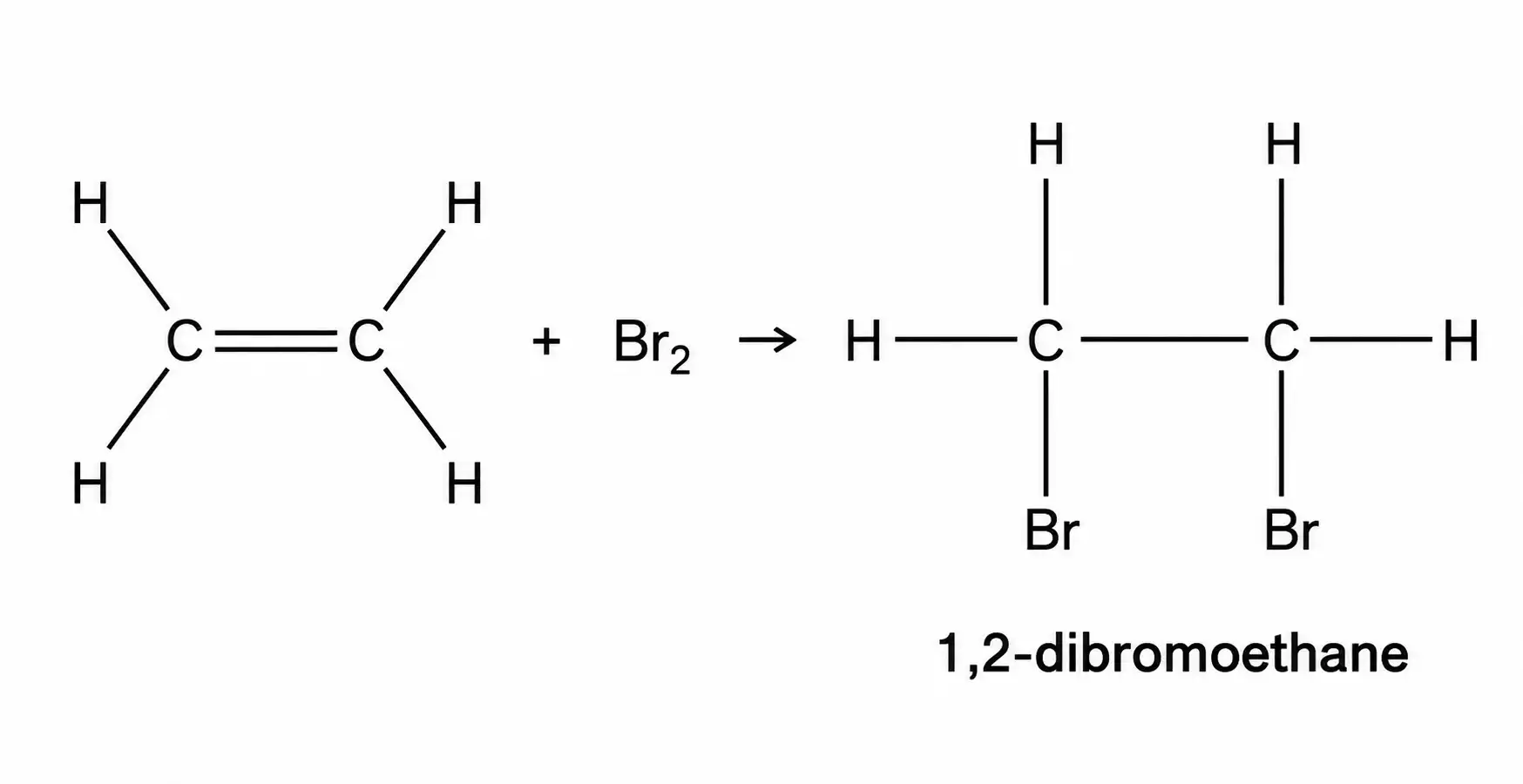
Work out what chlorine does to an alkene that is not shown on this page.
Why Bromine Acts as an Electrophile
The π bond in an alkene is a region of high electron density. As a Br2 molecule approaches the alkene, the electron-rich π bond repels the shared electron pair in the Br-Br bond.
This repulsion induces a dipole in the bromine molecule. One bromine atom becomes slightly positive, Brδ+, while the other becomes slightly negative, Brδ–.
The slightly positive bromine atom acts as the electrophile because it is attracted to the electron-rich π bond.
Electrophile: An electron-pair acceptor. In this reaction, the polarised bromine molecule provides Brδ+, which accepts electron density from the alkene π bond.
Quick Check: The Induced Dipole
In each round, choose the one statement that is accurate.
Bond Fission and Carbocation Formation
The Br-Br bond breaks by heterolytic fission. This means both electrons from the covalent bond go to one bromine atom, forming a bromide ion, Br–.
At the same time, the alkene π bond forms a new bond to Brδ+. One of the carbon atoms from the original double bond becomes positively charged, producing a carbocation intermediate.
Remember: A carbocation is an organic ion with a positively charged carbon atom.
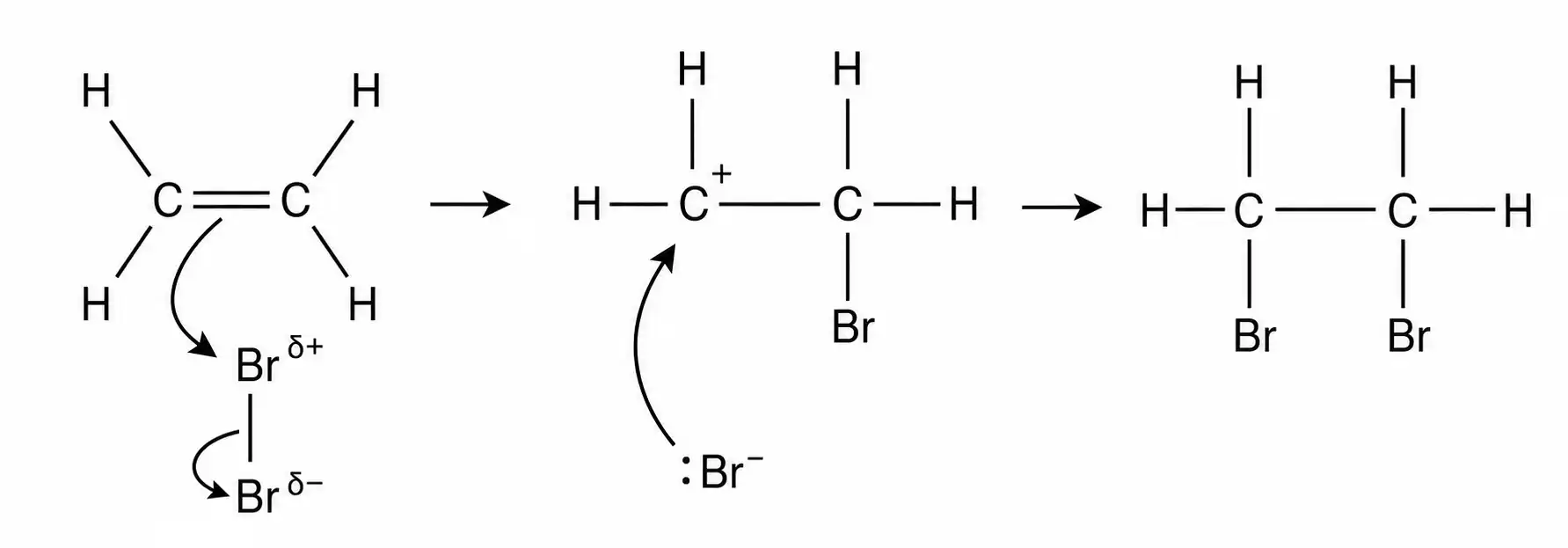
The π bond polarises Br2, Brδ+ adds first, then Br– attacks the carbocation to give the dibromo product.
Quick Check: Charges, Atoms and Amounts
Answer as quickly as you can, using new alkenes each time.
The Mechanism in Three Steps
Step 1: The π bond polarises Br2
The high electron density in the C=C bond repels the Br-Br bonding pair, making the nearer bromine atom Brδ+.
Step 2: The electrophile adds
The alkene π bond donates electron density to Brδ+, forming a C-Br bond and a carbocation intermediate.
Step 3: Bromide attacks
The Br– ion donates a lone pair to the carbocation, forming a second C-Br bond and producing the dihaloalkane.
Quick Check: Chlorine with Cyclopentene
Drag the words and numbers into place to build the account of the reaction.
Bromine and Chlorine Give Similar Products
The same addition pattern applies to chlorine. With Cl2, the product is a dichloroalkane. With Br2, the product is a dibromoalkane.
| Halogen | Product type | Example from ethene |
|---|---|---|
| Br2 | Dibromoalkane | 1,2-dibromoethane |
| Cl2 | Dichloroalkane | 1,2-dichloroethane |
Exam focus: Do not describe this as substitution. The C=C double bond breaks and two atoms are added, so this is an addition reaction.
Quick Check: Work It Out, Then Flip
Work each answer out on paper first, then turn the card over to check your reasoning.
Master Alkenes for OCR A Level Chemistry A
Continue from these free revision notes into the full 4.1.3 Alkenes course. The guided video lessons are ready now; the OCR A MCQ bank, teacher-marked short-answer questions and KASP spec-point report are being written, and the course opens for enrolment as soon as they are complete.
Guided video teaching
Learn the chemistry and exam technique through structured video lessons with worked examples and walkthroughs.
Instant MCQ feedback
Auto-marked MCQ quizzes provide immediate diagnostic feedback for every answer choice.
Teacher-marked SAQs
Submit written exam responses and receive chemistry specialist feedback with improvement guidance.
Progress tracking
Identify strengths and weaknesses across the full 4.1.3 specification with targeted reporting.
See how the course works
Click play to start the course preview animation.
Some ionic radii are shown.
| Ion | Ionic radius / nm |
|---|---|
| Na+ | 0.102 |
| K+ | 0.138 |
| F− | 0.133 |
| Cl− | 0.180 |
Which compound has the strongest ionic bonding?
Explain why the metallic bonding in magnesium is much stronger than that in sodium.
Copyright notice: This OLS revision content, including the explanations, layout, diagrams, tables and embedded learning structure, is authored for Online Learning System by Dr. Mohammed Al-Fatah. It may not be copied, reproduced, redistributed or adapted without written permission.
Keep this note — free
Save your progress across every OCR A topic. A free account remembers which topics you have covered, saves your question scores, and syncs across your phone and laptop.
- Track every topic you have finished
- Keep your practice-question scores
- No payment, no card, free forever
Already registered? Log in