Processing Waste Polymers
A concise OCR A Level Chemistry A revision guide to the two ways waste polymers are processed for sustainability in 4.1.3(k): combustion for energy production, and use as an organic feedstock for making new plastics and other organic chemicals.
GCSE Recap: Plastics, Burning and Landfill
Three quick questions on the GCSE ideas about polymers that this page builds on.
Why Waste Polymers Are Processed
Poly(alkenes) are made from crude oil, a finite resource, and because their chains are saturated and non-polar they do not break down in landfill. OCR 4.1.3(k) asks for the benefits for sustainability of processing waste polymers rather than burying them.
Three routes are named in the specification. This page covers the first two in detail: combustion for energy production and use as an organic feedstock. The third, removing toxic waste products such as HCl when halogenated plastics are burned, is covered on the Polymer Waste page.
| OCR 4.1.3(k) route | What happens to the polymer | What is recovered |
|---|---|---|
| (i) Combustion for energy production | Burned in an energy-from-waste plant | Heat, used to generate electricity |
| (ii) Use as an organic feedstock | Cracked back into small molecules | Alkenes and other chemicals for new products |
| (iii) Removal of toxic waste products | Acidic gases from combustion neutralised | A cleaner waste stream |
Key idea: Sustainability means meeting present needs without using up resources or damaging the environment for the future. Each route either recovers something useful from the waste or reduces the harm it causes.
Combustion for Energy Production
Poly(alkenes) are hydrocarbons, so they burn in the same way as the alkanes they were made from. In an energy-from-waste plant, sorted waste polymers are burned in a controlled incinerator. The heat released turns water into steam, which drives a turbine to generate electricity.
For the repeat unit of poly(ethene) the combustion is:
-(CH2-CH2)- + 3O2 → 2CO2 + 2H2O
Because the polymer chains contain many C-H bonds, the energy released per kilogram is similar to that of the fuel oil the polymer was made from. This is why combustion is described as energy recovery: the energy stored in the crude oil is not wasted even though the plastic itself is destroyed.
| Benefit for sustainability | Explanation |
|---|---|
| Reduces landfill | The volume of waste is cut by more than 90 per cent, so less land is needed for disposal |
| Reduces fossil fuel use | Electricity generated from the waste replaces electricity that would have been made by burning coal, oil or gas |
| Works for mixed or dirty plastics | Polymers that are too contaminated or too mixed to recycle can still be used |
Combustion does have costs. It still releases carbon dioxide, and plastics that contain chlorine, such as PVC, form hydrogen chloride which must be removed from the flue gases with a base such as calcium oxide. That is why OCR lists the removal of toxic waste products as a separate benefit in 4.1.3(k)(iii).
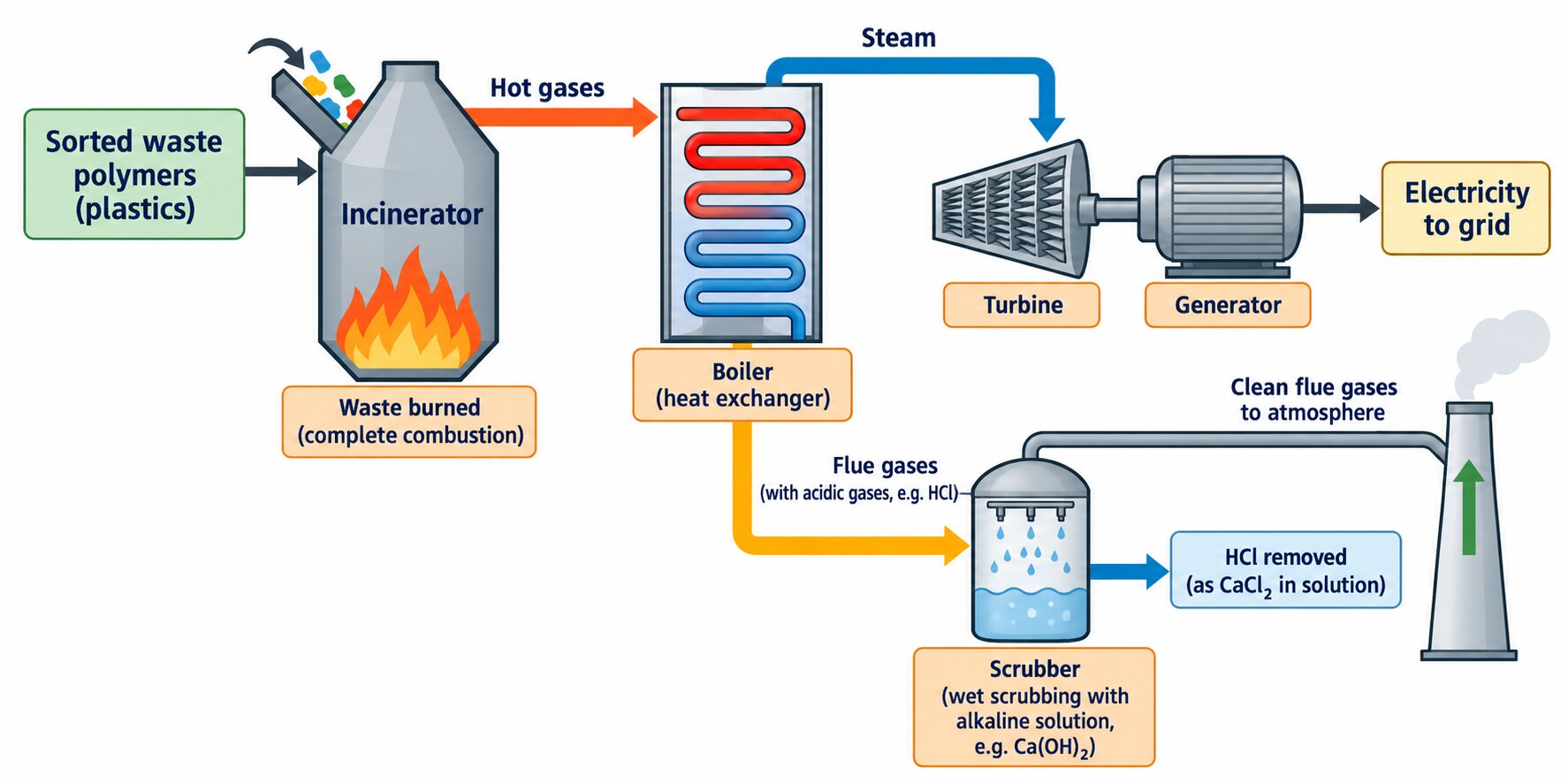
Energy recovery: the heat from burning waste polymers is used to generate electricity.
Exam sentence: Burning waste polymers releases energy which can be used to generate electricity, reducing both landfill and the amount of fossil fuel burned.
Quick Check: The Acidic Gas in the Flue Gases
Decide which polymer in a mixed load causes the problem, and what deals with it.
Use as an Organic Feedstock
A feedstock is a raw material for a chemical process. Waste poly(alkenes) can be heated in the absence of air so that the long chains crack into smaller molecules, mainly alkenes and alkanes. This is the same type of reaction used to crack the heavy fractions of crude oil.
The alkenes produced can be polymerised again to make new plastics, or used as the starting point for other organic chemicals such as alcohols and solvents. The waste polymer therefore replaces crude oil as the source of these molecules.
For example, cracking waste poly(propene) can give propene, which is then re-polymerised:
-(CH2-CH(CH3))n– → n CH2=CHCH3 → new poly(propene)
| Benefit for sustainability | Explanation |
|---|---|
| Conserves crude oil | The carbon in the waste is reused, so less oil has to be extracted and cracked to make new plastics |
| Handles mixed polymers | Cracking works on a mixture of poly(alkenes) that would be difficult to sort for ordinary recycling |
| Keeps the chemical value | Unlike combustion, the atoms end up in useful products rather than in carbon dioxide |
The process needs energy for heating and the products must be separated by fractional distillation before they can be used, so it is more expensive than burning the waste. It is also unsuitable for polymers containing chlorine unless the HCl is dealt with first.
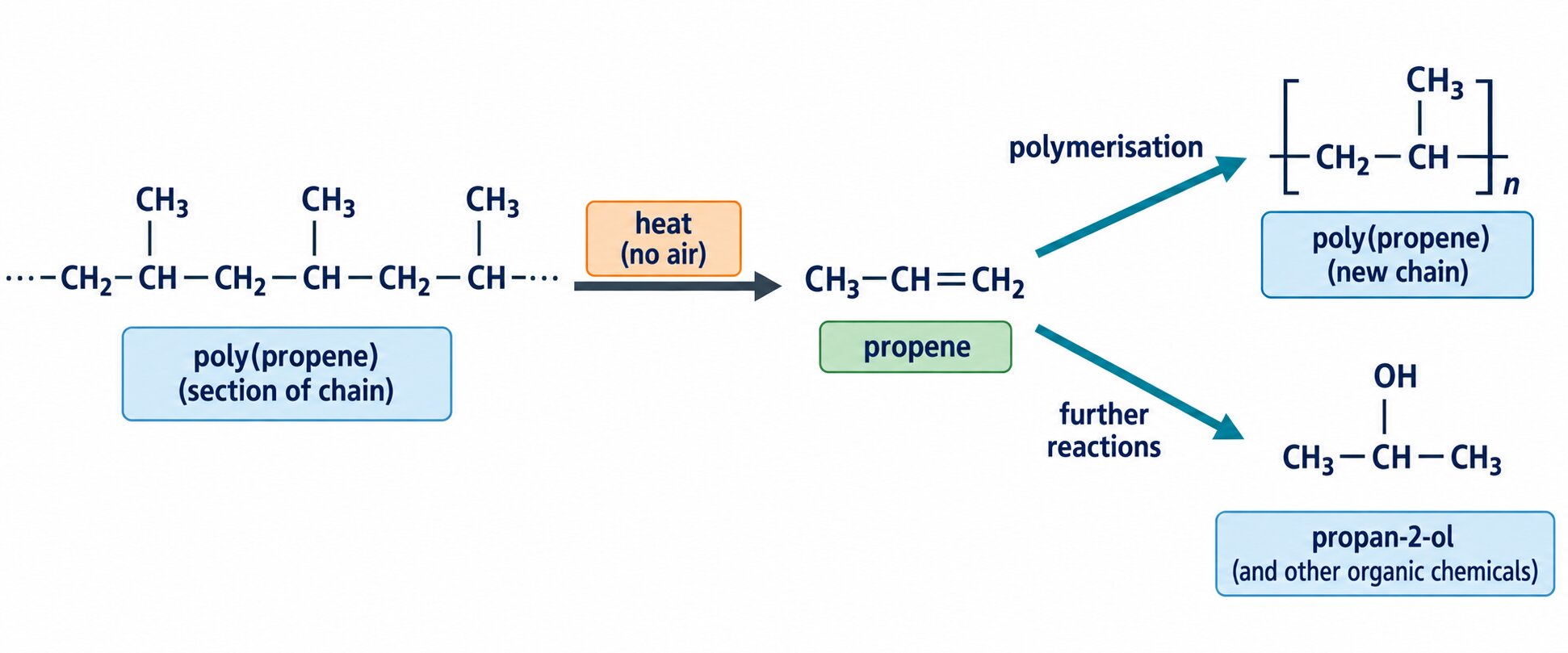
Feedstock recycling: cracking returns the polymer to small molecules that can be polymerised again or converted into other chemicals.
Exam sentence: Waste polymers can be cracked into alkenes and other small molecules, which are then used as a feedstock to make new plastics and organic chemicals, conserving crude oil.
Quick Check: Three Options for One Waste Stream
Drag the words into the gaps to work through what each option recovers.
Quick Check: Put the Stages in Order
Six stages of a feedstock recycling plant, to be put into the order in which they happen.
Comparing the Two Routes
Examiners often ask you to compare the routes or to choose the more sustainable option for a given waste stream. The table gathers the points that earn marks.
| Feature | Combustion for energy | Organic feedstock |
|---|---|---|
| What is recovered | Energy, as electricity | Chemicals, as alkenes and other molecules |
| Effect on crude oil use | Replaces oil burned for electricity | Replaces oil cracked for new plastics |
| Carbon dioxide | All the carbon becomes CO2 | Most carbon stays in useful products |
| Waste needed | Mixed and contaminated plastics acceptable | Mixed poly(alkenes) acceptable; chlorinated plastics need pre-treatment |
| Main limitation | Toxic gases such as HCl must be removed | Energy and separation costs |
Exam focus: Name the route, state what is recovered, and link it to sustainability: less landfill, less crude oil used, or fewer harmful emissions.
Quick Check: Choose a Route and Justify It
Write a short explanation, then compare it with the mark points and the model answer.
Quick Check: Judge Four Claims
In each round, choose the one statement that is accurate.
Common Exam Mistakes
- Describing combustion as simply “burning the plastic”. State that the energy released is used to generate electricity.
- Confusing feedstock recycling with ordinary recycling. Melting and remoulding keeps the polymer; feedstock recycling cracks it into new molecules.
- Forgetting that cracking waste polymers gives alkenes, which is why the products can be polymerised again.
- Ignoring the drawbacks. A balanced answer mentions carbon dioxide from combustion and the energy needed for cracking.
Exam sentence: Processing waste polymers by combustion or as an organic feedstock reduces landfill and conserves crude oil, which is why OCR describes both as benefits for sustainability.

Master Alkenes for OCR A Level Chemistry A
Continue from these free revision notes into the full 4.1.3 Alkenes course. The guided video lessons are ready now; the OCR A MCQ bank, teacher-marked short-answer questions and KASP spec-point report are being written, and the course opens for enrolment as soon as they are complete.
Guided video teaching
Learn the chemistry and exam technique through structured video lessons with worked examples and walkthroughs.
Instant MCQ feedback
Auto-marked MCQ quizzes provide immediate diagnostic feedback for every answer choice.
Teacher-marked SAQs
Submit written exam responses and receive chemistry specialist feedback with improvement guidance.
Progress tracking
Identify strengths and weaknesses across the full 4.1.3 specification with targeted reporting.
See how the course works
Click play to start the course preview animation.
Some ionic radii are shown.
| Ion | Ionic radius / nm |
|---|---|
| Na+ | 0.102 |
| K+ | 0.138 |
| F− | 0.133 |
| Cl− | 0.180 |
Which compound has the strongest ionic bonding?
Explain why the metallic bonding in magnesium is much stronger than that in sodium.
Copyright notice: This OLS revision content, including the explanations, layout, diagrams, tables and embedded learning structure, is authored for Online Learning System by Dr. Mohammed Al-Fatah. It may not be copied, reproduced, redistributed or adapted without written permission.
Keep this note — free
Save your progress across every OCR A topic. A free account remembers which topics you have covered, saves your question scores, and syncs across your phone and laptop.
- Track every topic you have finished
- Keep your practice-question scores
- No payment, no card, free forever
Already registered? Log in