Choose Your Course
Select the topic course you want to study. Some topics appear in more than one exam paper, so each card shows the relevant Edexcel paper coverage.
Available Topic Courses
Click an available course card to open the WooCommerce product page. Paper coverage is shown on each card to avoid repeated course listings.
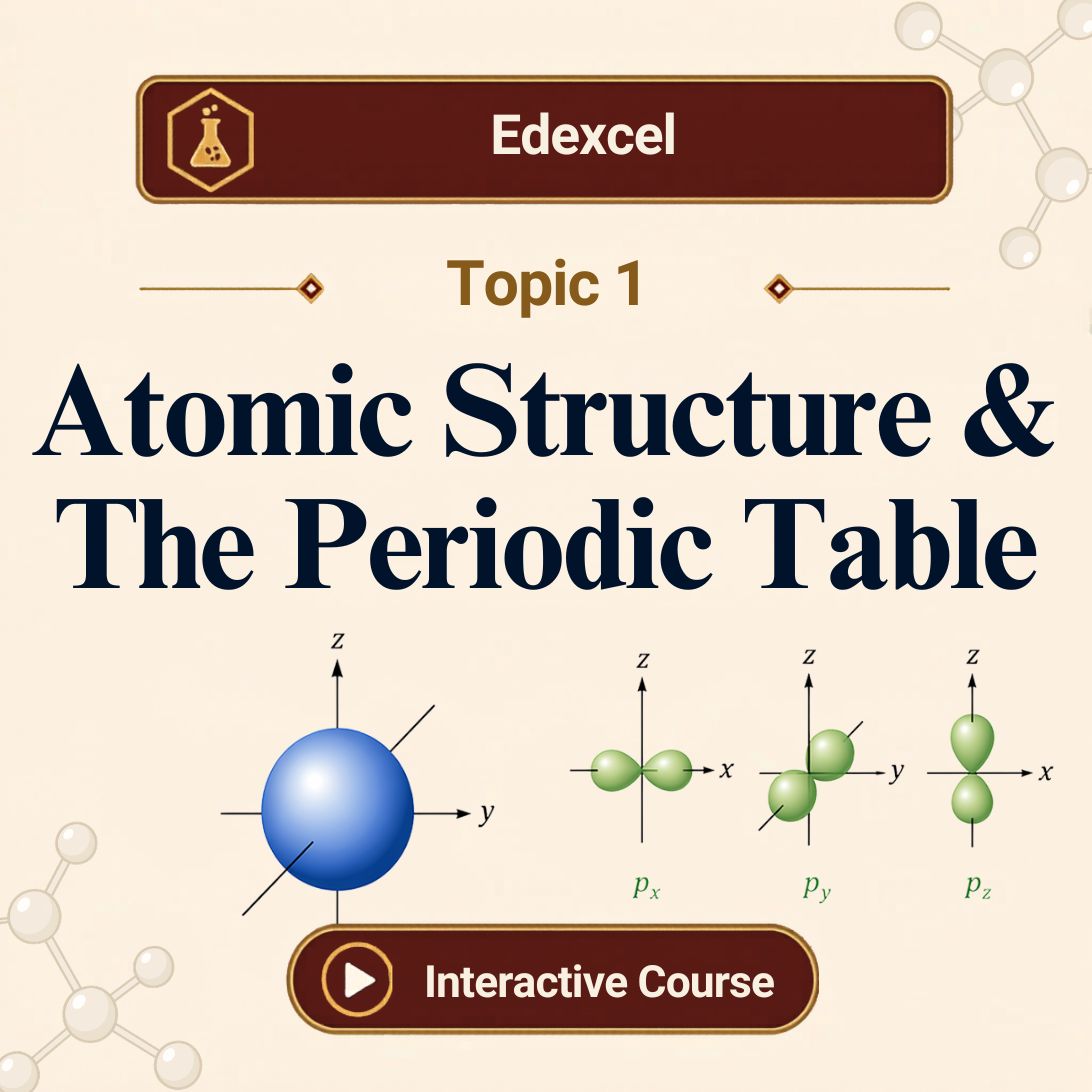
Atomic Structure and the Periodic Table
Build the foundation for Edexcel A Level Chemistry with atomic structure, isotopes, electronic configuration and periodic trends.
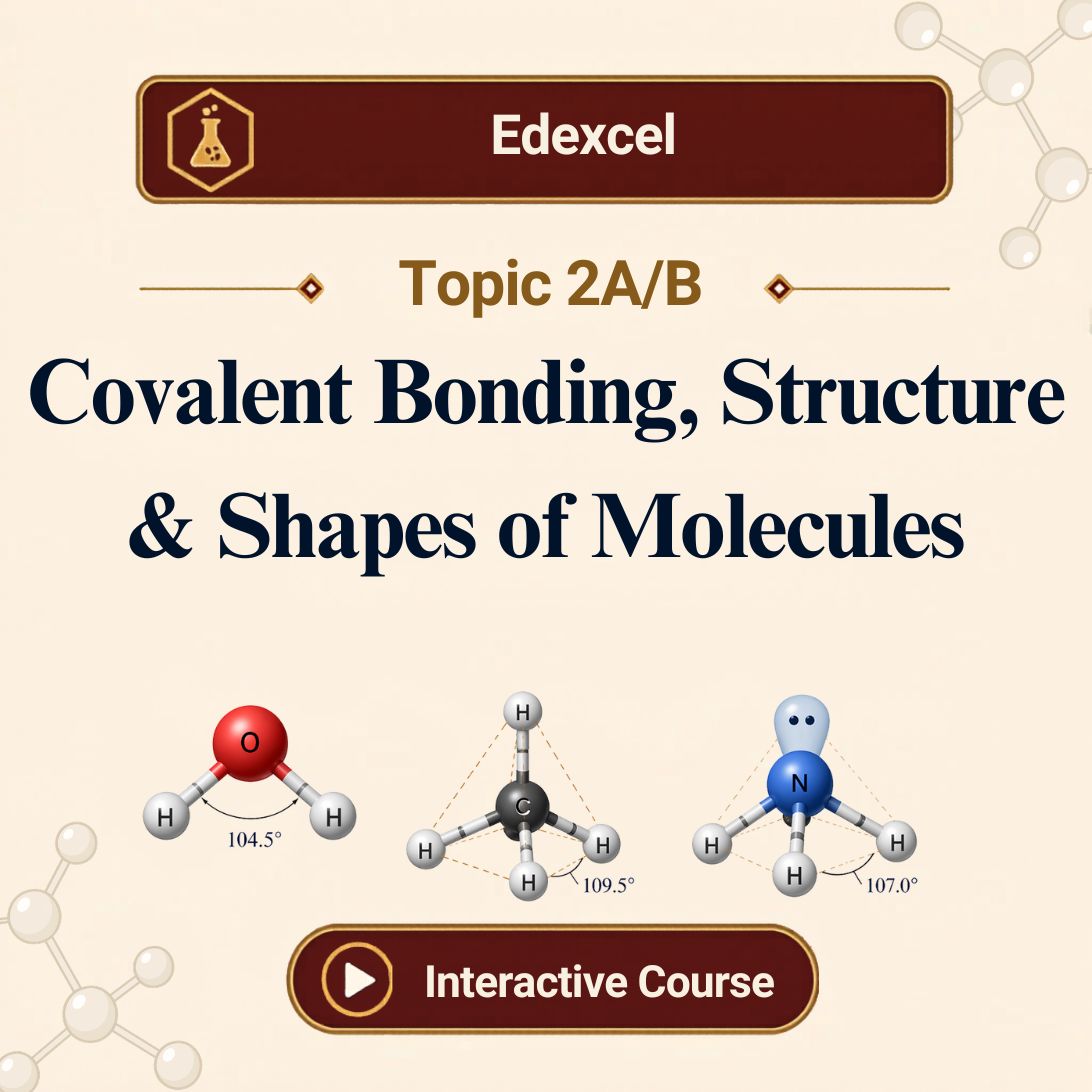
Covalent Bonding, Structure and Shapes of Molecules
Cover covalent bonding, dot-and-cross diagrams, electronegativity, intermolecular forces, bond angles and molecular shapes.
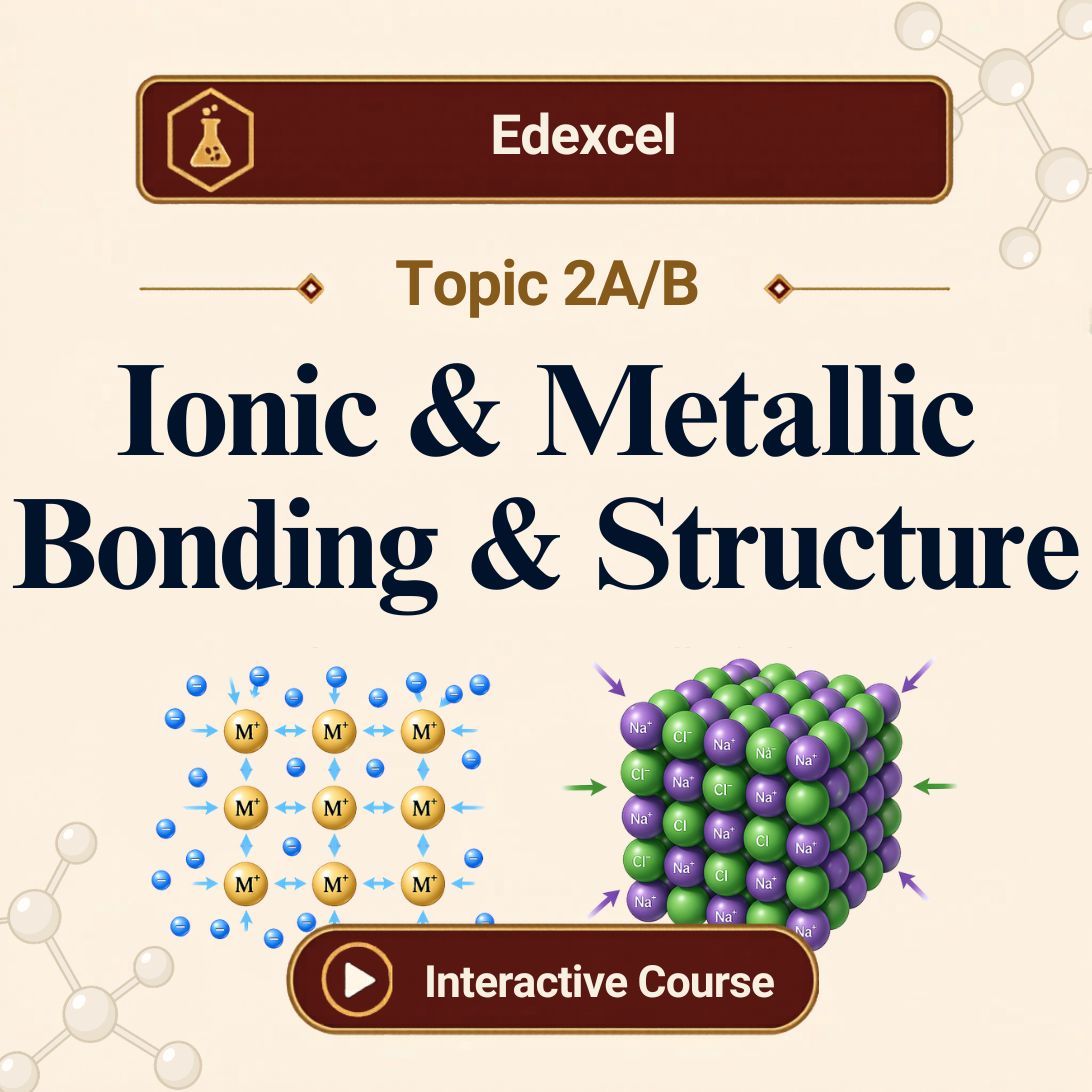
Metallic Bonding
Understand metallic bonding, giant metallic lattices, delocalised electrons and the properties of metals.
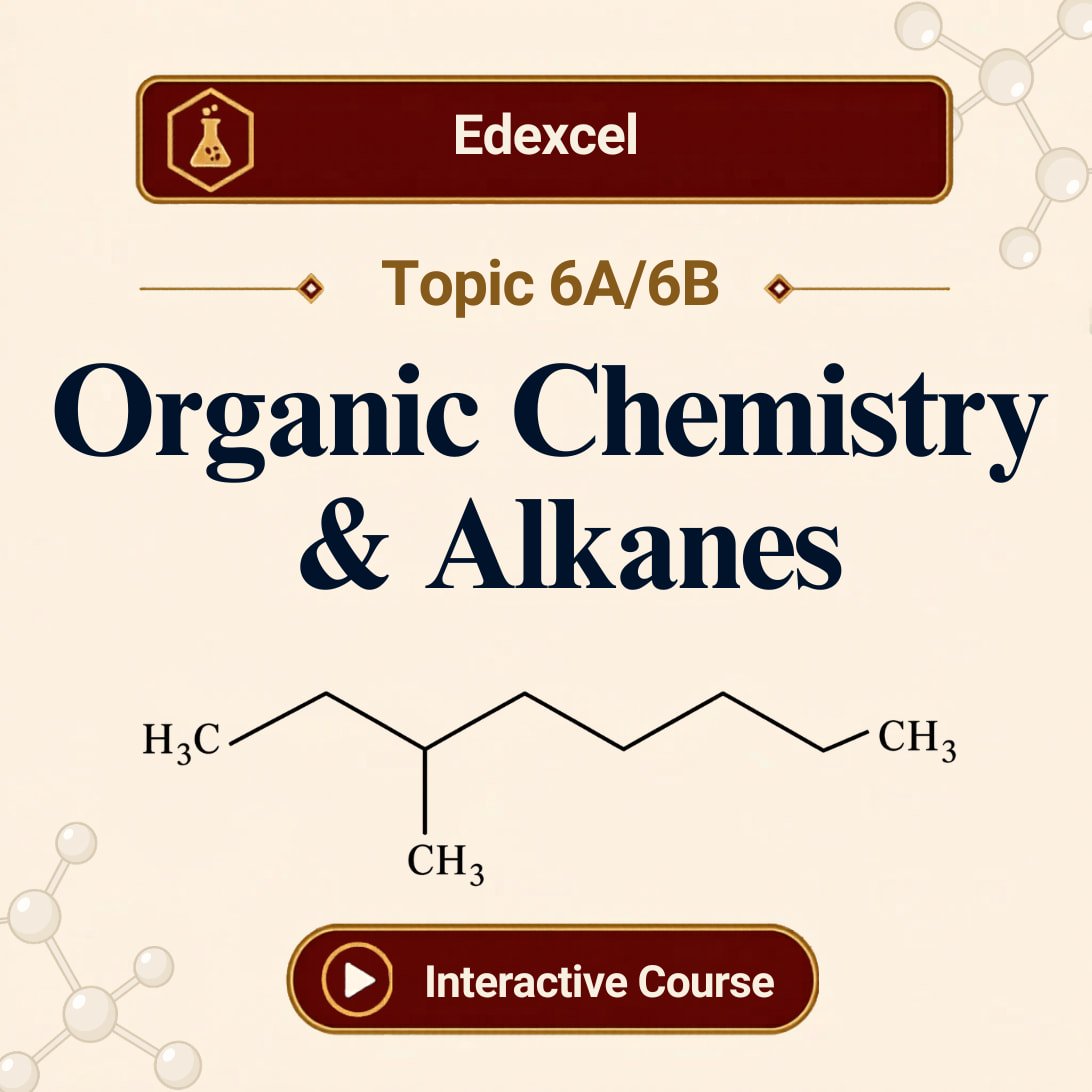
Organic Chemistry and Alkanes
Start organic chemistry with nomenclature, formulae, homologous series, crude oil, alkanes and alkane reactions.
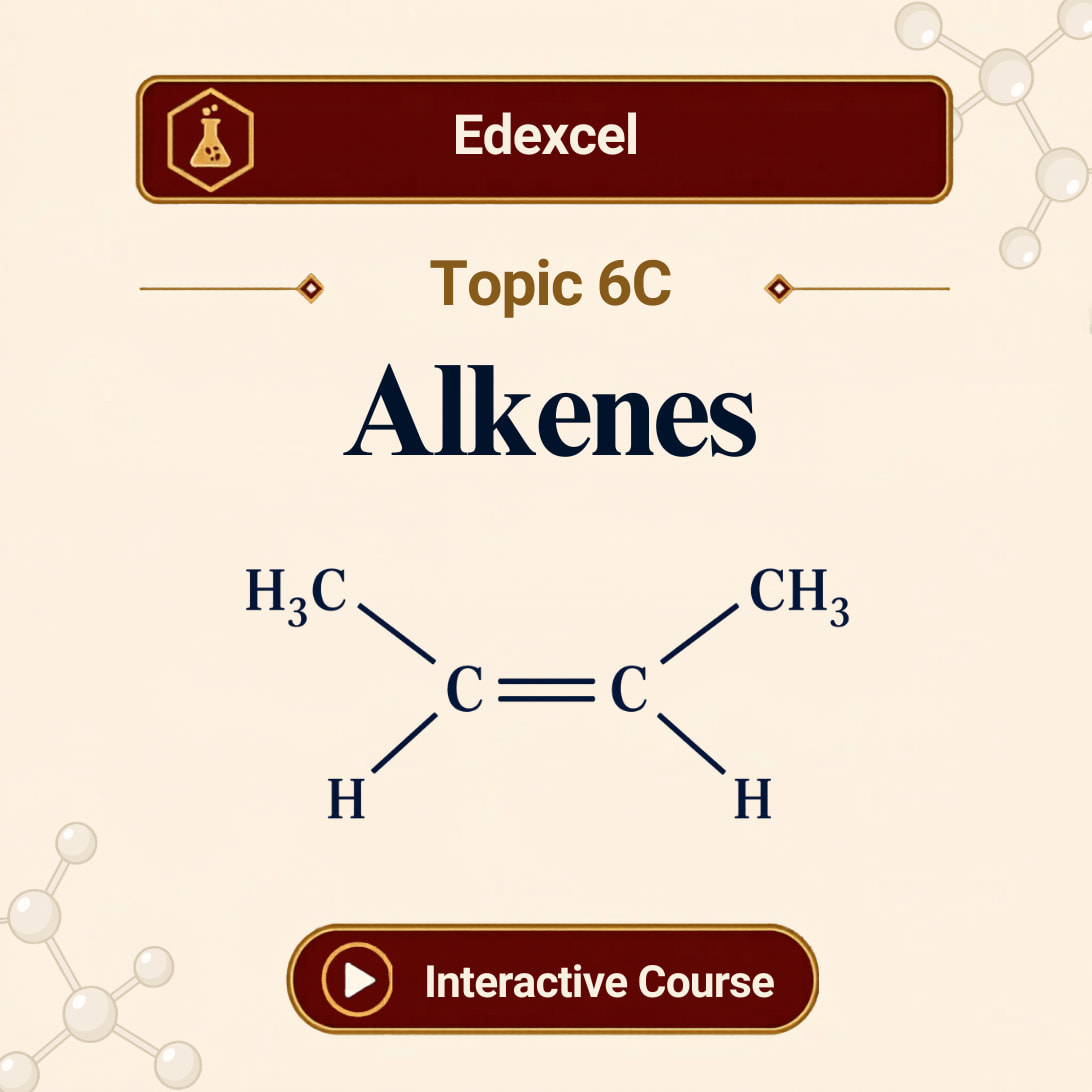
Alkenes
Learn alkene bonding, electrophilic addition, addition reactions, polymerisation and tests for unsaturation.
Courses Being Built
These courses are included in the Edexcel A Level Chemistry pathway, but the product pages are not live yet.
Redox I
This course is being built and will support oxidation numbers, electron transfer, half-equations and redox classification.
Inorganic Chemistry and the Periodic Table
This course will cover key inorganic trends, periodicity and the chemistry required for the Paper 1 specification.
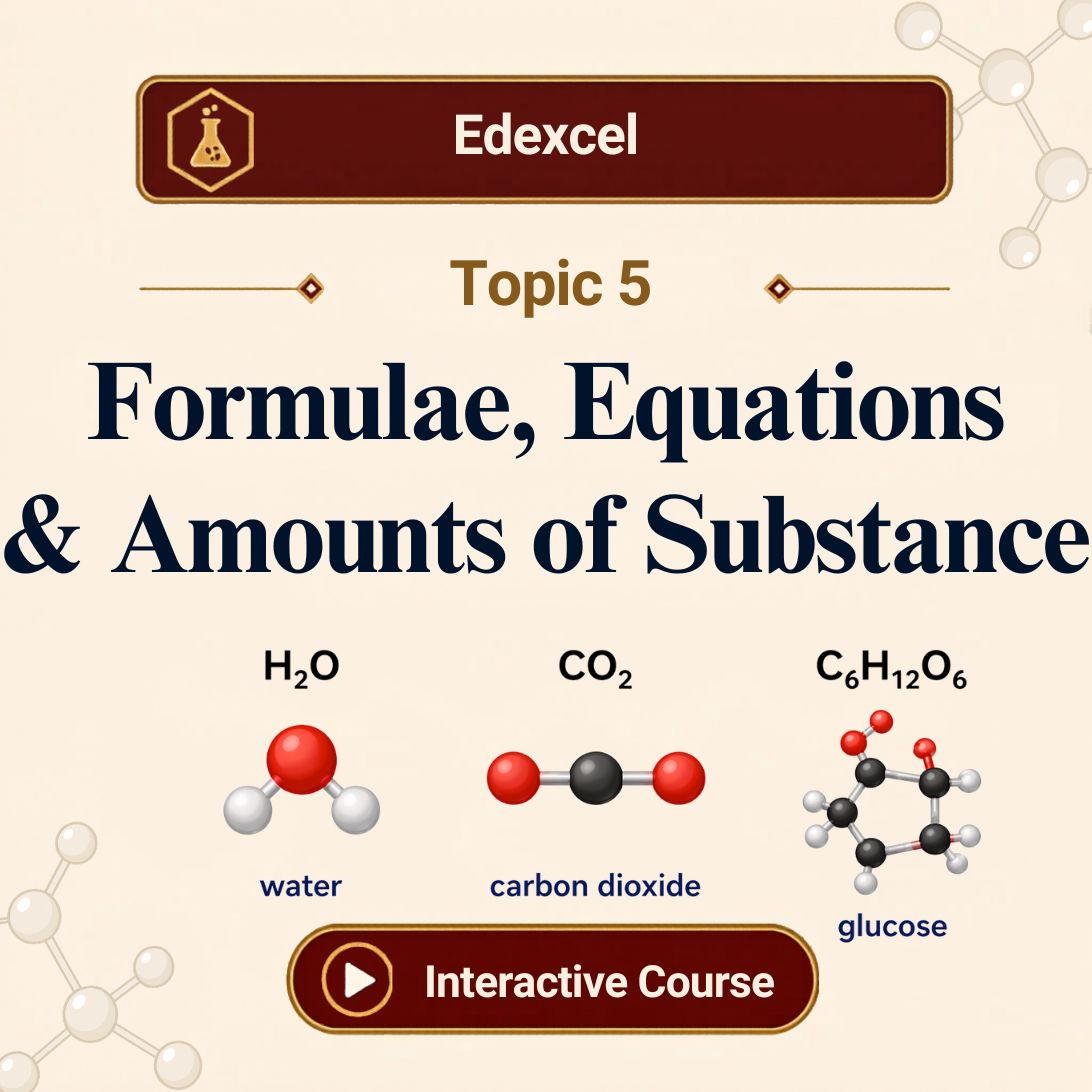
Formulae, Equations and Amounts of Substance
This calculation course is being built and will cover formulae, balanced equations, moles, reacting masses, solutions and gases.
Modern Analytical Techniques I
This course will cover mass spectrometry, infrared spectroscopy and introductory analytical interpretation.
Energetics I
This course will support enthalpy changes, Hess cycles, calorimetry and the energetic foundations needed for Paper 1.
Kinetics I
This course will support rates of reaction, rate equations, activation energy and graphical analysis.
Equilibrium I
This course will introduce reversible reactions, dynamic equilibrium and qualitative equilibrium shifts.
Equilibrium II
This course will extend equilibrium ideas for Paper 1, including quantitative reasoning where required by the specification.
Acid-base Equilibria
This course will cover acid-base theory, pH calculations, buffers and equilibrium applications for Paper 1.
Energetics II
This course will support lattice enthalpy, Born-Haber cycles, entropy and free-energy calculations.
Redox II
This course will extend redox chemistry for Paper 1 with advanced redox equilibria and exam-style applications.
Transition Metals
This course will cover transition metal properties, complexes, colours, ligand substitution and catalysis.
Kinetics II
This course will extend rate equations, mechanisms and quantitative kinetics for advanced Paper 2 questions.
Organic Chemistry II
This course will cover further organic reactions, mechanisms and synthetic routes required for advanced organic chemistry.
Organic Chemistry III
This course will support advanced functional-group chemistry, synthesis and multi-step organic problem solving.
Modern Analytical Techniques II
This course will develop advanced analytical interpretation, including modern spectroscopy and structure determination.
Synoptic Chemistry Skills
This course will support multi-topic exam questions that combine ideas from physical, inorganic and organic chemistry.
Practical Principles and Core Practicals
This course will support experimental methods, practical planning, analysis, uncertainty, evaluation and application of core practical knowledge.
Calculations and Extended Responses
This course will focus on calculation strategy, mathematical skills, extended writing, data interpretation and high-mark response structure.
Measuring the Molar Volume of a Gas
This core practical course will support gas collection, molar volume calculations, experimental method and evaluation.
Preparation of a Standard Solution from a Solid Acid
This core practical course will cover accurate weighing, volumetric flasks, solution preparation, concentration calculations and uncertainty.
Finding the Concentration of Hydrochloric Acid
This core practical course will support titration technique, endpoint judgement, calculations and sources of error.
Rates of Hydrolysis of Halogenoalkanes
This core practical course will cover rate comparisons, experimental variables, observations and interpretation.
Oxidation of Ethanol
This core practical course will support oxidation conditions, distillation or reflux decisions, observations and product identification.
Chlorination of 2-methylpropan-2-ol
This core practical course will cover organic preparation, apparatus, purification, safety and practical reasoning.
Analysis of Inorganic and Organic Unknowns
This core practical course will cover qualitative tests, observations, deductions and practical analysis.
Enthalpy Change Using Hess’s Law
This core practical course will cover calorimetry, Hess cycles, enthalpy calculations, uncertainty and practical evaluation.
Ka Value for a Weak Acid
This core practical course will cover pH measurement, weak acid equilibria, Ka calculations and uncertainty.
Investigating Electrochemical Cells
This core practical course will support cell construction, electrode potentials, salt bridges, measurements and feasibility predictions.
Redox Titration
This core practical course will cover redox titration technique, calculation method, indicators, endpoints and evaluation.
Preparation of a Transition Metal Complex
This core practical course will support inorganic preparation, filtration, recrystallisation, yield and purity considerations.
Iodine-Propanone and Iodine Clock Kinetics
This core practical course will cover rate experiments, timing methods, concentration effects, graphs and kinetic interpretation.
Activation Energy of a Reaction
This core practical course will support temperature-rate investigations, Arrhenius plots, gradients and activation energy calculations.
Analysis of Inorganic and Organic Unknowns
This core practical course will cover advanced qualitative analysis, functional-group tests, ion tests and evidence-based conclusions.
Preparation of Aspirin
This core practical course will support organic synthesis, purification, recrystallisation, melting-point analysis and yield calculations.