The Iodine–Propanone Reaction
A concise revision guide to the acid-catalysed iodination of propanone: how the rate data are collected by sampling, quenching and titration or by colorimetry, why the reaction is zero order in iodine and first order in propanone and in hydrogen ions, and what that tells us about the rate-determining step and the mechanism.
- 3.1.9.2vi
- 3.1.9.2vii
What these spec points say
- 3.1.9.2vi use the orders with respect to reactants to provide information about the rate determining step of a reaction
- 3.1.9.2vii understand that the orders with respect to reactants can provide information about the mechanism of a reaction
The Reaction
Propanone reacts with iodine in aqueous acid to give iodopropanone and hydrogen iodide: CH₃COCH₃ + I₂ → CH₃COCH₂I + HI.
The reaction is acid-catalysed: hydrogen ions do not appear in the overall equation but the reaction is far too slow without them.
It is the classic rate experiment for three reasons. Iodine is the only coloured substance, so its disappearance can be followed by eye, by titration or in a colorimeter. The other two concentrations can be set independently, so each order can be found in turn.
And the answer is surprising: the order with respect to iodine is zero, which forces the question of what the rate equation says about the mechanism.
There is one complication. The product HI is a strong acid, so H⁺ is both the catalyst and a product: as the reaction runs, [H⁺] rises and the reaction speeds itself up slightly, a mild autocatalysis.
It is controlled by using a large excess of acid, so that the H⁺ formed is negligible beside the H⁺ already there and [H⁺] is effectively constant.
Key idea: Follow the one substance whose concentration is changing on its own: iodine, with propanone and acid in large excess.
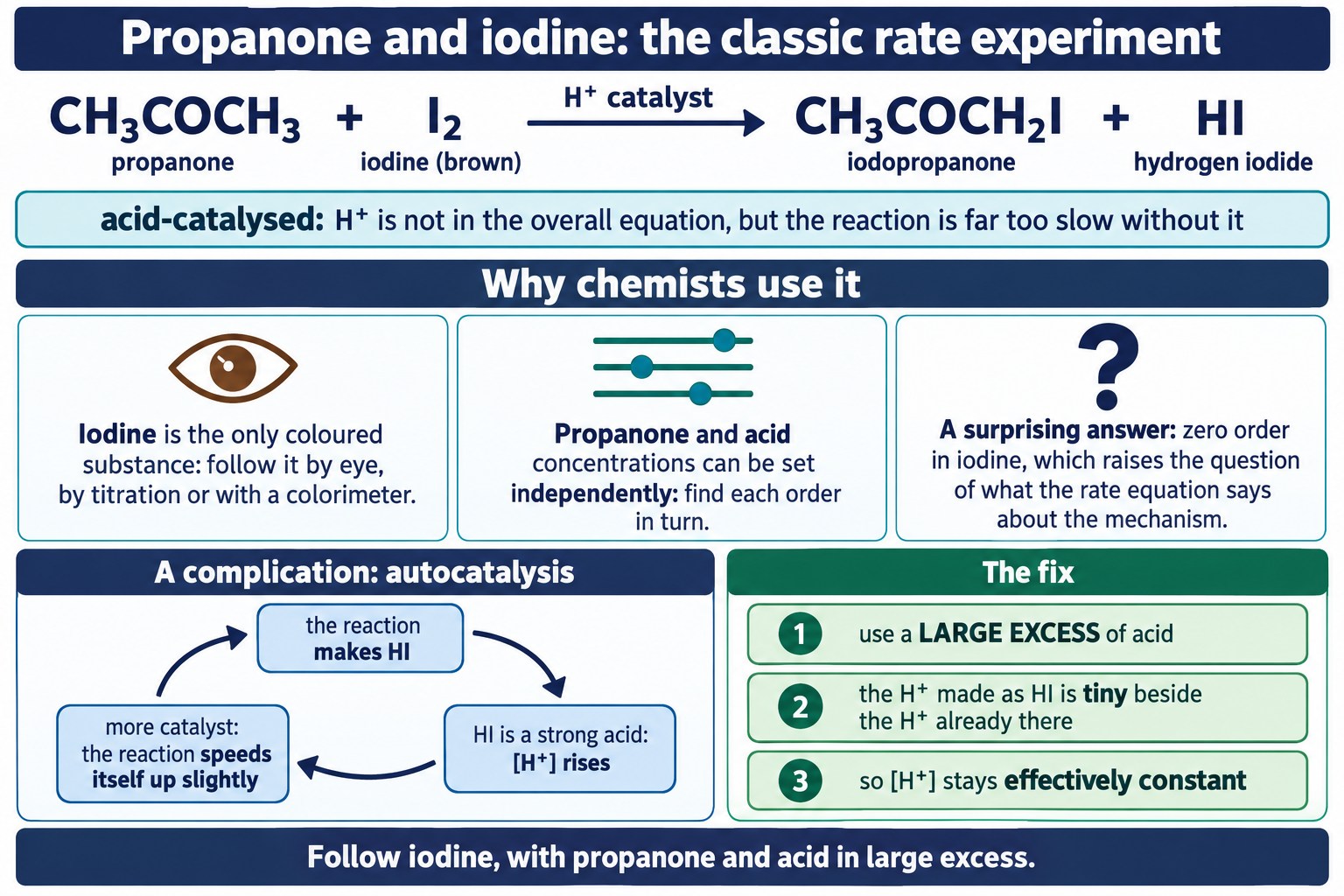
Iodine is the only coloured species and the other concentrations can be set independently, while a large excess of acid stops the HI product from speeding the reaction up.
Collecting the Data
Route A, sampling and titration. Known volumes of propanone and dilute sulfuric acid are mixed, the iodine solution is added and a clock started.
Every few minutes a sample is withdrawn with a pipette and run into a flask of sodium hydrogencarbonate solution. This quenches the reaction: the NaHCO₃ neutralises the H⁺ catalyst, so the reaction stops in the sample and the iodine present at that moment is fixed.
The iodine is then titrated with sodium thiosulfate solution, 2S₂O₃²⁻ + I₂ → S₄O₆²⁻ + 2I⁻, adding a few drops of starch near the end point so that the blue-black colour vanishes sharply.
Each titre is proportional to [I₂] at the time the sample was quenched.
Route B, colorimetry. The mixture is placed in a colorimeter set to a filter that iodine absorbs (blue-green).
The absorbance falls as the brown colour fades, and a calibration curve of absorbance against known [I₂] converts each reading into a concentration.
Colorimetry gives many readings without disturbing the mixture and needs no quenching, but the solutions must be dilute enough for the absorbance to stay on the calibration curve.
In both routes propanone and acid are in large excess, so their concentrations barely change and only [I₂] falls. The graph of [I₂] against time then shows the order with respect to iodine alone.
Repeating the experiment with different starting concentrations of propanone (acid fixed) and then of acid (propanone fixed) gives the initial rate in each case and so the other two orders.
In an initial-rates investigation such as Required practical 7 (rate by an initial-rate method and by continuous monitoring), the same choices (what to follow, how to stop the reaction, which reagents to put in excess) have to be made and justified.
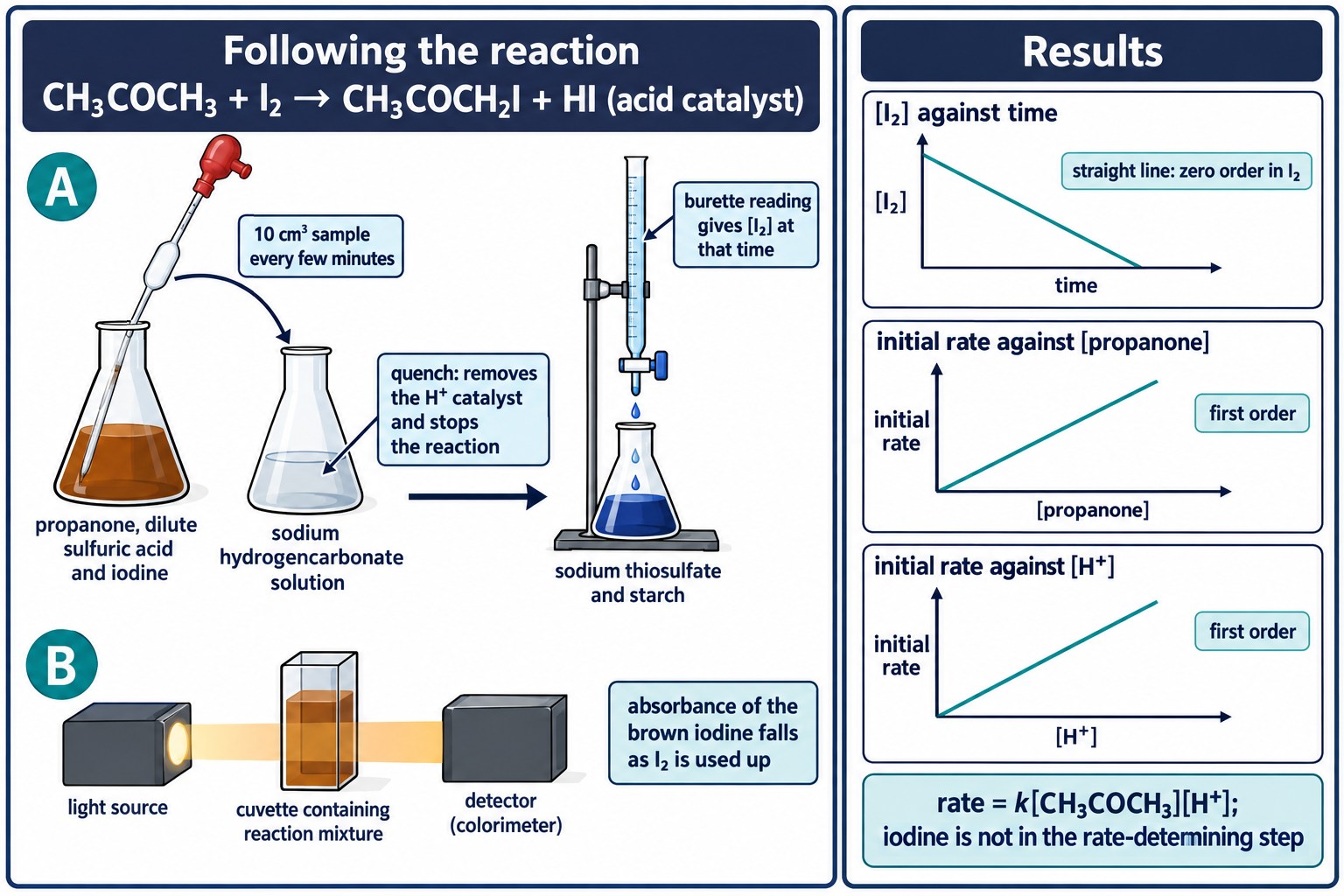
The two ways of following the iodine–propanone reaction, and the three graphs that give the orders: zero in I₂, first in propanone and first in H⁺.
Exam wording: Quenching: “sodium hydrogencarbonate removes the H⁺ catalyst so the reaction stops and the iodine concentration at that time is fixed”. Excess: “so that the concentration of propanone (and of acid) is effectively constant and only [I₂] changes”.
Check: Collecting Rate Data by Sampling
Questions on the method: what a quench does, what the titration measures and why the other reactants are kept in excess, applied to reactions other than the one on this page.
What the Results Show
The graph of [I₂] against time is a straight line falling at a constant gradient. The rate does not change as iodine is used up, so the reaction is zero order with respect to iodine.
The same experiment run with double the propanone concentration gives a line of double the gradient: first order in propanone.
Doubling the acid concentration also doubles the gradient: first order in hydrogen ions. Put together:
rate = k[CH₃COCH₃][H⁺]
The overall order is 2, so k has the units mol⁻¹ dm³ s⁻¹ (rate in mol dm⁻³ s⁻¹ divided by two concentrations).
Iodine is not in the rate equation at all, even though it is a reactant in the balanced equation.
Key idea: this is the point the experiment exists to make: the orders come from the experiment and not from the stoichiometry.
| Substance | How its order was found | Order |
|---|---|---|
| I₂ | shape of the [I₂]–time graph with the others in excess: straight line | 0 |
| CH₃COCH₃ | initial rate doubles when [propanone] doubles | 1 |
| H⁺ | initial rate doubles when [H⁺] doubles | 1 |
Exam focus: State the evidence with the order: “the [I₂]–time graph is a straight line, so the rate is constant as [I₂] falls, so zero order in iodine”.
From Orders to Mechanism
The rate equation contains only the species that take part in or before the rate-determining step, the slowest step of the mechanism.
Iodine is absent, so iodine can only react after the slow step.
Propanone and H⁺ are both present, each to the first power, so one molecule of propanone and one hydrogen ion are involved up to and including the slow step. Any proposed mechanism has to fit those facts.
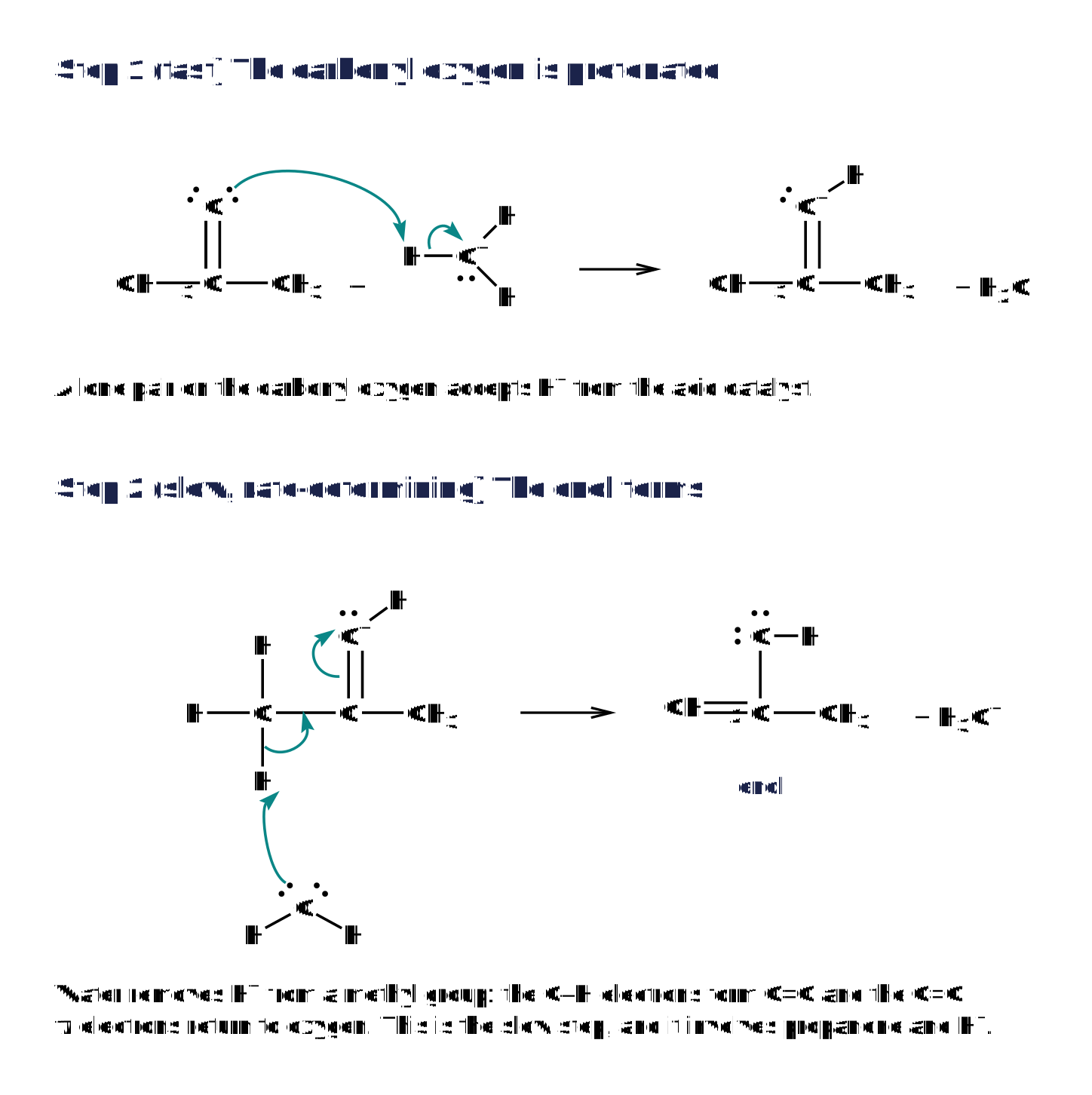
The accepted mechanism does. First the carbonyl oxygen of propanone is protonated by H⁺ (fast).
Then, in the slow step, a water molecule removes a hydrogen from a methyl group and the molecule rearranges to an enol, CH₂=C(OH)CH₃, releasing the H⁺ again.
Finally the electron-rich C=C of the enol attacks iodine (fast) and the carbonyl group re-forms, giving iodopropanone and HI.
The slow step involves the protonated propanone, formed from one propanone and one H⁺, so the rate depends on [propanone][H⁺]. Iodine reacts with the enol as fast as the enol appears, so its concentration does not matter.
![Mechanism of the acid-catalysed iodination of propanone, step 3: the enol attacks iodine and loses H⁺ to give 1-iodopropanone, with the rate equation rate = k[CH₃COCH₃][H⁺], zero order in iodine](https://www.onlinelearningsystem.net/xyz/wp-content/uploads/2026/09/skel-t11-iodination-propanone-b.svg)
The acid-catalysed iodination of propanone: fast protonation, slow enol formation (the rate-determining step) and fast attack of the enol on iodine.
Notice what the rate equation can and cannot do. It rules out any mechanism in which iodine reacts in or before the slow step, such as a single-step collision between propanone and I₂.
It does not prove the enol mechanism; other mechanisms with the same slow-step species would fit equally well.
The enol route is accepted because other evidence (bromination and deuterium exchange happen at the same rate) supports it.
Key idea: A rate equation identifies the species in the rate-determining step and rules out mechanisms that disagree with it. It cannot prove that a mechanism is right.
Check: Orders and the Rate-Determining Step
Interpret orders from rate data for other reactions: which species are in the rate-determining step, which react after it, and which proposed mechanisms are ruled out.
Common Exam Points
Say
“Zero order in iodine: the [I₂]–time graph is a straight line, so the rate is independent of [I₂].” “Iodine does not appear in the rate equation, so it reacts after the rate-determining step.” “Propanone and acid are in large excess so their concentrations are effectively constant.”
Do not say
“The order of iodine is 1 because one I₂ appears in the equation” (orders never come from the balanced equation). “The rate equation proves the mechanism.” “Sodium hydrogencarbonate removes the iodine” (it removes the acid).
Watch for
A question that asks why the acid concentration is much larger than the iodine concentration: two reasons. One is to keep [H⁺] constant so the order in propanone can be found; the other is to swamp the small amount of H⁺ produced as HI.
Also expect to be asked for the units of k for a second-order reaction: mol⁻¹ dm³ s⁻¹.
FAQs
Use these quick answers to check the iodine–propanone reaction.
Why does the order with respect to iodine come out as zero?
Because iodine is not involved in the rate-determining step. The slow step is the acid-catalysed conversion of propanone to its enol; the enol then reacts with iodine in a fast step, so adding more iodine cannot speed things up.
How can I tell iodine is zero order just from the colorimeter trace?
The absorbance falls in a straight line, so the iodine concentration falls at a constant rate. A constant rate while the iodine is used up means the rate does not depend on [I₂].
Why is hydrogen ion in the rate equation when it is a catalyst?
Because it takes part in the rate-determining step, protonating the carbonyl oxygen before the enol forms. It is regenerated later, so it does not appear in the overall equation, but the rate still depends on how much of it is present.
What is used to quench the samples?
Sodium hydrogencarbonate solution. It neutralises the acid catalyst, and with no H⁺ the slow step effectively stops, so the iodine left in the sample can be titrated with sodium thiosulfate using starch as the indicator.
Why is the propanone concentration kept much larger than the iodine concentration?
So that only a small fraction of the propanone is used up while all the iodine reacts. Its concentration is then effectively constant, so any change in rate during a run is due to iodine alone, which is how the zero order is seen.
Copyright and author footprint: This OLS revision page was written for Online Learning System by Dr. Mohammed Al-Fatah. It is designed for A Level Chemistry revision and should not be copied or redistributed without permission.
Keep this note — free
Save your progress across every AQA topic. A free account remembers which topics you have covered, saves your question scores, and syncs across your phone and laptop.
- Track every topic you have finished
- Keep your practice-question scores
- No payment, no card, free forever
Already registered? Log in