Identifying Unknown Compounds
A concise revision guide to combining mass spectra, infrared spectra and test-tube reactions to deduce the structure of an unknown organic compound, with the table of functional group tests and a fully worked example.
Putting the Evidence Together
An exam question rarely gives one piece of evidence. It gives a mass spectrum, an infrared spectrum, perhaps an elemental analysis or a molecular formula, and one or two test-tube observations, and asks for the structure. Each technique answers a different question, so use them in order. The mass spectrum gives the relative molecular mass from the molecular ion and pieces of the structure from the fragments. The infrared spectrum gives the functional group. The test-tube reactions confirm the functional group and distinguish between the remaining possibilities. A logical answer states each piece of evidence, what it shows, and how the pieces combine.
| Question | Technique | What to read |
|---|---|---|
| What is the relative molecular mass? | mass spectrum | m/z of the molecular ion (highest, ignoring M+1) |
| Which halogen, if any? | mass spectrum | M and M+2 peaks: 3 : 1 chlorine, 1 : 1 bromine |
| What pieces is it made of? | mass spectrum | fragment ions and the losses from M |
| Which functional group? | infrared spectrum | absorptions above 1500 cm⁻¹ and the data sheet |
| Is it pure and which isomer? | infrared spectrum | fingerprint region against a database |
| Confirm the group | test-tube reactions | reagent, condition, observation |
Key idea: Mass spectrum for Mr and pieces, infrared for the functional group, chemical tests to confirm. Say which evidence gives which conclusion.
Check: Which Evidence Answers Which Question
Match evidence to conclusions for an unknown that is not the worked example below.
Test-Tube Reactions for Functional Groups
The chemical tests met across the course are collected here because the analysis question uses them together. Each is written as reagent, condition and observation, and a negative result is as useful as a positive one: a compound that does not fizz with sodium carbonate is not a carboxylic acid.
| Functional group | Test | Positive result |
|---|---|---|
| C=C (alkene) | shake with bromine water | orange to colourless |
| Aldehyde | warm with Fehling’s solution | blue solution to brick-red precipitate |
| Aldehyde | warm with Tollens’ reagent | silver mirror |
| Ketone | either aldehyde reagent | no change (carbonyl present if 2,4-DNPH gives an orange precipitate) |
| Carboxylic acid | add sodium carbonate or sodium hydrogencarbonate | fizzing, CO₂ turns limewater milky |
| O–H (alcohol, acid, water) | add PCl₅ | steamy white fumes of HCl |
| Primary or secondary alcohol, aldehyde | warm with acidified potassium dichromate(VI) | orange to green |
| Tertiary alcohol | warm with acidified potassium dichromate(VI) | stays orange |
| Halogenoalkane | warm with aqueous silver nitrate in ethanol | white (Cl), cream (Br) or yellow (I) precipitate |
| CH₃CH(OH)– or CH₃CO– | warm with alkaline aqueous iodine | yellow precipitate of tri-iodomethane |
The practical paper (identifying organic unknowns) uses these tests on unknown organic liquids.
Exam focus: Three parts to every test: reagent, condition, observation. “Add sodium carbonate solution: effervescence” scores; “test with carbonate” does not.
Check: Choosing a Test
Pick a single test that separates pairs of compounds not listed above.
Worked Example: an Unknown Liquid
An unknown liquid has a molecular ion peak at m/z 60, fragment peaks at 45, 43 and 15, a very broad infrared absorption from 2500 to 3300 cm⁻¹ and a strong absorption at 1715 cm⁻¹, and it fizzes with sodium hydrogencarbonate solution.
Step 1, Mr: the molecular ion at 60 gives Mr = 60. Formulae that fit include C₃H₈O (propan-1-ol, propan-2-ol), C₂H₄O₂ (ethanoic acid, methyl methanoate) and C₃H₈O with an ether structure.
Step 2, functional group: the very broad absorption at 2500–3300 cm⁻¹ is the O–H of a carboxylic acid, and 1715 cm⁻¹ is a C=O. Together they point to a carboxylic acid, so C₂H₄O₂ as ethanoic acid, CH₃COOH.
Step 3, fragments: m/z 45 is COOH⁺ (M − 15, loss of CH₃•), m/z 43 is CH₃CO⁺ (M − 17, loss of •OH) and m/z 15 is CH₃⁺. All three fit CH₃COOH and none fits methyl methanoate, which would show m/z 31 (OCH₃⁺).
Step 4, confirm: effervescence with sodium hydrogencarbonate shows an acid. The unknown is ethanoic acid.
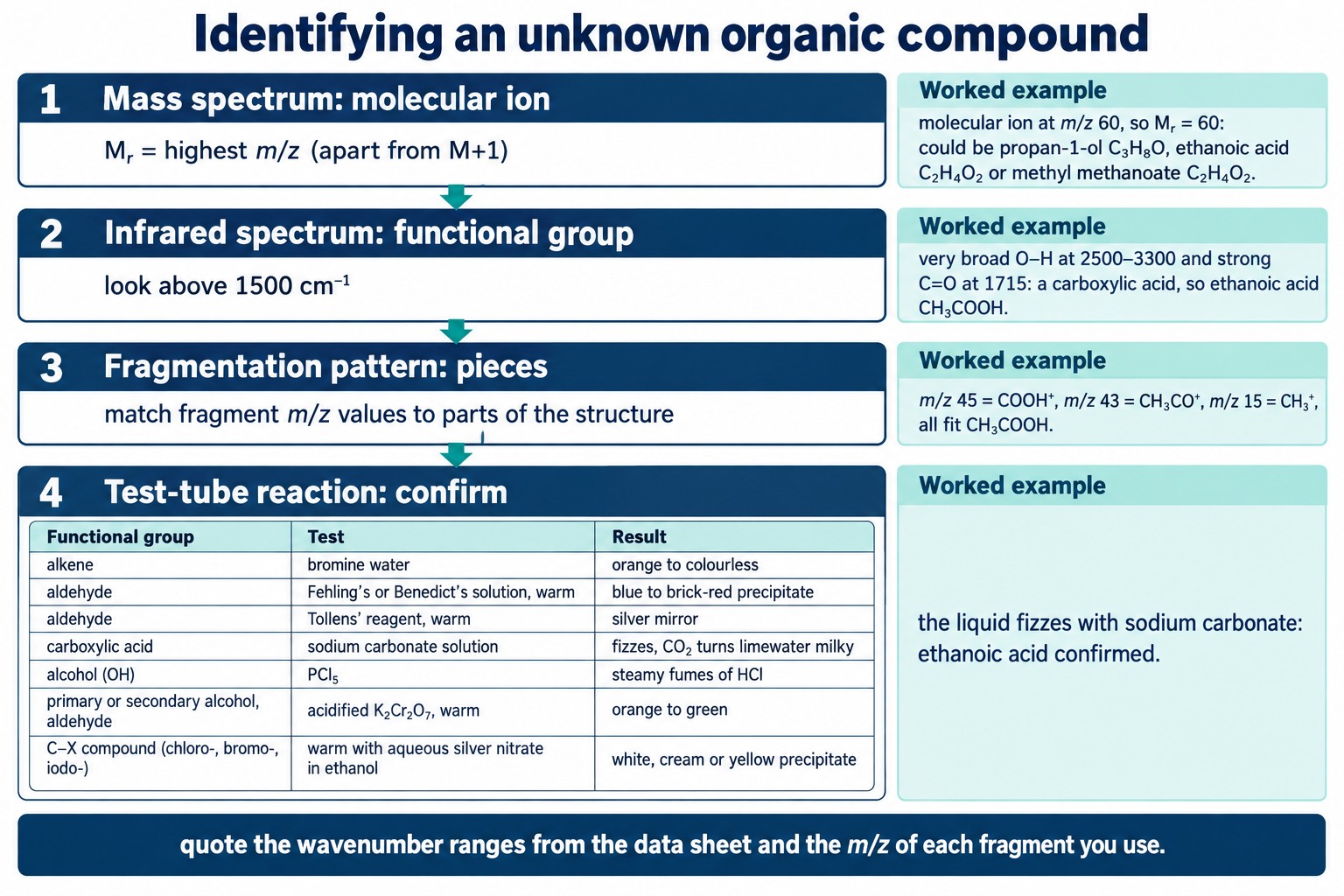
The four-step route from spectra and tests to a structure, worked for the unknown with Mr 60.
Exam technique: Number the steps, quote every value you use (m/z 60, 2500–3300 cm⁻¹), and finish with the name AND the structural formula.
Common Exam Points
Say
“Molecular ion at m/z 60, so Mr = 60.” “Absorption at 1680–1750 cm⁻¹ shows C=O; the very broad absorption at 2500–3300 cm⁻¹ shows the O–H of a carboxylic acid.” “Effervescence with sodium carbonate confirms the acid.”
Do not say
“The IR shows it is ethanoic acid” (infrared shows the functional group; the mass spectrum and tests give the rest). “The peak at 45 is 45.”
Watch for
Isomers with the same Mr and functional group: use a fragment that only one isomer can give, or a test such as tri-iodomethane or the rate of oxidation.
Check: Solving an Unknown
Work through evidence for an unknown compound that is not ethanoic acid.
FAQs
Use these quick answers to check the identification method.
In what order should I use the evidence?
Molecular ion for Mr, infrared for the functional group, fragments to fit the pieces together, then a chemical test to confirm. State what each piece shows as you go.
What if two isomers fit all the spectra?
Look for a fragment that only one of them can give, or choose a test that distinguishes them: rate of oxidation with dichromate(VI), or the tri-iodomethane test for a CH₃CH(OH)– or CH₃CO– group.
How do I show a compound is an acid rather than an alcohol?
The infrared O–H band of an acid is very broad (2500–3300 cm⁻¹) and comes with a strong C=O at 1680–1750 cm⁻¹; an alcohol has a broad O–H at 3200–3600 and no C=O. Sodium carbonate then fizzes only with the acid.
Why quote wavenumber ranges rather than single values?
Because the data sheet gives ranges and the mark scheme expects them. An absorption “at 1715 cm⁻¹, in the C=O range 1680–1750 cm⁻¹” covers both.
Do I need to draw the structure at the end?
Yes. Give the name and the structural or displayed formula; a name alone can lose the final mark if the question asked for a structure.
Copyright and author footprint: This OLS revision page was written for Online Learning System by Dr. Mohammed Al-Fatah. It is designed for A Level Chemistry revision and should not be copied or redistributed without permission.
Keep this note — free
Save your progress across every Cambridge topic. A free account remembers which topics you have covered, saves your question scores, and syncs across your phone and laptop.
- Track every topic you have finished
- Keep your practice-question scores
- No payment, no card, free forever
Already registered? Log in