Mass Spectra of Organic Compounds
A concise revision guide to using mass spectra to identify organic compounds: the molecular ion and relative molecular mass, fragmentation patterns and common fragment ions, and the M and M+2 peaks of chlorine and bromine compounds, with the M+1 peak used to count carbon atoms.
GCSE Recap: Relative Formula Mass
Three quick questions on relative atomic mass, working out a relative formula mass and what an ion is.
The Molecular Ion
When an organic compound is put through a mass spectrometer, its molecules are ionised by losing one electron each: M → M⁺• + e⁻. The ion formed is the molecular ion, written M⁺ or M⁺•, and it is both a positive ion and a radical because it has an unpaired electron. It has the same mass as the molecule, so on the spectrum the peak with the highest m/z value gives the relative molecular mass of the compound directly, because the charge is +1.
The molecular ion peak is often small, because most of the ions break up before they reach the detector, and it is not the tallest peak. A tiny peak one unit higher, the M+1 peak, comes from molecules containing one ¹³C atom (1.1% of carbon) and must not be mistaken for the molecular ion.
The M+1 peak is useful in its own right. Because each carbon atom has a 1.1% chance of being ¹³C, the ratio of the M+1 to the M peak gives the number of carbon atoms: n = (100 × abundance of M+1) ÷ (1.1 × abundance of M). If M has abundance 40 and M+1 has abundance 1.76, n = 176 ÷ 44 = 4 carbon atoms.
Definition: The molecular ion is the molecule that has lost one electron. Its m/z value is the relative molecular mass of the compound.
Check: Reading the Molecular Ion
Identify molecular ions and Mr values for compounds not used on this page.
Fragmentation Patterns
The energy of ionisation breaks many of the molecular ions into pieces. A covalent bond breaks so that one fragment keeps the positive charge and the other is a neutral radical: M⁺• → X⁺ + Y•. Only the charged fragment is detected, so every other peak in the spectrum is a fragment ion. The pattern of fragment peaks is characteristic of the structure and lets the molecule be pieced together.
The most stable ions give the tallest peaks. Carbocations such as CH₃⁺ (m/z 15), C₂H₅⁺ (29) and C₃H₇⁺ (43), and acylium ions such as CH₃CO⁺ (43) and C₂H₅CO⁺ (57), appear again and again. The loss from the molecular ion is as useful as the fragment itself: M − 15 means a methyl group has been lost, M − 29 an ethyl group, M − 17 an OH group, M − 18 a water molecule from an alcohol, M − 45 a COOH group.
| m/z of fragment | Likely ion | Suggests |
|---|---|---|
| 15 | CH₃⁺ | a methyl group |
| 29 | CH₃CH₂⁺ or CHO⁺ | an ethyl group or an aldehyde |
| 31 | CH₂OH⁺ | a primary alcohol |
| 43 | CH₃CH₂CH₂⁺ or CH₃CO⁺ | a propyl group or a CH₃C=O group |
| 45 | COOH⁺ or CH₃CHOH⁺ | a carboxylic acid or a secondary alcohol |
| 57 | C₄H₉⁺ or C₂H₅CO⁺ | a butyl group or an ethyl ketone |
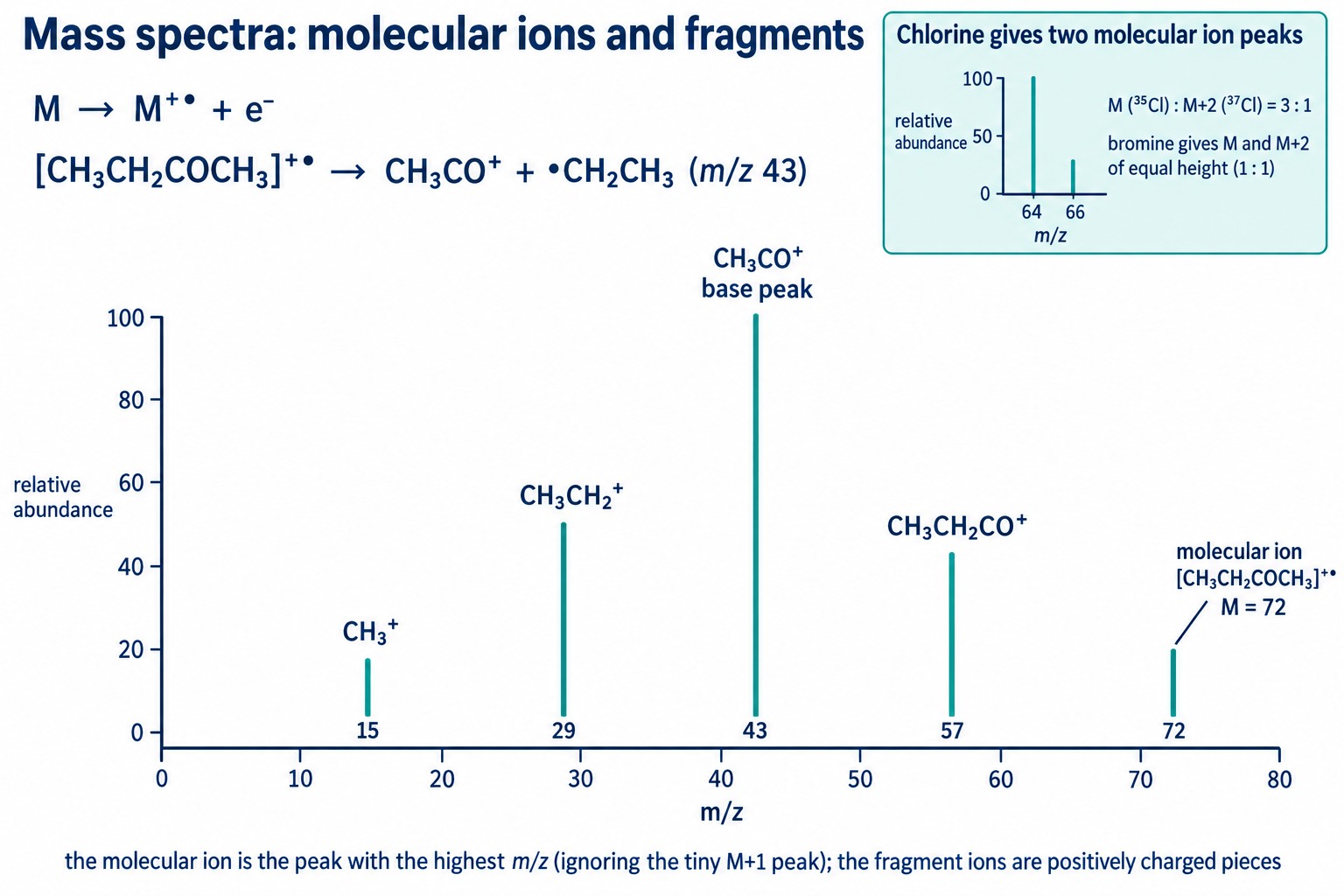
The mass spectrum of butanone with its molecular ion and fragment ions labelled, and the M and M+2 peaks that chlorine produces.
Worked example: A spectrum has its molecular ion at m/z 58 and peaks at 43 and 15. Mr 58 fits C₃H₆O (propanal or propanone) or C₄H₁₀ (butane). A strong peak at 43 = CH₃CO⁺ with 15 = CH₃⁺ and no peak at 29 points to propanone, CH₃COCH₃, which splits only into CH₃CO⁺ and CH₃•.
Check: Using Fragments
Match fragment peaks to structures that are not the ones above.
Chlorine and Bromine: M+2 Peaks
Chlorine has two isotopes, ³⁵Cl (75%) and ³⁷Cl (25%), so a compound with one chlorine atom gives two molecular ion peaks: M containing ³⁵Cl and M+2 containing ³⁷Cl, with heights in the ratio 3 : 1. Bromine is ⁷⁹Br and ⁸¹Br in almost equal amounts, so a bromine compound gives M and M+2 peaks of equal height. Fragment ions that still contain the halogen show the same pair of peaks; fragments that have lost it do not. Two chlorine atoms give M, M+2 and M+4 in the ratio 9 : 6 : 1.
Exam focus: Two molecular ion peaks two units apart: 3 : 1 means one chlorine, 1 : 1 means one bromine.
Common Exam Points
Say
“The molecular ion peak at m/z 72 gives Mr = 72.” “The peak at 43 is CH₃CO⁺, formed by loss of a C₂H₅• radical.” “M and M+2 in a 1 : 1 ratio show one bromine atom.”
Do not say
“The tallest peak is the molecular ion.” “The fragment at 15 is CH₃” without the positive charge.
Watch for
Equations for fragmentation must balance in mass and charge: [CH₃CH₂COCH₃]⁺• → CH₃CO⁺ + •CH₂CH₃, with the radical dot on the neutral piece.
Check: Halogens and Fragmentation Equations
Interpret M+2 patterns and write fragmentation equations for compounds not used above.
FAQs
Use these quick answers to check mass spectra.
Is the molecular ion the tallest peak?
No. It is the peak with the highest m/z (ignoring the small M+1 peak) and is often quite small, because most molecular ions fragment before they are detected.
What is the tiny peak one unit above the molecular ion?
The M+1 peak, from molecules containing one carbon-13 atom. About 1.1% of carbon atoms are ¹³C, so the more carbons a molecule has, the larger the M+1 peak.
Why are the fragments positive ions?
When a molecular ion breaks, one piece keeps the positive charge and the other leaves as a neutral radical. Only charged particles are accelerated and detected.
How can two different fragments both be at m/z 43?
CH₃CH₂CH₂⁺ (C₃H₇⁺) and CH₃CO⁺ both have a mass of 43. The rest of the spectrum, or the infrared spectrum, decides which is present.
How do I recognise chlorine or bromine?
Two molecular ion peaks two units apart: heights 3 : 1 for one chlorine atom, 1 : 1 for one bromine atom.
Copyright and author footprint: This OLS revision page was written for Online Learning System by Dr. Mohammed Al-Fatah. It is designed for A Level Chemistry revision and should not be copied or redistributed without permission.
Keep this note — free
Save your progress across every Cambridge topic. A free account remembers which topics you have covered, saves your question scores, and syncs across your phone and laptop.
- Track every topic you have finished
- Keep your practice-question scores
- No payment, no card, free forever
Already registered? Log in