Infrared Spectroscopy
A concise revision guide to infrared spectroscopy: why bonds absorb infrared radiation, wavenumbers and transmittance, the characteristic absorptions of C–H, C=C, C=O, O–H, N–H and C–X bonds, the fingerprint region.
GCSE Recap: Bonds and Energy
Three quick questions on covalent bonds, the electromagnetic spectrum and why greenhouse gases warm the atmosphere.
Why Bonds Absorb Infrared
The atoms joined by a covalent bond are always vibrating: the bond stretches and compresses, and the angles between bonds bend. Each vibration has its own natural frequency, which depends on the masses of the atoms and the strength of the bond. When infrared radiation of that same frequency passes through the sample, the bond absorbs it and vibrates more energetically. An infrared spectrometer records which frequencies are absorbed, so the spectrum shows which bonds are present.
The frequency is given as a wavenumber in cm⁻¹ (the number of waves per centimetre), plotted from about 4000 on the left to 500 on the right. The y-axis is transmittance, the percentage of the radiation that passes through, so an absorption appears as a trough pointing downwards. Stronger bonds and lighter atoms vibrate faster and absorb at higher wavenumbers: O–H and N–H absorb near 3300 cm⁻¹, C=O near 1700 cm⁻¹, and C–Cl near 700 cm⁻¹.
Infrared Spectroscopy: Bonds That Vibrate
Pick a bond, watch it stretch and bend, and see where it absorbs in the infrared spectrum of ethanol, ethanal, ethanoic acid or chloroethane.
© Dr. Mohammed Al-Fatah – onlinelearningsystem.net
Key idea: A bond absorbs infrared radiation at the frequency of its own vibration. The wavenumber of the trough identifies the bond.
Characteristic Absorptions
The region above 1500 cm⁻¹ is used for functional group identification, because the absorptions there belong to particular bonds and are found in a data booklet. The exam provides the table; the skill is to match each trough to a bond and to give the range in the answer.
| Bond | Where it is found | Wavenumber / cm⁻¹ | Appearance |
|---|---|---|---|
| C–H | alkanes, alkenes, aldehydes, almost every organic compound | 2850–3100 | sharp, medium |
| C=C | alkenes | 1620–1680 | medium |
| C=O | aldehydes, ketones, carboxylic acids, esters | 1680–1750 | strong, sharp |
| O–H | alcohols | 3200–3600 | broad |
| O–H | carboxylic acids | 2500–3300 | very broad, overlaps C–H |
| N–H | amines | 3300–3500 | medium, often two peaks |
| C–O | alcohols, acids, esters | 1000–1300 | strong |
| C–X | halogenoalkanes: C–Cl, C–Br | 600–800 (C–Cl), 500–600 (C–Br) | in the fingerprint region |
The O–H absorptions are broad because hydrogen bonding between molecules spreads the vibration over a range of frequencies; a carboxylic acid O–H is the broadest of all and runs into the C–H region. An alcohol shows a broad O–H near 3350 and no C=O; a carboxylic acid shows both a very broad O–H and a strong C=O near 1715; an aldehyde or ketone shows the C=O but no O–H. An alkene’s C=C is weaker than a C=O and is easy to miss.
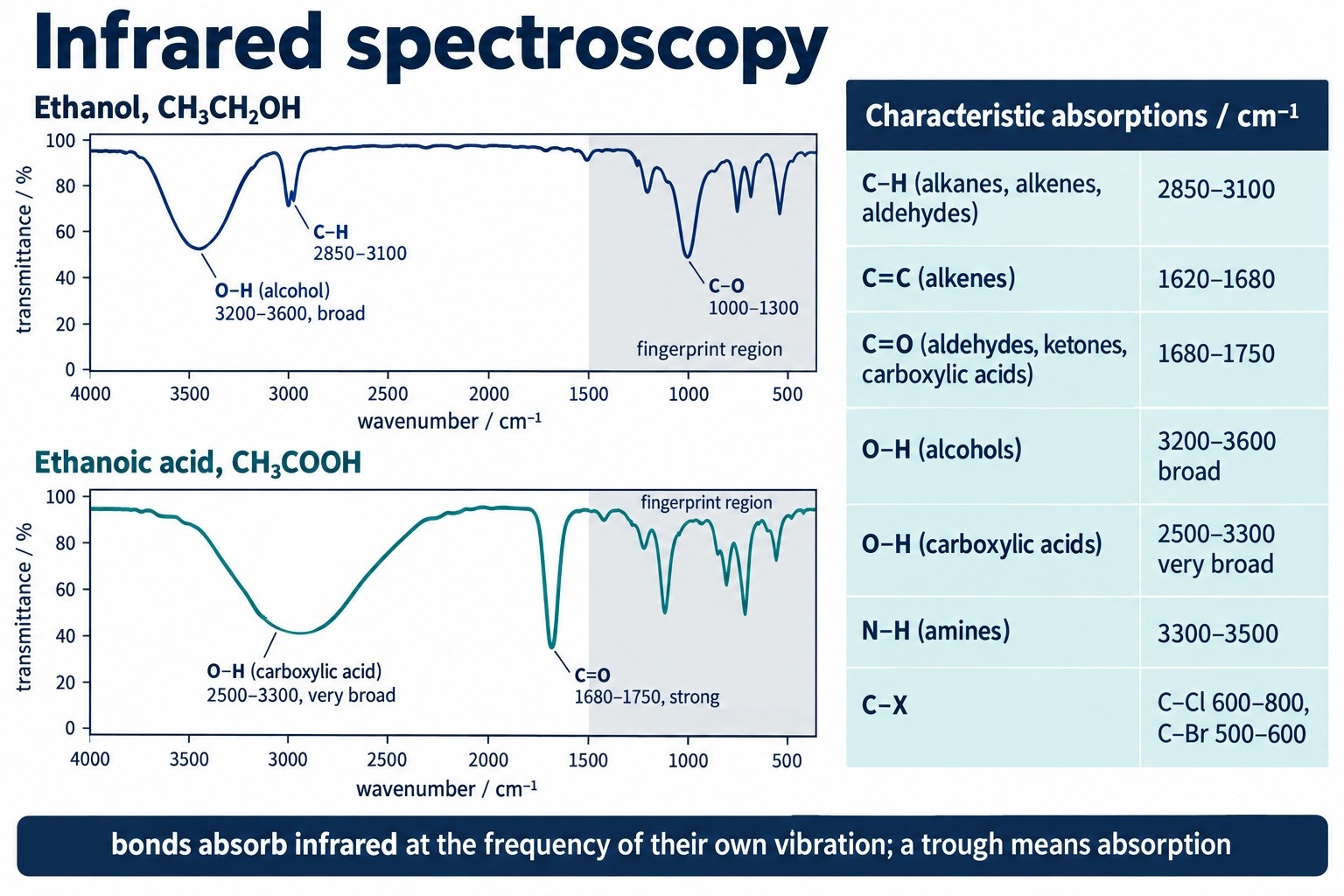
The infrared spectra of ethanol and ethanoic acid with the O–H, C=O, C–H and C–O absorptions labelled and the fingerprint region shaded, beside the wavenumber table.
Exam focus: Write “absorption at 1680–1750 cm⁻¹ due to C=O”. The bond, the range from the data sheet and the word absorption (or trough) are the three parts of the mark.
Check: Which Bond, Which Trough
Assign absorptions in spectra of compounds not discussed on this page.
The Fingerprint Region
Below about 1500 cm⁻¹ the spectrum contains many overlapping absorptions from bending vibrations and from C–C and C–O stretches. This fingerprint region is too complicated to assign bond by bond, but its exact pattern is unique to each compound. A computer compares the fingerprint region of an unknown with a database of spectra of pure compounds; an exact match identifies the compound and confirms its purity.
Key idea: Above 1500 cm⁻¹: identify the functional groups. Below 1500 cm⁻¹: match the fingerprint to a database.
Check: Telling Compounds Apart
Use spectra to distinguish between compounds that are not the examples above.
Common Exam Points
Say
“A broad absorption at 3200–3600 cm⁻¹ shows an O–H group in an alcohol.” “No absorption at 1680–1750 cm⁻¹, so no C=O bond.” “The fingerprint region matches the database spectrum of the pure compound.”
Do not say
“A peak at 1700” (say absorption or trough, and quote the range). “The O–H peak” without saying alcohol or acid.
Watch for
Distinguishing questions: name the absorption that one compound has and the other lacks, with the wavenumber range.
Check: Predicting a Spectrum
Predict the absorptions of compounds not shown on this page.
FAQs
Use these quick answers to check infrared spectroscopy.
Why does the spectrum have troughs rather than peaks?
The y-axis is transmittance, the fraction of radiation that gets through. Where a bond absorbs, less radiation is transmitted, so the line dips.
Why is the O–H absorption broad?
Hydrogen bonding between molecules varies the strength of each O–H bond slightly, so the vibrations are spread over a range of wavenumbers. Carboxylic acids hydrogen bond most strongly and give the broadest band.
Can I tell an aldehyde from a ketone by infrared?
Not reliably. Both show the C=O absorption near 1700 cm⁻¹. Use the mass spectrum or a chemical test such as Tollens’ reagent or Fehling’s solution.
What is the fingerprint region for?
Matching. Below 1500 cm⁻¹ the pattern is unique to each compound, so comparing it with a database spectrum identifies the compound and shows whether it is pure.
Do I have to remember the wavenumbers?
No. The exam gives a data sheet; the skill is to look up the right bond and quote the range in your answer.
Copyright and author footprint: This OLS revision page was written for Online Learning System by Dr. Mohammed Al-Fatah. It is designed for A Level Chemistry revision and should not be copied or redistributed without permission.
Keep this note — free
Save your progress across every Cambridge topic. A free account remembers which topics you have covered, saves your question scores, and syncs across your phone and laptop.
- Track every topic you have finished
- Keep your practice-question scores
- No payment, no card, free forever
Already registered? Log in