Trends in a Group
A concise revision guide to first ionisation energy trends down a group, including atomic radius, shielding, nuclear charge and why outer electrons become easier to remove.
- 2.10-a
- 2.10-b
- 2.18iii
- 8.11
What these spec points say
- 2.10-a understand how ionisation energies are influenced by the number of protons in the nucleus
- 2.10-b understand how ionisation energies are influenced by electron shielding
- 2.18iii be able to explain: the decrease in first ionisation energy down a group
- 8.11 understand reasons for the trend in ionisation energy down Groups 1 and 2
Period 3 Structures and Melting
Choose a step to watch each Period 3 structure, then see how much energy each element needs to melt.
© Dr. Mohammed Al-Fatah – onlinelearningsystem.net
GCSE Recap: Groups, Shells and Reactivity
Before you start, check what you remember about groups and the reactivity of the Group 1 metals.
What Does Going Down a Group Mean?
A group is a vertical column in the periodic table. Elements in the same group have the same number of outer-shell electrons, so they often show similar chemical behaviour.
When you go down a group, each element has one more occupied electron shell than the element above it. This increases the distance between the nucleus and the outer electron.
Core idea: down a group, the outer electron is further from the nucleus and is shielded by more inner electron shells.
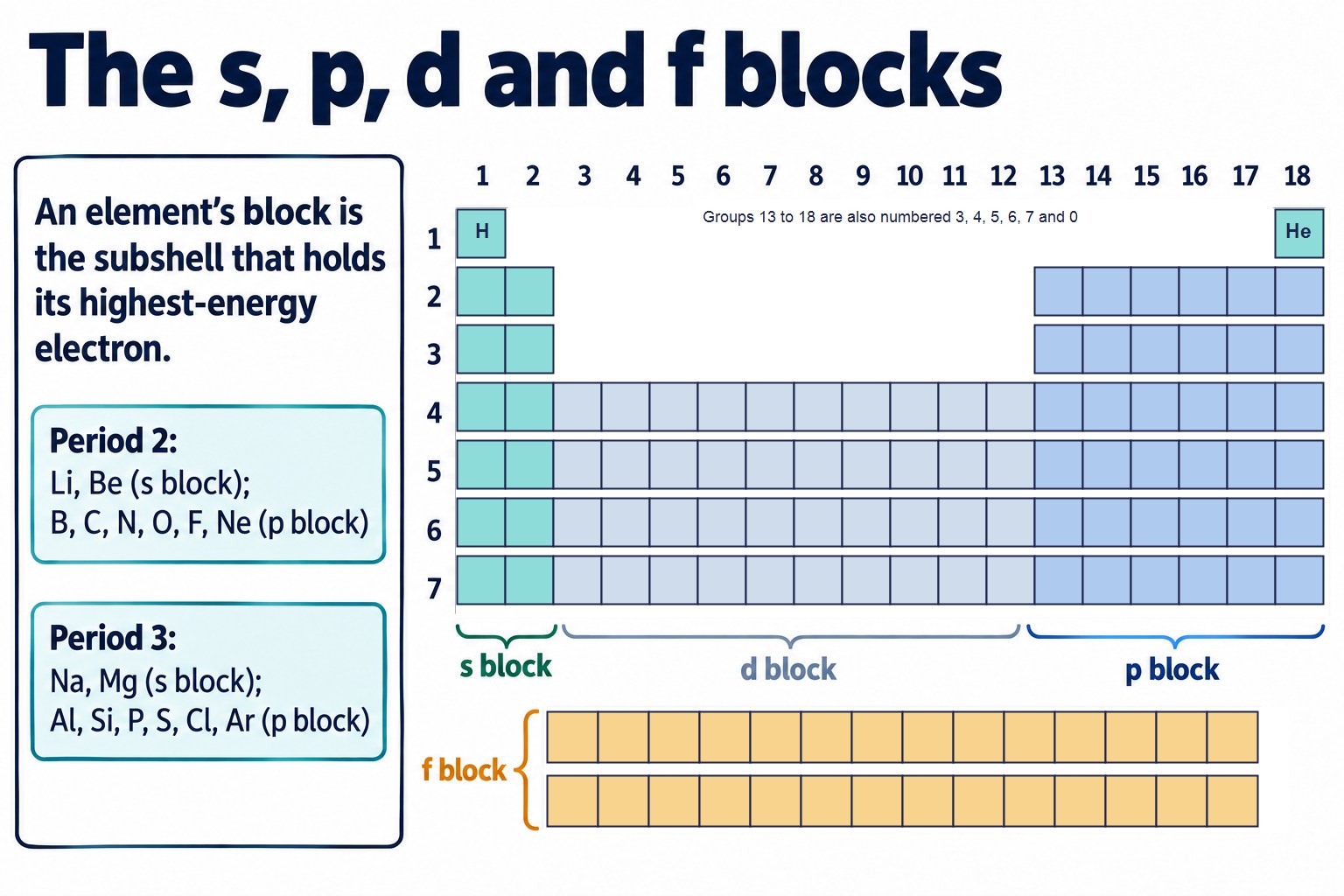
Groups are vertical columns in the periodic table. The block also helps identify which subshell receives the outer electrons.
Atomic Radius Increases Down a Group
Atomic radius increases down a group because each element has an additional main electron shell.
The outer electron is further from the nucleus, so the attraction between the nucleus and the outer electron becomes weaker. This increased distance is one of the main reasons ionisation energy decreases down a group.
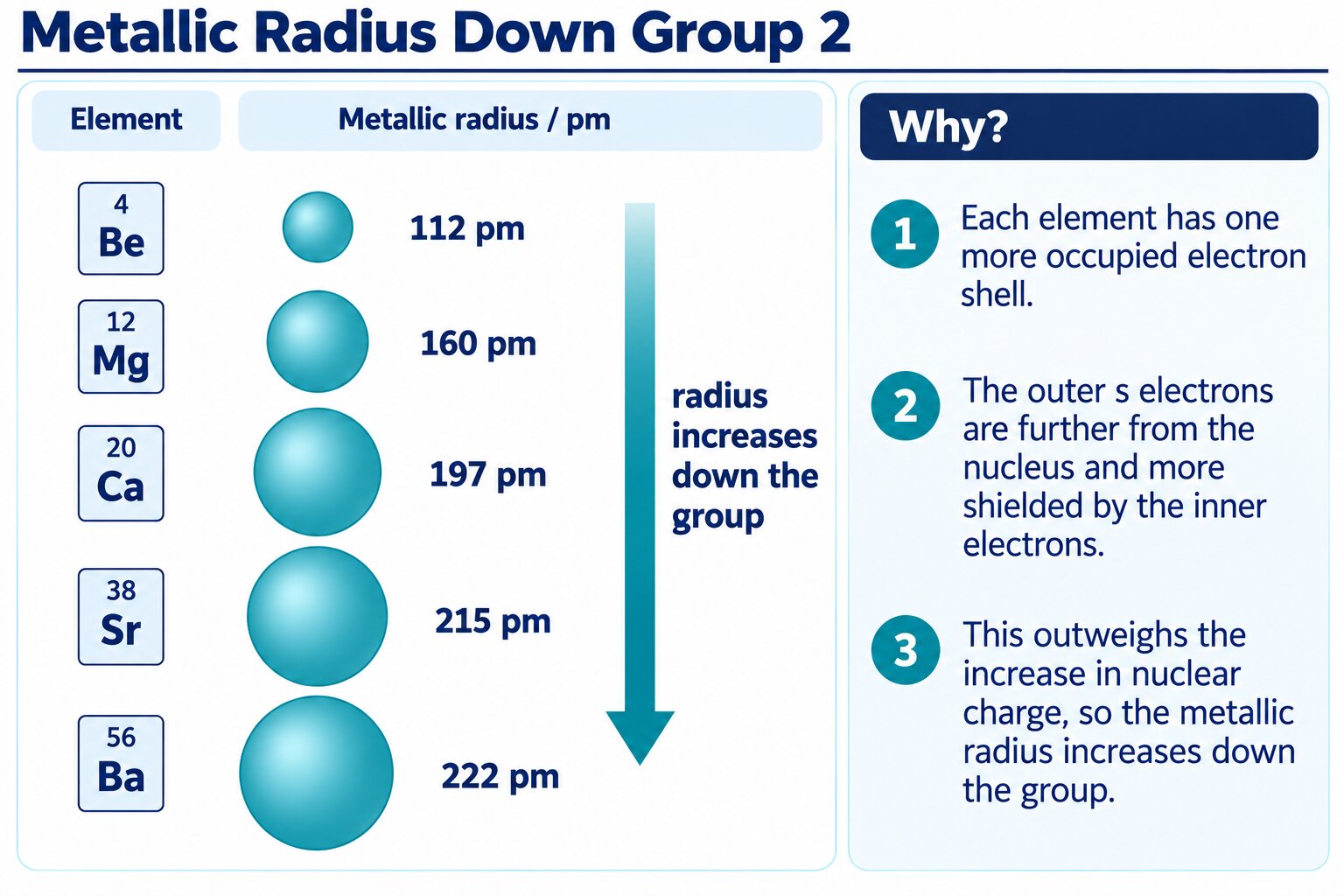
Each element lower in Group 2 has an extra occupied electron shell, so its outer electron is further from the nucleus.
Exam phrase: the outer electron is further from the nucleus because there are more occupied electron shells.
Quick Check: Count the Shells and Inner Electrons
Use the two electron arrangements to type each number.
Shielding Increases Down a Group
As atoms get larger down a group, there are more inner shells between the nucleus and the outer electron. These inner shells shield the outer electron from the full attraction of the nucleus.
This means the outer electron experiences a lower effective nuclear attraction, even though the total number of protons in the nucleus has increased.
Shielding: the reduction in attraction between the nucleus and an outer electron due to repulsion from inner-shell electrons.
| Factor down a group | What happens? | Effect on the outer electron |
|---|---|---|
| Number of shells | Increases | Outer electron is further from the nucleus. |
| Shielding | Increases | Inner shells reduce the attraction felt by the outer electron. |
| Nuclear charge | Increases | More protons increase attraction, but this is outweighed by extra shells and shielding. |
| First ionisation energy | Decreases | Less energy is needed to remove the outer electron. |
Quick Check: Rank the Noble Gases
Drag the noble gases into order of first ionisation energy, highest at the top.
Watch: three factors down a group
Down a group the nuclear charge rises, but so do distance and shielding. Which wins?
First Ionisation Energy Decreases Down a Group
First ionisation energy generally decreases down a group. This means it becomes easier to remove the outer electron from atoms lower in the group.
The nuclear charge does increase because atoms lower in the group have more protons. However, the effect of the extra shells and increased shielding is greater. The outer electron is less strongly attracted to the nucleus, so less energy is needed to remove it.
The values for Group 2 show the size of the decrease:
| Element | Protons | Inner-shell electrons | First ionisation energy / kJ mol⁻¹ |
|---|---|---|---|
| Be (2,2) | 4 | 2 | 900 |
| Mg (2,8,2) | 12 | 10 | 738 |
| Ca (2,8,8,2) | 20 | 18 | 590 |
| Sr (2,8,18,8,2) | 38 | 36 | 550 |
| Ba (2,8,18,18,8,2) | 56 | 54 | 503 |
From one element to the next, the number of protons and the number of inner-shell electrons rise by the same amount. The extra nuclear charge is cancelled by the extra shielding, so the greater distance from the nucleus decides the trend.
Best exam answer: down a group, there are more occupied shells, the outer electron is further from the nucleus and shielding increases. These effects outweigh the increased nuclear charge.
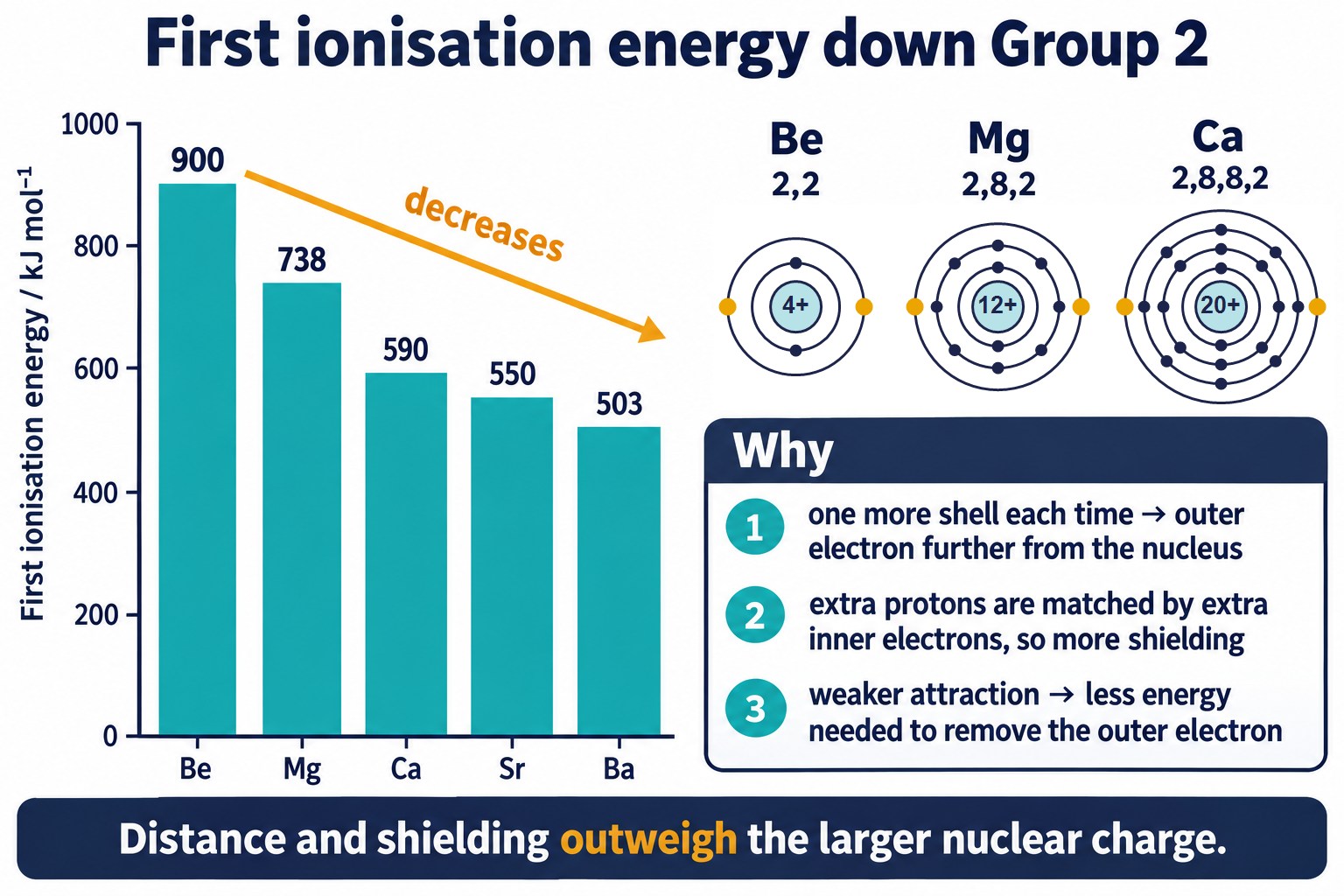
Down Group 2 each atom has one more shell, so the outer electron is further away and easier to remove.
Quick Check: Explain Chlorine and Bromine
Write a short explanation, then compare it with the mark points and the model answer.
Quick Check: Pick the Accurate Statement
In each round, choose the one statement that is accurate.
Group Trend Compared with Period Trend
It is useful to separate down a group from across a period. Across a period, electrons are added to the same main shell, so shielding remains similar and atomic radius generally decreases.
Down a group, electrons are added to new shells. This gives a larger atomic radius and more shielding, so first ionisation energy decreases.
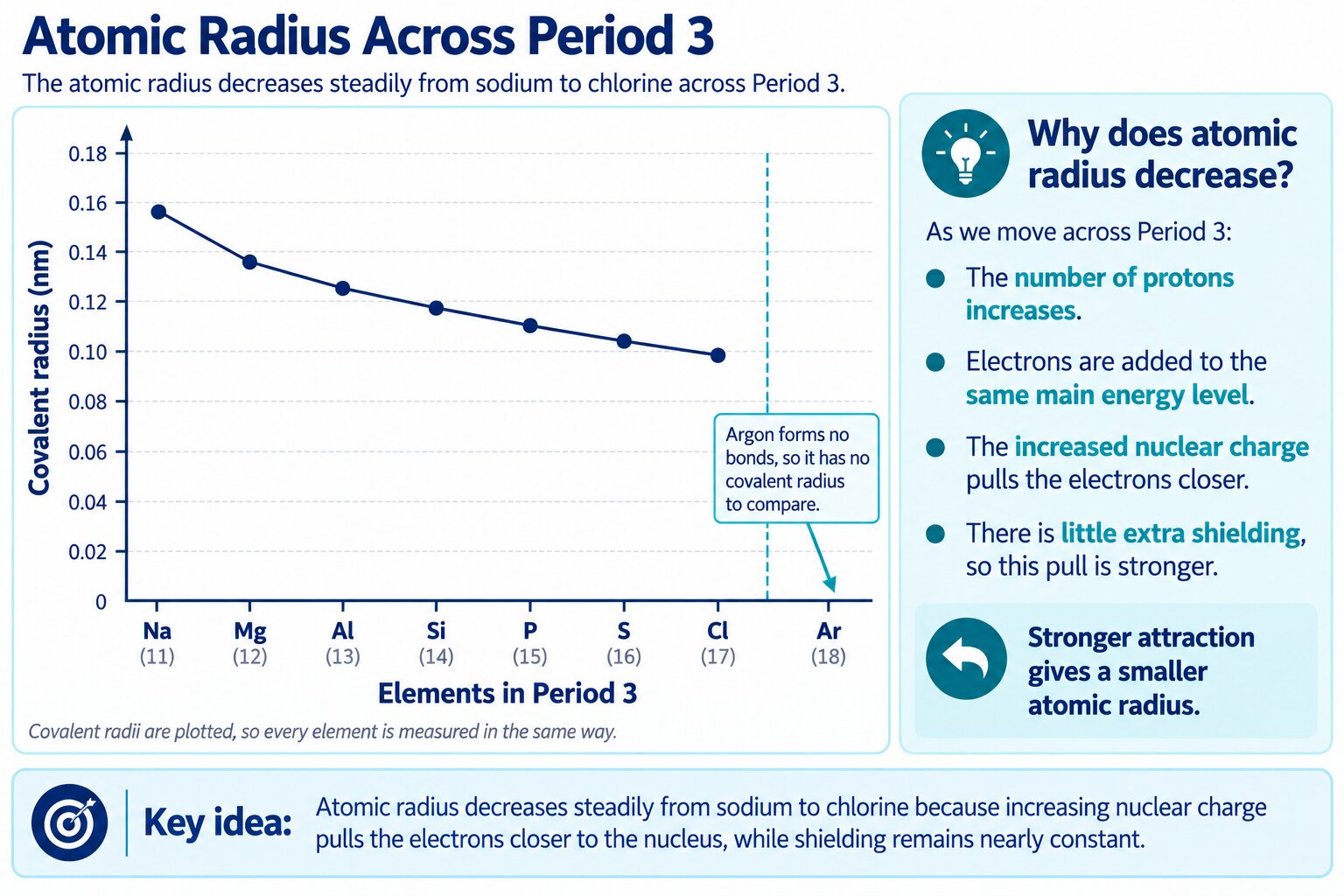
Across a period, atomic radius decreases because nuclear charge increases while shielding remains similar.
Avoid Mixing Up Ionisation Energy with Melting Temperature
Ionisation energy is about removing an electron from a gaseous atom. It is not the same as melting temperature or boiling temperature, which depend on bonding and structure.
Across Period 3, melting and boiling temperatures do not follow the same pattern as ionisation energy because sodium, magnesium and aluminium are metallic, silicon is giant covalent, and phosphorus, sulfur, chlorine and argon are simple molecular or monatomic.
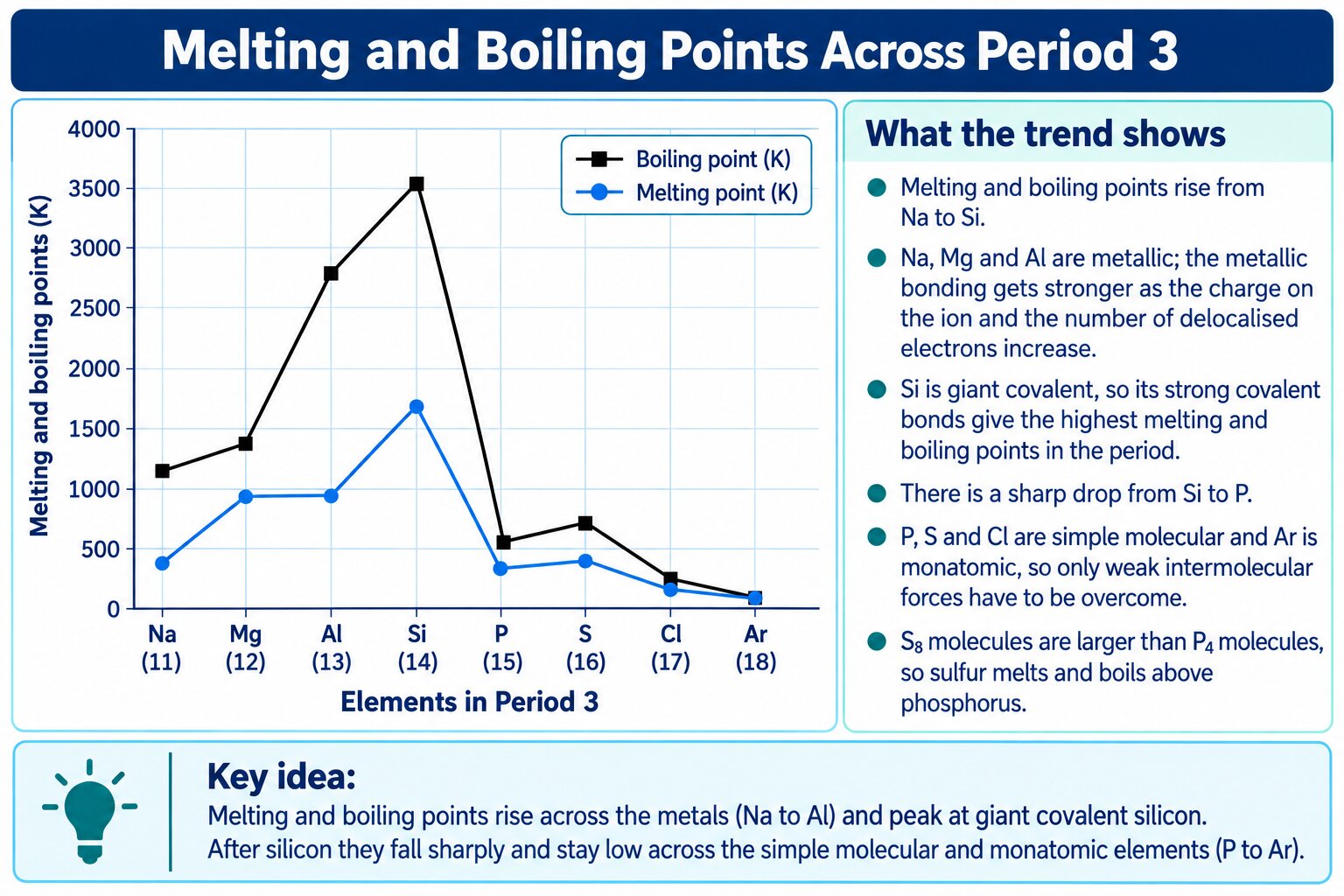
Physical property trends depend on bonding and structure, so they should not be explained using ionisation energy arguments alone.
Quick Check: Group Trend, Period Trend or Structure?
Decide quickly which idea applies in each case.
Common Exam Points
- First ionisation energy is the energy needed to remove one electron from each atom in one mole of gaseous atoms to form one mole of gaseous 1+ ions.
- Down a group, the number of occupied electron shells increases.
- The atomic radius increases because the outer electron is further from the nucleus.
- Shielding increases because there are more inner shells between the nucleus and the outer electron.
- Nuclear charge increases down the group, but this does not reverse the trend.
- The effect of increased distance and shielding outweighs the increase in nuclear charge.
- First ionisation energy decreases, so the outer electron is removed more easily.
FAQs
These questions target the most common exam wording for ionisation energy trends down a group.
Why does first ionisation energy decrease down a group?
First ionisation energy decreases down a group because atoms have more occupied electron shells. The outer electron is further from the nucleus and is shielded more strongly by inner shells, so the attraction to the nucleus is weaker.
Why does atomic radius increase down a group?
Atomic radius increases down a group because each element has an additional main electron shell. This places the outer electron further from the nucleus.
What is shielding in ionisation energy?
Shielding is the reduction in attraction between the nucleus and the outer electron due to repulsion from inner-shell electrons. More inner shells mean greater shielding.
Why does increased nuclear charge not make ionisation energy increase down a group?
Nuclear charge increases down a group because there are more protons. However, the extra occupied shells and increased shielding have a greater effect, so the outer electron is less strongly attracted overall.
What wording should I use in an exam answer?
Use this sequence: more occupied shells, larger atomic radius, more shielding, weaker attraction between the nucleus and the outer electron, less energy needed to remove the electron.
Copyright notice: This OLS revision content, including the explanations, layout, diagrams, tables and embedded learning structure, is authored for Online Learning System by Dr. Mohammed Al-Fatah. It may not be copied, reproduced, redistributed or adapted without written permission.
Keep this note — free
Save your progress across every Edexcel IAL topic. A free account remembers which topics you have covered, saves your question scores, and syncs across your phone and laptop.
- Track every topic you have finished
- Keep your practice-question scores
- No payment, no card, free forever
Already registered? Log in