Mass Spectrometry
Mass spectrometry separates positive ions according to their mass-to-charge ratio, written as m/z. These pages build from the operation of the mass spectrometer through to isotope abundance, relative atomic mass and interpreting molecular spectra.
Revision Notes
4 revision notes, in the order the specification teaches them.

The Mass Spectrometer
Revise vaporisation, ionisation, acceleration, deflection, detection and why ions are separated by m/z.
Start revising
RAM Calculations
Use isotopic mass and percentage abundance data to calculate relative atomic mass using weighted means.
Start revising
Predicting Diatomic Mass Spectra
Predict molecular ion peak patterns for diatomic molecules using isotope combinations and probability ratios.
Start revising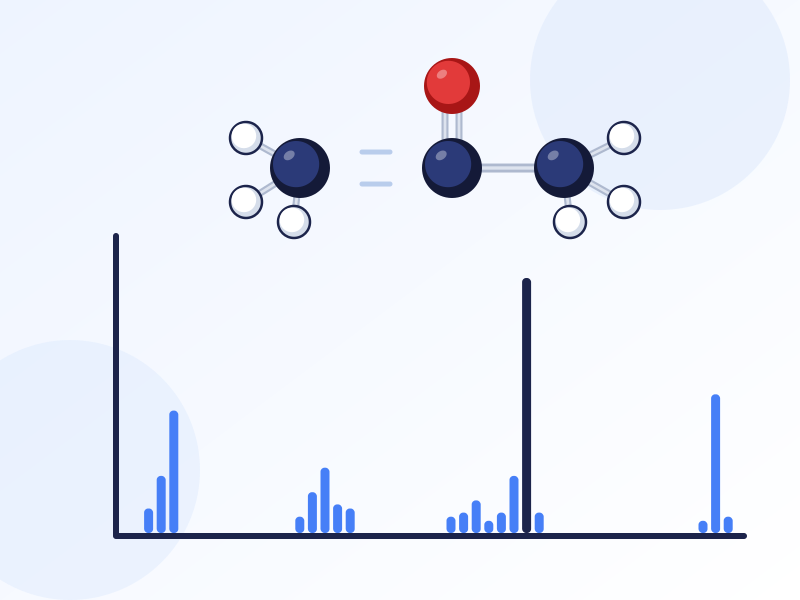
Identifying Compounds from Mass Spectra
Use molecular ion peaks and fragment peaks to support compound identification from a mass spectrum.
Start revisingSummary Map
Download, print and revise the key facts of this topic at a glance.
Summary map
Download, print and revise the key facts of this topic at a glance.

Atoms and Mass Spectrometry Map
Edexcel International A Level Chemistry · Unit 1 · Topic 2A Atoms and Mass Spectrometry
The whole section on one A4 page: sub-atomic particles, isotopes, the mass spectrometer, relative atomic mass and the spectra of molecules.
© 2026 Online Learning System. For personal study: printing is allowed; editing, copying and redistribution are not.
Virtual Lessons
Recorded video lessons that teach the topic step by step.

MCQ Bank
Multiple-choice papers on this topic, marked the moment you submit. MCQ (A) is free.

SAQ Bank
Written, drawn and worked exam practice on this topic, marked by a specialist chemistry teacher.

Revision Game
Match reagents to products, with your board's reagents and conditions.
The revision game for Topic 2 Atomic Structure and The Periodic Table is being built.
Study Cards
Pick a deck, then turn each card to check what you remember.
Specification
Every specification point in this topic, in the exam board's own words. Rate how confident you are with each one.
Self-assessment · 54 points
Sign in to rate how confident you feel about each point. Your ratings are saved to your account, follow you to any device, and appear beside your KASP analytics, kept apart from your marks.
2.1
2.2
2.3
2.4
- a
be able to use atomic number and mass number to determine the number of electrons in an atom or ion
Revise - b
be able to use atomic number and mass number to determine the number of protons in an atom or ion
Revise - c
be able to use atomic number and mass number to determine the number of neutrons in an atom or ion
Revise
2.5
2.6
- i b
be able to analyse and interpret mass spectra to: deduce the isotopic composition of a sample of an element
Revise - ii b
be able to analyse and interpret mass spectra to: calculate the relative atomic mass of an element from relative abundances of isotopes and vice versa
Revise - iii b
be able to analyse and interpret mass spectra to: determine the relative molecular mass of a molecule, and hence identify molecules in a sample
Revise - iv b
be able to analyse and interpret mass spectra to: understand that ions in a mass spectrometer may have a 2+ charge
Revise
2.7
2.8
2.9
- 2.9
know that an orbital is a region within an atom that can hold up to two electrons with opposite spins
Revise
2.10
- c
understand how ionisation energies are influenced by the sub-shell from which the electron is removed
Revise
2.11
- i
know that ideas about electronic structure developed from: an understanding that successive ionisation energies provide evidence for the existence of quantum shells and the group to which the element belongs
Revise - ii
know that ideas about electronic structure developed from: an understanding that the first ionisation energy of successive elements provides evidence for electron sub-shells
Revise
2.12
2.13
2.14
- a
be able to predict the electronic configuration of atoms of the elements from hydrogen to krypton inclusive using s, p, d notation
Revise - b
be able to predict the electronic configuration of ions of the elements from hydrogen to krypton inclusive using s, p, d notation
Revise - c
be able to predict the electronic configuration of atoms of the elements from hydrogen to krypton inclusive using electron-in-boxes notation
Revise - d
be able to predict the electronic configuration of ions of the elements from hydrogen to krypton inclusive using electron-in-boxes notation
Revise
2.15
- 2.15
understand that electronic configuration determines the chemical properties of an element
2.16
- a
know that the Periodic Table is divided into blocks, such as s, p and d
2.17
- b
be able to use logarithms of first ionisation energies on a graph for elements 1 to 36
2.18
- i
be able to explain: the trends in melting and boiling temperatures of the elements of Periods 2 and 3 of the Periodic Table in terms of the structure of the element and the bonding between its atoms or molecules
Revise - ii
be able to explain: the general increase and the specific trends in ionisation energy of the elements across Periods 2 and 3 of the Periodic Table
Revise
Keep this note — free
Save your progress across every Edexcel IAL topic. A free account remembers which topics you have covered, saves your question scores, and syncs across your phone and laptop.
- Track every topic you have finished
- Keep your practice-question scores
- No payment, no card, free forever
Already registered? Log in