Titrations and Measurement Uncertainty
A concise revision guide to concentrations in mol dm⁻³ and g dm⁻³, acid–base titration technique and calculations with methyl orange and phenolphthalein, and estimating and reducing the percentage uncertainty of a volumetric result.
- 8.20
- 8.21
- 8.22
What these spec points say
- 8.20 be able to calculate solution concentrations, in mol dm-3 and g dm-3, including simple acid-base titrations using the indicators methyl orange and phenolphthalein
- 8.21 CORE PRACTICAL 3 Finding the concentration of a solution of hydrochloric acid.
- 8.22 understand how to minimise the sources of measurement uncertainty in volumetric analysis and estimate the overall uncertainty in the calculated result
GCSE Recap: Moles in Solution
Three quick questions on concentration, volume and moles before the titration calculations begin.
Concentration in mol dm⁻³ and g dm⁻³
The concentration of a solution is the amount of solute in one cubic decimetre of solution. In mol dm⁻³ it is the moles per dm³; in g dm⁻³ it is the mass per dm³. The two are linked by the molar mass:
concentration in g dm⁻³ = concentration in mol dm⁻³ × Mr
Because volumes in the laboratory are measured in cm³, the volume must be divided by 1000 before it is used: n = c × V ÷ 1000, with V in cm³.
Worked example: 4.00 g of sodium hydroxide (Mr 40.0) is dissolved to make 250 cm³ of solution. n = 4.00 ÷ 40.0 = 0.100 mol; c = 0.100 ÷ 0.250 = 0.400 mol dm⁻³, which is 0.400 × 40.0 = 16.0 g dm⁻³.
Unit check: cm³ ÷ 1000 = dm³. A titre of 23.45 cm³ is 0.02345 dm³.
Carrying Out an Acid–Base Titration
A titration finds the volume of one solution that exactly reacts with a measured volume of another.
A pipette delivers a fixed volume of one solution (usually 25.0 cm³) into a conical flask. The other solution is run in from a burette until the indicator changes colour at the end point.
The first titration is rough. Accurate titrations are then repeated until two concordant titres, within 0.10 cm³ of each other, are obtained and averaged.
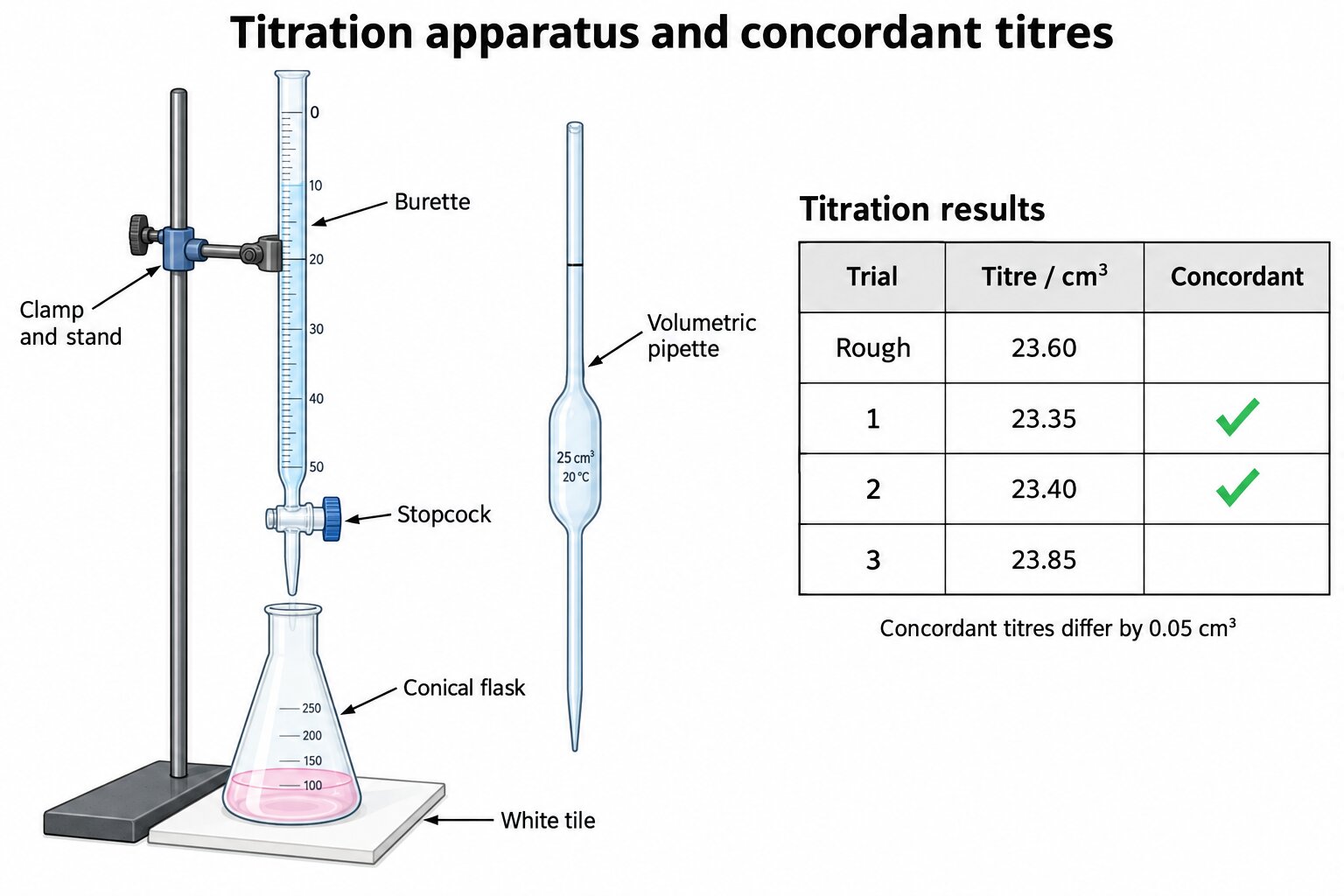
The burette, pipette and conical flask, and a results table showing which titres are concordant and which are discarded.
| Indicator | Colour in acid | Colour in alkali | End point |
|---|---|---|---|
| Methyl orange | red | yellow | orange |
| Phenolphthalein | colourless | pink | first permanent pale pink (or the pink just disappears) |
Either indicator suits a strong acid with a strong base. Only a few drops are used, because indicators are themselves weak acids and too much would react with the alkali.
Technique point: Rinse the burette with the solution it will hold and the pipette with the solution it will deliver, but rinse the conical flask with distilled water only: any solution left in the flask would add extra moles.
Check: Titration Practice
Put the steps of a titration in order and decide which titres from a results table are concordant.
Titration Calculations
The calculation always follows the same four steps. Write the equation, find the moles of the solution whose concentration is known, use the equation ratio to get the moles of the other solution, then divide by its volume in dm³.
Worked example: 25.0 cm³ of sodium hydroxide solution needed 22.30 cm³ of 0.100 mol dm⁻³ hydrochloric acid for neutralisation with methyl orange. Find the concentration of the sodium hydroxide.
- NaOH + HCl → NaCl + H₂O, so the ratio is 1 : 1.
- n(HCl) = 0.100 × 22.30 ÷ 1000 = 2.23 × 10⁻³ mol.
- n(NaOH) = 2.23 × 10⁻³ mol.
- c(NaOH) = 2.23 × 10⁻³ ÷ 0.0250 = 0.0892 mol dm⁻³.
With a diprotic acid the ratio changes: 2NaOH + H₂SO₄ → Na₂SO₄ + 2H₂O, so the moles of sodium hydroxide are twice the moles of sulfuric acid.
Common mistake: Using the pipette volume with the burette concentration. Match each volume to its own solution before multiplying.
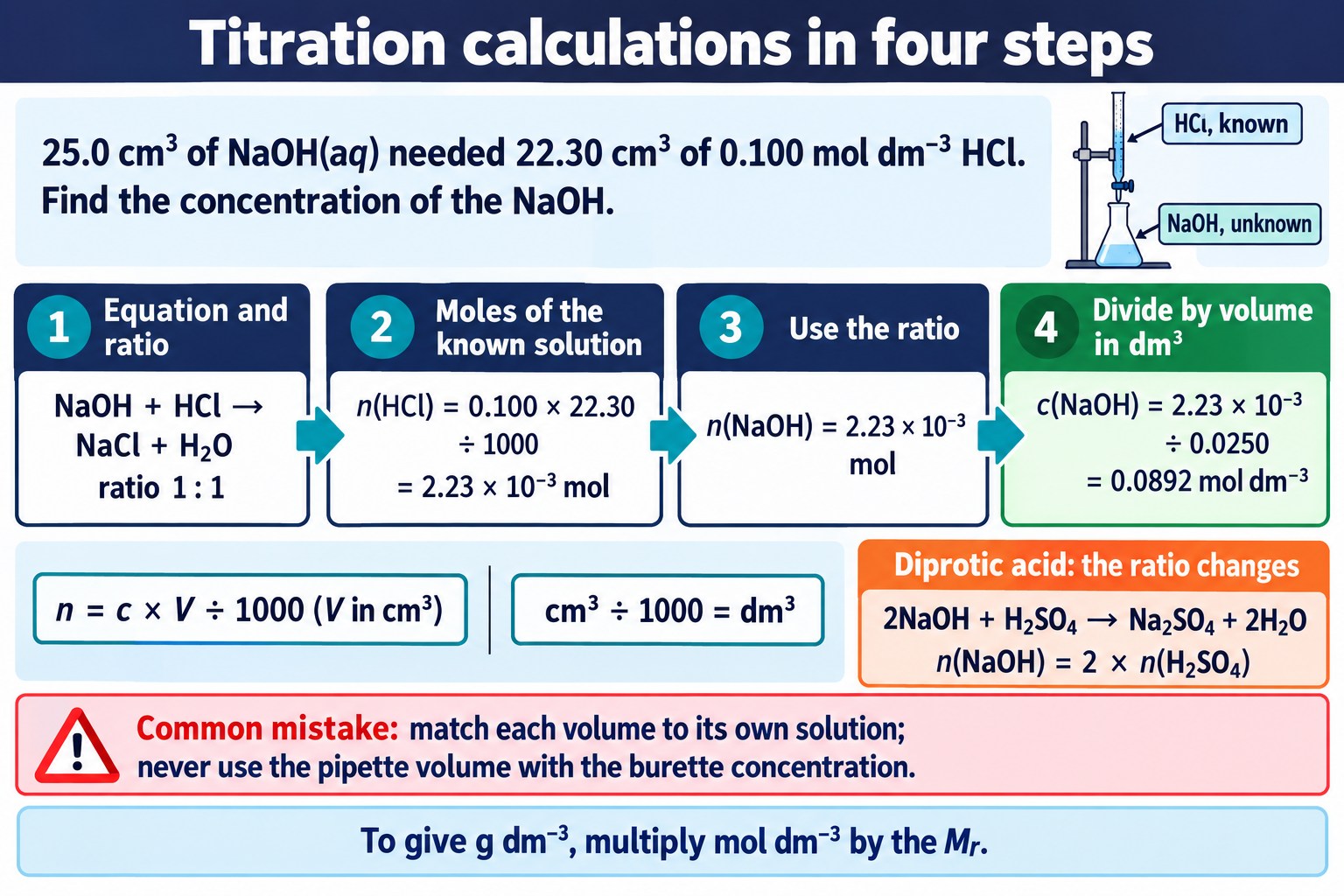
Every titration calculation follows the same four steps: equation and ratio, moles of the known solution, moles of the unknown, then concentration.
Check: A Titration Calculation
Calculate a concentration from titration results for an acid and base pair not used in the worked example, then convert it to g dm⁻³.
Measurement Uncertainty
Every piece of apparatus has an uncertainty, the largest amount by which a reading may differ from the true value.
A burette read to 0.05 cm³ has an uncertainty of ±0.05 cm³ per reading, and a titre is the difference of two readings, so its uncertainty is ±0.10 cm³.
The percentage uncertainty compares the uncertainty with the size of the reading:
percentage uncertainty = uncertainty ÷ measured value × 100
| Apparatus | Typical uncertainty | Reading | Percentage uncertainty |
|---|---|---|---|
| Burette (two readings) | ±0.10 cm³ | 22.30 cm³ | 0.10 ÷ 22.30 × 100 = 0.45% |
| 25 cm³ pipette | ±0.06 cm³ | 25.0 cm³ | 0.24% |
| 250 cm³ volumetric flask | ±0.30 cm³ | 250 cm³ | 0.12% |
| Balance (2 d.p.) | ±0.005 g per reading | 2.65 g | 0.19% (0.38% if weighed by difference) |
When a result is calculated from several measurements, the percentage uncertainties are added to give the overall percentage uncertainty of the result. For the worked example above, the burette, pipette and the concentration of the standard solution all contribute.
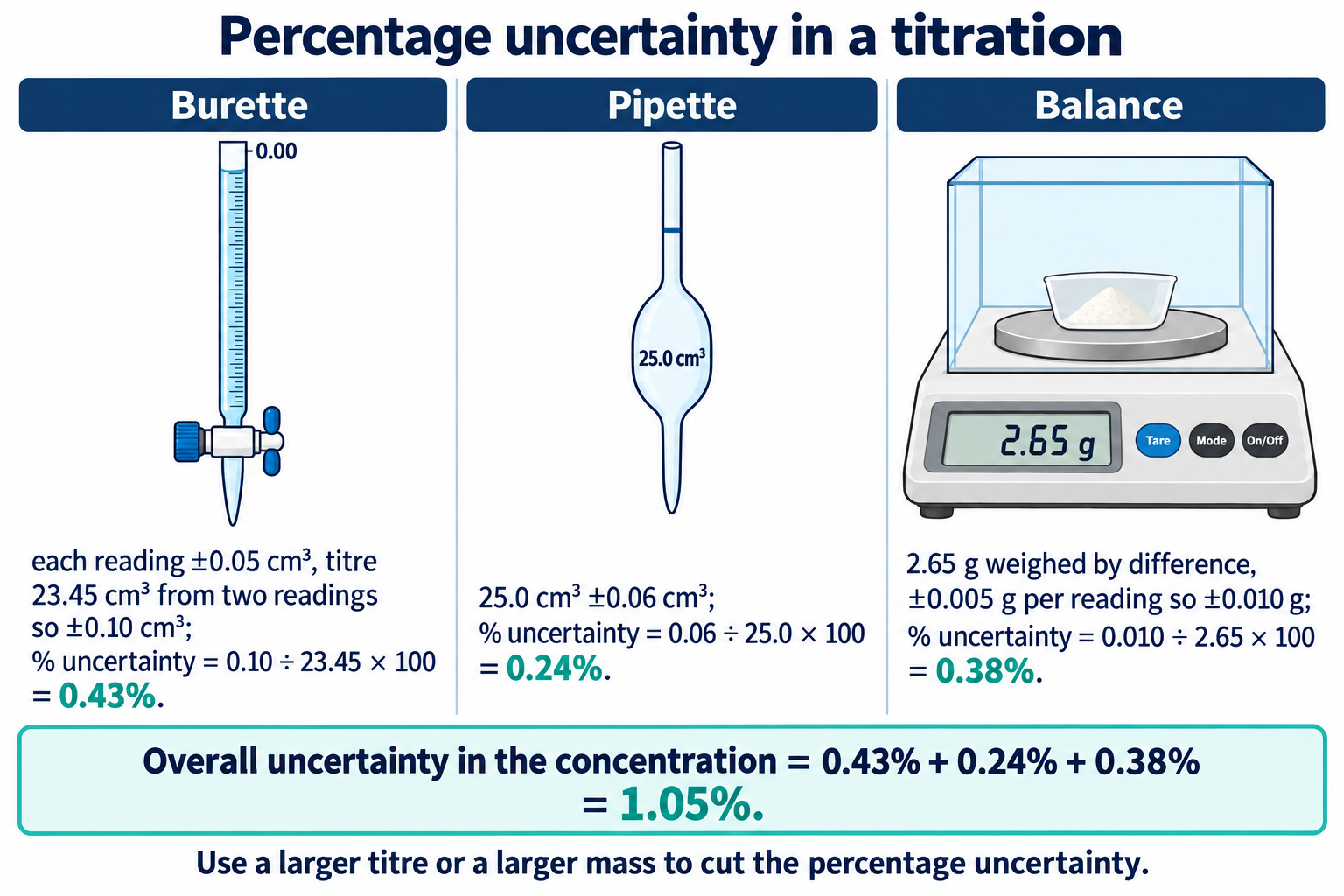
Each reading contributes its own percentage; the percentages add to give the uncertainty in the final concentration.
Key idea: A small titre gives a large percentage uncertainty. Aim for a titre of 20 to 25 cm³ by choosing sensible concentrations.
Reducing the Uncertainty
The percentage uncertainty falls when the measured value is larger or the uncertainty is smaller.
Practical ways to reduce it include weighing a larger mass of solid, using a larger volume pipette, choosing concentrations that give a titre above 20 cm³, and reading the burette to the nearest 0.05 cm³ at eye level.
Remember: Repeating titrations and averaging concordant results reduces random error but does not change the apparatus uncertainty.
CP 3 Concentration of HCl by Titration and CP 4 Preparation of a Standard Solution are the practicals in which these calculations and uncertainties are put to work.
Exam wording: A question asking how to reduce the uncertainty wants a change to the measurement, for example “use a larger titre by diluting the acid”, not “be more careful”.
Check: Uncertainty Calculations
Calculate percentage uncertainties for readings not in the table and decide which change reduces the overall uncertainty most.
Common Exam Points
Calculate a concentration from a titration
Equation, moles of the known solution, ratio, divide by volume in dm³, then convert units if g dm⁻³ is asked for.
Calculate the percentage uncertainty in a titre
The titre is two readings, so the uncertainty is 2 × 0.05 = 0.10 cm³; divide by the titre and multiply by 100.
Suggest how to reduce the uncertainty
Increase the measured quantity: a larger mass, a larger volume, or a larger titre.
Do not say
“Uncertainty of a burette reading is 0.1 cm³” for a single reading; “repeat the experiment” as a way of reducing apparatus uncertainty; “use a more accurate burette” without saying how.
FAQs
Use these quick answers to check the titration calculations and the uncertainty ideas.
How do I convert mol dm⁻³ to g dm⁻³?
Multiply the concentration in mol dm⁻³ by the molar mass of the solute.
What are concordant titres?
Accurate titres within 0.10 cm³ of each other. Only these are averaged; the rough titre is never included.
Why is the uncertainty of a titre 0.10 cm³ when the burette reads to 0.05 cm³?
A titre is the difference between two burette readings, and each reading carries ±0.05 cm³, so the uncertainties add.
How do I find the overall percentage uncertainty?
Work out the percentage uncertainty of each measurement and add them together.
How can I reduce the percentage uncertainty?
Make the measured value larger: weigh more solid, use a larger pipette, or adjust concentrations so the titre is above 20 cm³.
Copyright notice: This OLS revision content, including the explanations, layout, diagrams, tables and embedded learning structure, is authored for Online Learning System by Dr. Mohammed Al-Fatah. It may not be copied, reproduced, redistributed or adapted without written permission.
Keep this note — free
Save your progress across every Edexcel IAL topic. A free account remembers which topics you have covered, saves your question scores, and syncs across your phone and laptop.
- Track every topic you have finished
- Keep your practice-question scores
- No payment, no card, free forever
Already registered? Log in