Nature of Covalent Bonding
A concise revision guide to the nature of covalent bonding, shared electron density, orbital overlap, sigma bonds, pi bonds, multiple bonds and dot-and-cross representations for Edexcel A Level Chemistry.

What Is a Covalent Bond?
A covalent bond is a strong electrostatic attraction between a shared pair of electrons and the nuclei of the bonded atoms.
In a hydrogen molecule, X-ray diffraction evidence shows a high concentration of negative charge between the two hydrogen nuclei. This shared negative charge is attracted to both nuclei, so the attractive forces are greater than the repulsive forces.
The bond is therefore strongest when there is a significant density of shared electrons between the bonded atoms.
Definition: A covalent bond forms when atomic orbitals overlap and a pair of electrons is shared between two atoms. The shared electron density between the nuclei holds the atoms together.
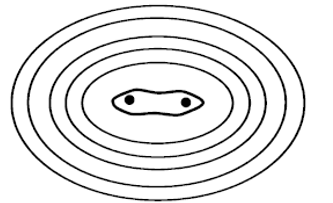
The highest electron density is between the nuclei, which explains the attractive force in the covalent bond.
Orbital Overlap and Single Covalent Bonds
Covalent bonds form when atomic orbitals overlap. The shared electrons occupy the overlapping region and are attracted by both nuclei.
In hydrogen, two 1s orbitals overlap to form a molecular orbital containing the shared pair of electrons. In chlorine, a pair of p orbitals overlap, with each chlorine atom contributing one unpaired electron.
| Molecule | Orbitals involved | Bond formed |
|---|---|---|
| H2 | Overlap of two 1s orbitals | A single covalent bond with electron density between the two nuclei |
| Cl2 | Overlap of two p orbitals, each containing one unpaired electron | A single covalent bond between the two chlorine atoms |
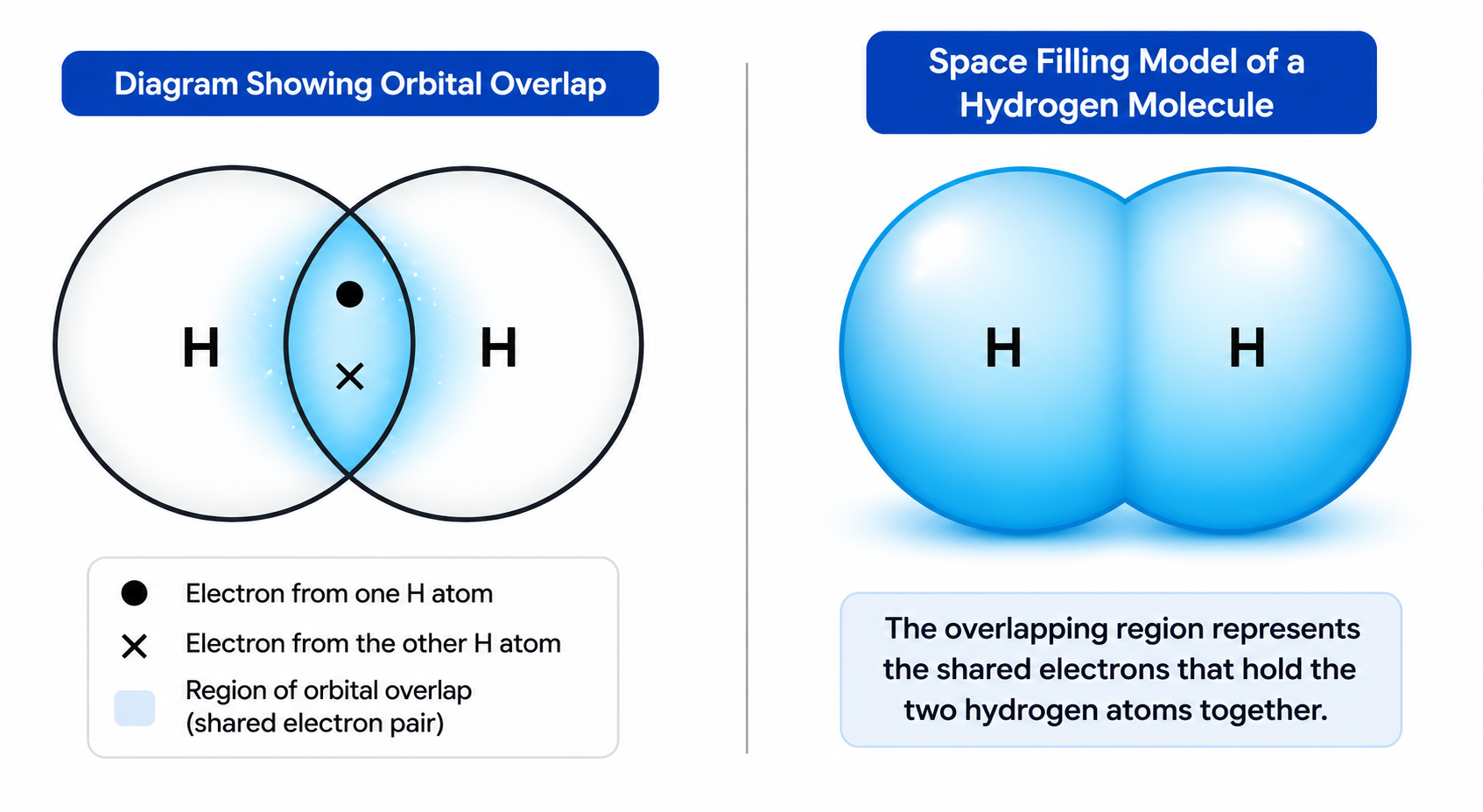
In H2, the two 1s orbitals overlap and the shared electrons occupy the new molecular orbital.
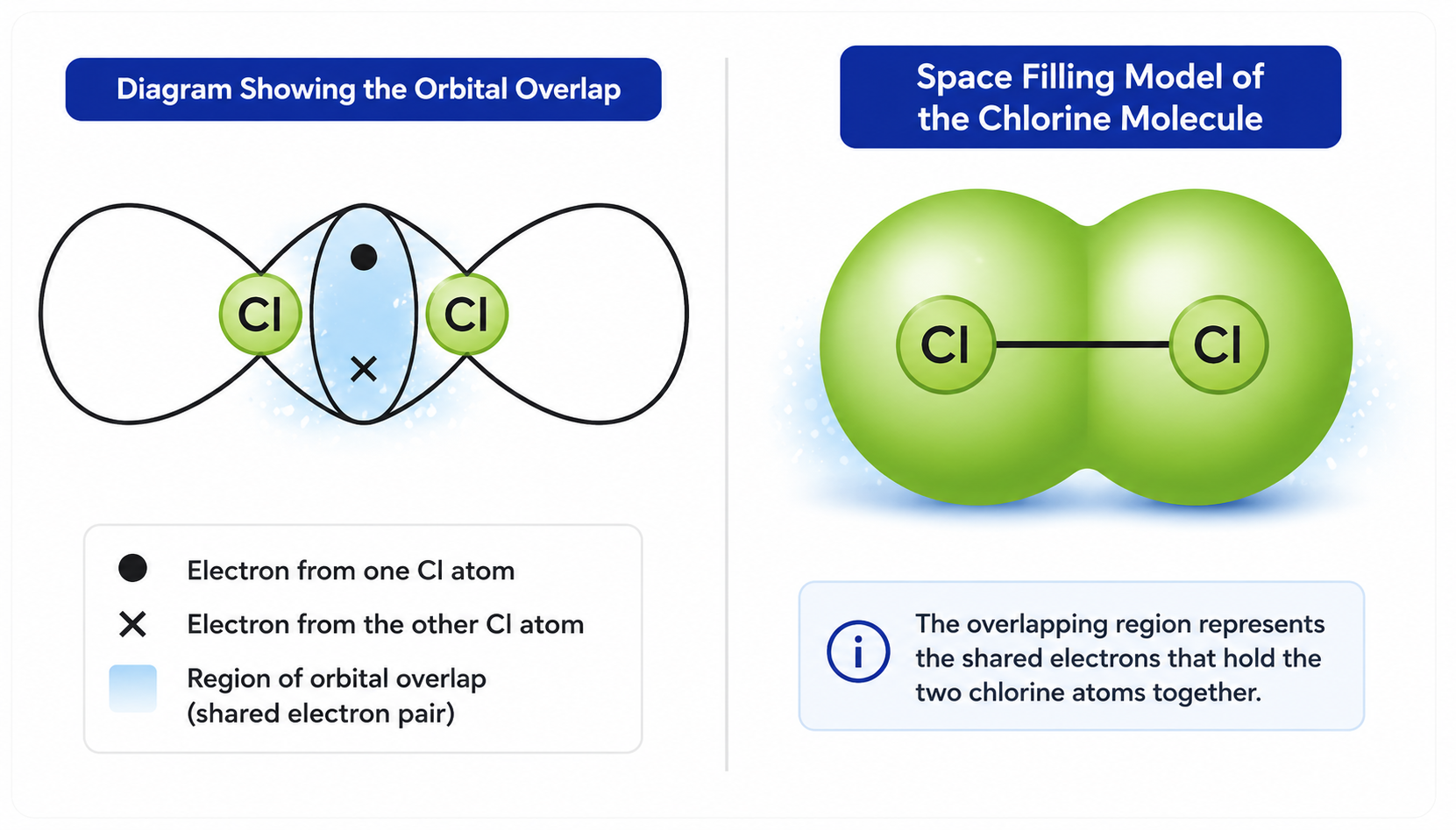
In Cl2, two p orbitals overlap to form one shared pair of electrons between the chlorine atoms.
Key idea: The shared pair of electrons is not just drawn between atoms for convenience. It represents electron density in the overlapping region between the nuclei.
Sigma Bonds and Pi Bonds
A sigma, σ, bond is formed by direct orbital overlap along the line between two nuclei. It is the first covalent bond formed between two atoms.
After a sigma bond has formed, it is sometimes possible for a pi, π, bond to form. A pi bond is formed by the sideways overlap of p orbitals, creating electron density above and below the plane of the molecule.
| Bond type | How it forms | Electron density |
|---|---|---|
| σ bond | Direct overlap of orbitals along the internuclear axis | Concentrated directly between the two nuclei |
| π bond | Sideways overlap of p orbitals after a σ bond has already formed | Above and below the plane of the molecule |
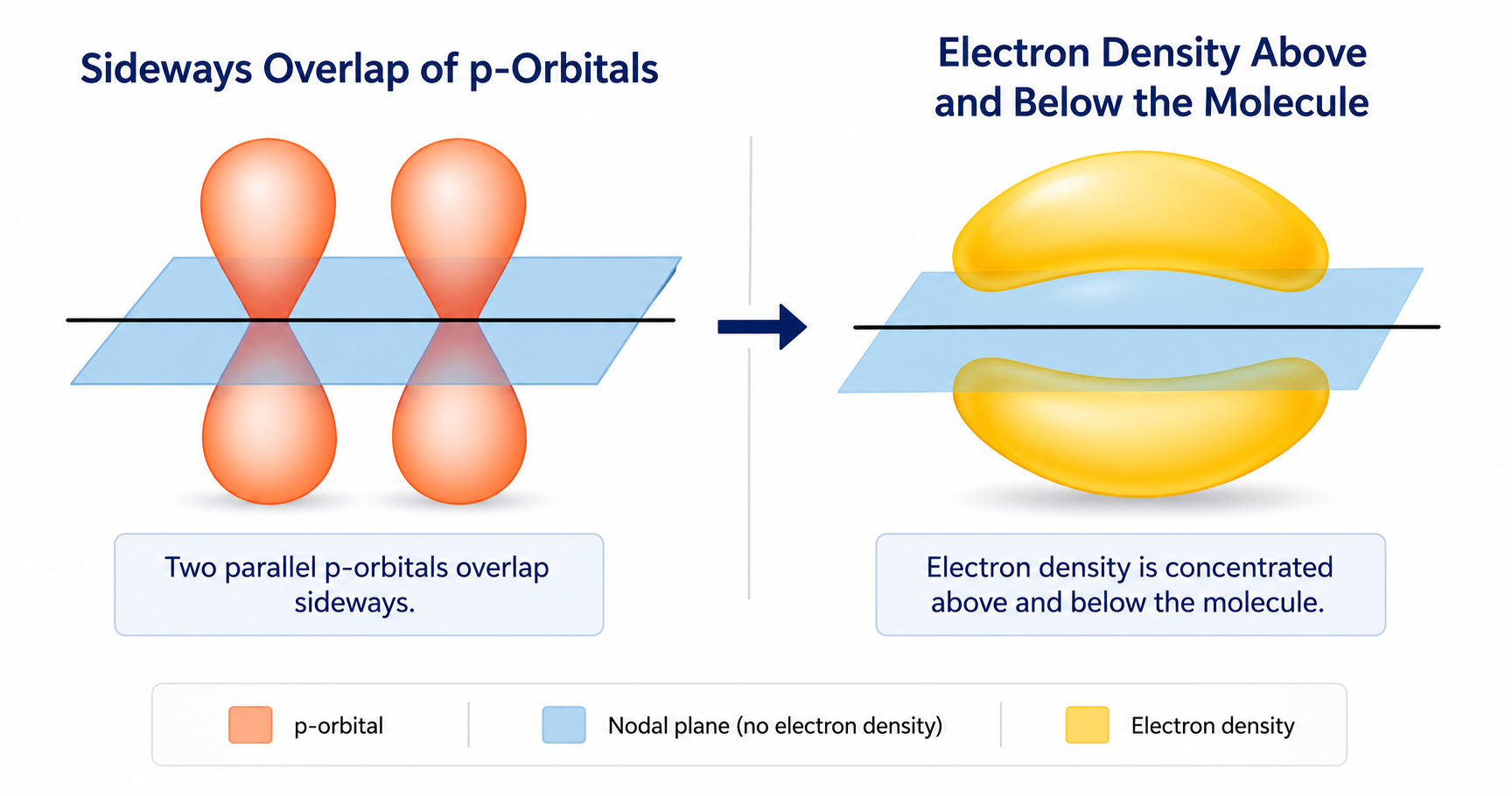
The sideways overlap of p orbitals produces two regions of electron density, one above and one below the molecular plane.
Double Bonds, Triple Bonds and Bond Strength
A double bond contains one σ bond and one π bond. For example, the carbon-carbon double bond in ethene contains one sigma bond and one pi bond.
A triple bond contains one σ bond and two π bonds. For example, the nitrogen molecule, N≡N, contains one sigma bond and two pi bonds.
Double and triple bonds place a greater electron density between the nuclei. This increases the electrostatic attraction between nuclei and bonding electrons, giving shorter bond length and stronger bond strength.
Exam focus: More shared electron pairs usually means greater electron density between nuclei, stronger attraction, shorter bond length and greater bond strength.
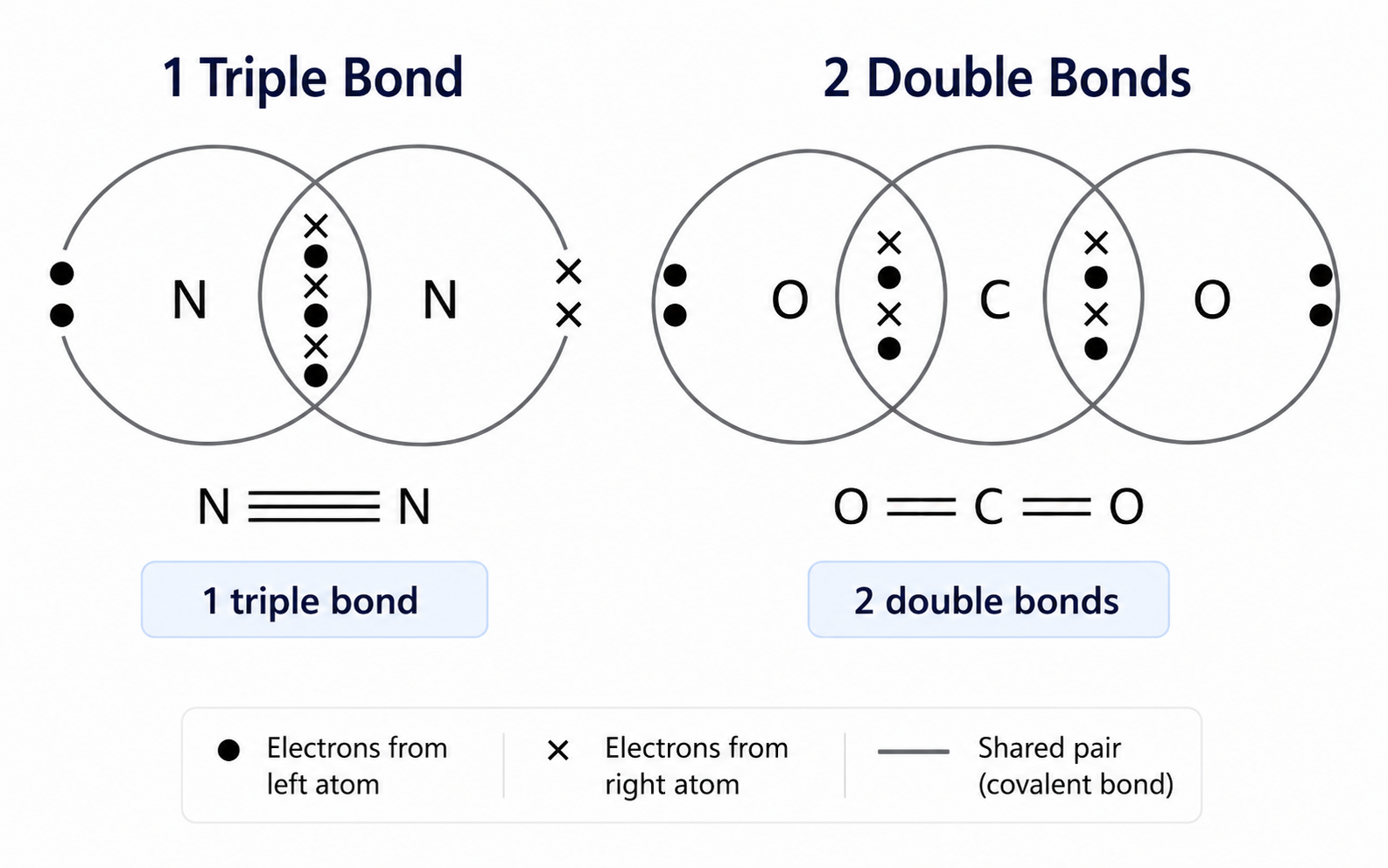
Multiple bonds contain more shared electron pairs, which changes both bond length and bond strength.
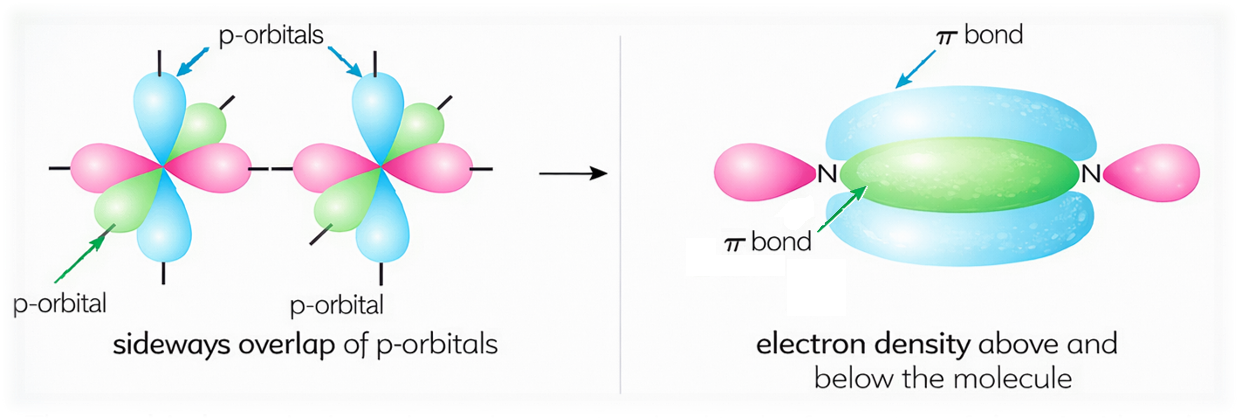
Nitrogen contains a triple bond, made from one σ bond and two π bonds.
Dot-and-Cross Diagrams and Electron Configuration
Dot-and-cross diagrams show how outer shell electrons are shared in covalent bonds. Only the outer shell electrons are normally shown.
Most atoms aim to have eight electrons in their outer shell, a stable arrangement often described as the octet rule. Hydrogen is an exception, because it becomes stable with two electrons in its outer shell.
Single bond
One shared pair of electrons is shown between the two atoms.
Double bond
Two shared pairs of electrons are shown between the two atoms.
Triple bond
Three shared pairs of electrons are shown between the two atoms.
Remember: Dot-and-cross diagrams show electron sharing, but orbital overlap explains why the shared electrons hold the nuclei together.
Common Exam Points
Strong covalent bonding answers link electron sharing to electrostatic attraction, orbital overlap and the location of electron density.
Do not say electrons are simply transferred
Covalent bonding involves shared electron pairs. Electron transfer is used to explain ionic bonding.
Use attraction between nuclei and shared electrons
The bond is held by electrostatic attraction between the positively charged nuclei and the shared negative electron density.
Distinguish σ and π bonds clearly
A sigma bond forms by direct overlap along the internuclear axis. A pi bond forms by sideways overlap of p orbitals.
Link multiple bonds to electron density
Double and triple bonds have greater electron density between the nuclei, so they are generally shorter and stronger than single bonds between the same atoms.
Check Your Understanding
Use these short activities to check covalent bonding, orbital overlap, sigma bonds, pi bonds and multiple bond structure.
QuickSnap
Covalent bonding is explained by shared electron density between bonded atoms. This electron density is attracted to both nuclei, holding the atoms together.
Covalent bond
A shared pair of electrons attracted to the nuclei of both bonded atoms.
Orbital overlap
Atomic orbitals overlap, and the shared electrons occupy the overlapping region.
σ bond
Forms by direct overlap along the internuclear axis, with electron density between the nuclei.
π bond
Forms by sideways overlap of p orbitals, with electron density above and below the molecular plane.
Multiple bonds
Double bonds contain one σ and one π bond. Triple bonds contain one σ and two π bonds.
Master Covalent Bonding, Structure and Shapes of Molecules for Edexcel A Level Chemistry
Continue from these free revision notes into the full Topic 2A/B Covalent Bonding, Structure and Shapes of Molecules course, with guided video teaching, diagnostic MCQ practice, teacher-marked short-answer questions and a specification assignment with a personalised progress report.
Guided video teaching
Learn covalent bonding, dot-and-cross diagrams, giant covalent structures, electronegativity, polarity and molecular shapes through structured video lessons with worked examples and walkthroughs.
Instant MCQ feedback
Auto-marked MCQ quizzes provide immediate diagnostic feedback for every answer choice.
Teacher-marked SAQs
Submit written exam responses and receive chemistry specialist feedback with improvement guidance.
Progress tracking
Identify strengths and weaknesses across covalent bonding, giant covalent structures, polarity, VSEPR theory and molecular shapes with targeted reporting.
See how the course works
Click play to start the course preview animation.
The shapes of some species are being compared.
Which species is not tetrahedral?
Explain this difference in terms of structure and bonding.
FAQs
Use these quick answers to check the common covalent bonding ideas that appear in Edexcel A Level Chemistry questions.
What is a covalent bond?
A covalent bond is a strong electrostatic attraction between a shared pair of electrons and the nuclei of the bonded atoms.
Why is electron density important in covalent bonding?
The shared electron density lies between the nuclei and is attracted to both positively charged nuclei. This attraction holds the atoms together.
What is the difference between a sigma bond and a pi bond?
A sigma bond forms by direct orbital overlap along the internuclear axis. A pi bond forms by sideways overlap of p orbitals and has electron density above and below the molecular plane.
How many sigma and pi bonds are in a double bond?
A double bond contains one sigma bond and one pi bond.
How many sigma and pi bonds are in a triple bond?
A triple bond contains one sigma bond and two pi bonds.
Copyright and author footprint: This OLS revision page was written for Online Learning System by Dr. Mohammed Al-Fatah. It is designed for A Level Chemistry revision and should not be copied or redistributed without permission.