Square Planar Molecular Shape
A focused revision guide to the square planar molecular shape, using XeF4 as the key example. This page explains why four bonding pairs and two lone pairs around a central atom give a flat square arrangement with 90° bond angles.
- 2A.12-a
- 2A.12-b
What these spec points say
- 2A.12-a be able to predict the shapes of simple molecules analogous to specified examples using electron-pair repulsion theory
- 2A.12-b be able to predict the bond angles in simple molecules analogous to specified examples using electron-pair repulsion theory
Square Planar Shape of XeF₄
Choose a step to watch six electron pairs spread out round xenon, two become lone pairs on opposite sides, and four fluorines stay in a flat square.
© Dr. Mohammed Al-Fatah – onlinelearningsystem.net
GCSE Recap: Charges and Electron Counts
Before you start, check the GCSE ideas about ion charges and electron counts that this page builds on.
What Square Planar Means
A square planar molecule has four atoms bonded to a central atom in one flat plane. The four bonded atoms form the corners of a square, so adjacent bond angles are 90°.
The key example for this page is XeF4. Xenon is the central atom, four fluorine atoms are bonded to xenon, and xenon also has two lone pairs.
Key idea: four bonding pairs and two lone pairs around a central atom give a square planar shape when the two lone pairs occupy opposite positions.
Watch: where do two lone pairs go?
Four bonding pairs and two lone pairs. Lone pairs repel the most, so where do they sit?
Why XeF4 Is Square Planar
In XeF4, the central xenon atom is surrounded by four Xe-F bonding pairs and two lone pairs. This gives six regions of negative charge around xenon.
Six electron regions arrange themselves octahedrally to minimise repulsion. The two lone pairs occupy opposite positions, above and below the plane, leaving the four Xe-F bonds in a flat square arrangement.
The molecular shape only describes the positions of the atoms. Therefore, XeF4 is described as square planar, even though its electron-pair arrangement is octahedral.
How to count:
- Start with the outer-shell electrons of the central atom.
- Add one electron for each negative charge and take one away for each positive charge.
- Each single bond uses one of those electrons and each double bond uses two. A double or triple bond still counts as one bonding region.
- Divide the electrons left over by two to get the lone pairs.
In XeF4: xenon has 8 outer-shell electrons, the molecule has no charge, and the four Xe-F single bonds use four of them.
Four are left over, which is two lone pairs. Four bonding regions and two lone pairs give six regions, so the arrangement is octahedral and the shape is square planar.
For the ion ICl4–: iodine has 7 outer-shell electrons and the negative charge adds one to make 8, so the count then runs exactly as it does for XeF4.
A square planar species has four bonding regions and two lone pairs around the central atom. XeF4 is the standard example, with adjacent bond angles of 90°.
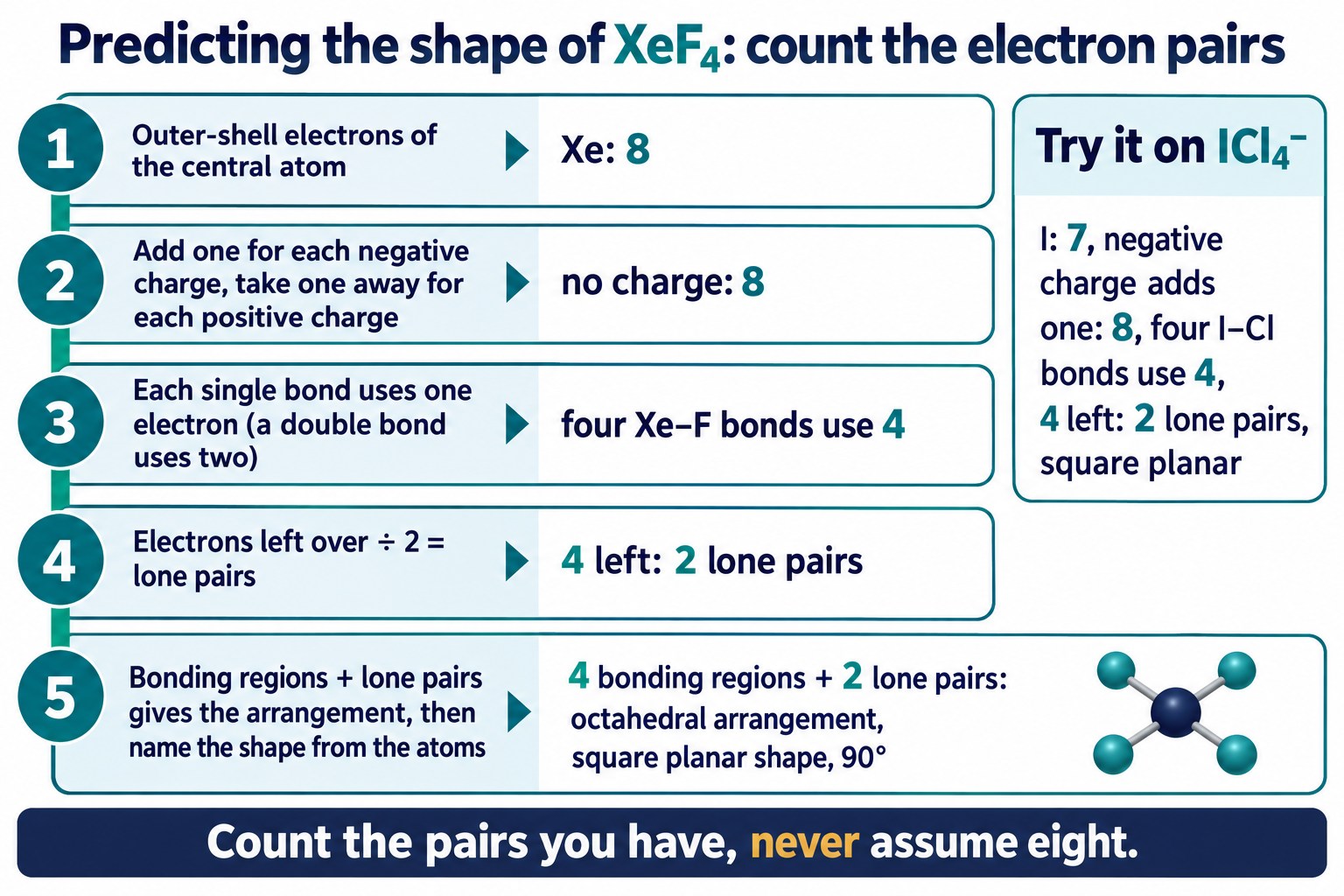
Xenon keeps 4 of its 8 outer electrons as two lone pairs, which sit opposite each other: the four F atoms form a square plane.
Quick Check: Arrangement or Shape?
Choose the species with the same electron-pair arrangement as BrF₄⁻ but a different shape.
Electron-Pair Arrangement vs Molecular Shape
The electron-pair arrangement in XeF4 is based on an octahedral arrangement because there are six electron regions around xenon.
The molecular shape is different. Lone pairs are not counted as atoms when naming the shape, so the visible arrangement of the four fluorine atoms is square planar.
Six electron regions
Four bonding pairs and two lone pairs arrange themselves as far apart as possible around xenon.
Opposite lone pairs
Lone pairs repel more strongly than bonding pairs, so the two lone pairs take opposite positions, as far from each other as possible.
One sits above the square plane and one below it, so they push on the four Xe-F bonds equally. The extra repulsion cancels out and the bond angle stays at exactly 90° instead of being squeezed.
Flat square of bonded atoms
The four Xe-F bonds remain in one plane, giving 90° angles between adjacent bonds and 180° across the square.
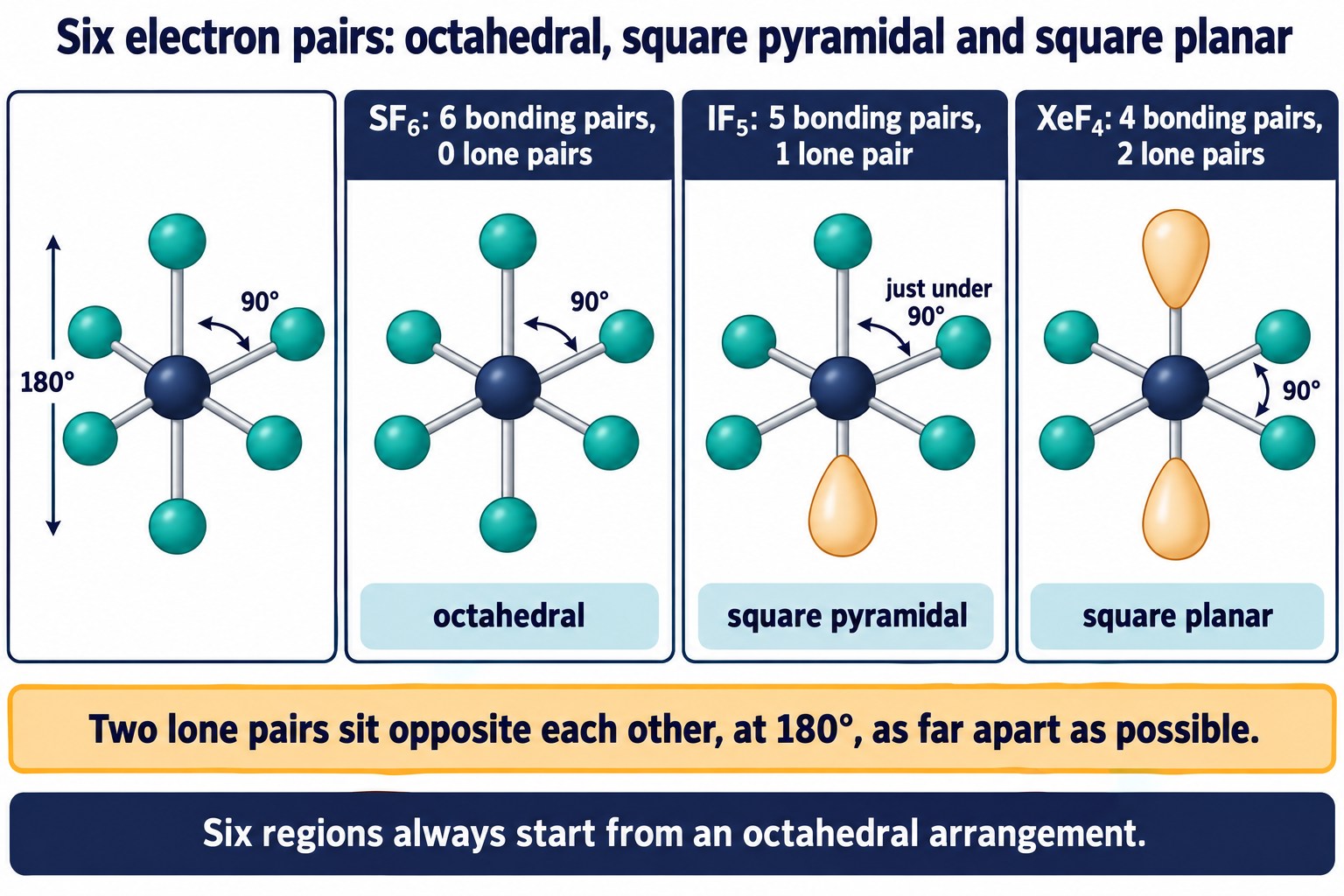
Six regions form an octahedron; one lone pair gives a square pyramid and two opposite lone pairs give a square plane.
Quick Check: Explain the 90° Angle
Write a short explanation, then compare it with the mark points and the model answer.
Square Planar Shape Examples
The square planar shape is found when the central atom has four bonding pairs and two lone pairs. The common exam examples usually include xenon tetrafluoride and square planar halogen-containing ions.
| Species | Central atom | Electron regions | Shape | Typical exam angle |
|---|---|---|---|---|
| XeF4 | Xe | 4 bonding regions, 2 lone pairs | Square planar | 90° |
| ICl4– | I | 4 bonding regions, 2 lone pairs | Square planar | 90° |
| BrCl4– | Br | 4 bonding regions, 2 lone pairs | Square planar | 90° |
| IF4– | I | 4 bonding regions, 2 lone pairs | Square planar | 90° |
Quick Check: Square Planar or Not?
Work out each species on paper, then flip the card to check.
How to Explain Square Planar Shape in an Exam
A full exam explanation should connect the number of electron regions to electron-pair repulsion, then explain why the two lone pairs are opposite and why the atoms form a square plane.
1. Identify the central atom
For XeF4, the central atom is xenon.
2. Count bonding pairs and lone pairs
Xenon has four bonding pairs and two lone pairs around it.
3. Apply electron-pair repulsion
The six electron regions arrange themselves as far apart as possible. The two lone pairs are placed opposite each other to minimise repulsion.
4. State the shape and angle
The four bonded atoms form a square planar shape with 90° angles between adjacent Xe-F bonds.
Exam answer model: XeF4 has four bonding pairs and two lone pairs around the central xenon atom. The six electron regions arrange themselves octahedrally.
The two lone pairs occupy opposite positions to minimise repulsion, leaving the four Xe-F bonds in one plane. Therefore, XeF4 is square planar with bond angles of 90°.
Quick Check: Which Answer Scores Full Marks?
Choose the explanation of ClF₄⁻ that would score full marks.
Quick Check: The Whole Page in Four Statements
In each round, pick the one accurate statement to review everything on this page.
Common Exam Points
Do not call XeF4 octahedral
The electron-pair arrangement is octahedral, but the molecular shape is square planar because the two lone pairs are not counted as atoms.
State the lone pairs are opposite
The two lone pairs occupy opposite positions above and below the square plane to minimise repulsion.
Use 90° for adjacent bonds
Adjacent bonds in the square plane are separated by 90°. Opposite bonds are 180° apart.
Count around the central atom only
The shape is determined by the bonding pairs and lone pairs around the central atom, not by the total number of atoms in the species.
QuickSnap
The square planar shape is produced when a central atom has four bonding pairs and two lone pairs. The lone pairs occupy opposite positions, leaving the four bonded atoms in one flat square plane with 90° bond angles.
Memory line: 4 bonding pairs + 2 lone pairs = square planar = 90°.
Square Planar FAQs
These questions target the points students most often lose marks on when explaining square planar molecular shape.
Why is XeF4 square planar?
XeF4 is square planar because xenon has four bonding pairs and two lone pairs. The six electron regions arrange octahedrally, but the two lone pairs occupy opposite positions, leaving the four Xe-F bonds in a flat square plane.
What is the bond angle in a square planar molecule?
The bond angle between adjacent bonds in a square planar molecule is 90°. Opposite bonds across the square are 180° apart.
Is square planar the same as octahedral?
No. Square planar is the molecular shape, based on the positions of atoms. Octahedral is the electron-pair arrangement for six regions of negative charge around the central atom.
Why are the two lone pairs opposite in XeF4?
The two lone pairs are opposite because this places them as far apart as possible, reducing lone pair-lone pair repulsion.
Does ICl4– have the same shape as XeF4?
Yes. Iodine has 7 outer-shell electrons and the negative charge adds one, giving 8, as in xenon. Four bonds use four, leaving two lone pairs, so ICl4– is also square planar with 90° angles.
Copyright notice: This OLS revision content, including the explanations, layout, diagrams, tables and embedded learning structure, is authored for Online Learning System by Dr. Mohammed Al-Fatah. It may not be copied, reproduced, redistributed or adapted without written permission.
Keep this note — free
Save your progress across every Edexcel topic. A free account remembers which topics you have covered, saves your question scores, and syncs across your phone and laptop.
- Track every topic you have finished
- Keep your practice-question scores
- No payment, no card, free forever
Already registered? Log in