Distorted T Molecular Shape
A focused revision guide to the distorted T molecular shape, using ClF3 as the key example. This page explains why three bonding pairs and two lone pairs around a central atom give a T-shaped arrangement with bond angles slightly less than 90°.
- 2A.10-a
- 2A.11-j
- 2A.12-a
- 2A.12-b
What these spec points say
- 2A.10-a understand that the shape of a simple molecule is determined by repulsion between electron pairs around a central atom
- 2A.11-j understand reasons for the shape of, and bond angles in, related molecules and ions
- 2A.12-a be able to predict the shapes of simple molecules analogous to specified examples using electron-pair repulsion theory
- 2A.12-b be able to predict the bond angles in simple molecules analogous to specified examples using electron-pair repulsion theory
Distorted T Shape of ClF₃
Choose a step to watch five electron pairs spread out round chlorine, two lone pairs take equatorial positions, and the T bend to about 87.5°.
© Dr. Mohammed Al-Fatah – onlinelearningsystem.net
GCSE Recap: Halogen Atoms and Their Electron Pairs
Before you start, check that you can count the shared pairs and lone pairs on a halogen atom.
What Distorted T Means
A distorted T molecule has three atoms bonded to a central atom in a T-shaped arrangement. It is called distorted because the bond angles are slightly compressed by lone pair repulsion.
The key example for this page is ClF3. Chlorine is the central atom, three fluorine atoms are bonded to chlorine, and chlorine also has two lone pairs.
Key idea: three bonding pairs and two lone pairs around a central atom give a distorted T shape when the two lone pairs occupy equatorial positions in a trigonal bipyramidal electron-pair arrangement.
Watch: three bonding pairs and two lone pairs
Two lone pairs on a five-pair atom bend the shape into a T. What is the bond angle?
Why ClF3 Is Distorted T-Shaped
In ClF3, the central chlorine atom is surrounded by three Cl-F bonding pairs and two lone pairs. This gives five regions of negative charge around chlorine.
Chlorine therefore has 10 electrons in its outer shell. An atom in Period 3 or below can hold more than eight electrons in this way, so ClF3 exists.
Fluorine is in Period 2 and is limited to eight, which is why it is always the outer atom here.
Five electron regions arrange themselves as a trigonal bipyramidal electron-pair arrangement to minimise repulsion. The two lone pairs occupy equatorial positions, where they are approximately 120° apart from each other.
The molecular shape only describes the positions of the atoms. Therefore, ClF3 is described as distorted T-shaped, even though its electron-pair arrangement is trigonal bipyramidal.
How to count:
- Start with the outer-shell electrons of the central atom.
- Add one electron for each negative charge and take one away for each positive charge.
- Each single bond uses one of those electrons and each double bond uses two. A double or triple bond still counts as one bonding region.
- Divide the electrons left over by two to get the lone pairs.
In ClF3: chlorine has 7 outer-shell electrons, the molecule has no charge, and the three Cl-F single bonds use three of them.
Four are left over, which is two lone pairs. Three bonding regions and two lone pairs give five regions, so the arrangement is trigonal bipyramidal and the shape is a distorted T.
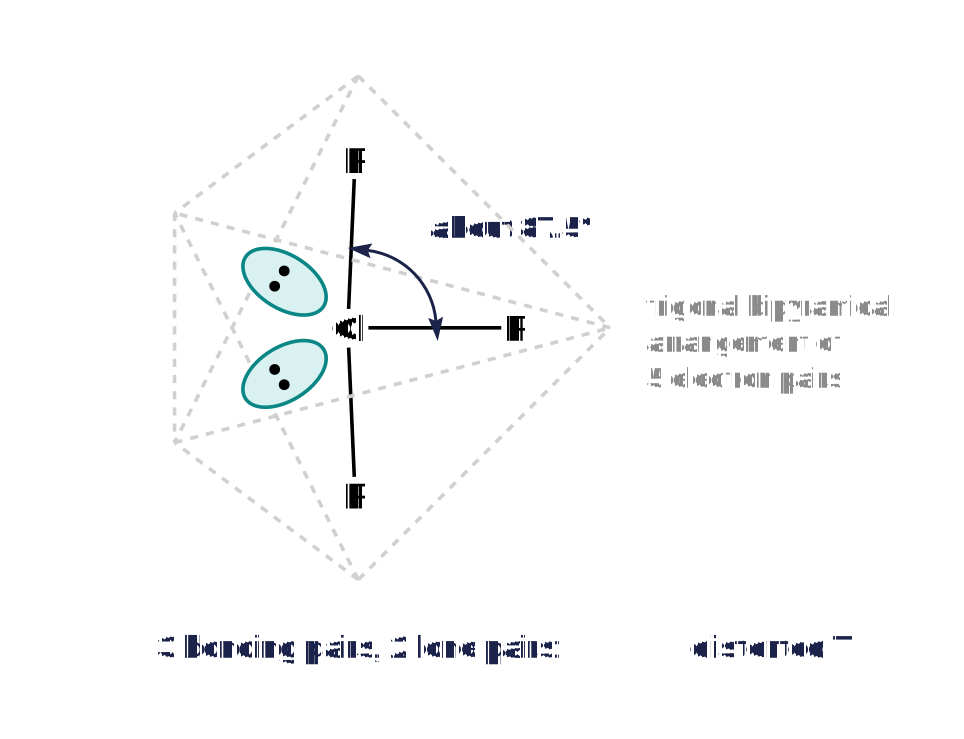
A distorted T species has three bonding regions and two lone pairs around the central atom. ClF3 is the standard example, with bond angles close to 89°.
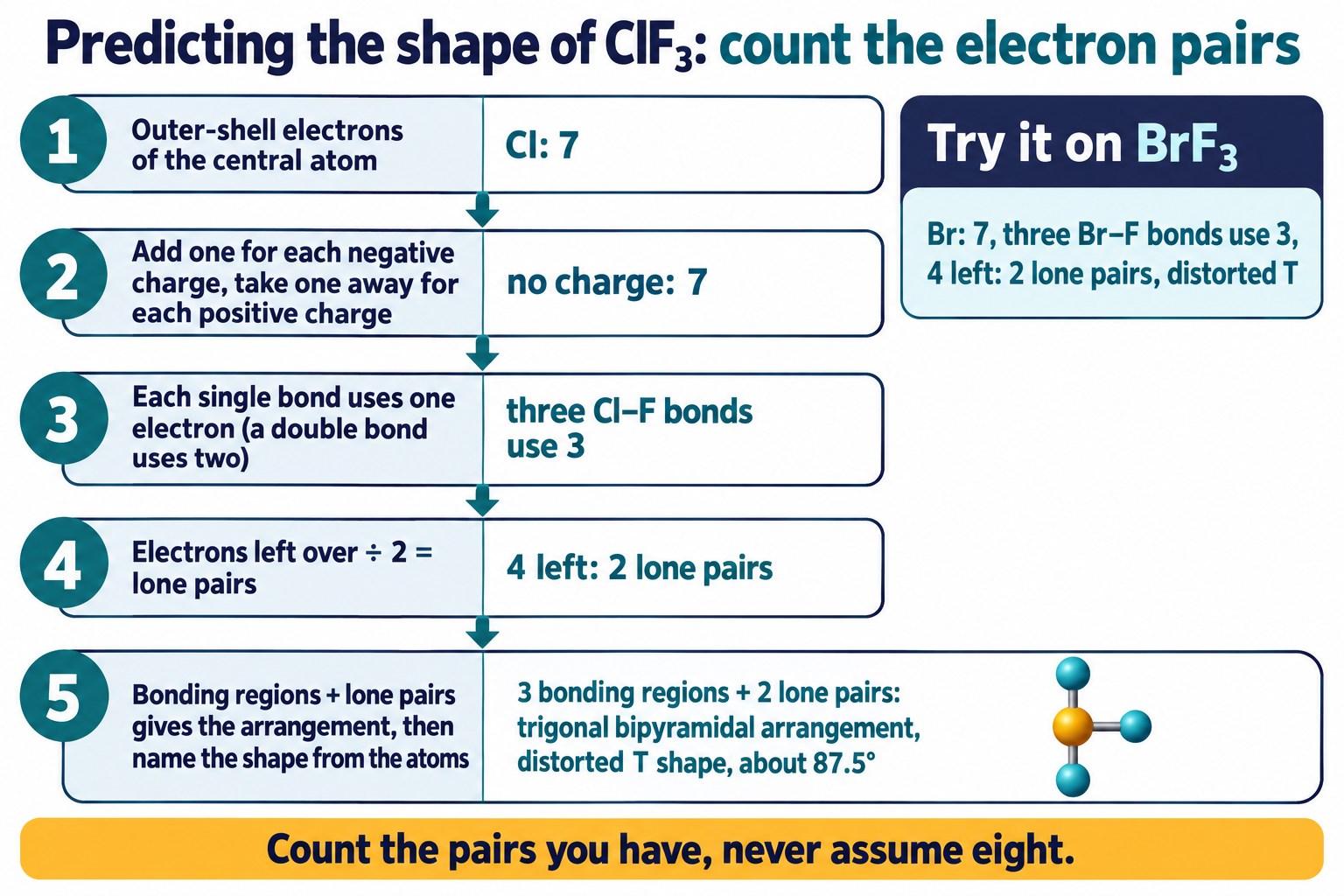
Chlorine keeps 4 of its 7 outer electrons as two equatorial lone pairs: the three F atoms form a distorted T.
Quick Check: Count the Pairs in Three Tribromides
Work out the lone pairs and electron pairs for three molecules that are not on this page, then type each number.
Electron-Pair Arrangement vs Molecular Shape
The electron-pair arrangement in ClF3 is based on a trigonal bipyramidal arrangement because there are five electron regions around chlorine.
The molecular shape is different. Lone pairs are not counted as atoms when naming the shape, so the visible arrangement of the three fluorine atoms is distorted T-shaped.
Five electron regions
Three bonding pairs and two lone pairs arrange themselves as far apart as possible around chlorine.
Equatorial lone pairs
The two lone pairs occupy equatorial positions in the trigonal bipyramidal arrangement. This keeps the lone pairs approximately 120° apart and reduces lone pair-lone pair repulsion.
Count the close neighbours: an equatorial position has only two at 90°, while an axial position has three, so a lone pair always takes an equatorial position.
T-shaped bonded atoms
The remaining three bonding pairs form two axial bonds and one equatorial bond, producing a distorted T shape.
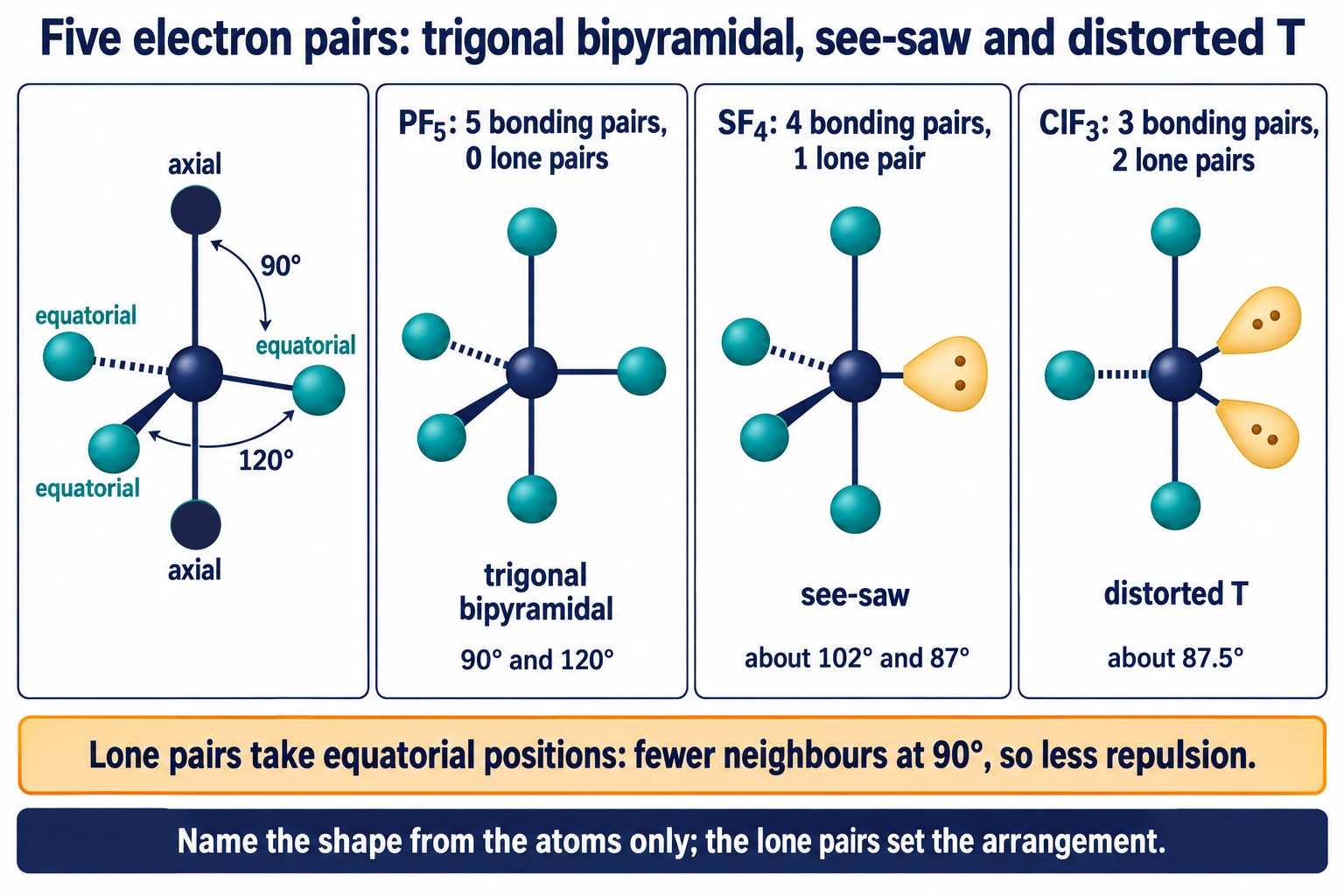
Five regions form a trigonal bipyramid; lone pairs take equatorial positions to give the see-saw and distorted T shapes.
Quick Check: Place the Lone Pairs in Xenon Difluoride
Use the rule for placing lone pairs to predict the shape of a molecule with three lone pairs.
Distorted T Shape Examples
The distorted T shape is found when the central atom has three bonding pairs and two lone pairs. The common exam examples are usually interhalogen species.
| Species | Central atom | Electron regions | Shape | Bond angles |
|---|---|---|---|---|
| ClF3 | Cl | 3 bonding regions, 2 lone pairs | Distorted T | About 87.5° and about 175° |
| BrF3 | Br | 3 bonding regions, 2 lone pairs | Distorted T | Slightly less than 90° and slightly less than 180° |
| IF3 | I | 3 bonding regions, 2 lone pairs | Distorted T | Slightly less than 90° and slightly less than 180° |
| ICl3 | I | 3 bonding regions, 2 lone pairs | Distorted T | Slightly less than 90° and slightly less than 180° |
Quick Check: Find the Distorted T Species
Count the electron pairs around each central atom and click every species with three bonding pairs and two lone pairs.
How to Explain Distorted T Shape in an Exam
A full exam explanation should connect the number of electron regions to electron-pair repulsion, then explain why the two lone pairs are equatorial and why the bonded atoms form a T shape.
1. Identify the central atom
For ClF3, the central atom is chlorine.
2. Count bonding pairs and lone pairs
Chlorine has three bonding pairs and two lone pairs around it.
3. Apply electron-pair repulsion
The five electron regions arrange themselves as far apart as possible. The two lone pairs occupy equatorial positions to reduce repulsion.
4. State the shape and angle
The three bonded atoms form a distorted T shape.
The two lone pairs repel more strongly than the bonding pairs, so the bond angles are slightly less than 90°, about 87.5° in ClF3, and the axial to axial angle is slightly less than 180°.
Exam answer model: ClF3 has three bonding pairs and two lone pairs around the central chlorine atom. The five electron regions arrange themselves as a trigonal bipyramidal electron-pair arrangement.
The two lone pairs occupy equatorial positions to minimise repulsion. Therefore, ClF3 is distorted T-shaped, with bond angles slightly less than 90°, about 87.5°.
Quick Check: Explain the Shape of an Ion
Write a short exam-style explanation, then compare it with the mark points and the model answer.
Quick Check: Whose Reasoning Is Sound?
In each round, choose the one student whose reasoning is correct.
Common Exam Points
Do not call ClF3 trigonal bipyramidal
The electron-pair arrangement is trigonal bipyramidal, but the molecular shape is distorted T because the two lone pairs are not counted as atoms.
State the lone pairs are equatorial
The two lone pairs occupy equatorial positions. This gives fewer 90° lone pair interactions than placing a lone pair in an axial position.
Give an angle just under 90°
Write slightly less than 90°, or about 87.5° for ClF3. Mark schemes accept values from about 87° to 90°, and some boards simply expect 90° and 180° for a T shape. The axial to axial angle is slightly less than 180°.
Count around the central atom only
The shape is determined by the bonding pairs and lone pairs around the central atom, not by the total number of atoms in the species.
QuickSnap
The distorted T shape is produced when a central atom has three bonding pairs and two lone pairs.
The lone pairs occupy equatorial positions in a trigonal bipyramidal electron-pair arrangement, leaving three bonded atoms in a T-shaped arrangement with bond angles slightly less than 90°, about 87.5° in ClF3.
Memory line: 3 bonding pairs + 2 lone pairs = distorted T = just under 90°.
Distorted T FAQs
These questions target the points students most often lose marks on when explaining the distorted T molecular shape.
Why is ClF3 distorted T-shaped?
ClF3 is distorted T-shaped because chlorine has three bonding pairs and two lone pairs. The five electron regions arrange as trigonal bipyramidal, but the two lone pairs occupy equatorial positions, leaving two axial Cl-F bonds and one equatorial Cl-F bond.
What is the bond angle in a distorted T molecule?
The bond angles are slightly less than 90°, about 87.5° in ClF3 and about 86° in BrF3. Mark schemes accept about 87° to 90°. The axial to axial angle is slightly less than 180°.
Is distorted T the same as trigonal bipyramidal?
No. Trigonal bipyramidal is the electron-pair arrangement for five regions of negative charge. Distorted T is the molecular shape after the two lone pairs are ignored when naming the shape.
Why do the lone pairs in ClF3 occupy equatorial positions?
The lone pairs occupy equatorial positions because this arrangement minimises repulsion. The two lone pairs are approximately 120° apart and avoid unnecessary 90° lone pair-lone pair interactions.
Why is ClF3 not trigonal planar?
Trigonal planar needs three bonding regions and no lone pairs. ClF3 has three bonding pairs and two lone pairs, five regions in all, so the arrangement is trigonal bipyramidal and the three fluorine atoms form a distorted T.
Copyright notice: This OLS revision content, including the explanations, layout, diagrams, tables and embedded learning structure, is authored for Online Learning System by Dr. Mohammed Al-Fatah. It may not be copied, reproduced, redistributed or adapted without written permission.
Keep this note — free
Save your progress across every Edexcel topic. A free account remembers which topics you have covered, saves your question scores, and syncs across your phone and laptop.
- Track every topic you have finished
- Keep your practice-question scores
- No payment, no card, free forever
Already registered? Log in