Nature of Covalent Bonding
A concise revision guide to the nature of covalent bonding, shared electron density, orbital overlap, sigma bonds, pi bonds, multiple bonds and dot-and-cross representations for Edexcel A Level Chemistry.
- 2A.7
- 2A.8i
- 2A.9
What these spec points say
- 2A.7 know that a covalent bond is the strong electrostatic attraction between two nuclei and the shared pair of electrons between them
- 2A.8i be able to draw dot-and-cross diagrams to show electrons in covalent substances, including: molecules with single, double and triple bonds
- 2A.9 understand the relationship between bond lengths and covalent bond strengths
Sigma and Pi Bonds: End-On and Sideways Overlap
Choose a step to watch atoms approach, their orbitals combine into a σ molecular orbital and then a π molecular orbital, and see why a C=C bond cannot twist.
© Dr. Mohammed Al-Fatah – onlinelearningsystem.net
GCSE Recap: Shared Pairs in Simple Molecules
Before you start, check the GCSE ideas about shared pairs that this page builds on.
What Is a Covalent Bond?
A covalent bond is a strong electrostatic attraction between a shared pair of electrons and the nuclei of the bonded atoms.
In a hydrogen molecule, X-ray diffraction evidence shows a high concentration of negative charge between the two hydrogen nuclei. This shared negative charge is attracted to both nuclei, so the attractive forces are greater than the repulsive forces.
The evidence is drawn as an electron density map.
Each contour joins points of equal electron density, in the same way that contour lines on a map join points of equal height, so contours packed tightly between the two nuclei show where the shared charge is concentrated.
The bond is therefore strongest when there is a significant density of shared electrons between the bonded atoms.
Definition: A covalent bond forms when atomic orbitals overlap and a pair of electrons is shared between two atoms. The shared electron density between the nuclei holds the atoms together.
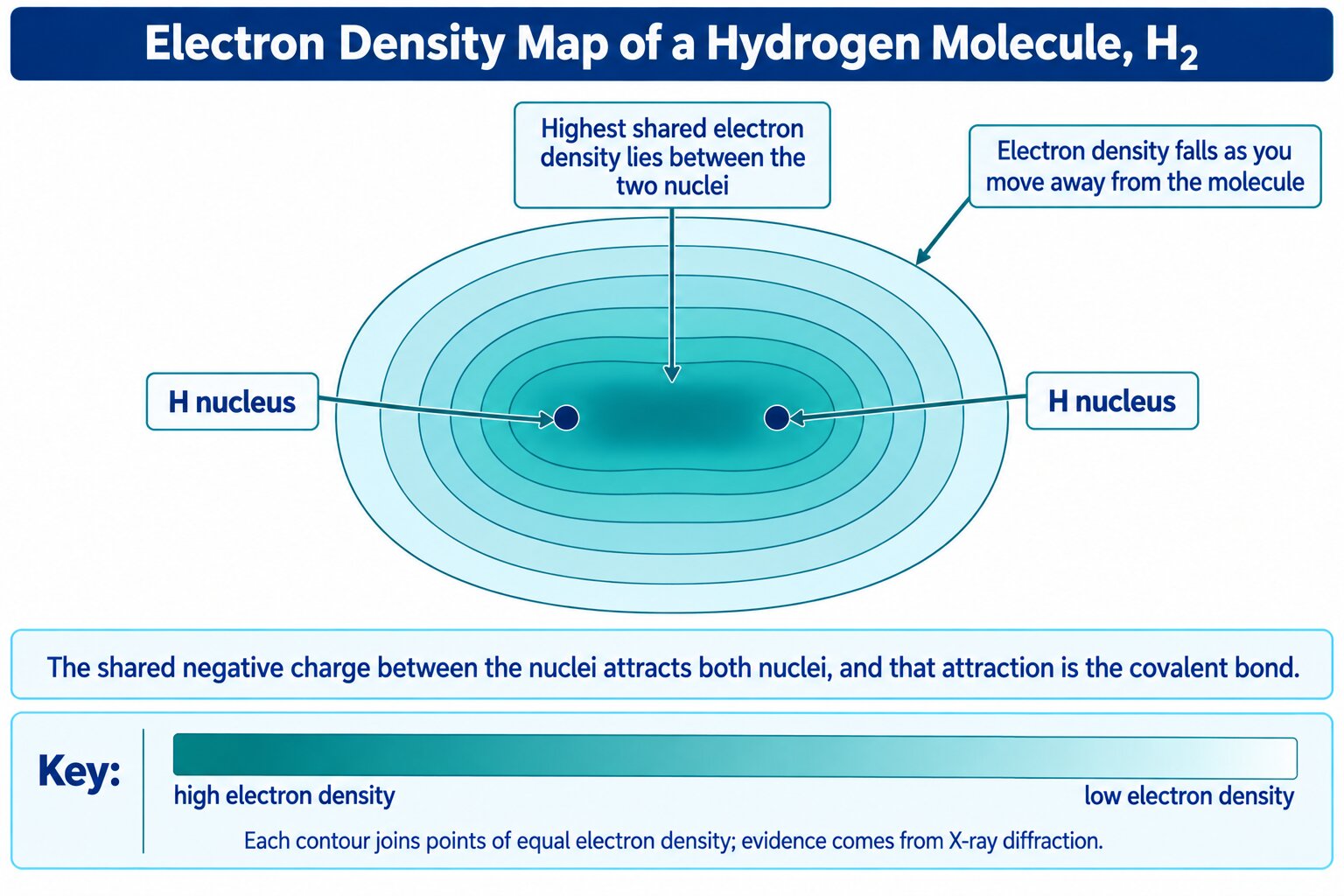
The highest electron density is between the nuclei, which explains the attractive force in the covalent bond.
Quick Check: What Holds F₂ Together?
Choose the statement that explains why the two fluorine atoms stay together.
Orbital Overlap and Single Covalent Bonds
Covalent bonds form when atomic orbitals overlap. The shared electrons occupy the overlapping region and are attracted by both nuclei.
In hydrogen, two 1s orbitals overlap to form a molecular orbital containing the shared pair of electrons. In chlorine, a pair of p orbitals overlap, with each chlorine atom contributing one unpaired electron.
A molecular orbital is the new orbital produced by the overlap. It belongs to both atoms and holds the shared pair.
The two orbitals that overlap need not be the same type, and the two atoms need not be the same element.
An s orbital on one atom can overlap end-on with a p orbital on another atom, and the bond formed is still a single covalent bond.
To decide which orbitals overlap, write the electron configuration of each atom and pick out the orbital that holds the unpaired electron.
| Molecule | Orbitals involved | Bond formed |
|---|---|---|
| H2 | Overlap of two 1s orbitals | A single covalent bond with electron density between the two nuclei |
| Cl2 | Overlap of two p orbitals, each containing one unpaired electron | A single covalent bond between the two chlorine atoms |
Key idea: The shared pair of electrons is not just drawn between atoms for convenience. It represents electron density in the overlapping region between the nuclei.
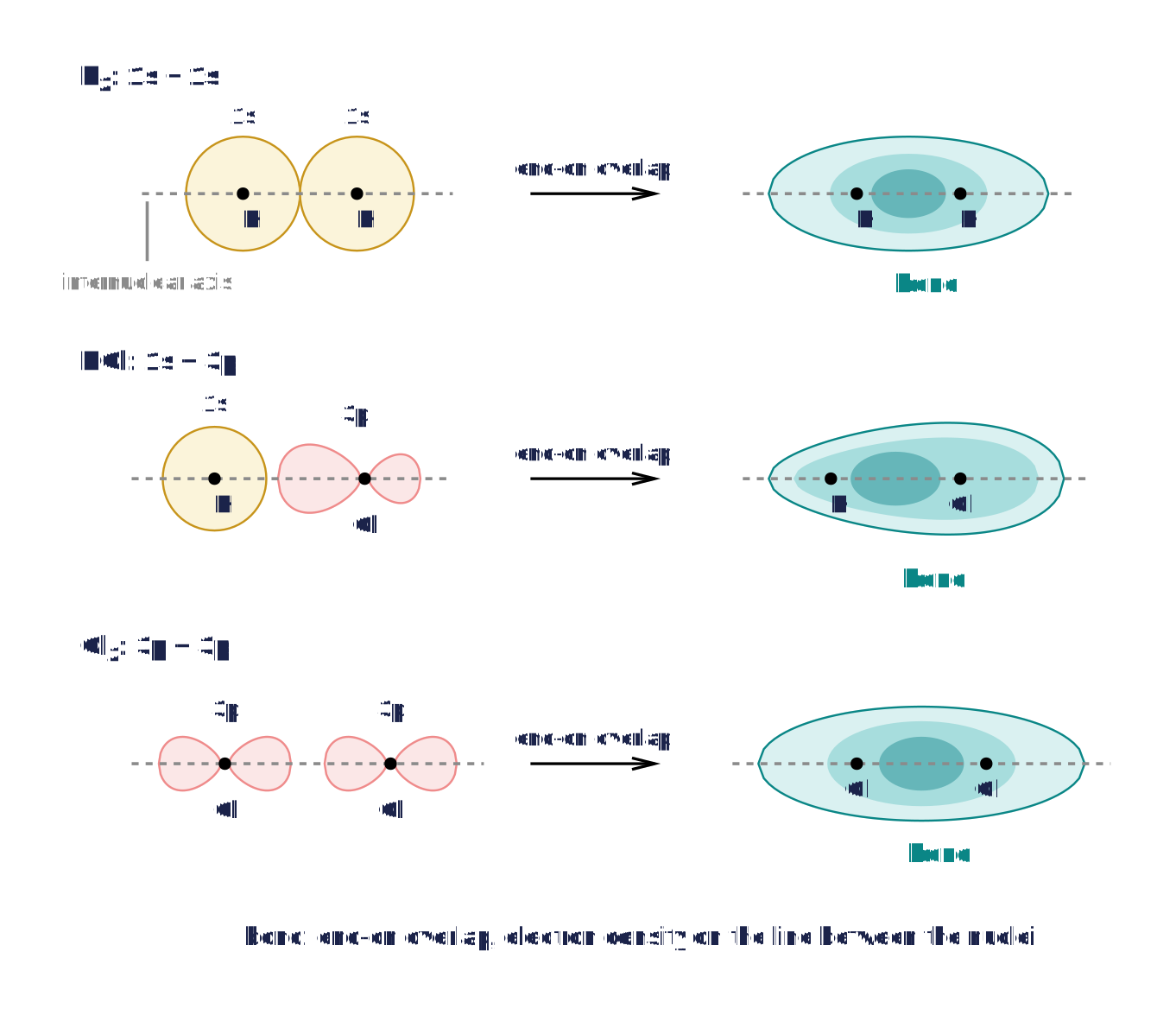
End-on overlap of 1s or p orbitals gives a σ molecular orbital with electron density on the line between the two nuclei.
Quick Check: Which Orbitals Overlap?
Answer each quick question on the orbitals that overlap in a new molecule.
Sigma Bonds and Pi Bonds
A sigma, σ, bond is formed by direct orbital overlap along the line between two nuclei. It is the first covalent bond formed between two atoms.
After a sigma bond has formed, it is sometimes possible for a pi, π, bond to form. A pi bond is formed by the sideways overlap of p orbitals, creating electron density above and below the internuclear axis, the line joining the two nuclei.
In a planar molecule such as ethene that is the same as above and below the plane of the molecule, but it is not the same in every molecule.
N≡N is linear and has no molecular plane, and its two pi bonds lie at right angles to each other. Quote the internuclear axis and the answer is right every time.
| Bond type | How it forms | Electron density |
|---|---|---|
| σ bond | Direct overlap of orbitals along the internuclear axis | Concentrated directly between the two nuclei |
| π bond | Sideways overlap of p orbitals after a σ bond has already formed | Above and below the internuclear axis, the line joining the two nuclei |
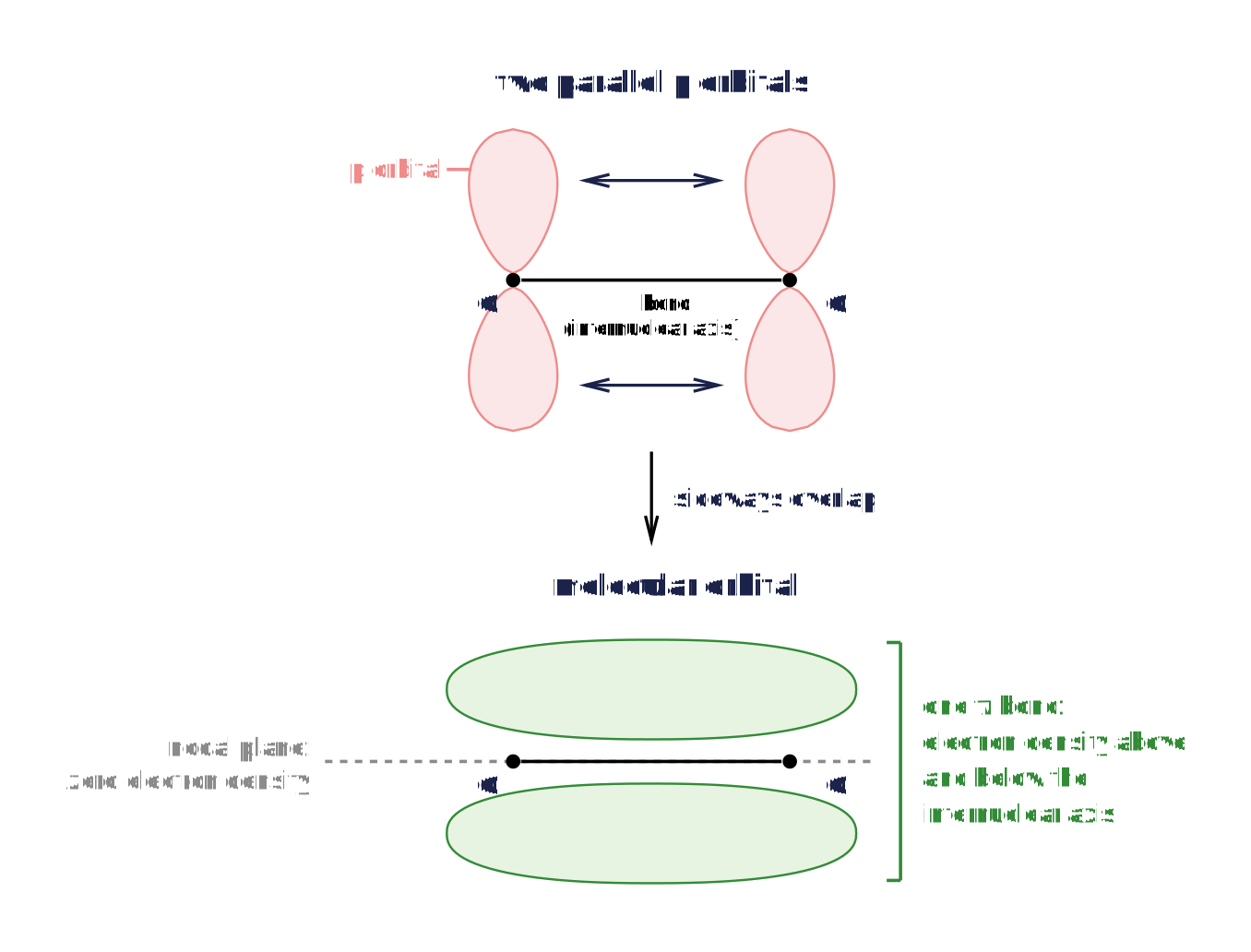
The sideways overlap of p orbitals produces two regions of electron density, one above and one below the molecular plane.
Bonding in Nitrogen, N₂: sp Hybrids, Sigma and Pi Bonds
Choose a step to watch two nitrogen atoms build a triple bond: one σ bond, then two π bonds at right angles, with a lone pair left on each atom.
© Dr. Mohammed Al-Fatah – onlinelearningsystem.net
Quick Check: Sigma or Pi?
Decide what type of bond forms in hydrogen chloride and why.
Double Bonds, Triple Bonds and Bond Strength
A double bond contains one σ bond and one π bond. For example, the carbon-carbon double bond in ethene contains one sigma bond and one pi bond.
A triple bond contains one σ bond and two π bonds. For example, the nitrogen molecule, N≡N, contains one sigma bond and two pi bonds.
Double and triple bonds place a greater electron density between the nuclei. This increases the electrostatic attraction between nuclei and bonding electrons, giving a shorter bond and a stronger bond.
A π bond is weaker than a σ bond. Sideways overlap is less effective than end-on overlap, so the electron density of a π bond lies further from the two nuclei and is held less strongly.
That is why the enthalpy of a C=C bond is less than twice the enthalpy of a C-C bond, and why it is the π bond that breaks in the reactions of alkenes.
| Bond | Bond length / nm | Mean bond enthalpy / kJ mol⁻¹ |
|---|---|---|
| C-C | 0.154 | +347 |
| C=C | 0.134 | +612 |
| C≡C | 0.120 | +838 |
Exam focus: More shared electron pairs usually means greater electron density between nuclei, stronger attraction, shorter bond length and greater bond strength.
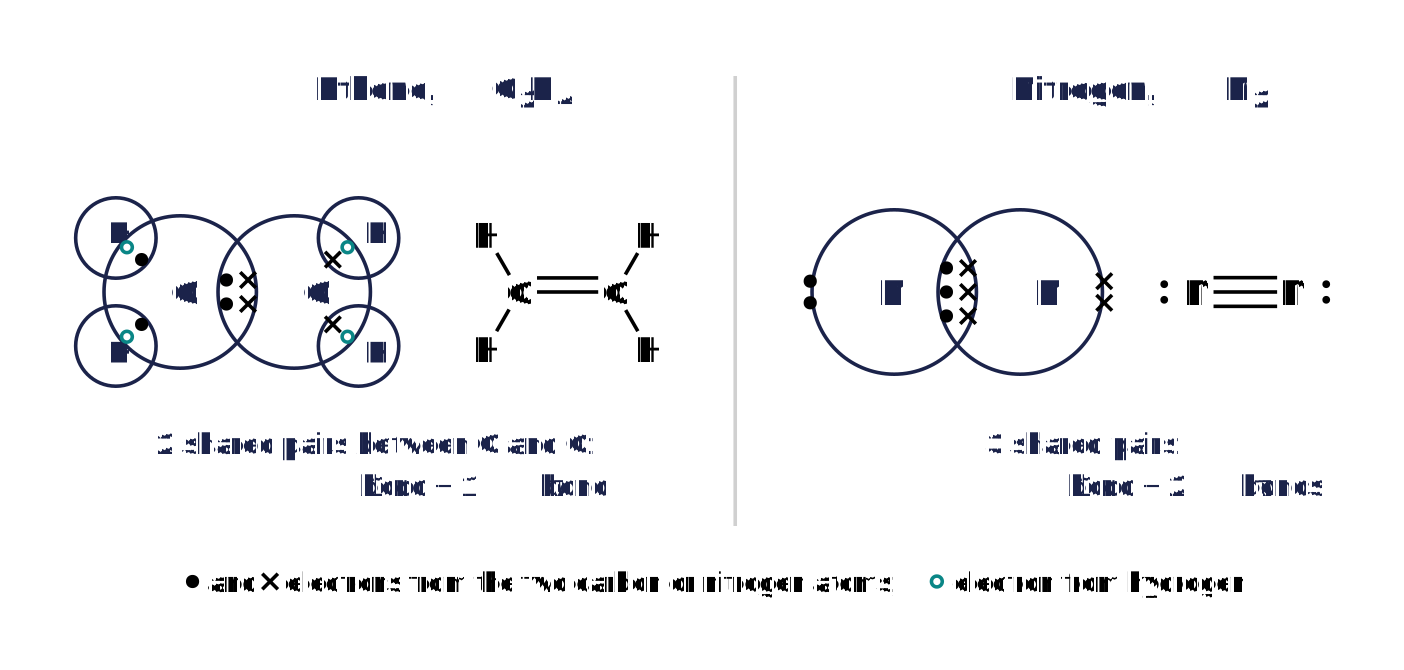
Multiple bonds contain more shared electron pairs, which changes both bond length and bond strength.
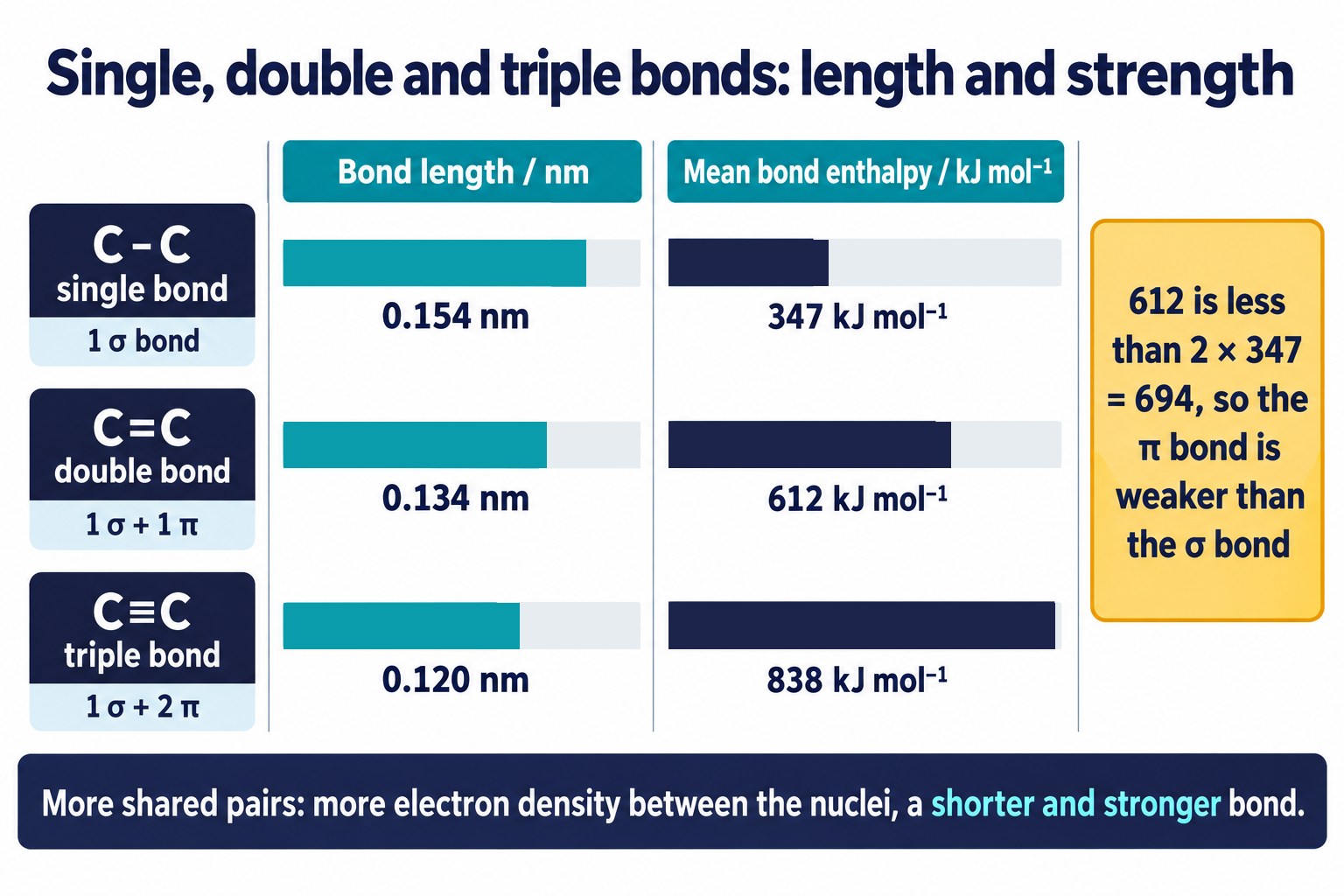
More shared pairs give a shorter, stronger bond, but each π bond adds less strength than the σ bond.
Quick Check: Count the Sigma and Pi Bonds
Count the σ and π bonds in each molecule and type the numbers.
Quick Check: Explain Bond Length and Strength
Write a short explanation, then compare it with the mark points and the model answer.
Watch: dot-and-cross diagrams from the group number
H2S first, then PH3: how the group number tells you where every electron goes.
Dot-and-Cross Diagrams and Electron Configuration
Dot-and-cross diagrams show how outer shell electrons are shared in covalent bonds. Only the outer shell electrons are normally shown.
Many atoms reach eight electrons in their outer shell when they bond, a stable arrangement often described as the octet rule. Hydrogen is an exception, because it becomes stable with two electrons in its outer shell.
The octet rule is a guide, not a law. Some central atoms finish with fewer than eight outer electrons, and some from Period 3 onwards finish with more, so count the pairs you have actually drawn instead of assuming eight.
Single bond
One shared pair of electrons is shown between the two atoms.
Double bond
Two shared pairs of electrons are shown between the two atoms.
Triple bond
Three shared pairs of electrons are shown between the two atoms.
Remember: Dot-and-cross diagrams show electron sharing, but orbital overlap explains why the shared electrons hold the nuclei together.
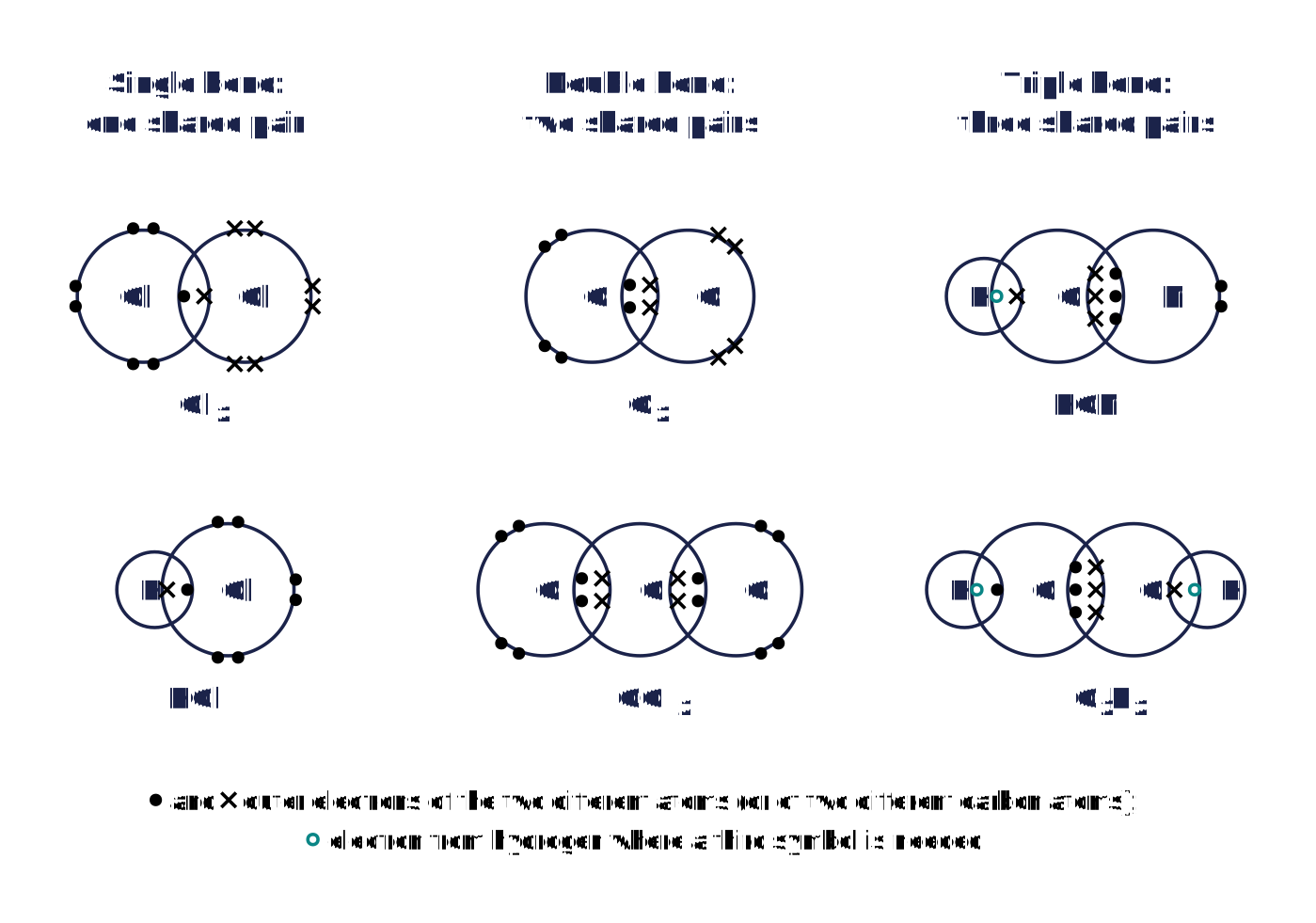
Dot-and-cross diagrams with one, two and three shared pairs: Cl₂ and HCl, O₂ and CO₂, HCN and ethyne.
Quick Check: Pairs in New Dot-and-Cross Diagrams
Sketch each dot-and-cross diagram on paper, then type the number of pairs.
Quick Check: The Whole Page in Five Statements
In each round, pick the one accurate statement to review everything on this page.
Common Exam Points
Strong covalent bonding answers link electron sharing to electrostatic attraction, orbital overlap and the location of electron density.
Do not say electrons are simply transferred
Covalent bonding involves shared electron pairs. Electron transfer is used to explain ionic bonding.
Use attraction between nuclei and shared electrons
The bond is held by electrostatic attraction between the positively charged nuclei and the shared negative electron density.
Distinguish σ and π bonds clearly
A sigma bond forms by direct overlap along the internuclear axis. A pi bond forms by sideways overlap of p orbitals.
Link multiple bonds to electron density
Double and triple bonds have greater electron density between the nuclei, so they are generally shorter and stronger than single bonds between the same atoms.
QuickSnap
Covalent bonding is explained by shared electron density between bonded atoms. This electron density is attracted to both nuclei, holding the atoms together.
Covalent bond
A shared pair of electrons attracted to the nuclei of both bonded atoms.
Orbital overlap
Atomic orbitals overlap, and the shared electrons occupy the overlapping region.
σ bond
Forms by direct overlap along the internuclear axis, with electron density between the nuclei.
π bond
Forms by sideways overlap of p orbitals, with electron density above and below the internuclear axis. It is weaker than a σ bond.
Multiple bonds
Double bonds contain one σ and one π bond. Triple bonds contain one σ and two π bonds.
FAQs
Use these quick answers to check the common covalent bonding ideas that appear in Edexcel A Level Chemistry questions.
What is a covalent bond?
A covalent bond is a strong electrostatic attraction between a shared pair of electrons and the nuclei of the bonded atoms.
Why is electron density important in covalent bonding?
The shared electron density lies between the nuclei and is attracted to both positively charged nuclei. This attraction holds the atoms together.
What is the difference between a sigma bond and a pi bond?
A sigma bond forms by direct orbital overlap along the internuclear axis. A pi bond forms by sideways overlap of p orbitals and has electron density above and below that same axis. A pi bond is weaker than a sigma bond.
How many sigma and pi bonds are in a double bond?
A double bond contains one sigma bond and one pi bond.
How many sigma and pi bonds are in a triple bond?
A triple bond contains one sigma bond and two pi bonds.

Copyright notice: This OLS revision content, including the explanations, layout, diagrams, tables and embedded learning structure, is authored for Online Learning System by Dr. Mohammed Al-Fatah. It may not be copied, reproduced, redistributed or adapted without written permission.
Keep this note — free
Save your progress across every Edexcel topic. A free account remembers which topics you have covered, saves your question scores, and syncs across your phone and laptop.
- Track every topic you have finished
- Keep your practice-question scores
- No payment, no card, free forever
Already registered? Log in