Electronegativity
A concise revision guide to electronegativity, bond polarity, non-polar covalent bonds, polar covalent bonds, permanent dipoles and the link between electronegativity difference and bonding type.

What Is Electronegativity?
Electronegativity is the relative tendency of an atom in a covalent bond to attract the shared pair of electrons towards itself.
The more electronegative atom pulls bonding electron density more strongly. This can make the bonding electrons unevenly distributed between the bonded atoms.
Electronegativity values are commonly compared using the Pauling scale. Fluorine is the most electronegative element, with a value of 4.0.
Definition: Electronegativity is the ability of an atom in a covalent bond to attract the shared electrons in that bond towards itself.
Key idea: Electronegativity only becomes meaningful when atoms are bonded. It tells you which atom attracts the bonding electrons more strongly.
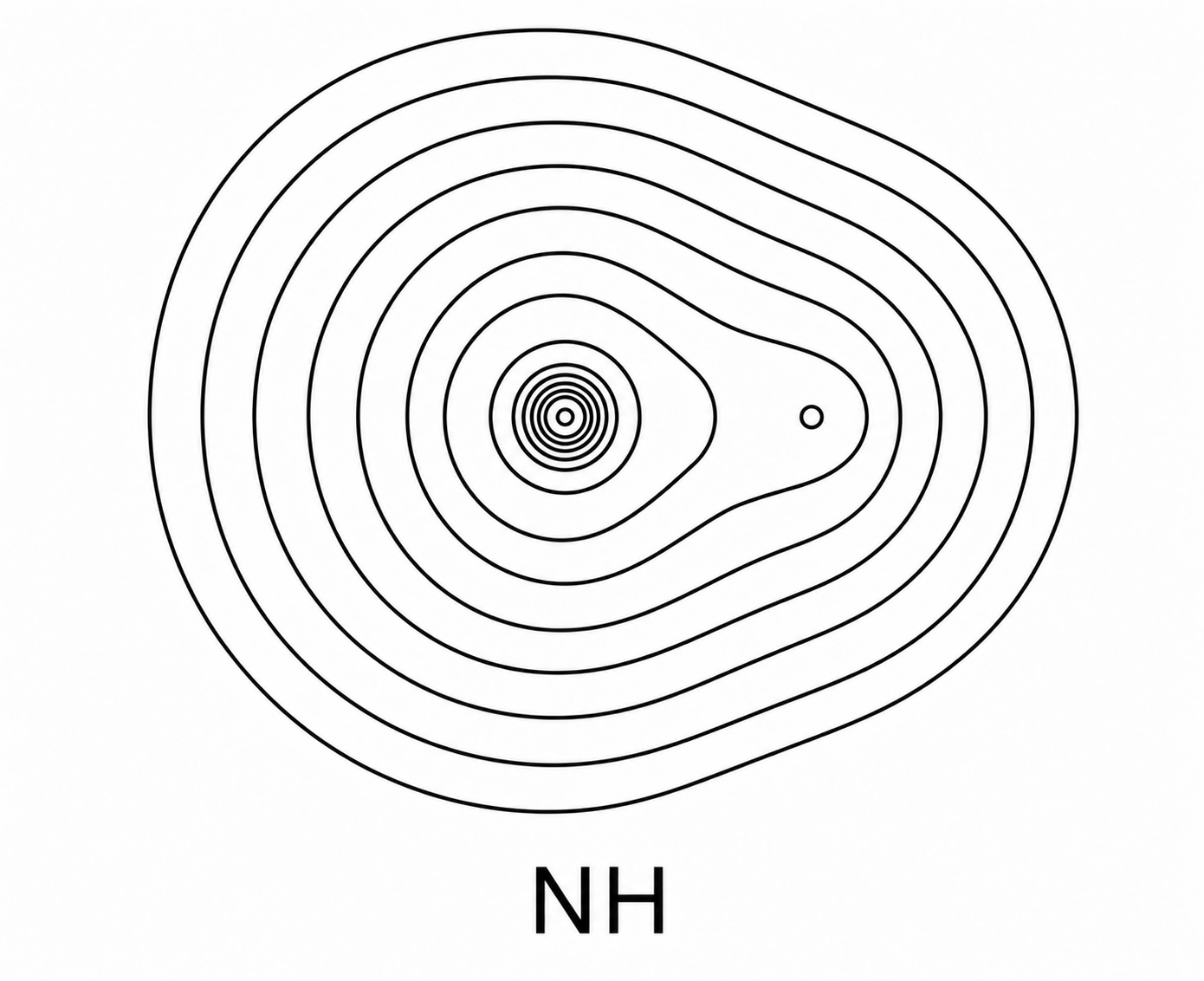
Contour diagrams help show where electron density is concentrated within a covalent molecule.
Trends in Electronegativity
Electronegativity generally increases across a period and increases up a group, excluding noble gases.
Across a period, nuclear charge increases and atomic radius decreases. The bonding electrons are attracted more strongly because the nucleus has a stronger pull on the shared electrons.
Down a group, atoms have more electron shells. The bonding electrons are further from the nucleus and more shielded, so the attraction is weaker.
Most electronegative common elements
Fluorine, oxygen, nitrogen and chlorine are key electronegative elements to recognise in A Level bonding questions.
Fluorine is highest
Fluorine has the strongest attraction for bonding electrons on the Pauling scale.
Electronegativity Difference and Bond Type
The electronegativity difference, often written as ΔEN, helps predict whether a bond is best described as non-polar covalent, polar covalent or ionic.
These boundaries are useful revision guides. Real bonding exists on a continuum, so increasing ΔEN usually means increasing ionic character.
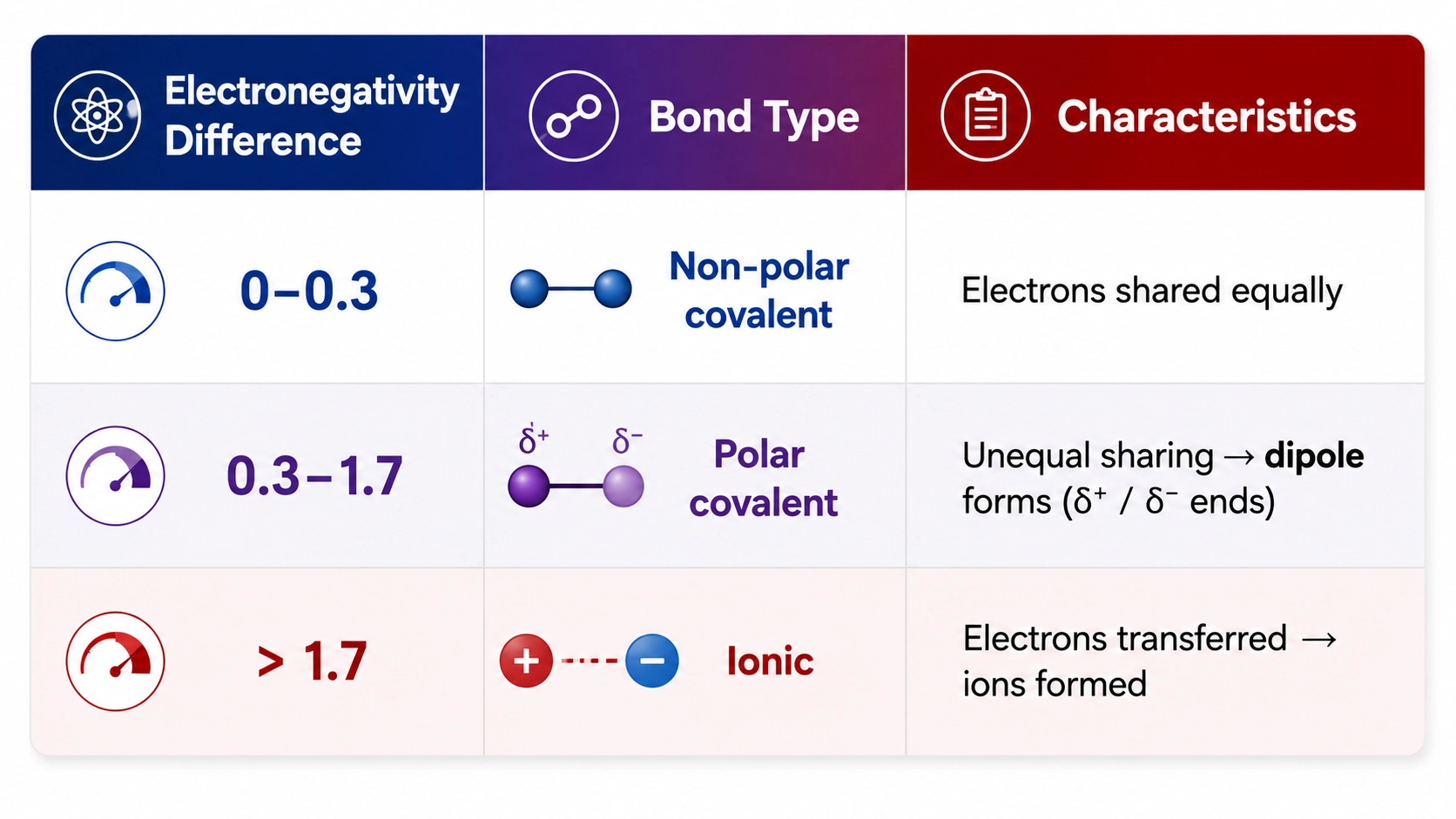
As the difference in electronegativity increases, the bond shows more ionic character.
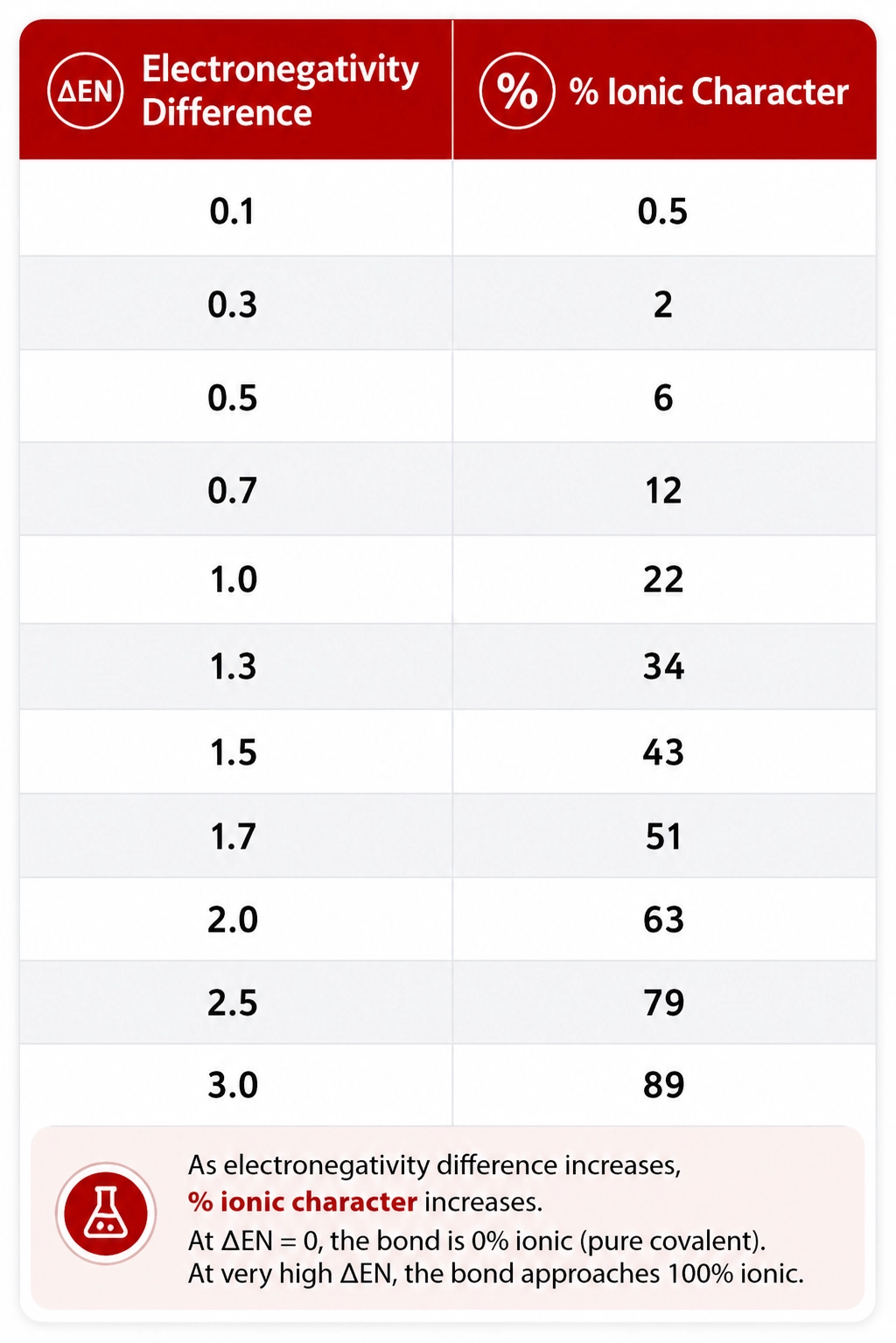
The percentage ionic character increases as the electronegativity difference becomes larger.
Non-Polar Covalent Bonds
A non-polar covalent bond forms when the bonded atoms have identical or very similar electronegativities.
The shared pair of electrons is attracted equally by both nuclei. There is no charge separation, so the bond has no permanent dipole.
Examples include bonds in Cl2, H2 and N2, because each bond is between identical atoms.
Exam focus: Non-polar covalent bonds have electron density distributed symmetrically, so there is no δ+ end and no δ- end.
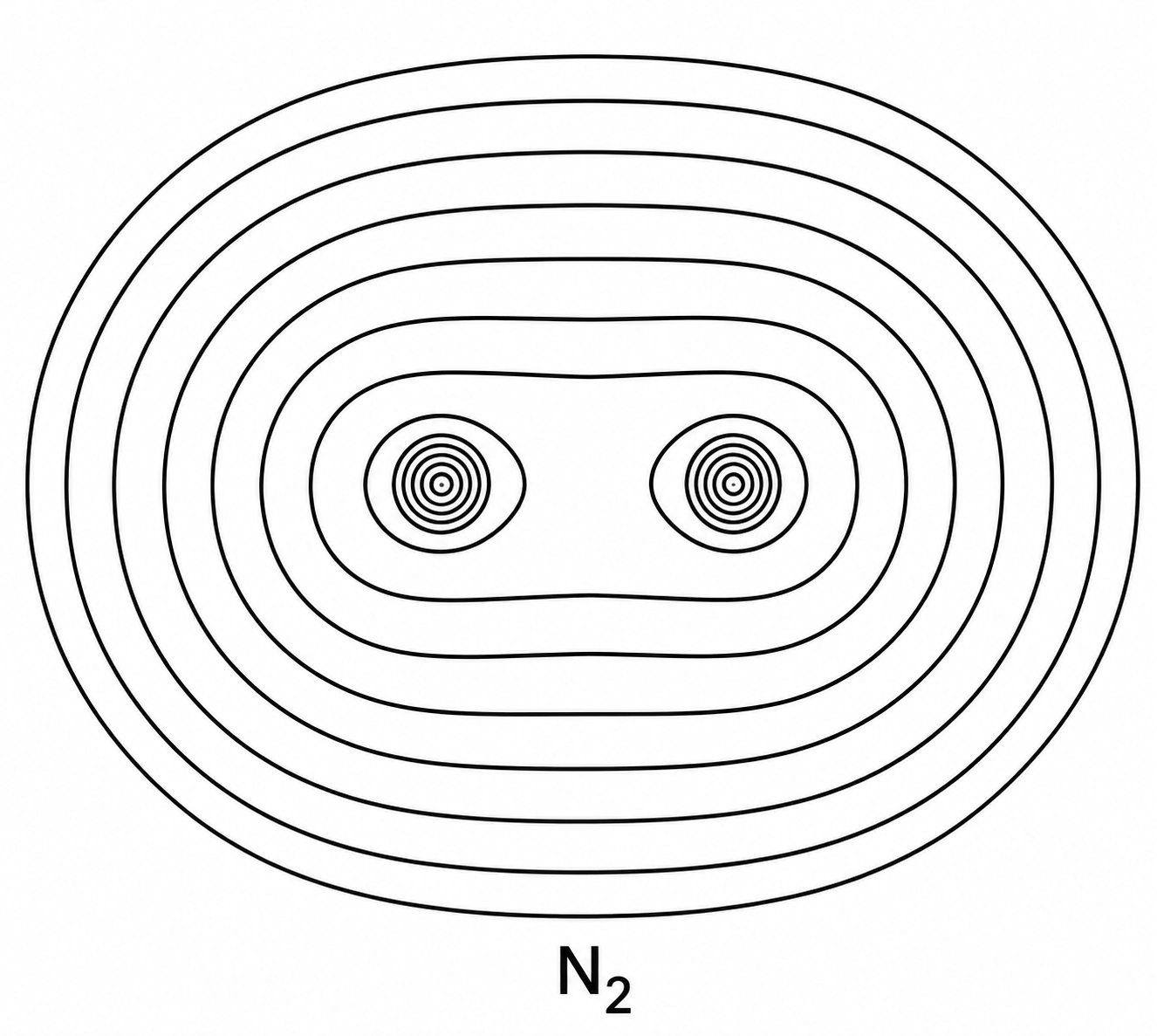
Symmetrical electron density is expected when identical atoms share bonding electrons equally.
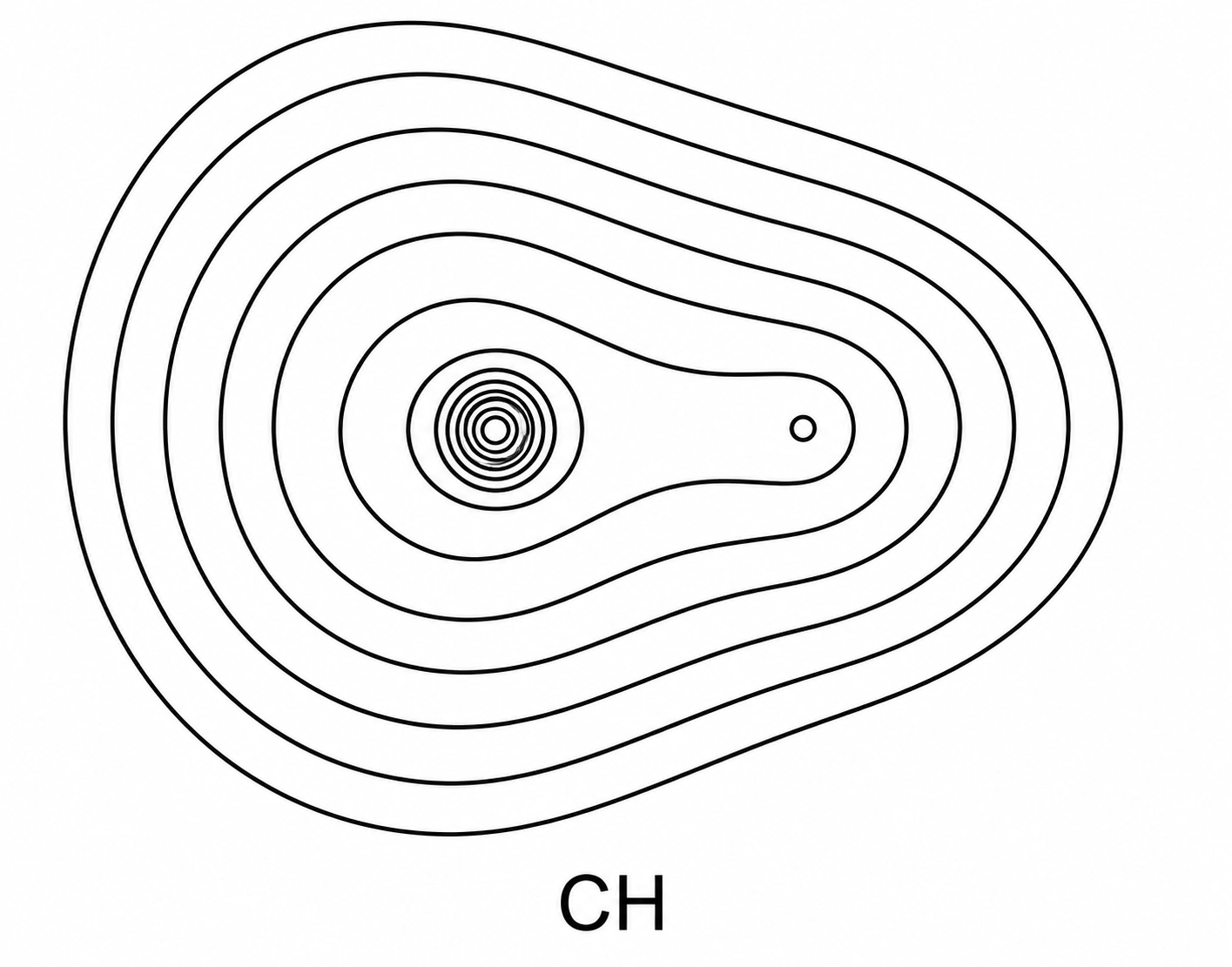
Very small electronegativity differences give little or no meaningful charge separation in the bond.
Polar Covalent Bonds and Permanent Dipoles
A polar covalent bond forms when one bonded atom is more electronegative than the other.
The more electronegative atom pulls the bonding electrons closer. This creates charge separation, with a partial negative charge on the more electronegative atom and a partial positive charge on the less electronegative atom.
Partial charges are written using delta symbols: δ+ means slightly positive and δ- means slightly negative.
Permanent dipole: A permanent separation of charge across a bond or molecule, caused by unequal sharing of bonding electrons.
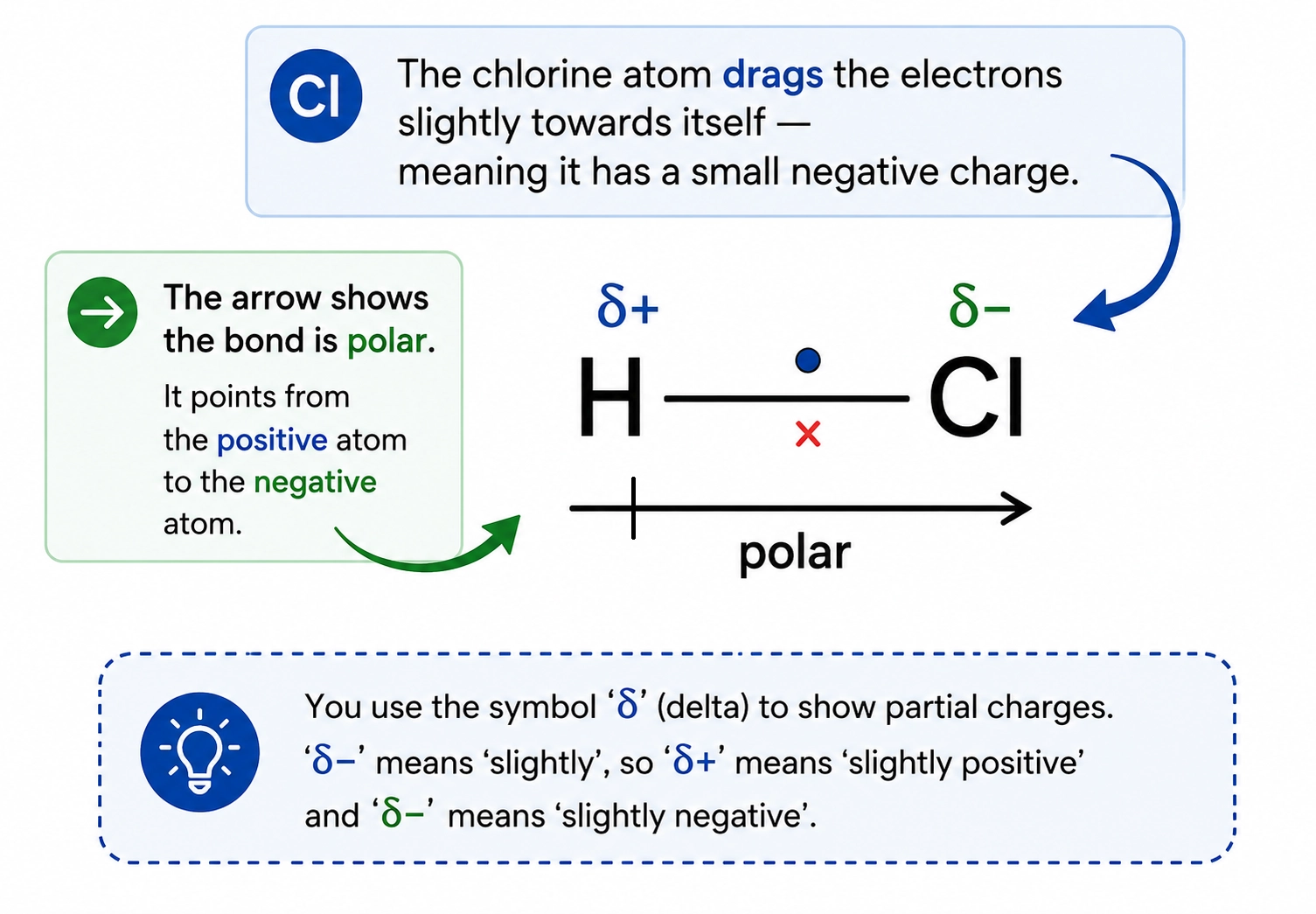
In HCl, chlorine attracts the bonding electrons more strongly, so chlorine becomes δ- and hydrogen becomes δ+.
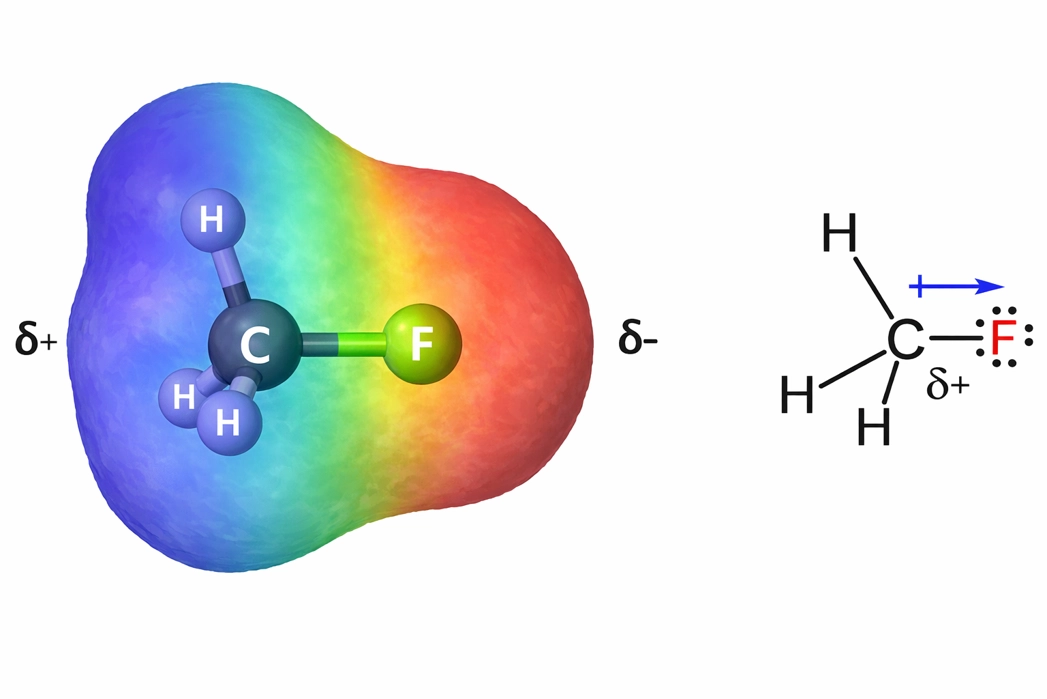
The C-F bond is polar because fluorine is much more electronegative than carbon.
Bond Dipoles and Molecular Polarity
A bond dipole shows the direction of polarity in a bond. In chemistry diagrams, the arrow points towards the more electronegative atom.
A molecule with polar bonds is not automatically a polar molecule. The overall molecular polarity depends on the shape of the molecule and whether the bond dipoles cancel.
This becomes especially important in the next subtopic, polar and non-polar molecules.
| Term | Meaning | Common exam wording |
|---|---|---|
| Bond polarity | Unequal sharing of electrons in a covalent bond. | One atom is more electronegative and attracts the bonding pair more strongly. |
| Bond dipole | A partial charge separation across a bond. | The less electronegative atom is δ+ and the more electronegative atom is δ-. |
| Molecular polarity | The overall polarity of the molecule after considering all bond dipoles and shape. | Dipoles may cancel in symmetrical molecules. |
Common Exam Points
Strong electronegativity answers link the definition to bonding electrons, partial charges and permanent dipoles.
Do not define electronegativity using lone pairs
Electronegativity is about attracting the shared pair of electrons in a covalent bond.
Use partial charges for polar covalent bonds
The more electronegative atom is δ-, while the less electronegative atom is δ+.
Non-polar bonds have no charge separation
Identical atoms have the same electronegativity, so electrons are shared equally and no dipole forms.
Bond type is a continuum
Electronegativity difference is a guide. A larger difference means greater ionic character.
Check Your Understanding
Use these short activities to check electronegativity, non-polar covalent bonds, polar covalent bonds and permanent dipoles.
QuickSnap
Electronegativity explains how strongly an atom attracts bonding electrons. When bonded atoms attract the shared electrons equally, the bond is non-polar. When one atom attracts them more strongly, the bond becomes polar and has partial charges.
Electronegativity
Relative tendency of an atom in a covalent bond to attract the shared electrons towards itself.
Non-polar covalent bond
Bonding electrons are shared equally or almost equally, so there is no permanent dipole.
Polar covalent bond
Bonding electrons are shared unequally, giving a δ+ end and a δ- end.
Ionic character
A larger electronegativity difference gives a bond with more ionic character.
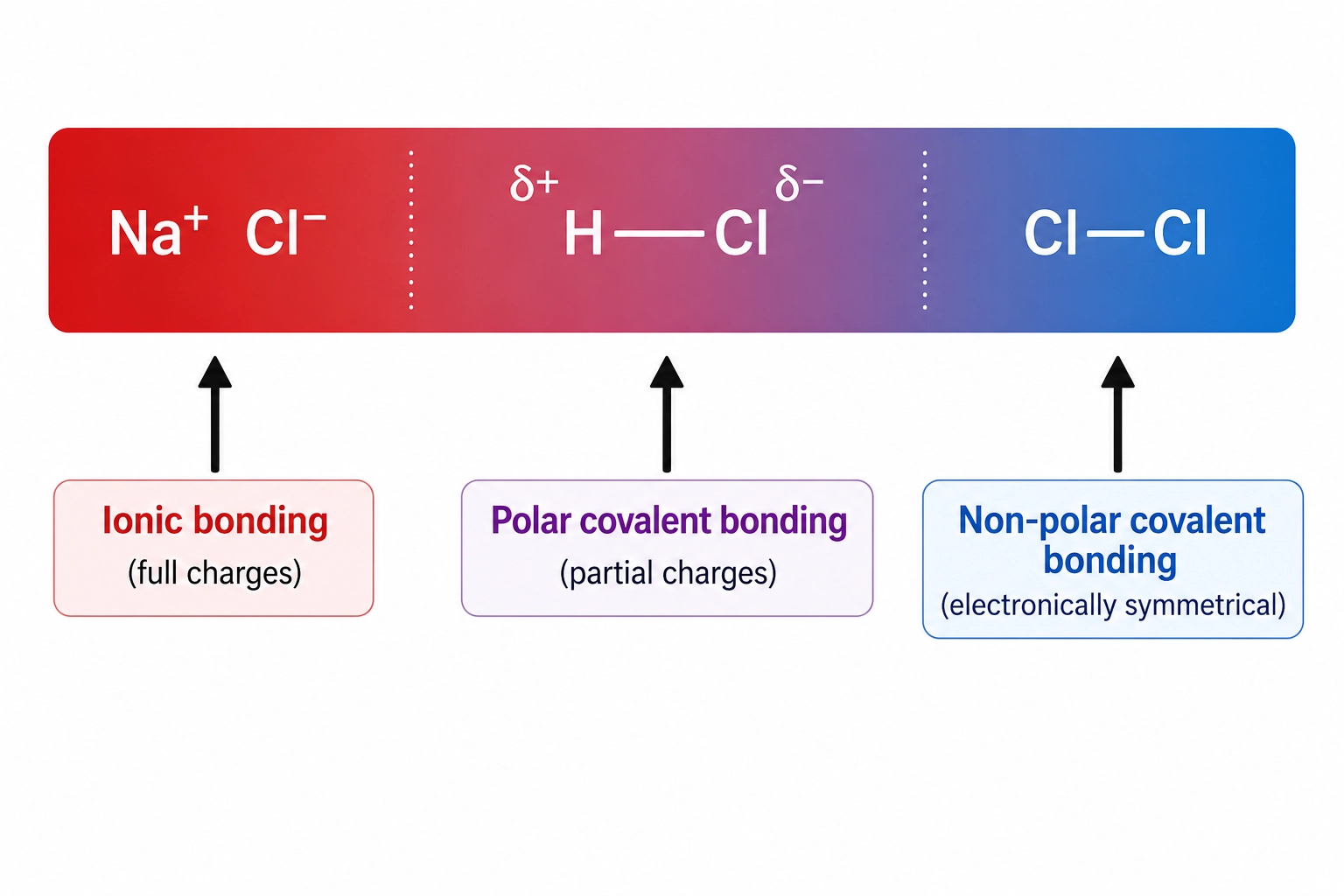
Use this visual comparison to connect electron distribution with ionic, polar covalent and non-polar covalent bonding.

Master Covalent Bonding, Structure and Shapes of Molecules for Edexcel A Level Chemistry
Continue from these free revision notes into the full Topic 2A/B Covalent Bonding, Structure and Shapes of Molecules course, with guided video teaching, diagnostic MCQ practice, teacher-marked short-answer questions and a specification assignment with a personalised progress report.
Guided video teaching
Learn covalent bonding, dot-and-cross diagrams, giant covalent structures, electronegativity, polarity and molecular shapes through structured video lessons with worked examples and walkthroughs.
Instant MCQ feedback
Auto-marked MCQ quizzes provide immediate diagnostic feedback for every answer choice.
Teacher-marked SAQs
Submit written exam responses and receive chemistry specialist feedback with improvement guidance.
Progress tracking
Identify strengths and weaknesses across covalent bonding, giant covalent structures, polarity, VSEPR theory and molecular shapes with targeted reporting.
See how the course works
Click play to start the course preview animation.
The shapes of some species are being compared.
Which species is not tetrahedral?
Explain this difference in terms of structure and bonding.
FAQs
These answers summarise the key ideas students often confuse when revising electronegativity and bond polarity.
What is electronegativity?
Electronegativity is the relative tendency of an atom in a covalent bond to attract the shared pair of electrons towards itself.
Which element is the most electronegative?
Fluorine is the most electronegative element on the Pauling scale, with an electronegativity value of 4.0.
What makes a bond polar?
A bond is polar when the bonded atoms have different electronegativities, so the bonding electrons are attracted more strongly by one atom.
What do δ+ and δ- mean?
δ+ means slightly positive and δ- means slightly negative. These symbols show partial charges in polar covalent bonds.
Is a molecule with polar bonds always polar?
No. A molecule can contain polar bonds but still be non-polar overall if the bond dipoles cancel because of the molecular shape.
Copyright and author footprint: This OLS revision page was written for Online Learning System by Dr. Mohammed Al-Fatah. It is designed for A Level Chemistry revision and should not be copied or redistributed without permission.