Bent Molecular Shape
A focused revision guide to the bent molecular shape, using H2O as the key example. This page explains why two bonding pairs and two lone pairs around a central atom give a non-linear arrangement with a bond angle of about 104.5°.
What Bent Means
A bent molecule has two atoms bonded to a central atom, with two lone pairs also present on the central atom. The bonded atoms are not arranged in a straight line because the lone pairs repel the bonding pairs and compress the bond angle.
The key example for this page is H2O. Oxygen is the central atom, each hydrogen atom is bonded to oxygen, and oxygen also has two lone pairs.
Key idea: two bonding pairs and two lone pairs around a central atom give a bent shape with a bond angle of about 104.5°.
Why H2O Is Bent
In H2O, the central oxygen atom is surrounded by two O-H bonding pairs and two lone pairs. These four regions of negative charge repel one another and are based on a tetrahedral electron-pair arrangement.
The molecular shape only considers the positions of the atoms, not the invisible lone pairs. Therefore, H2O is described as bent, not tetrahedral.
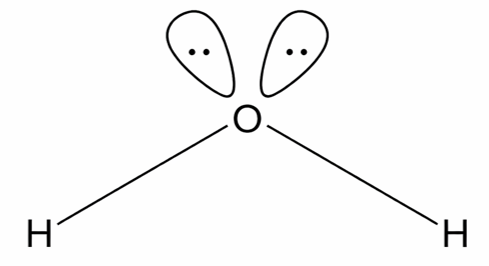
A bent species has two bonding regions and two lone pairs around the central atom. H2O is the key model example, with a bond angle of about 104.5°.
Bent Shape of H2O
In water, oxygen has two O-H bonding pairs and two lone pairs. Compared with NH3, another bonding pair has been replaced by a lone pair. The two lone pairs repel more strongly than bonding pairs, compressing the H-O-H bond angle to about 104.5°.
Bonding Pairs, Lone Pairs and Bond Angle
The four electron regions around oxygen in H2O are arranged to minimise repulsion. If all four regions were bonding pairs, the bond angle would be close to the tetrahedral angle of 109.5°.
However, H2O has two lone pairs. Lone pair-lone pair repulsion is stronger than lone pair-bonding pair repulsion, which is stronger than bonding pair-bonding pair repulsion. This stronger repulsion compresses the H-O-H bond angle to about 104.5°.
Bonding pair-bonding pair
Weakest repulsion of the three common repulsion types.
Lone pair-bonding pair
Stronger repulsion, so bond angles are compressed.
Lone pair-lone pair
Strongest repulsion. In H2O, two lone pairs compress the bond angle more than in NH3.
Bent Shape Examples
The bent shape is found when the central atom has two bonding pairs and two lone pairs. H2O is the standard example used to explain the 104.5° bond angle.
| Species | Central atom | Electron regions | Shape | Typical exam angle |
|---|---|---|---|---|
| H2O | O | 2 bonding regions, 2 lone pairs | Bent | about 104.5° |
| OCl2 | O | 2 bonding regions, 2 lone pairs | Bent | about 104.5° |
| H2S | S | 2 bonding regions, 2 lone pairs | Bent | about 104.5° |
| OF2 | O | 2 bonding regions, 2 lone pairs | Bent | about 104.5° |
| SCl2 | S | 2 bonding regions, 2 lone pairs | Bent | about 104.5° |
How to Explain Bent Shape in an Exam
A full exam explanation should connect the number of electron pairs to electron-pair repulsion, then explain why the bond angle is smaller than the tetrahedral angle.
1. Identify the central atom
For H2O, the central atom is oxygen.
2. Count bonding pairs and lone pairs
Oxygen has two bonding pairs and two lone pairs around it.
3. Apply electron-pair repulsion
The electron pairs repel and arrange themselves as far apart as possible, but the two lone pairs repel more strongly than bonding pairs.
4. State the shape and angle
The molecule is bent with a bond angle of about 104.5°.
Exam answer model: H2O has two bonding pairs and two lone pairs around the central oxygen atom. The electron pairs repel and arrange themselves as far apart as possible. The two lone pairs repel the bonding pairs more strongly, compressing the H-O-H bond angle from 109.5° to about 104.5°. Therefore, H2O is bent.
Common Exam Points
Do not call H2O linear
Although there are only two bonded atoms, the two lone pairs on oxygen bend the molecule.
Separate electron-pair arrangement from molecular shape
The electron-pair arrangement is based on tetrahedral geometry, but the molecular shape is bent because only atoms are used to describe the visible shape.
Use the correct repulsion order
Lone pair-lone pair repulsion is strongest, followed by lone pair-bonding pair, then bonding pair-bonding pair.
Count around the central atom only
The shape is determined by the bonding pairs and lone pairs around the central atom, not by the total number of atoms in the whole species.
Check Your Understanding
Use these short activities to check the bent shape, H2O, two bonding pairs, two lone pairs and the 104.5° bond angle.
QuickSnap
The bent shape is produced when a central atom has two bonding pairs and two lone pairs. The lone pairs repel bonding pairs more strongly and compress the bond angle to about 104.5°.
Memory line: 2 bonding pairs + 2 lone pairs = bent = about 104.5°.
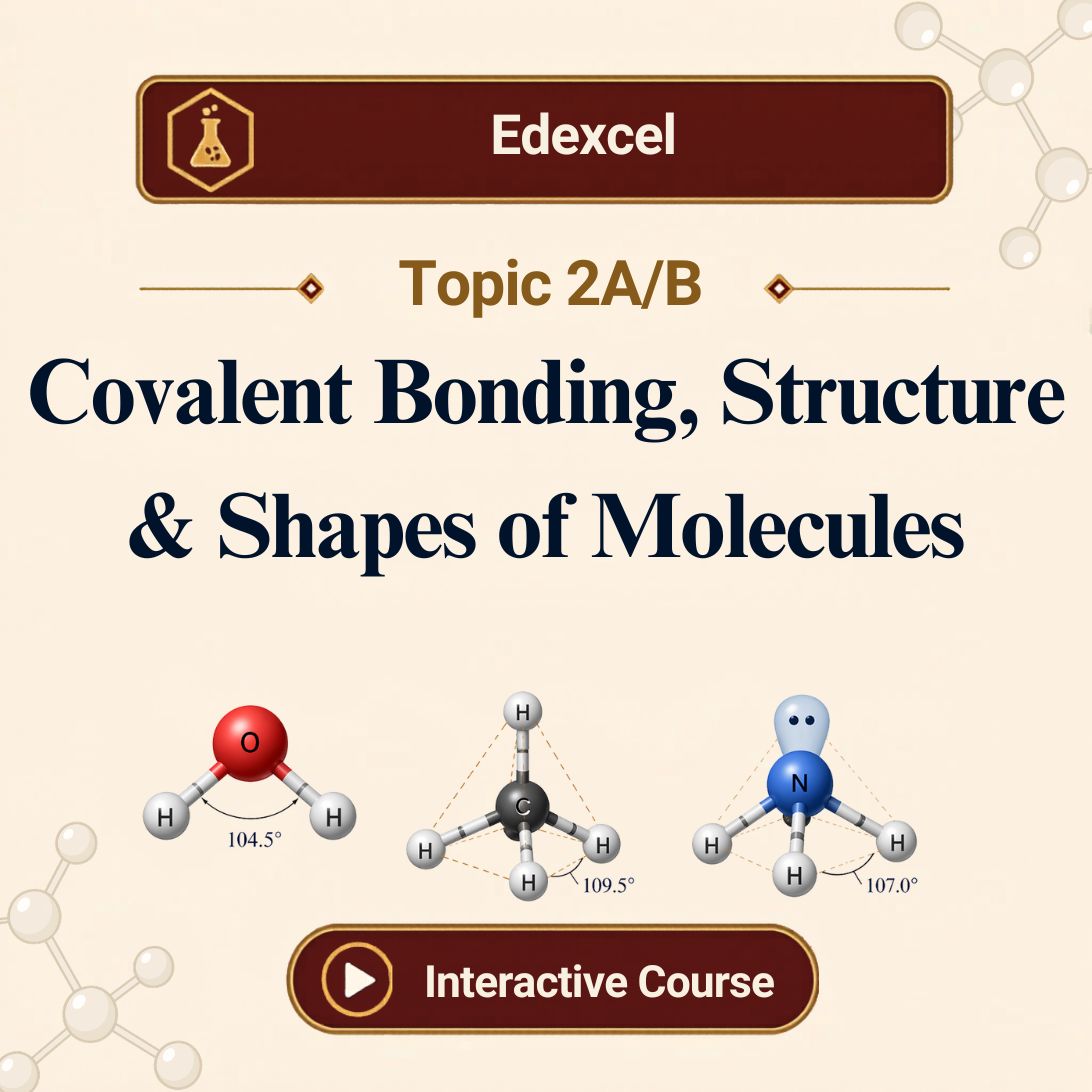
Master Covalent Bonding, Structure and Shapes of Molecules for Edexcel A Level Chemistry
Continue from these free revision notes into the full Topic 2A/B Covalent Bonding, Structure and Shapes of Molecules course, with guided video teaching, diagnostic MCQ practice, teacher-marked short-answer questions and a specification assignment with a personalised progress report.
Guided video teaching
Learn covalent bonding, dot-and-cross diagrams, giant covalent structures, electronegativity, polarity and molecular shapes through structured video lessons with worked examples and walkthroughs.
Instant MCQ feedback
Auto-marked MCQ quizzes provide immediate diagnostic feedback for every answer choice.
Teacher-marked SAQs
Submit written exam responses and receive chemistry specialist feedback with improvement guidance.
Progress tracking
Identify strengths and weaknesses across covalent bonding, giant covalent structures, polarity, VSEPR theory and molecular shapes with targeted reporting.
See how the course works
Click play to start the course preview animation.
The shapes of some species are being compared.
Which species is not tetrahedral?
Explain this difference in terms of structure and bonding.
FAQs
These are the key questions students often ask when revising the bent molecular shape.
What makes a molecule bent?
A molecule is bent when the central atom has two bonded atoms and lone pairs that repel the bonding pairs. In the standard H2O example, oxygen has two bonding pairs and two lone pairs.
Why is H2O bent?
H2O is bent because oxygen has two O-H bonding pairs and two lone pairs. The lone pairs occupy electron regions but are not shown as atoms in the molecular shape.
What is the bond angle in H2O?
The H-O-H bond angle in H2O is about 104.5°. It is smaller than 109.5° because the two lone pairs repel bonding pairs more strongly.
Is bent the same as linear?
No. A linear molecule has a bond angle of 180°. A bent molecule has a smaller bond angle because lone pairs on the central atom repel the bonding pairs.
Copyright notice: This OLS revision content, including the explanations, layout, diagrams, tables and embedded learning structure, is authored for Online Learning System by Dr. Mohammed Al-Fatah. It may not be copied, reproduced, redistributed or adapted without written permission.