Rates of Hydrolysis and Bond Enthalpy
A concise revision guide to comparing the rates of hydrolysis of halogenoalkanes with aqueous silver nitrate in ethanol: the precipitate colours and times, the chloro-, bromo- and iodo- trend explained by bond enthalpy, and the primary, secondary and tertiary trend.
- 10.8iii
- 10.10i
- 10.10ii
- 10.11
- 10.12-a
- 10.12-b
- 10.12-c
- 10.13-a
- 10.13-b
- 10.13-c
What these spec points say
- 10.8iii understand the reactions of halogenoalkanes with: aqueous silver nitrate in ethanol (where water acts as a nucleophile)
- 10.10i understand that experimental observations and data can be used to compare the relative rates of hydrolysis of: primary, secondary and tertiary structural isomers of a halogenoalkane
- 10.10ii understand that experimental observations and data can be used to compare the relative rates of hydrolysis of: primary chloro-, bromo- and iodoalkanes using aqueous silver nitrate in ethanol
- 10.11 CORE PRACTICAL 5 Investigation of the rates of hydrolysis of some halogenoalkanes.
- 10.12-a know the trend in reactivity of primary halogenoalkanes
- 10.12-b know the trend in reactivity of secondary halogenoalkanes
- 10.12-c know the trend in reactivity of tertiary halogenoalkanes
- 10.13-a understand the trend in reactivity of chloroalkanes in terms of bond enthalpy
- 10.13-b understand the trend in reactivity of bromoalkanes in terms of bond enthalpy
- 10.13-c understand the trend in reactivity of iodoalkanes in terms of bond enthalpy
Comparing Rates with Silver Nitrate
The rate at which different halogenoalkanes are hydrolysed is compared with aqueous silver nitrate in ethanol. Equal amounts of each halogenoalkane are placed in test tubes with ethanol, the tubes are warmed in a water bath at about 50 °C, aqueous silver nitrate at the same temperature is added to each at the same moment, and the time taken for a precipitate to appear is recorded. Water is the nucleophile: R–X + H₂O → R–OH + H⁺ + X⁻. The halide ion released reacts with silver ions, Ag⁺ + X⁻ → AgX, and the sooner the precipitate forms, the faster the hydrolysis.
The ethanol is a co-solvent that lets the water-insoluble halogenoalkane mix with the aqueous silver nitrate.
The water bath keeps every tube at the same temperature so that the comparison is fair.
The colour of the precipitate confirms which halogen has left: white silver chloride, cream silver bromide, yellow silver iodide.
Core Practical 5 (rates of hydrolysis of halogenoalkanes) carries out this experiment and asks for the variables to be controlled: volume and concentration of each reagent, temperature, and the moment the timing starts.
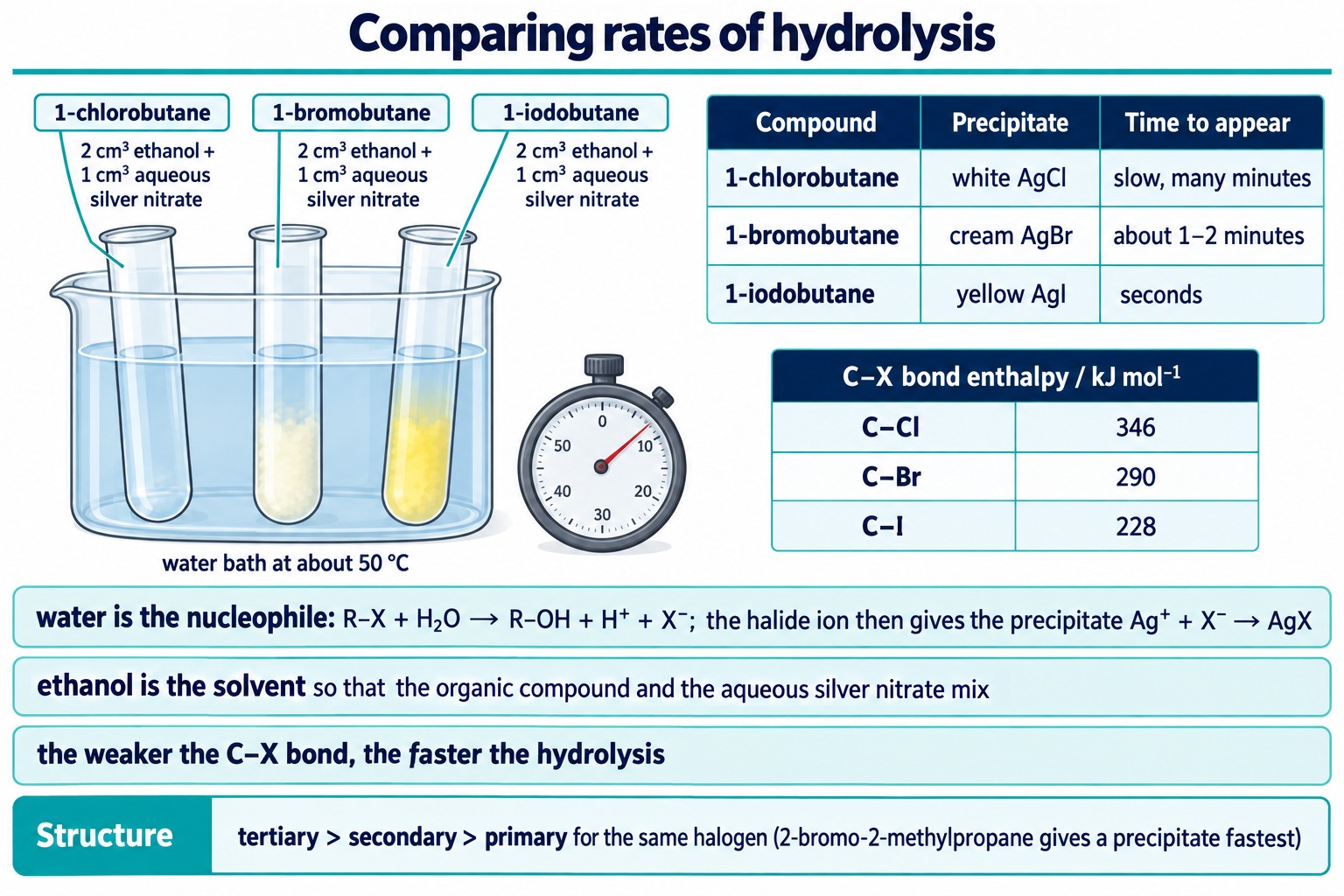
Three halogenoalkanes in aqueous silver nitrate and ethanol in a water bath: the precipitate colours, the times, and the bond enthalpies that explain them.
Key idea: Faster precipitate means faster hydrolysis. Chloro slowest, iodo fastest; tertiary fastest, primary slowest.
Check: The Silver Nitrate Experiment
Plan and interpret the experiment for compounds and conditions not described above.
Chloro, Bromo and Iodo: the Bond Enthalpy Trend
For primary compounds with the same carbon chain, the order of reactivity is iodoalkane > bromoalkane > chloroalkane. 1-iodobutane gives a yellow precipitate within seconds, 1-bromobutane a cream precipitate in a minute or two, and 1-chlorobutane only a faint white cloudiness after many minutes. Fluoroalkanes give no precipitate at all.
The explanation is the bond enthalpy of the carbon–halogen bond: C–Cl 346, C–Br 290, C–I 228 kJ mol⁻¹.
The rate-determining step involves breaking the C–X bond, so the weaker the bond, the lower the activation energy and the faster the reaction.
Bond polarity would predict the opposite order, because C–Cl is the most polar of the three.
Exam focus: The exam answer must be about bond strength: the C–I bond is the longest and weakest and breaks most easily.
| Compound | C–X bond enthalpy / kJ mol⁻¹ | Precipitate | Relative rate |
|---|---|---|---|
| 1-chlorobutane | 346 | white AgCl, very slow | slowest |
| 1-bromobutane | 290 | cream AgBr, a few minutes | middle |
| 1-iodobutane | 228 | yellow AgI, seconds | fastest |
Exam answer model: “The C–I bond has the lowest bond enthalpy, so less energy is needed to break it, the activation energy is lower and hydrolysis is fastest. Bond polarity does not explain the trend.”
Check: Explaining the Halogen Trend
Use bond enthalpy data on compounds not compared above.
Primary, Secondary and Tertiary: the Structure Trend
For the same halogen, the order of reactivity is tertiary > secondary > primary. 2-bromo-2-methylpropane gives a precipitate almost at once at room temperature, 2-bromopropane takes longer, and 1-bromopropane is the slowest.
A tertiary compound can lose its halide ion first to form a carbocation, which is stabilised by the three alkyl groups around the positive carbon, and water then attacks the carbocation rapidly.
A primary compound cannot form a stable carbocation, so it must wait for the water molecule to attack the crowded δ+ carbon directly, which is slower.
Questions on this experiment often give times for several compounds and ask which factor, halogen or structure, is being tested.
Exam tip: Change one thing at a time: to test the halogen use three primary compounds with the same chain; to test the structure use three bromo compounds with the same number of carbons.
Exam focus: State the trend, state the evidence (time for the precipitate), then give the reason (bond enthalpy for the halogen, carbocation stability for the structure).
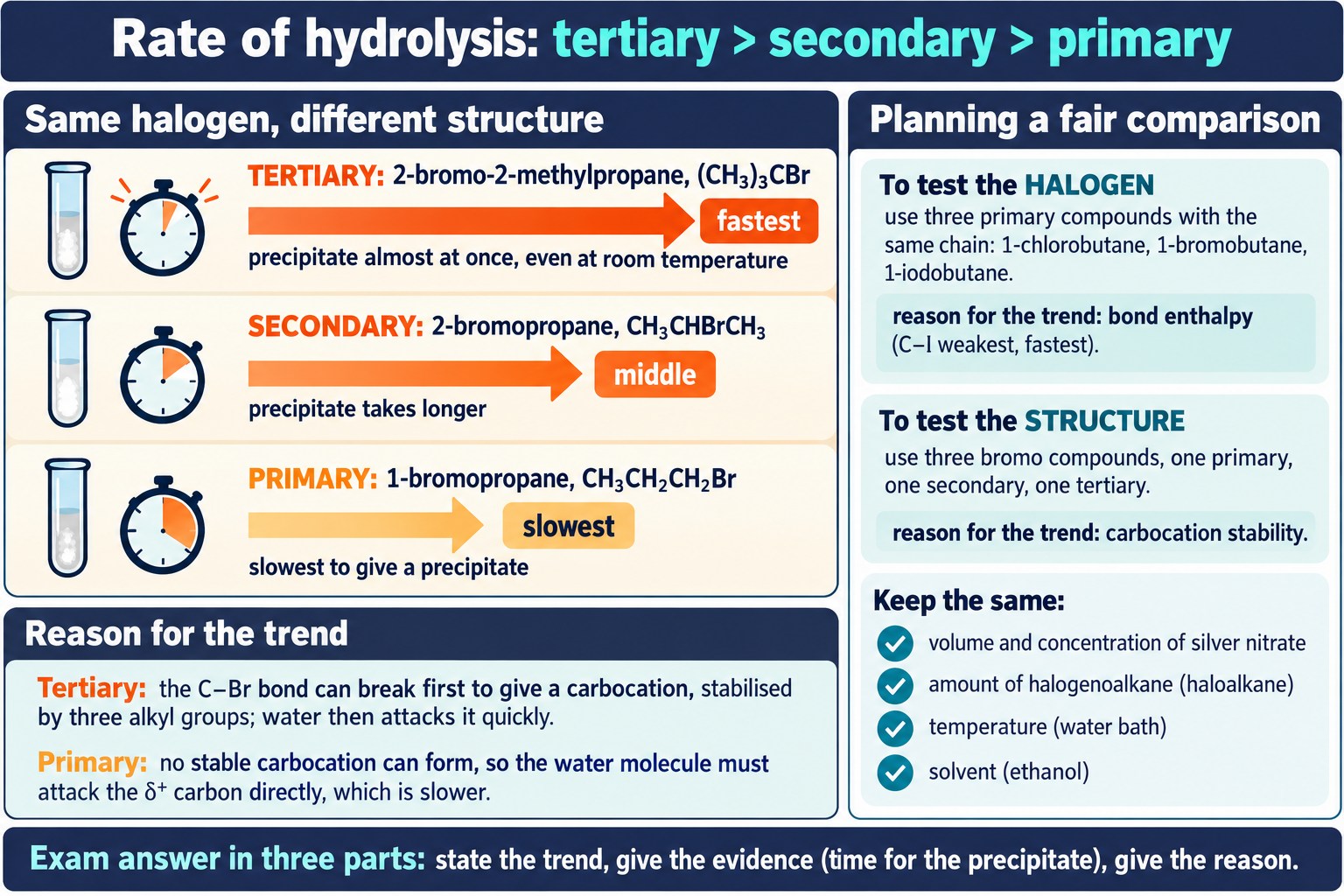
For the same halogen a tertiary compound is hydrolysed fastest and a primary compound slowest, and a fair test changes only the halogen or only the structure.
Common Exam Points
Say
“Aqueous silver nitrate in ethanol, water bath at the same temperature, time the precipitate.” “Cream precipitate of silver bromide.” “C–I weakest, so fastest.”
Do not say
“Silver nitrate is the nucleophile” (water is). “Iodoalkanes are fastest because iodine is the most reactive halogen.”
Watch for
Fair-test questions: same volume and concentration of silver nitrate, same amount of halogenoalkane, same temperature, same solvent.
Check: Structure and Fair Tests
Interpret results tables for compounds not shown on this page.
FAQs
Use these quick answers to check the hydrolysis experiment.
Why is ethanol added to the test tubes?
The halogenoalkane does not dissolve in water and the silver nitrate does not dissolve in the halogenoalkane. Ethanol mixes with both, so the reactants meet in one solution.
What is the nucleophile in this experiment?
Water. The silver ions do not take part in the hydrolysis; they react with the halide ion after it has been released to form the precipitate.
Why is a water bath used?
To hold every tube at the same temperature, so that the rates can be compared fairly and the reaction is fast enough to time.
Why does the C–I bond break most easily if it is the least polar?
Bond enthalpy falls as the halogen atom gets larger and the bond longer: C–I is only 228 kJ mol⁻¹ against 346 for C–Cl. Less energy is needed to break it, so the activation energy is lower.
Why is a tertiary compound hydrolysed faster than a primary one?
It can lose its halide ion to form a carbocation that three alkyl groups stabilise, and water then attacks that ion quickly. A primary compound cannot form a stable carbocation and must be attacked directly, which is slower.
Copyright notice: This OLS revision content, including the explanations, layout, diagrams, tables and embedded learning structure, is authored for Online Learning System by Dr. Mohammed Al-Fatah. It may not be copied, reproduced, redistributed or adapted without written permission.
Keep this note — free
Save your progress across every Edexcel IAL topic. A free account remembers which topics you have covered, saves your question scores, and syncs across your phone and laptop.
- Track every topic you have finished
- Keep your practice-question scores
- No payment, no card, free forever
Already registered? Log in