Bond Enthalpy and Pauling Values
A concise OCR A Level Chemistry A revision guide to two numbers you must be able to read and use in 2.2.2: the average bond enthalpy as a measure of how strong a covalent bond is (2.2.2(f)), and Pauling electronegativity values as a measure of how unequally that bond is shared (2.2.2(i)).
GCSE Recap: Shared Pairs and Breaking Bonds
Before you start, check what a covalent bond is and which way the energy goes when one is broken.
Average Bond Enthalpy Measures Bond Strength
A covalent bond is a strong electrostatic attraction between a shared pair of electrons and the nuclei of the bonded atoms. The strength of that attraction is measured by the average bond enthalpy: the energy needed to break one mole of a particular covalent bond in gaseous molecules, averaged over many different compounds containing that bond. Values are always positive because bond breaking is endothermic, and they are quoted in kJ mol-1.
| Bond | Average bond enthalpy / kJ mol-1 | What it tells you |
|---|---|---|
| H-H | 436 | Strong single bond; hydrogen needs a catalyst or high temperature to react |
| C-H | 413 | Typical strong bond of an alkane |
| C-C | 347 | A single bond between carbon atoms |
| C=C | 612 | Stronger than C-C, but less than twice as strong |
| C≡C | 838 | The strongest carbon-carbon bond |
| N≡N | 945 | Exceptionally strong; nitrogen gas is very unreactive |
| O=O | 498 | Oxygen reacts readily once started |
| Cl-Cl | 243 | Weak single bond; easily broken by ultraviolet light |
| H-Cl | 432 | Strong polar bond |
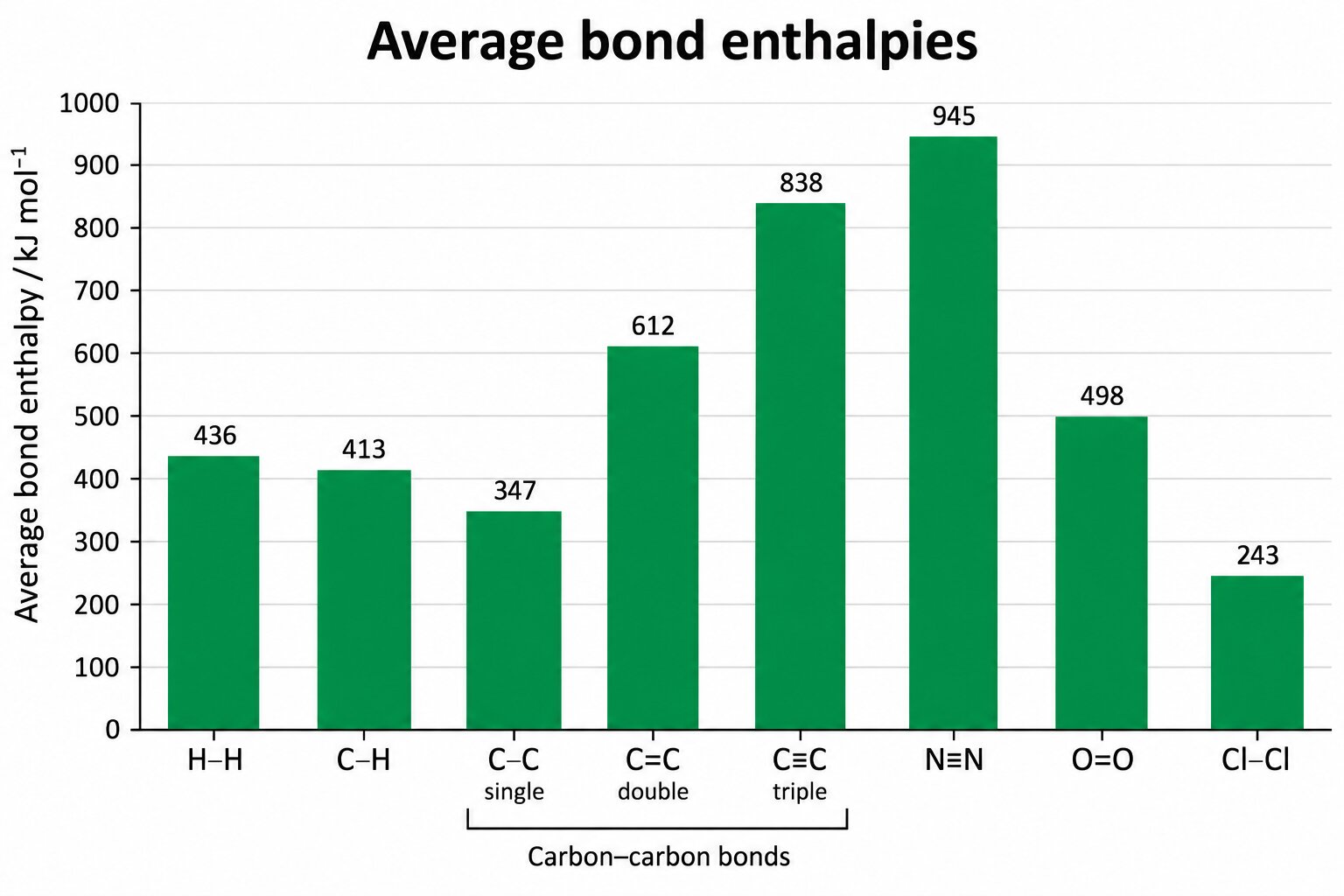
The higher the bar, the more energy is needed to break one mole of that bond in the gas phase.
Key idea: A larger average bond enthalpy means a stronger bond. More energy is needed to break it, so the bond is less likely to be broken during a reaction.
Quick Check: Which Bond Gives Way First
Use the two bond enthalpies to explain the difference in reactivity.
Why the Value Is an Average
The exact energy needed to break a C-H bond depends on the molecule it sits in: the four C-H bonds in methane do not all break with the same energy, and a C-H bond in ethanol differs again. The data-book value of 413 kJ mol-1 is the mean across a wide range of compounds. Only diatomic molecules such as H2, Cl2 and HCl have a single, exact bond enthalpy, because there is only one environment for that bond.
This is why enthalpy changes calculated from average bond enthalpies rarely match the experimentally measured value: the average is a good estimate, not the exact figure for that molecule.
Exam sentence: The average bond enthalpy is the mean energy required to break one mole of a specified bond in gaseous molecules, averaged over many compounds containing that bond.
Quick Check: Exact or Averaged?
Decide which of these four bonds has an exact bond enthalpy.
Quick Check: Explain the Single Quoted Value
Write a short explanation, then compare it with the mark points and the model answer.
Comparing Bonds with Enthalpy Values
Two patterns in the table are worth remembering because they explain reactivity later in the course.
- Multiple bonds are stronger than single bonds, but not proportionally. C=C (612 kJ mol-1) is much less than twice C-C (347 kJ mol-1). The second, π component of the double bond is therefore the weaker part, which is why alkenes react by breaking the π bond in addition reactions while the σ bond survives.
- Weak bonds break first. The Cl-Cl bond (243 kJ mol-1) is weak enough to be split by ultraviolet light, which starts free-radical substitution. The N≡N bond (945 kJ mol-1) is so strong that nitrogen gas hardly reacts at all.
Exam focus: When asked why one molecule is more reactive than another, quote the bond enthalpies and state clearly which bond needs less energy to break.
Quick Check: Single, Double and Triple
Work out what each extra bonded pair adds, then complete the account.
Reading Pauling Electronegativity Values
Bond enthalpy tells you how strong a bond is; electronegativity tells you how unequally the shared pair is held. Linus Pauling devised a relative scale with fluorine, the most electronegative element, set at 4.0. The values have no units because they are relative, and they increase across a period and decrease down a group.
| Element | Pauling value | Element | Pauling value |
|---|---|---|---|
| F | 4.0 | C | 2.5 |
| O | 3.5 | S | 2.5 |
| Cl | 3.0 | H | 2.1 |
| N | 3.0 | Mg | 1.2 |
| Br | 2.8 | Na | 0.9 |
The difference between the two values in a bond tells you what kind of bond to expect. A difference of about zero gives a non-polar covalent bond; a small to moderate difference gives a polar covalent bond with δ+ and δ– charges; a very large difference (about 1.7 or more) means the electrons are transferred almost completely and the bonding is best described as ionic.
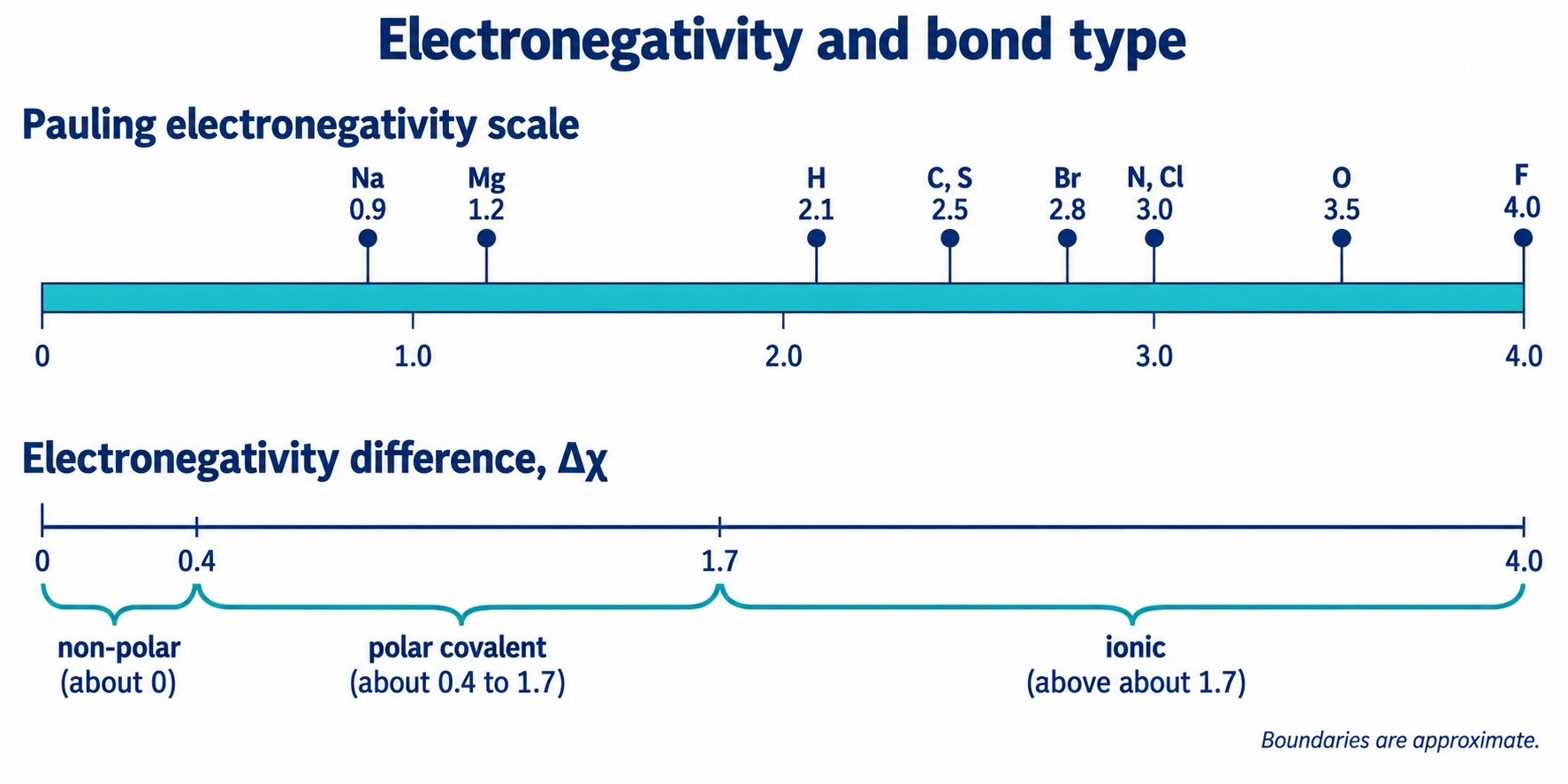
The Pauling scale is relative: only the differences between two bonded atoms matter.
| Bond | Difference in Pauling values | Type of bond |
|---|---|---|
| C-H | 2.5 – 2.1 = 0.4 | Almost non-polar covalent |
| H-Cl | 3.0 – 2.1 = 0.9 | Polar covalent, Hδ+-Clδ- |
| O-H | 3.5 – 2.1 = 1.4 | Strongly polar covalent |
| Na-Cl | 3.0 – 0.9 = 2.1 | Ionic |
Exam sentence: The greater the difference in electronegativity between the bonded atoms, the more polar the bond; the more electronegative atom carries the δ– charge.
Quick Check: Which Number Answers the Question
Five quick decisions: some need the bond enthalpy, some need the Pauling values.
Quick Check: Strength Is Not Polarity
In each round, pick the one statement that is accurate.
Common Exam Mistakes
- Giving average bond enthalpy a negative sign. Breaking bonds is endothermic, so the value is always positive.
- Forgetting the word gaseous in the definition. Bond enthalpies refer to molecules in the gas phase.
- Putting units on electronegativity. The Pauling scale is relative and has no units.
- Assuming a strong bond is always non-polar, or a polar bond is always weak. Bond enthalpy and polarity are separate ideas: H-Cl is both strong (432 kJ mol-1) and polar.
- Treating C=C as twice as strong as C-C. It is 612 compared with 347 kJ mol-1, so the extra π bond is weaker than the σ bond.
Exam sentence: Bond enthalpy measures strength; electronegativity difference measures polarity. Quote the numbers when you compare bonds.
Master Covalent Bonding and Shapes of Molecules for OCR A Level Chemistry A
Continue from these free revision notes into the full 2.2.2 Covalent Bonding and Shapes of Molecules course. The guided video lessons are ready now; the OCR A MCQ bank, teacher-marked short-answer questions and KASP spec-point report are being written, and the course opens for enrolment as soon as they are complete.
Guided video teaching
Learn the chemistry and exam technique through structured video lessons with worked examples and walkthroughs.
Instant MCQ feedback
Auto-marked MCQ quizzes provide immediate diagnostic feedback for every answer choice.
Teacher-marked SAQs
Submit written exam responses and receive chemistry specialist feedback with improvement guidance.
Progress tracking
Identify strengths and weaknesses across the full 2.2.2 specification with targeted reporting.
See how the course works
Click play to start the course preview animation.
Some ionic radii are shown.
| Ion | Ionic radius / nm |
|---|---|
| Na+ | 0.102 |
| K+ | 0.138 |
| F− | 0.133 |
| Cl− | 0.180 |
Which compound has the strongest ionic bonding?
Explain why the metallic bonding in magnesium is much stronger than that in sodium.
Copyright and author footprint: This OLS revision page was written for Online Learning System by Dr. Mohammed Al-Fatah. It is designed for A Level Chemistry revision and should not be copied or redistributed without permission.
Keep this note — free
Save your progress across every OCR A topic. A free account remembers which topics you have covered, saves your question scores, and syncs across your phone and laptop.
- Track every topic you have finished
- Keep your practice-question scores
- No payment, no card, free forever
Already registered? Log in