Choosing Solvents
A concise revision guide to how intermolecular forces decide the choice of solvent: hydration of ions, alcohols dissolving in water by hydrogen bonding, why water is a poor solvent for haloalkanes, and like-dissolves-like for non-aqueous solvents, for OCR A A Level Chemistry.
GCSE Recap: Solutes, Solvents and Layers
Before you start, check the words you will need and one thing you already know about oil and water.
What Decides Whether Something Dissolves
A substance dissolves in a solvent when the attractions formed between solute and solvent particles are strong enough to compensate for the attractions broken within the solute and within the solvent. Dissolving is therefore a balance of intermolecular forces, and the rule of thumb “like dissolves like” simply means that the new solute-solvent attractions must be of a similar kind and strength to the ones being lost. The two do not have to balance exactly: a small energy cost can still be paid, which is why solids such as ammonium nitrate dissolve even though the solution gets colder as they do.
Three questions decide the outcome: what holds the solute together (ionic lattice, hydrogen bonds, permanent dipoles or London forces), what holds the solvent together, and what the two can form with each other.
Key idea: Energy is needed to break solute-solute and solvent-solvent attractions; energy is released when solute-solvent attractions form. Dissolving happens when the two roughly balance.
Quick Check: What Holds the Solute Together?
Five quick questions on the first of the three questions from this card.
Water Dissolving Ionic Compounds: Hydration of Ions
Water is polar: its oxygen is δ- and its hydrogens δ+. When an ionic solid such as sodium chloride is placed in water, the δ- oxygen atoms of water molecules are attracted to the Na⁺ ions and the δ+ hydrogen atoms to the Cl⁻ ions. Each ion that leaves the lattice becomes surrounded by a shell of correctly oriented water molecules; this is hydration, and the attractions formed are called ion-dipole attractions.
The energy released by hydrating the ions is comparable to the energy needed to break up the lattice, so sodium chloride dissolves. Magnesium oxide does not dissolve appreciably. Its ions carry 2+ and 2- charges and are small, so they pull on each other far more strongly than Na⁺ and Cl⁻ do, and breaking that lattice costs far more energy than hydrating the ions can release.
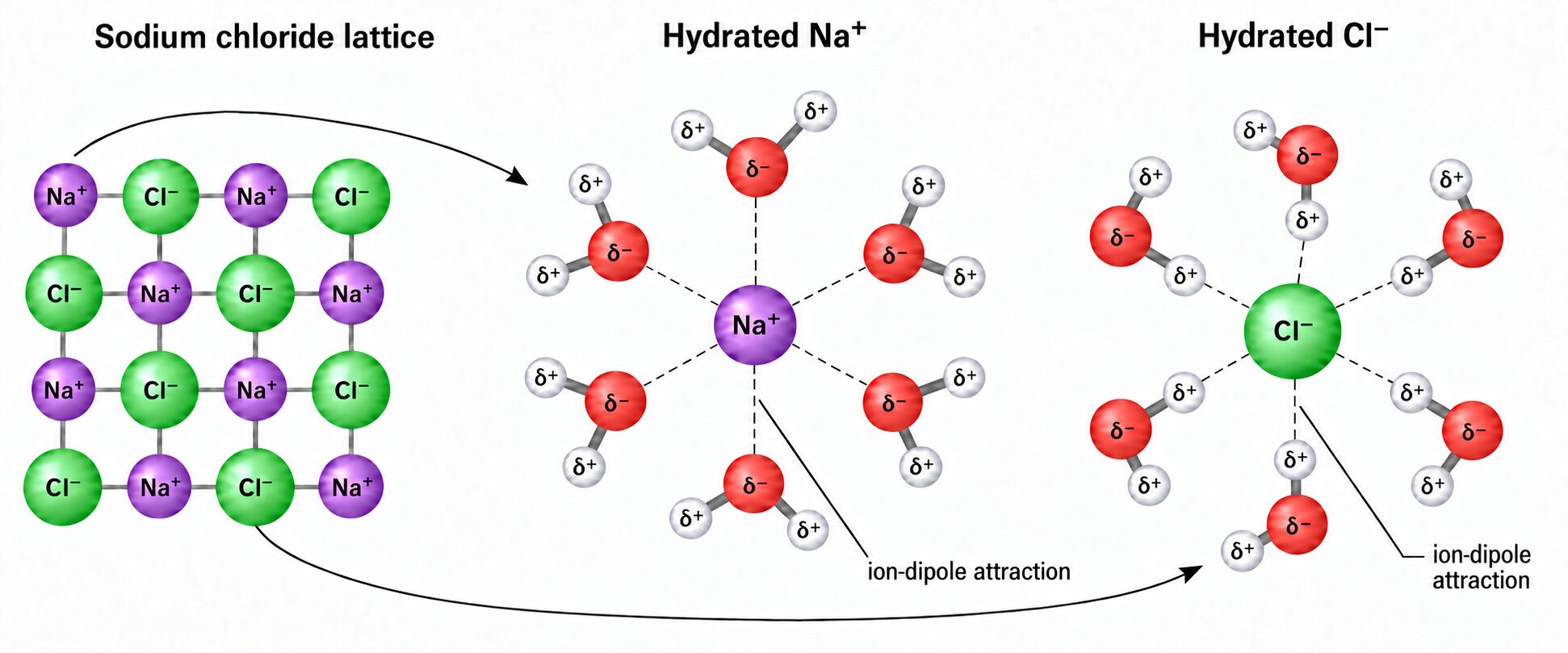
Hydration: water molecules orient their δ- oxygens towards cations and their δ+ hydrogens towards anions, and the attractions formed pay for breaking the lattice.
Exam sentence: Sodium chloride dissolves in water because the δ- oxygen atoms of water molecules attract the Na⁺ ions and the δ+ hydrogen atoms attract the Cl⁻ ions; the energy released when the ions are hydrated compensates for the energy needed to break the ionic lattice.
Quick Check: One Salt Dissolves, One Does Not
Drag the words into place to explain why two ionic solids behave so differently in water.
Water Dissolving Alcohols: Hydrogen Bonding
Methanol, ethanol and propan-1-ol mix with water in all proportions because the O-H group of the alcohol forms hydrogen bonds with water molecules. The hydrogen bonds formed between alcohol and water are similar in strength to the hydrogen bonds broken within the water and within the alcohol, so there is no barrier to mixing.
As the carbon chain grows the alcohol becomes less soluble: methanol, ethanol and propan-1-ol mix in all proportions, butan-1-ol dissolves only to about 7 g per 100 g of water and hexan-1-ol to less than 1 g. The long non-polar chain can only form London forces with water, and to make room for it water must break hydrogen bonds that the chain cannot replace. The hydrocarbon part outweighs the single O-H group.
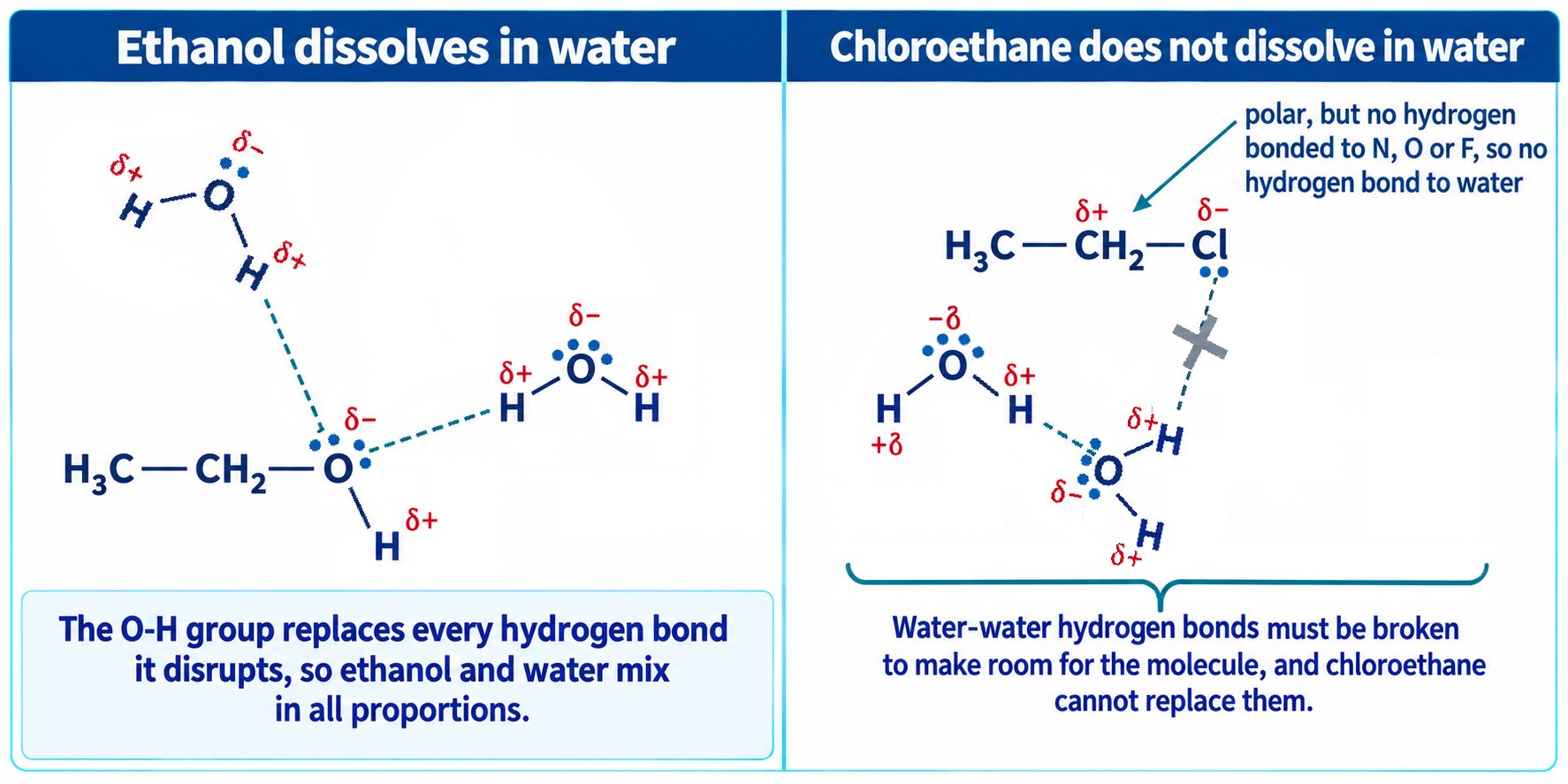
Ethanol forming hydrogen bonds with water beside chloroethane, which cannot hydrogen bond and so does not dissolve
Ethanol dissolves because its O-H group replaces the water hydrogen bonds it disrupts; chloroethane cannot form hydrogen bonds with water, so it does not dissolve.
Key idea: Small alcohols are miscible with water because they hydrogen bond with it; solubility falls as the non-polar chain lengthens.
Quick Check: Two Alcohols, Same Electrons
Explain why one of these alcohols mixes with water and the other barely dissolves.
Why Water Is a Poor Solvent for Haloalkanes
Haloalkanes such as chloroethane are polar molecules: the C-Cl bond has a permanent dipole. Yet they are almost insoluble in water. The reason is that a haloalkane cannot form hydrogen bonds with water: it has no hydrogen bonded to N, O or F, and the halogen atom is a poor acceptor of hydrogen bonds. To dissolve, the haloalkane would have to break hydrogen bonds between water molecules to make space for itself, and the weak permanent dipole–dipole interactions it could form with water would not pay back that energy.
The same argument applies to many polar molecules without an O-H or N-H group, and it explains why “polar” does not automatically mean “soluble in water”. The question is always whether the solute can form hydrogen bonds with water, or at least attractions comparable to the ones it disrupts. A solute does not have to donate a hydrogen bond to dissolve: accepting one is enough. Propanone has no O-H, but the lone pairs on its C=O oxygen accept hydrogen bonds from the δ+ hydrogens of water, which is why it mixes with water in all proportions. A halogen atom accepts far too weakly for that.
| Solute | Polar? | Can hydrogen bond with water? | Soluble in water? |
|---|---|---|---|
| Ethanol, C₂H₅OH | yes | yes, O-H | miscible |
| Propanone, CH₃COCH₃ | yes | yes, C=O accepts from water | miscible |
| Chloroethane, C₂H₅Cl | yes | no | almost insoluble |
| Hexane, C₆H₁₄ | no | no | insoluble |
| Sodium chloride | ionic | ions are hydrated | soluble |
Exam sentence: Chloroethane does not dissolve in water because chloroethane molecules cannot form hydrogen bonds with water molecules; the hydrogen bonds between water molecules that would have to be broken are not replaced by attractions of similar strength.
Quick Check: Pick the Accurate Statement
In each round, choose the one statement that is accurate.
Non-Aqueous Solvents: Like Dissolves Like
Substances that water cannot dissolve usually dissolve in a solvent whose intermolecular forces match their own. A non-polar solute dissolves in a non-polar solvent because the London forces broken between solute molecules and between solvent molecules are replaced by London forces of similar strength between solute and solvent. Iodine dissolves readily in hexane or cyclohexane but only slightly in water; grease and candle wax dissolve in hexane; haloalkanes dissolve in hexane and in ethanol.
| Solute | Forces within the solute | Good solvent | Poor solvent |
|---|---|---|---|
| Iodine, I₂ | London forces | hexane, cyclohexane | water |
| Candle wax (long alkanes) | London forces | hexane, white spirit | water |
| Chloroethane | permanent dipole–dipole interactions and London forces | hexane, ethanol | water |
| Sodium chloride | ionic lattice | water | hexane |
| Sugar (sucrose) | hydrogen bonds (many O-H) | water | hexane |
The choice of solvent matters in practical chemistry: an organic product is extracted from an aqueous mixture with a non-polar solvent in a separating funnel because the product dissolves in the organic layer and the ionic impurities stay in the water. Two layers form because neither liquid dissolves in the other: the water molecules hold on to each other by hydrogen bonds that a non-polar solvent cannot replace. The organic layer is usually the upper one, because most organic solvents are less dense than water, and you can identify the layers by adding a little more water and seeing which one grows. The lower layer is run out of the tap first.
Ethanol is useful because it is both at once: the O-H group hydrogen bonds like water, while the ethyl group sits happily among non-polar molecules. Ethanol therefore dissolves some ionic solids and many organic ones, which is why it appears in the table as a solvent for chloroethane.
Exam focus: When asked to choose or justify a solvent, name the strongest force in the solute, name the strongest force in the candidate solvent, and say whether the solute-solvent attractions formed can replace those broken.
Quick Check: Choose the Solvent
Click every substance that would dissolve better in a non-polar solvent than in water.
Common Exam Points
Explain why sodium chloride dissolves in water
δ- oxygen of water attracts Na⁺, δ+ hydrogen attracts Cl⁻; the energy released on hydrating the ions compensates for the energy needed to break the lattice.
Explain why ethanol mixes with water but hexane does not
Ethanol forms hydrogen bonds with water; hexane can only form London forces, which cannot replace the hydrogen bonds broken in water.
Explain why a polar haloalkane is insoluble in water
It cannot hydrogen bond with water; the attractions it forms do not compensate for the water hydrogen bonds broken.
Suggest a solvent for iodine
A non-polar solvent such as hexane, because both are held by London forces only.
FAQs
Use these quick answers to check how intermolecular forces decide what dissolves in what.
Why does sodium chloride dissolve in water?
The δ- oxygen atoms of water molecules are attracted to the Na⁺ ions and the δ+ hydrogen atoms to the Cl⁻ ions, so the ions become hydrated. The energy released by hydration compensates for the energy needed to break up the ionic lattice.
Why do small alcohols mix with water?
The O-H group of the alcohol forms hydrogen bonds with water molecules that are similar in strength to the ones being broken, so there is no barrier to mixing. Solubility falls as the carbon chain lengthens.
Why does a polar haloalkane not dissolve in water?
It has no hydrogen bonded to N, O or F, so it cannot form hydrogen bonds with water. The water-water hydrogen bonds that must be broken to make room for it are not replaced by attractions of similar strength.
What does “like dissolves like” actually mean?
It means the solute-solvent attractions formed must be of the same kind and strength as the solute-solute and solvent-solvent attractions broken. Iodine dissolves in hexane because both are held only by London forces.
Does polar always mean water-soluble?
No. Chloroethane is polar but almost insoluble in water, because its dipole is not enough to replace the hydrogen bonds it disrupts. The question to ask is whether the solute can hydrogen bond with water.
Copyright and author footprint: This OLS revision page was written for Online Learning System by Dr. Mohammed Al-Fatah. It is designed for A Level Chemistry revision and should not be copied or redistributed without permission.
Keep this note — free
Save your progress across every OCR A topic. A free account remembers which topics you have covered, saves your question scores, and syncs across your phone and laptop.
- Track every topic you have finished
- Keep your practice-question scores
- No payment, no card, free forever
Already registered? Log in