Anomalous Properties of Water
A concise revision guide to the anomalous properties of water: its high melting point and boiling point, the open structure and low density of ice, surface tension and the Group 14 to 17 hydride graph, all explained by hydrogen bonding, for OCR A A Level Chemistry.
GCSE Recap: Solids, Density and Boiling
Before you start, check three GCSE ideas that water is about to disobey.
Why Water Is Anomalous
Water has a much higher melting point and boiling point, a solid that is less dense than its liquid, and a higher surface tension than any molecule of its size should have. Every one of these anomalous properties is caused by hydrogen bonding. A molecule with only 10 electrons would be expected to boil below -80 °C if London forces were the only force present; water boils at 100 °C.
Each water molecule can form up to four hydrogen bonds, more than any other small molecule, so a very large amount of energy is needed to separate the molecules. This is the single explanation behind all the anomalies on this page. A hydrogen bond needs about 20 kJ mol⁻¹ to break, against about 460 kJ mol⁻¹ for the covalent O-H bond, which is why boiling water separates the molecules and leaves every covalent bond intact.
Key idea: Two O-H bonds and two lone pairs per molecule mean water forms the maximum number of hydrogen bonds, and every anomalous property follows from that.
Quick Check: Count the O-H Bonds
Apply the counting argument to a molecule that is not on this page.
High Melting point and Boiling point
The hydrides of Group 16 show the effect most clearly. Going down the group from H₂S to H₂Te the boiling point rises steadily because the number of electrons rises and the London forces strengthen: a larger electron cloud distorts more easily, so it produces larger momentary dipoles. Extending that trend upwards predicts a boiling point for water of about -80 °C. The real value is 100 °C, because hydrogen bonds between water molecules are far stronger than the London forces and permanent dipole–dipole interactions that hold the other hydrides together.
| Hydride | Electrons | boiling point / °C | Strongest intermolecular force |
|---|---|---|---|
| H₂O | 10 | 100 | hydrogen bonds |
| H₂S | 18 | -60 | permanent dipole–dipole interactions |
| H₂Se | 36 | -41 | permanent dipole–dipole interactions (London forces growing) |
| H₂Te | 54 | -2 | London forces dominate |
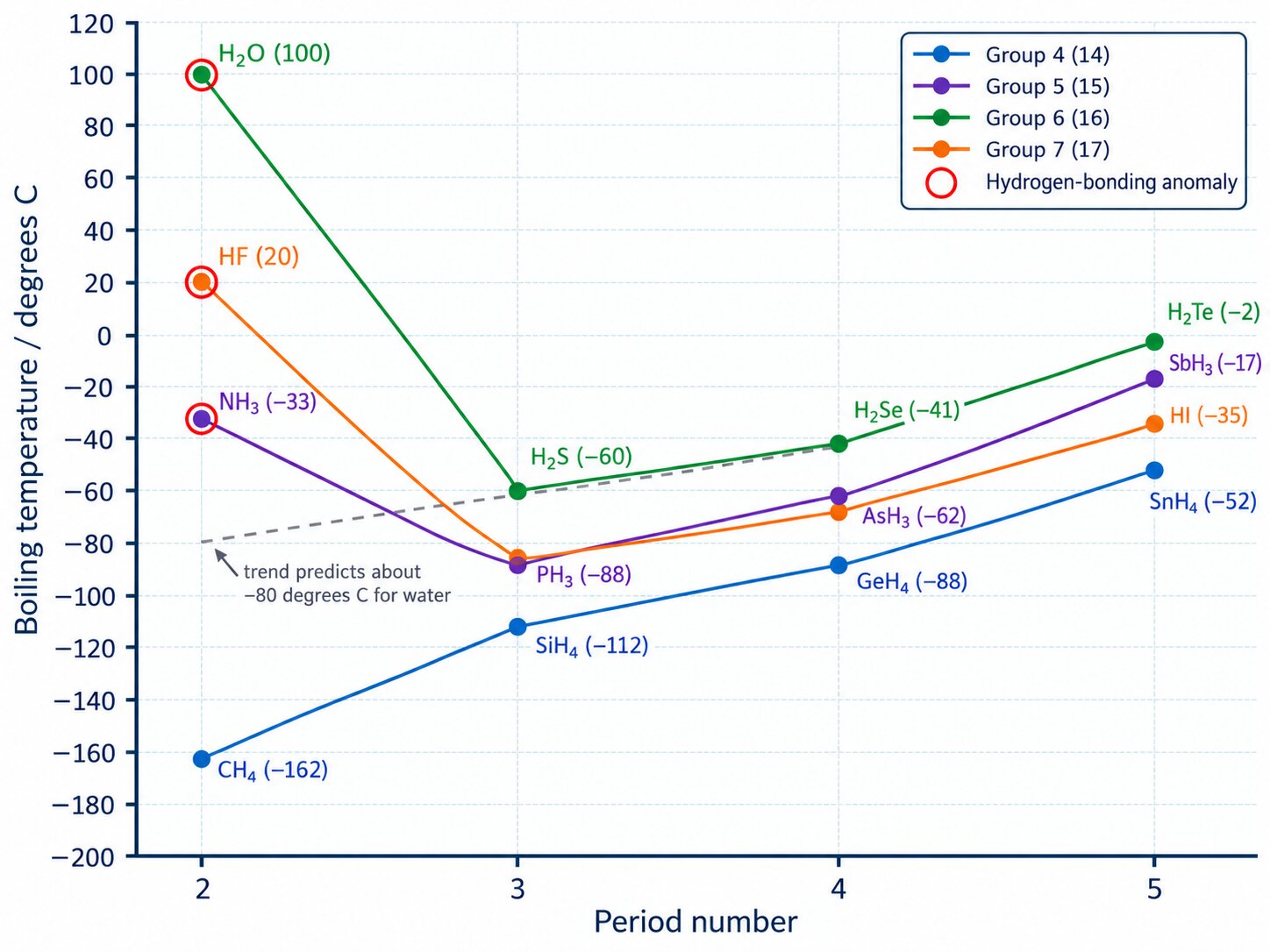
Boiling points of the Group 14 to 17 hydrides, with water, ammonia and hydrogen fluoride standing far above the trend because of hydrogen bonding
NH₃, H₂O and HF sit far above the trend of their groups because of hydrogen bonding; CH₄ does not, because carbon is not electronegative enough for C-H to hydrogen bond.
The same graph shows that methane is not anomalous: carbon is not electronegative enough for a C-H hydrogen to form a hydrogen bond, so the Group 14 hydrides follow a smooth London forces trend. Ammonia and hydrogen fluoride are anomalous but less so than water, because each forms on average only one hydrogen bond per molecule. Hydrogen fluoride has three lone pairs but only one hydrogen to donate, and ammonia has three hydrogens but only one lone pair to accept, so in each case the smaller number sets the count.
Exam sentence: Water has a much higher boiling point than H₂S because water molecules form hydrogen bonds, which are much stronger than the permanent dipole–dipole interactions and London forces between H₂S molecules, so much more energy is needed to separate water molecules.
Quick Check: Explain a Hydride That Breaks Its Trend
Write a short explanation, then compare it with the mark points and the model answer.
The Density of Ice
Ice floats on water because it is less dense: 0.92 g cm⁻³ against 1.00 g cm⁻³ for water at 4 °C. Almost every other substance is denser as a solid than as a liquid, because the particles pack more closely when they stop moving. Water is different because of the geometry of its hydrogen bonds.
In ice each water molecule is held by four hydrogen bonds to four neighbours arranged tetrahedrally around it, and the hydrogen bonds are fixed in place. This tetrahedral arrangement builds an open hexagonal lattice with large empty spaces, like a honeycomb, so the molecules are held further apart than they would be if they could pack freely. When ice melts, some of the hydrogen bonds break and the molecules can move into the spaces, so the liquid is denser than the solid. Water reaches its maximum density at 4 °C. Between 0 °C and 4 °C open, ice-like clusters left over from the lattice are still collapsing, which lets the molecules pack closer and makes the density rise; above 4 °C the molecules move faster and thermal expansion takes over, so the density falls again.
The Open Hexagonal Lattice of Ice, and Why It Collapses on Melting
Drag to rotate, scroll or pinch to zoom. Every molecule in the ice lattice is held by four hydrogen bonds in a tetrahedral arrangement, which forces open hexagonal channels through the solid. Switch to liquid water to watch the channels collapse.
© Dr. Mohammed Al-Fatah – onlinelearningsystem.net
This has consequences beyond the exam: ice on a pond insulates the water below it, so aquatic life survives winter, and water expanding as it freezes shatters rocks and bursts pipes.
Exam sentence: Ice is less dense than water because hydrogen bonds hold the water molecules in a fixed, open tetrahedral lattice with large spaces; when ice melts some hydrogen bonds break and the molecules move closer together.
Quick Check: How Much Does Ice Expand?
Use the two densities on this card to work out the change in volume.
Surface Tension
Water has a high surface tension because the molecules at the surface are pulled inwards and sideways by hydrogen bonds to their neighbours, with no molecules above to balance the pull. The surface therefore behaves like a stretched skin that resists being broken or increased in area. This is why water forms near-spherical droplets, why a steel needle can be floated on water and why pond skaters walk on it.
Liquids held only by London forces, such as hexane, have a much lower surface tension because far less energy is needed to create new surface. Adding a detergent to water lowers its surface tension by placing molecules at the surface that cannot hydrogen bond as strongly.
Exam focus: Surface tension is not named in the OCR A specification, but it appears in data-response questions; explain it with the same hydrogen-bonding argument.
Quick Check: A Liquid With a Lower Surface Tension
Explain why a liquid that does form hydrogen bonds still has a much lower surface tension than water.
Other Consequences of Hydrogen Bonding in Water
Water also has an unusually high specific heat capacity and a high enthalpy change of vaporisation, because energy supplied to water is used to break hydrogen bonds before the molecules can move faster or escape as a gas. These properties make water an excellent coolant and moderate the climate of coastal regions. Water is also an excellent solvent for ionic compounds and for molecules that can hydrogen bond, which the Choosing Solvents page explains.
| Property | Value for water | Comparison | Cause |
|---|---|---|---|
| Boiling point | 100 °C | H₂S: -60 °C | four hydrogen bonds per molecule |
| Density of solid | 0.92 g cm⁻³ | liquid: 1.00 g cm⁻³ | open hydrogen-bonded lattice |
| Surface tension | 72 mN m⁻¹ | hexane: 18 mN m⁻¹ | surface molecules pulled inwards by hydrogen bonds |
| Specific heat capacity | 4.18 J g⁻¹ K⁻¹ | ethanol: 2.44 J g⁻¹ K⁻¹ | energy breaks hydrogen bonds before raising temperature |
| Enthalpy change of vaporisation | 41 kJ mol⁻¹ | H₂S: 19 kJ mol⁻¹ | hydrogen bonds must be broken before a molecule can escape |
Key idea: Whatever the anomalous property, the answer begins “because water molecules form hydrogen bonds” and ends with what those bonds do.
Quick Check: Pick the Accurate Statement
In each round, choose the one statement that is accurate.
Common Exam Points
Explain why ice floats
Hydrogen bonds hold molecules in an open tetrahedral lattice with spaces; on melting some bonds break and molecules move closer, so the liquid is denser.
Explain the boiling point of water compared with H₂S
Hydrogen bonds between water molecules are stronger than the permanent dipole–dipole interactions and London forces between H₂S molecules.
Why is CH₄ not anomalous?
Carbon is not electronegative enough for C-H hydrogens to form hydrogen bonds.
Do not say
“Ice has stronger hydrogen bonds than water” (the bonds are the same strength; ice has more of them held rigidly); “covalent bonds break when ice melts”.
FAQs
Use these quick answers to check the explanations for water that OCR A questions ask for.
Why is the boiling point of water so high?
Each water molecule can form up to four hydrogen bonds, which are far stronger than the permanent dipole–dipole interactions and London forces holding together hydrides such as H₂S. Extending the Group 16 trend would predict about -80 °C; water boils at 100 °C.
Why does ice float on water?
In ice the hydrogen bonds hold each molecule to four neighbours in a fixed tetrahedral arrangement, building an open hexagonal lattice with large spaces. When ice melts some hydrogen bonds break and the molecules move closer together, so the liquid is denser.
Why is methane not anomalous?
Carbon is not electronegative enough for the hydrogen atoms in CH₄ to carry a large δ+ charge, so methane cannot hydrogen bond. The Group 14 hydrides follow a smooth trend set by their number of electrons.
Why does water have a high surface tension?
Molecules at the surface have no neighbours above them, so the hydrogen bonds pull them inwards and sideways. Making new surface therefore costs energy, which is why water forms beads and supports a floating needle.
Are the hydrogen bonds in ice stronger than in water?
No, they are the same strength. Ice simply has more of them and holds them in fixed positions, which is what produces the open structure.
Copyright and author footprint: This OLS revision page was written for Online Learning System by Dr. Mohammed Al-Fatah. It is designed for A Level Chemistry revision and should not be copied or redistributed without permission.
Keep this note — free
Save your progress across every OCR A topic. A free account remembers which topics you have covered, saves your question scores, and syncs across your phone and laptop.
- Track every topic you have finished
- Keep your practice-question scores
- No payment, no card, free forever
Already registered? Log in