Geometric Isomerism
A concise revision guide to stereoisomerism in alkenes, restricted rotation around C=C bonds, E-Z naming, priority groups and the link between E-Z and cis-trans isomerism.
What Are Stereoisomers?
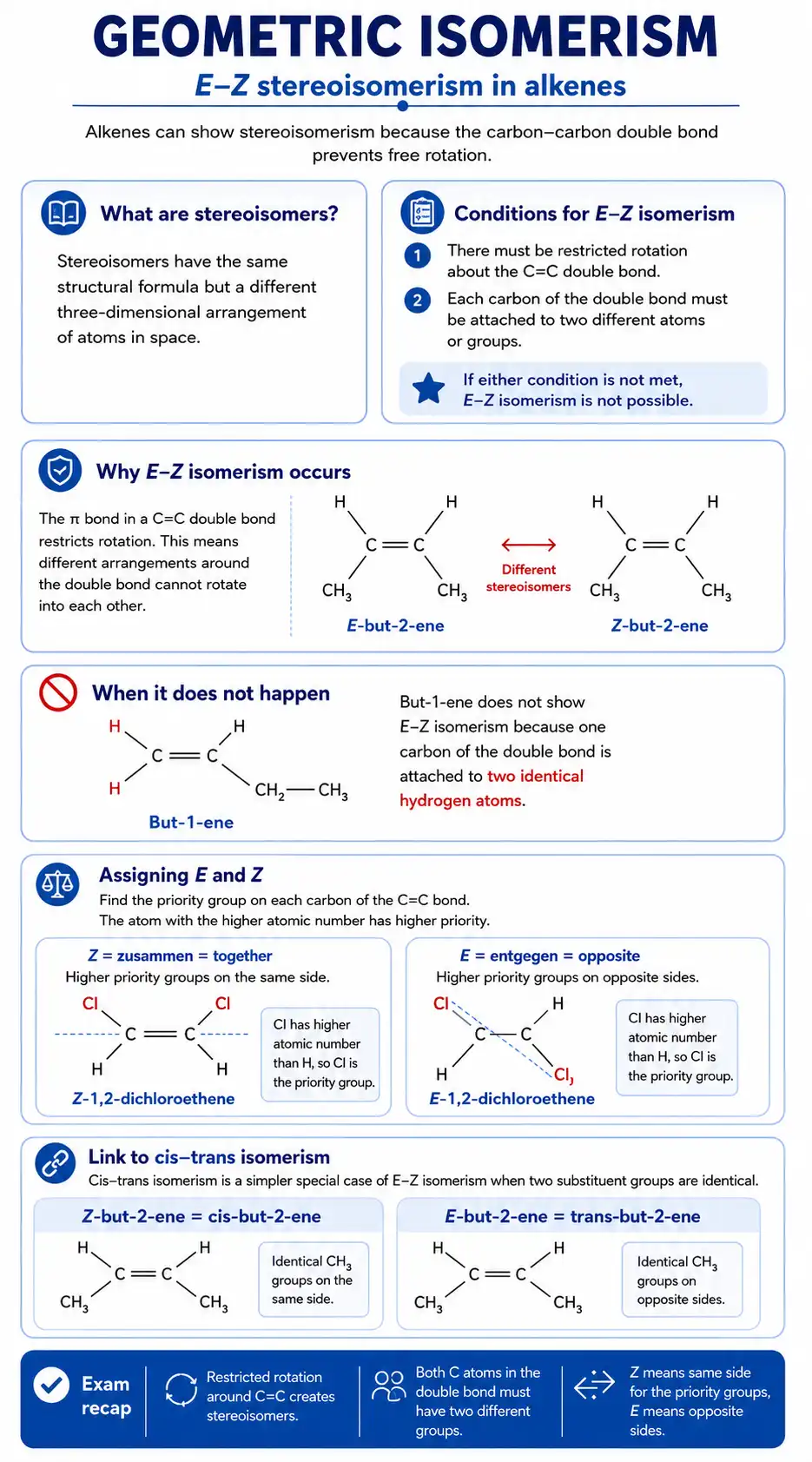
Stereoisomers are compounds with the same structural formula but a different three-dimensional arrangement of atoms in space.
In alkenes, this matters because the C=C double bond restricts rotation. The atoms or groups attached to the double bond cannot freely rotate into a new arrangement without breaking the pi bond.
This produces a type of stereoisomerism called E-Z stereoisomerism, also called geometric isomerism.
Key idea: E-Z isomers are not structural isomers. They have the same connectivity, but different spatial arrangement around the carbon-carbon double bond.
Why E-Z Isomerism Occurs
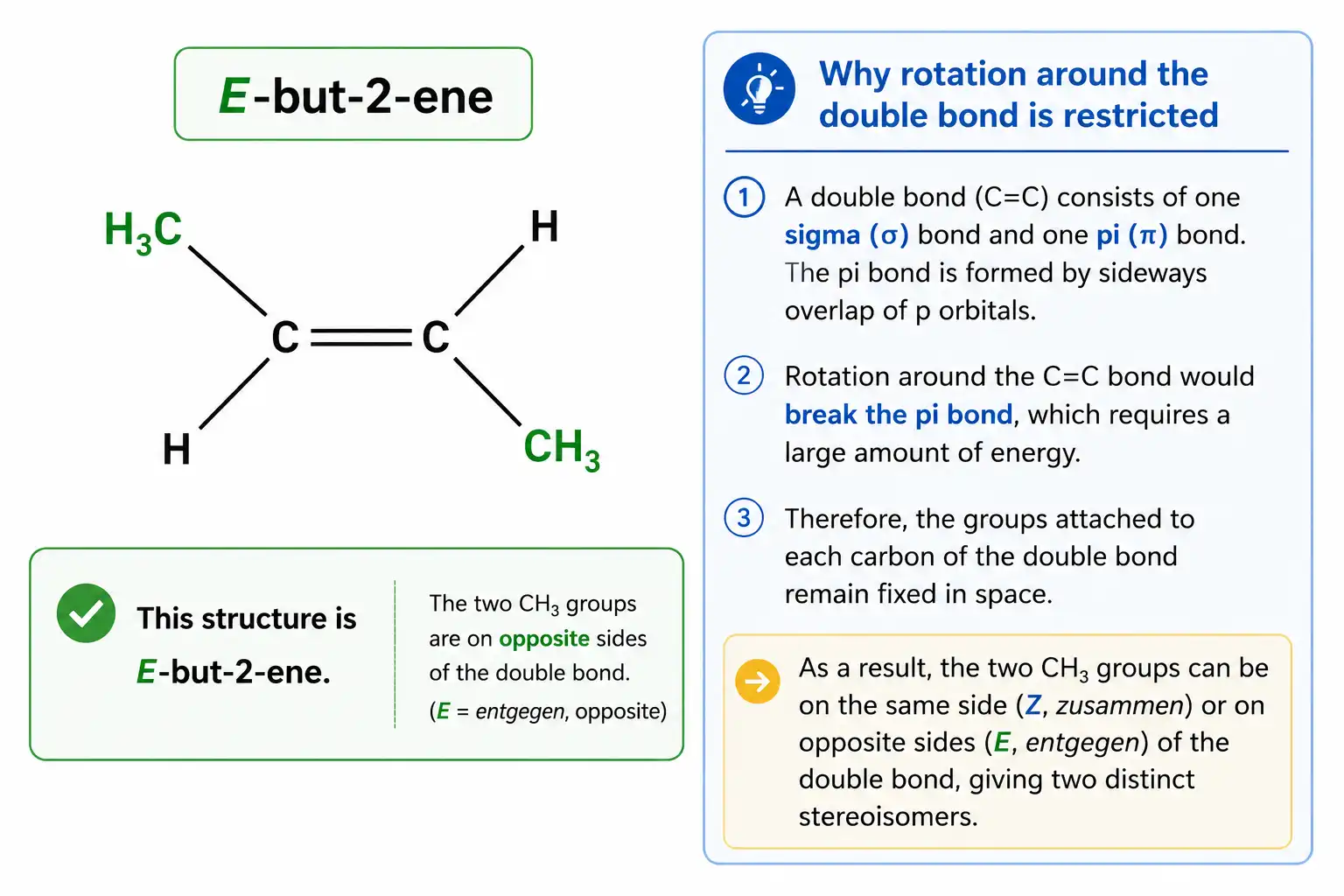
E-Z isomerism occurs because the carbon-carbon double bond contains a pi bond. Rotation around the C=C bond is restricted because rotating one carbon would break the sideways overlap of the p orbitals.
By contrast, a carbon-carbon single bond can rotate freely. This is why simple alkanes do not usually produce this type of fixed geometric arrangement.
Exam focus: Always link E-Z isomerism to restricted rotation around the C=C double bond.
Chloroethane: rotation around the C-C single bond
The C-C single bond is a σ bond. In this model, the CH₃ side remains fixed while the CH₂Cl side rotates slowly around the C-C bond axis.
Conditions for E-Z Stereoisomerism
For an alkene to show E-Z stereoisomerism, two conditions must both be met:
- There must be restricted rotation about the carbon-carbon double bond.
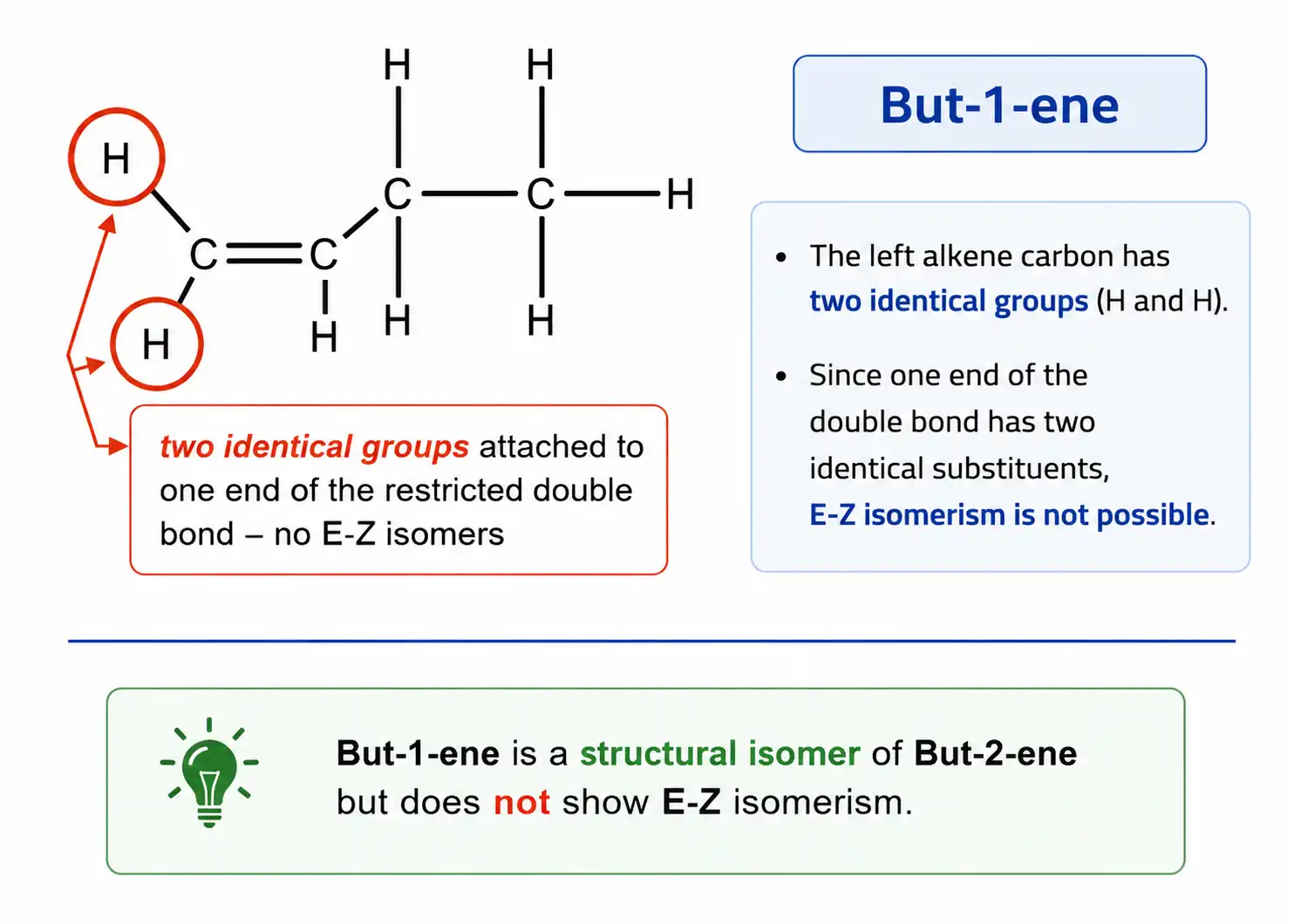
- Each carbon atom of the C=C bond must be attached to two different atoms or groups.
If either carbon in the C=C bond has two identical groups attached, E-Z isomerism is not possible.
1,2-Dichloroethene: restricted rotation around the C=C bond
The C=C double bond contains a π bond. When one side tries to rotate, the sideways overlap needed for the π bond would be disrupted, so the molecule is knocked back instead of rotating freely.
Assigning E and Z
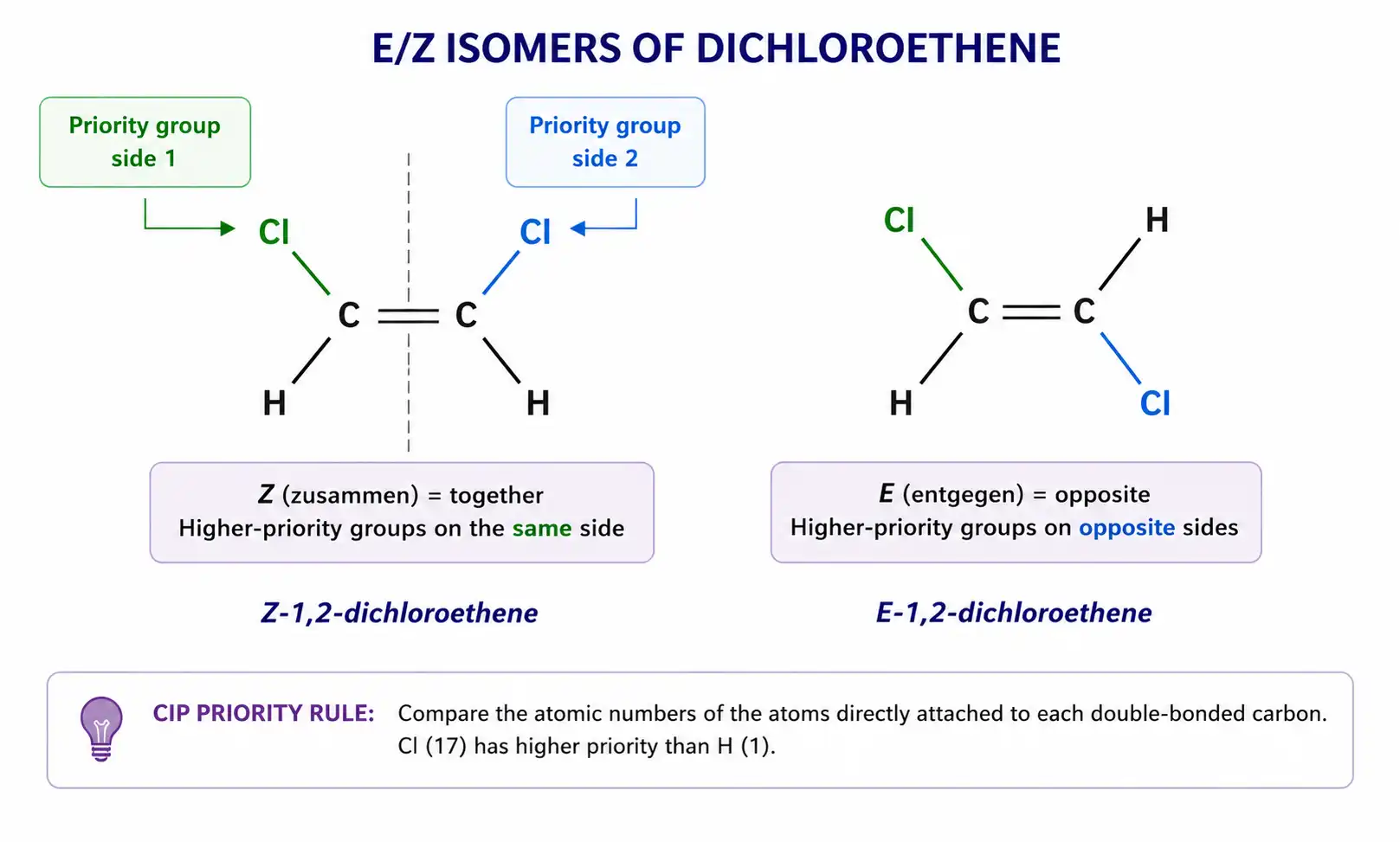
To name an alkene with E-Z stereoisomerism, first identify the priority group on each carbon atom of the double bond.
The priority group is found by comparing the atoms directly attached to each double-bond carbon. The atom with the higher atomic number has higher priority.
| Arrangement of priority groups | Name used | Memory aid |
|---|---|---|
| Priority groups on the same side of the C=C bond | Z | Z comes from zusammen, meaning together. |
| Priority groups on opposite sides of the C=C bond | E | E comes from entgegen, meaning opposite. |
Cis-Trans Isomerism
Cis-trans isomerism is a simpler special case of E-Z isomerism. It can be used when two of the substituent groups attached to the double bond are identical.
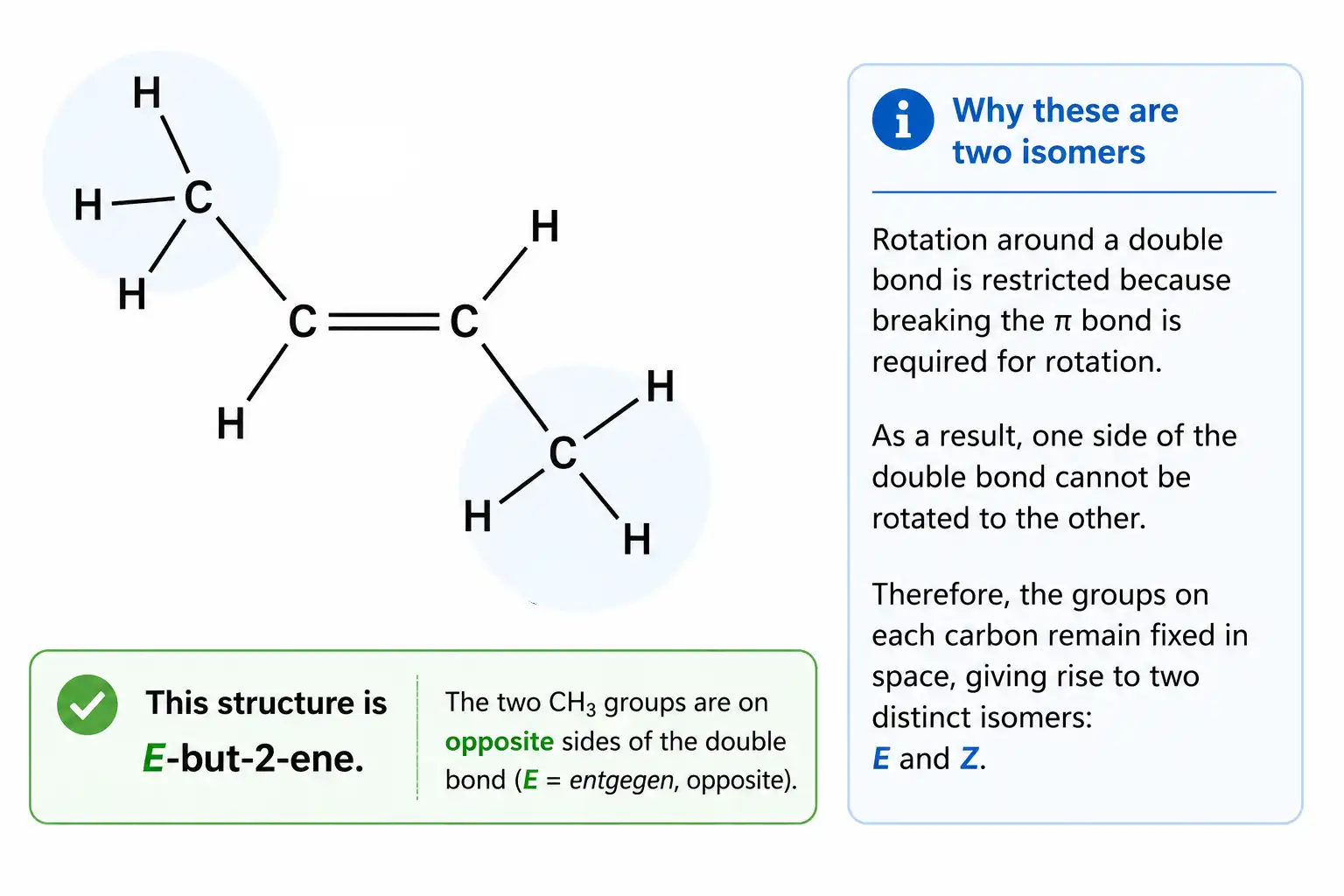
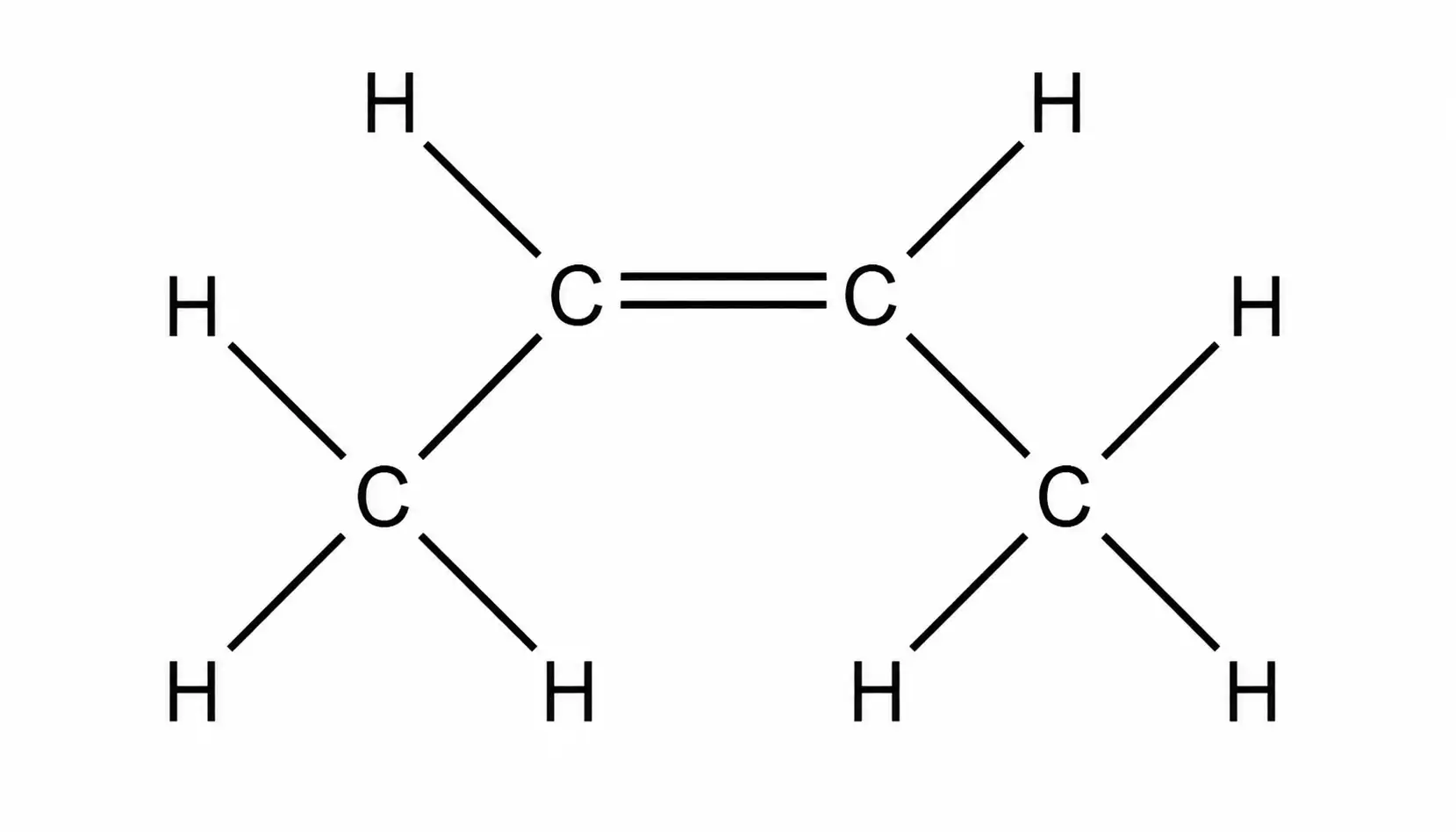
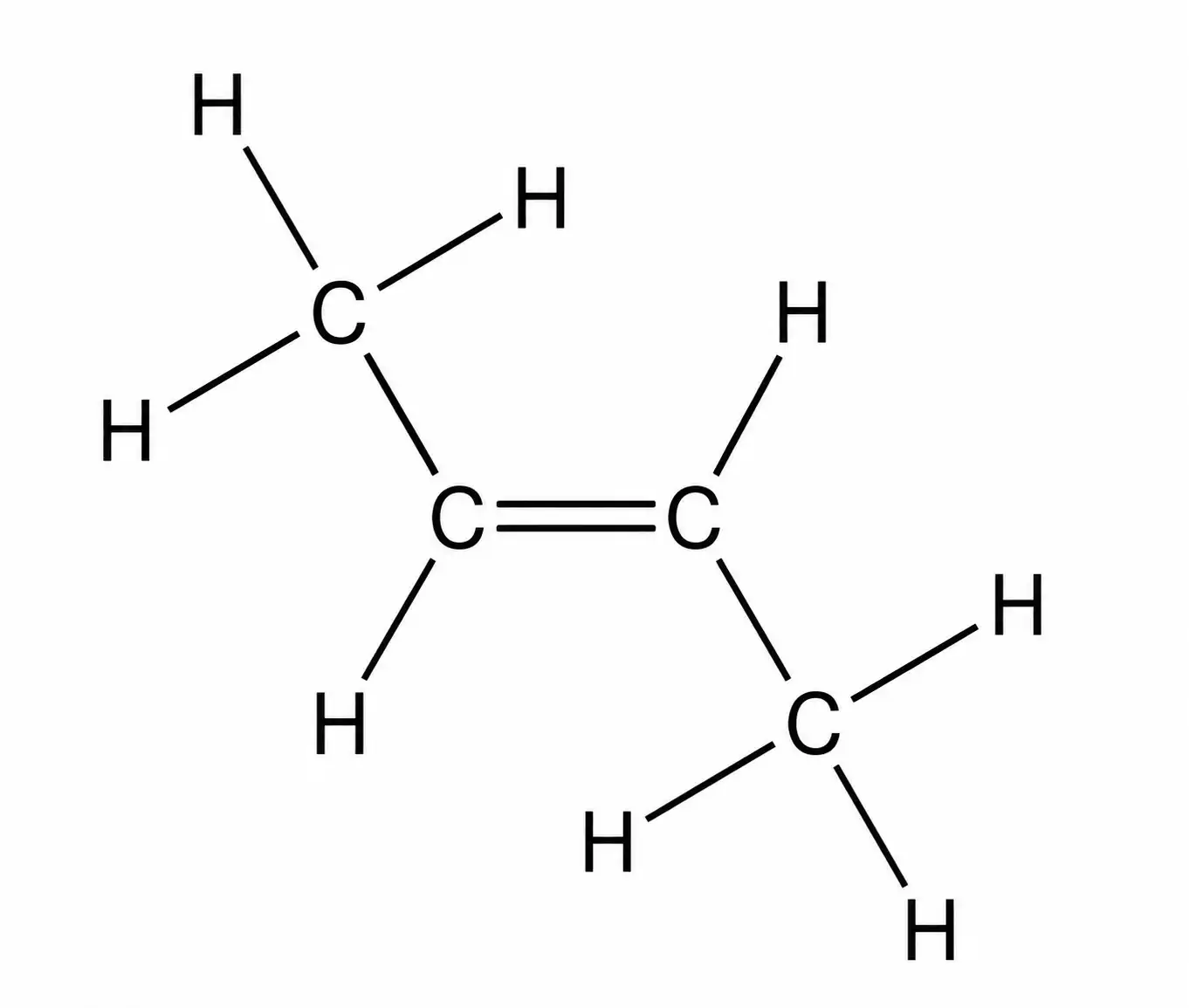
For but-2-ene, the two CH3 groups can be on the same side or on opposite sides of the double bond.
Z-but-2-ene
The two CH3 groups are on the same side, so this can also be called cis-but-2-ene.
E-but-2-ene
The two CH3 groups are on opposite sides, so this can also be called trans-but-2-ene.
Important: E-Z notation is the more general and accurate naming system, especially when the groups attached to the C=C bond are not identical.
Common Exam Mistakes
- Do not call E-Z isomers structural isomers. They have the same structural formula.
- Do not assign E or Z by only looking at the largest group visually. Use atomic number priority.
- Do not assume every alkene shows E-Z isomerism. Each carbon in the C=C bond must have two different groups attached.
- Do not say the molecule rotates around the double bond. The whole point is that rotation around C=C is restricted.
Check Your Understanding
Use these short activities to check the key ideas before moving on to electrophilic addition.
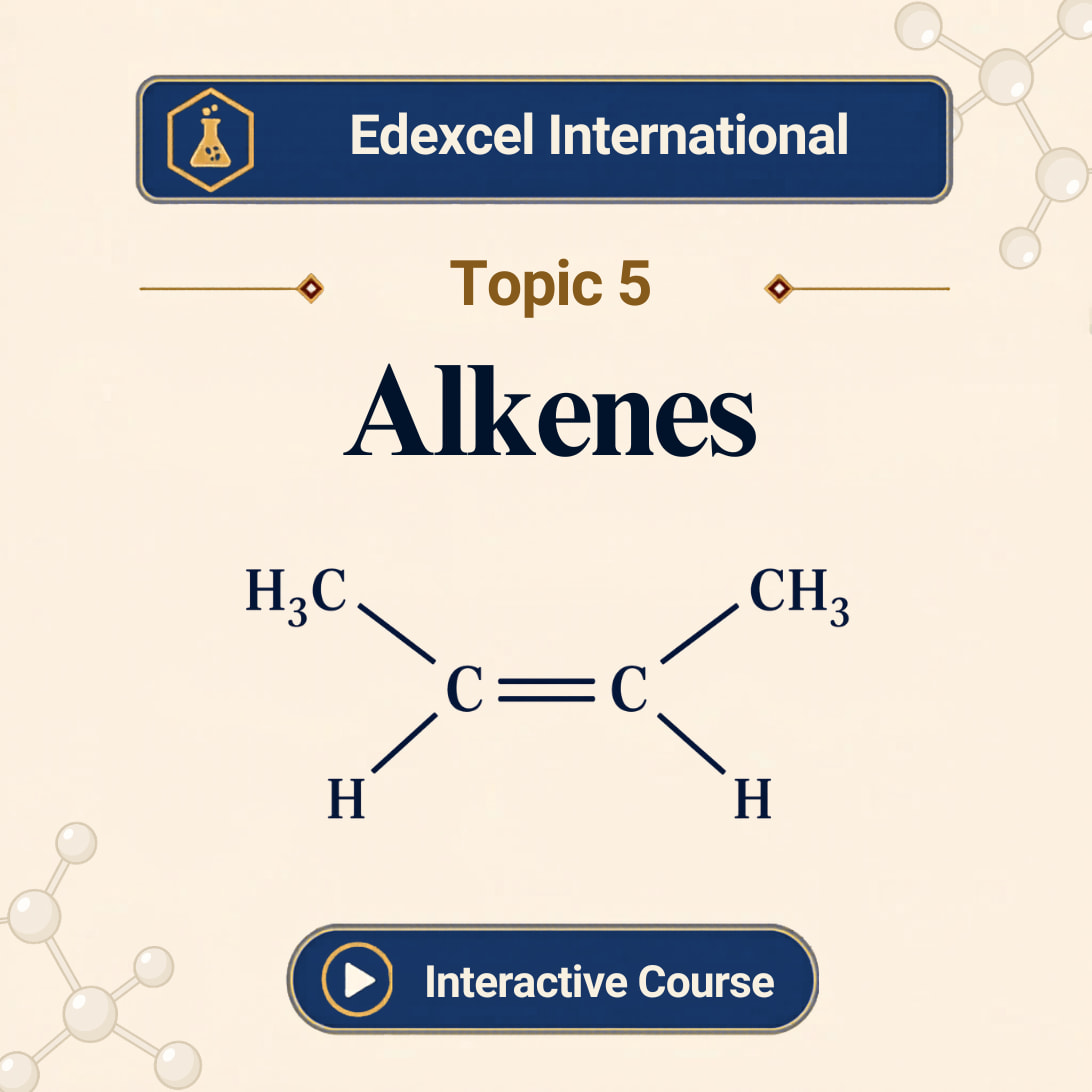
Master Alkenes for Edexcel International A Level Chemistry
Continue from these free revision notes into the full Topic 5 Alkenes course, with guided video teaching, diagnostic MCQ practice, teacher-marked short-answer questions and a specification assignment with a personalised progress report.
Guided video teaching
Learn the chemistry and exam technique through structured video lessons with worked examples and walkthroughs.
Instant MCQ feedback
Auto-marked MCQ quizzes provide immediate diagnostic feedback for every answer choice.
Teacher-marked SAQs
Submit written exam responses and receive chemistry specialist feedback with improvement guidance.
Progress tracking
Identify strengths and weaknesses across the full Topic 5 specification with targeted reporting.
See how the course works
Click play to start the course preview animation.
Some ionic radii are shown.
| Ion | Ionic radius / nm |
|---|---|
| Na+ | 0.102 |
| K+ | 0.138 |
| F− | 0.133 |
| Cl− | 0.180 |
Which compound has the strongest ionic bonding?
Explain why the metallic bonding in magnesium is much stronger than that in sodium.
Copyright notice: This OLS revision content, including the explanations, layout, diagrams, tables and embedded learning structure, is authored for Online Learning System by Dr. Mohammed Al-Fatah. It may not be copied, reproduced, redistributed or adapted without written permission.