Reactions of Alkenes with Steam
A concise revision guide to the reaction of alkenes with steam, including the conversion of ethene into ethanol, the use of concentrated phosphoric acid and why the reaction is carried out industrially rather than in a school laboratory.
- 4.6-a
- 5.4iv
What these spec points say
- 4.6-a be able to classify reactions as addition
- 5.4iv be able to describe the reactions of alkenes, limited to: the addition of steam, in the presence of an acid catalyst, to produce alcohols
GCSE Recap: Alcohols and Addition Reactions
Before you start, check what an alcohol is, what addition means and where ethanol comes from.
The Overall Reaction
Alkenes react with steam, H2O(g), to form alcohols. This reaction is called hydration because water is added across the carbon-carbon double bond.
For example, ethene reacts with steam to form ethanol.
The reaction converts the alkene functional group into an alcohol functional group. The C=C double bond opens, one hydrogen atom adds to one carbon atom, and an -OH group adds to the other carbon atom.
Key idea: Steam adds across the C=C double bond, so the alkene becomes an alcohol.
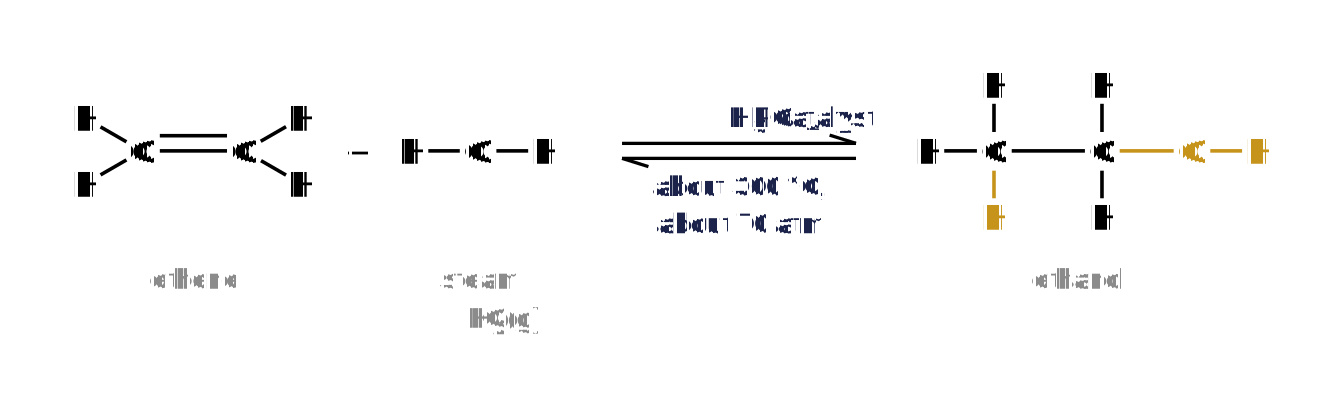
The displayed equation shows water added across the C=C double bond of ethene to produce ethanol.
Quick Check: Name the Alcohol
Apply the reaction to an alkene that this page does not use.
Watch: making an alcohol from an alkene with steam
Making an alcohol from an alkene with steam: the temperature and the pressure. And the catalyst?
Conditions for Hydration
The hydration of ethene is carried out using steam and a catalyst of concentrated H3PO4, which is phosphoric acid.
The reaction also needs a high temperature, usually around 300 °C, and a high pressure of about 60 to 70 atm.
These conditions are much more severe than the conditions normally used in a school laboratory, so the reaction is treated as an industrial process.
Exam focus: Include both the reagent and the conditions: steam, concentrated H3PO4, high temperature and high pressure.
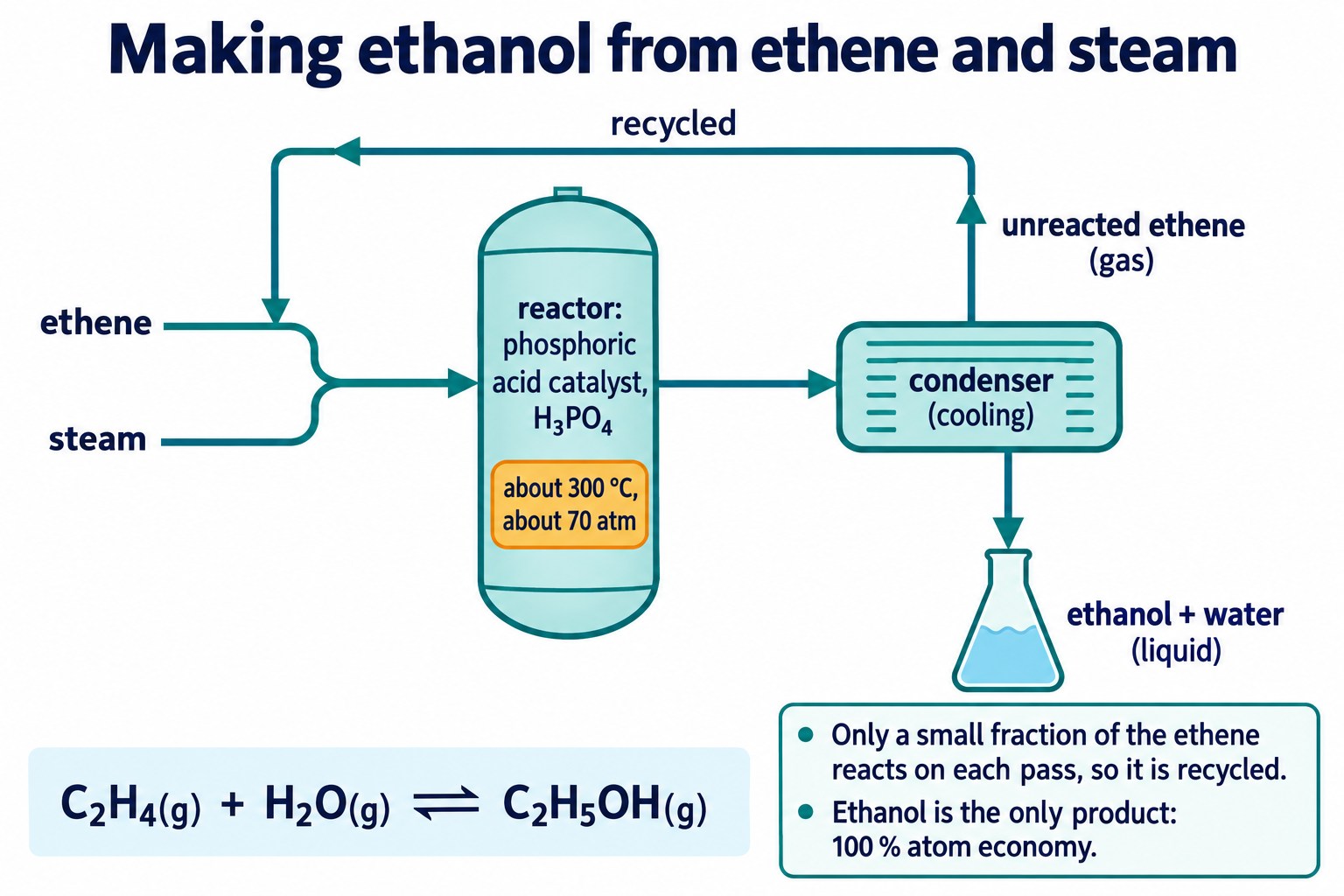
Ethene and steam pass over a phosphoric acid catalyst at high temperature and pressure; unreacted ethene is recycled.
Quick Check: Conditions for Propene
Apply the conditions to the hydration of propene, an alkene this page does not use.
Why This Is an Addition Reaction
This reaction is an addition reaction because atoms are added across the C=C double bond.
The alkene starts as an unsaturated molecule. During hydration, the double bond opens and the atoms from water are added to the two carbon atoms from the original double bond.
In the hydration of ethene, this produces only one main product: ethanol.
Hydration: An addition reaction in which water, usually as steam in this industrial process, adds across a carbon-carbon double bond to form an alcohol.
Remember: For steam, the functional group change is alkene to alcohol. This is different from hydrogenation, which converts an alkene into an alkane.
Quick Check: Two Additions Compared
Drag the words into place to complete the comparison of the two reactions.
Industrial Advantages and Exam Mistakes
The process is preferred industrially because no waste products are formed, giving the reaction a high atom economy.
Producing only one main product also makes separation simpler and cheaper, reducing overall processing costs.
A common exam error is to describe the reaction as a normal laboratory preparation. The very high pressure makes the process unsuitable for typical laboratory use.
Exam focus: Link the industrial scale to the high pressure, and link the efficiency to no waste products and easier product separation.
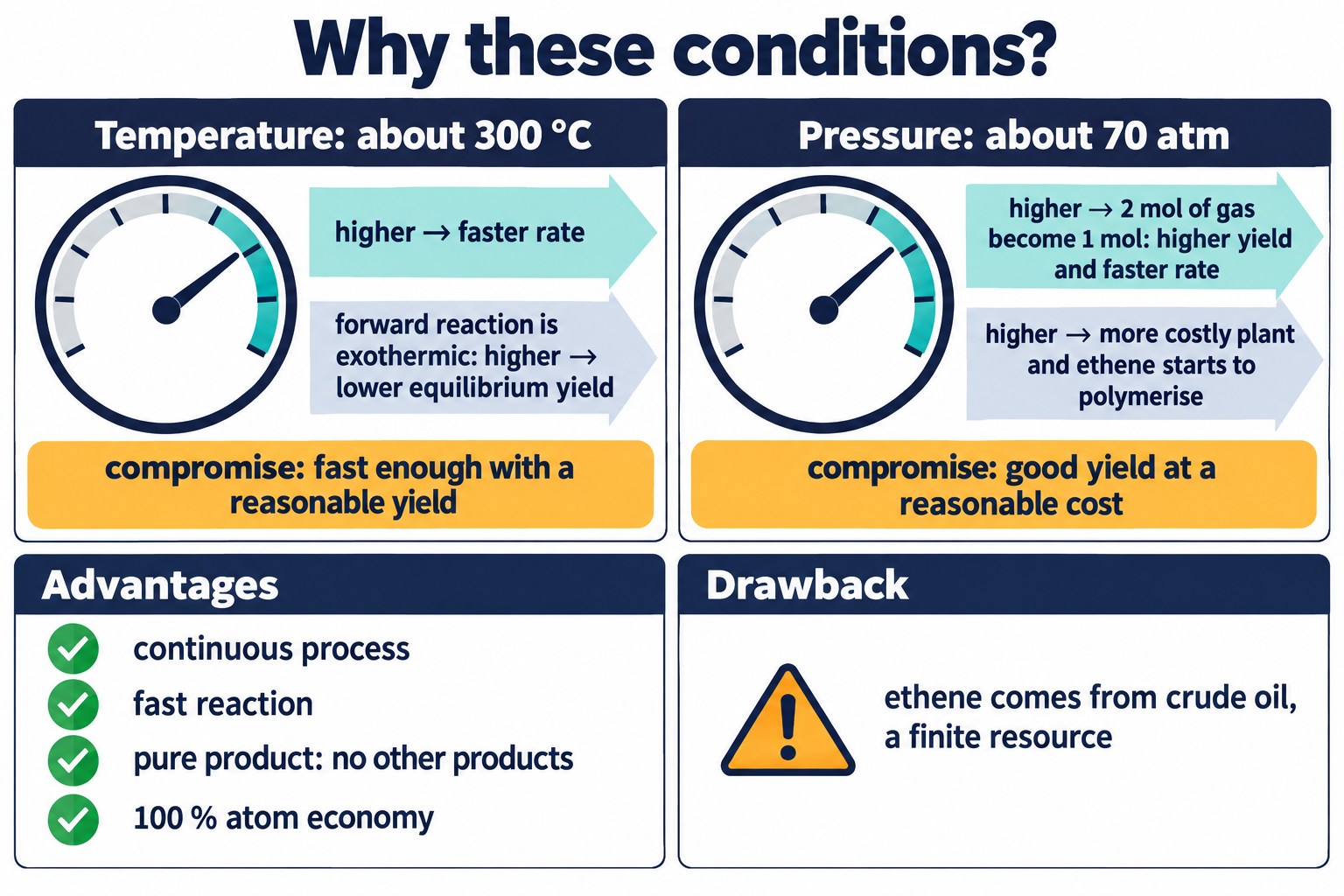
The temperature and pressure are compromises between rate, yield and cost; the process is continuous and gives ethanol as its only product.
Quick Check: Explain the Industrial Choice
Write a short explanation, then compare it with the mark points and the model answer.
Quick Check: Catalyst, Conditions and Atom Economy
Each round covers one part of the page, from the catalyst to the atom economy. Choose the one accurate statement.
FAQs
These questions secure the catalyst, conditions and yield reasoning behind the hydration of alkenes.
Why is phosphoric acid called a catalyst when it is an acid?
It supplies H+ to start the reaction and gets it back at the end, so it is not used up. It speeds up the reaction without appearing in the overall equation.
Why is only a small amount of ethene converted each time?
The reaction is reversible, so only about 5% of the ethene is converted on each pass over the catalyst. Unreacted ethene is separated and recycled, giving an overall conversion of about 95%.
Why not use a much higher pressure to get more ethanol?
A higher pressure would shift the equilibrium towards ethanol, but it costs more to generate and needs stronger equipment. It also makes ethene more likely to polymerise. About 60 to 70 atm is a compromise.
Does propene give only one alcohol with steam?
No. Propene is unsymmetrical, so H and OH can add either way round. The major product is propan-2-ol, formed through the more stable secondary carbocation, and the minor product is propan-1-ol.
Is hydration with steam the same as fermentation?
No. Hydration makes ethanol from ethene, obtained from crude oil, in a fast continuous process. Fermentation makes ethanol from sugars using yeast at about 35 °C, more slowly and as a dilute solution.
Copyright notice: This OLS revision content, including the explanations, layout, diagrams, tables and embedded learning structure, is authored for Online Learning System by Dr. Mohammed Al-Fatah. It may not be copied, reproduced, redistributed or adapted without written permission.
Keep this note — free
Save your progress across every Edexcel IAL topic. A free account remembers which topics you have covered, saves your question scores, and syncs across your phone and laptop.
- Track every topic you have finished
- Keep your practice-question scores
- No payment, no card, free forever
Already registered? Log in