Reactions of Alkenes with KMnO4
A concise revision guide to the oxidation of alkenes using potassium manganate(VII), including the formation of diols, the purple to colourless observation and how this reaction can be used as a test for the alkene functional group.
- 5.4v
What these spec points say
- 5.4v be able to describe the reactions of alkenes, limited to: oxidation of the double bond by acidified potassium manganate(VII) to produce a diol
GCSE Recap: Saturated, Unsaturated and a Positive Test
Before you start, check the GCSE ideas this page builds on: what makes a hydrocarbon unsaturated, and what a positive test looks like.
The Overall Reaction
Alkenes react with KMnO4, potassium manganate(VII), in acidified solution to form diols.
A diol is an organic compound containing two alcohol, -OH, groups. In this reaction, the C=C double bond opens and an -OH group is added to each carbon atom from the original double bond.
For example, propene is oxidised to form propane-1,2-diol.
Key idea: KMnO4 oxidises the alkene functional group, converting the C=C double bond into a diol.
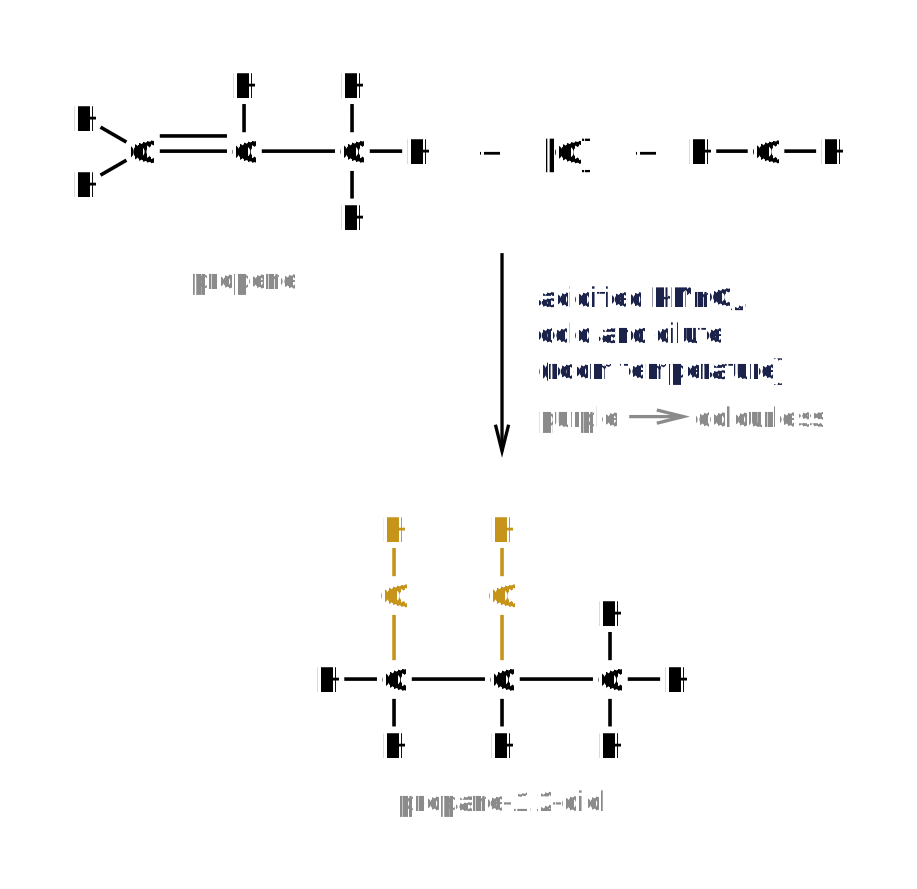
The displayed reaction shows the alkene functional group in propene changing into a diol after oxidation with KMnO4.
Quick Check: Name the Diol
Apply the reaction to an alkene that this page does not use.
Conditions and Observation
This reaction is carried out using dilute acidified KMnO4 at room temperature.
The important observation is that the purple colour of the MnO4– ion decolourises to colourless.
This colour change is useful because it provides a simple chemical test for the presence of the alkene functional group.
Exam focus: State the full observation as purple to colourless. Do not write only “goes clear”.
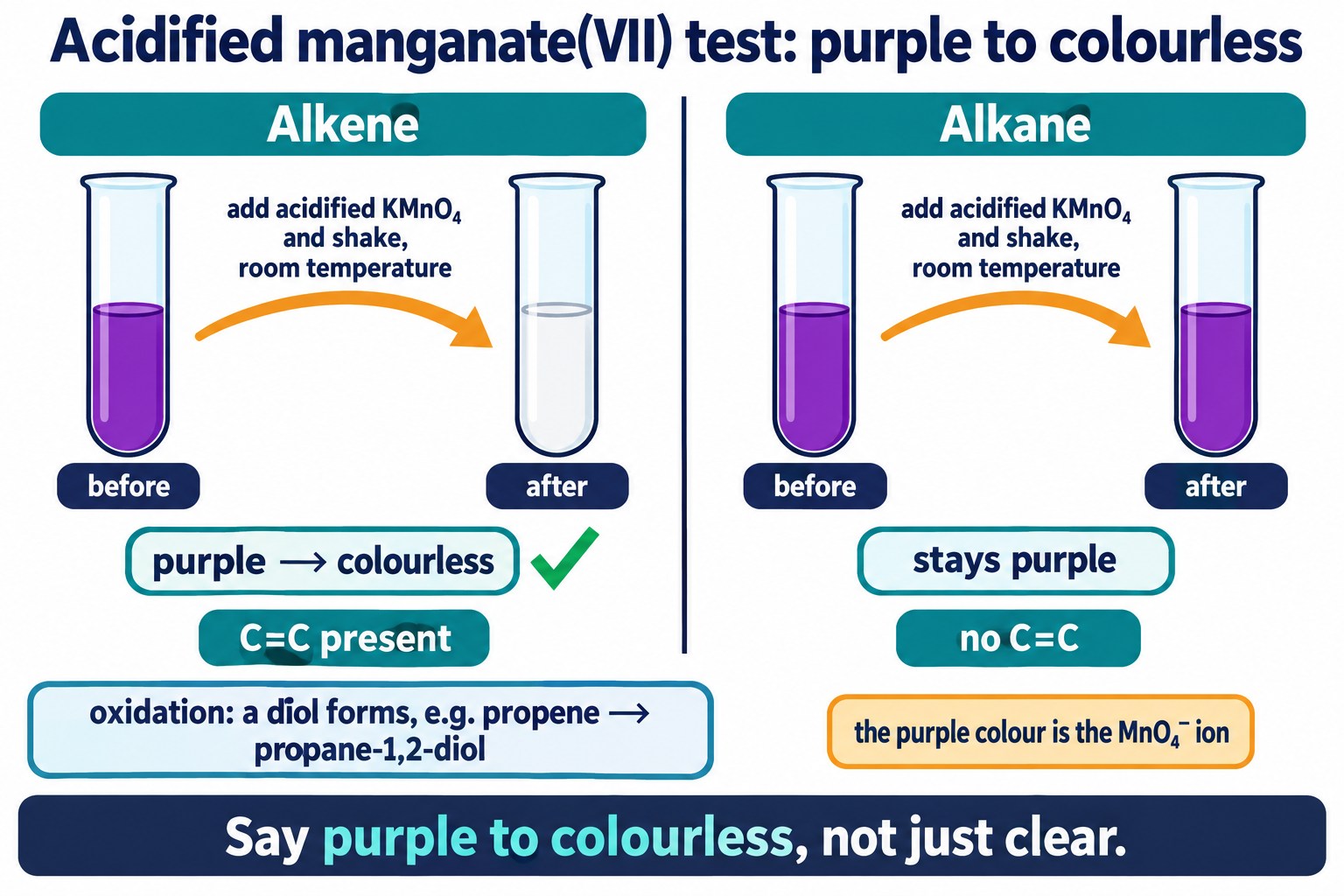
Shaken with an alkene at room temperature, acidified KMnO₄ turns from purple to colourless as a diol forms; with an alkane it stays purple.
Quick Check: Two Unlabelled Bottles
Drag the words into place to complete the account of the two tests.
Why It Tests for Alkenes
The reaction can be used as a test for alkenes because alkenes contain a C=C double bond that can be oxidised under these conditions.
Alkanes do not contain a carbon-carbon double bond. They are saturated hydrocarbons, so they do not react in the same way with acidified KMnO4 at room temperature.
Therefore, an alkene gives the purple to colourless change, but an alkane would show no colour change.
Diol: An organic compound containing two alcohol, -OH, groups. In this alkene oxidation reaction, the two -OH groups form on the two carbon atoms from the original C=C double bond.
Remember: The test depends on oxidation of the alkene double bond, not substitution or hydrogenation.
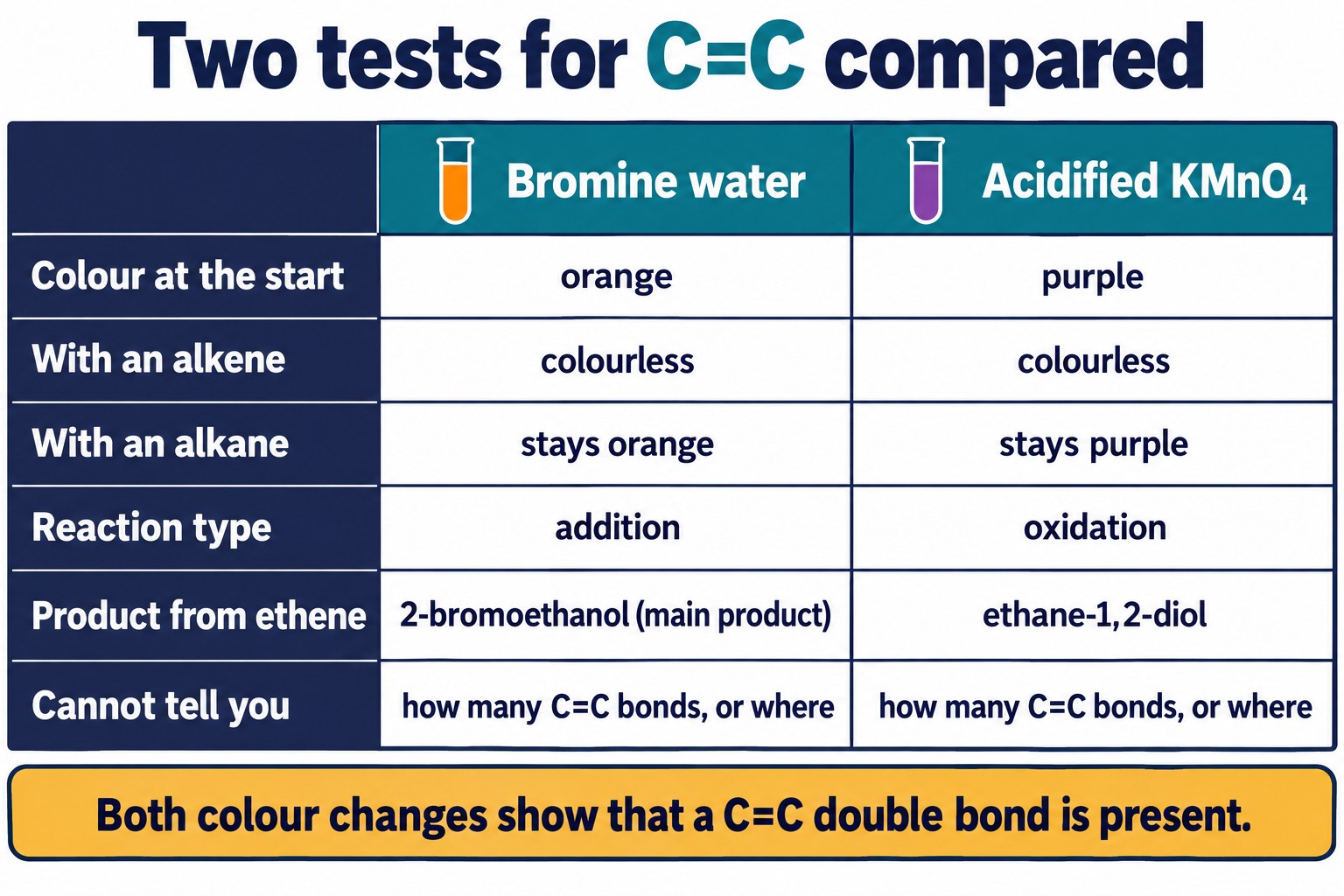
Bromine water and acidified KMnO₄ both lose their colour with an alkene, but by addition and by oxidation respectively.
Quick Check: Which Samples React?
Click every hydrocarbon that makes the purple colour fade.
Quick Check: The Limits of the Test
Write a short explanation, then compare it with the mark points and the model answer.
Common Exam Mistakes
Students often lose marks by forgetting that the product is a diol, not a single alcohol.
Another common error is to describe the reaction as addition only. The expected reaction type here is oxidation.
For observation questions, the safest answer should include both the starting colour and the final colour.
Exam focus: Link the colour change to the reaction of MnO4– with the alkene C=C double bond.
Quick Check: Oxidising an Alkene from Start to Finish
Each round covers one part of the page, from the product to the conditions. Choose the one accurate statement.
FAQs
These questions secure the conditions, product and limits of the manganate(VII) test.
Why is this reaction called oxidation?
In organic chemistry, gaining oxygen or losing hydrogen counts as oxidation. The alkene gains two OH groups, so it is oxidised. The manganate(VII) ions are reduced at the same time.
Does the KMnO4 need to be hot or cold?
Cold and dilute. Hot, concentrated manganate(VII) is a much stronger oxidising agent and breaks the carbon chain at the double bond instead of stopping at the diol.
What forms when ethene reacts with acidified KMnO4?
Ethane-1,2-diol, HOCH2CH2OH. One OH group adds to each carbon of the original C=C bond. Ethane-1,2-diol is used as antifreeze.
Why does the purple colour disappear?
The purple colour comes from MnO4– ions. As they oxidise the alkene, they are reduced to almost colourless Mn2+ ions in the acidic solution, so the purple fades to colourless.
Is acidified KMnO4 as reliable a test for alkenes as bromine water?
No. Acidified KMnO4 also oxidises other compounds, such as primary and secondary alcohols and aldehydes. A colour change with it does not prove a C=C bond on its own, so bromine water is the usual test.

Copyright notice: This OLS revision content, including the explanations, layout, diagrams, tables and embedded learning structure, is authored for Online Learning System by Dr. Mohammed Al-Fatah. It may not be copied, reproduced, redistributed or adapted without written permission.
Keep this note — free
Save your progress across every Edexcel IAL topic. A free account remembers which topics you have covered, saves your question scores, and syncs across your phone and laptop.
- Track every topic you have finished
- Keep your practice-question scores
- No payment, no card, free forever
Already registered? Log in