Ionic Bonding & Structure
Use this landing page to move quickly between the main ionic bonding revision pages for Edexcel A Level Chemistry Topic 2. Each card links to a focused page covering ionic bond formation, polarisation of ions and the physical properties of ionic compounds.
Choose an Ionic Bonding Page
Ionic compounds form when electrons are transferred and oppositely charged ions attract each other in a giant ionic lattice. These pages separate the key ideas so that students can revise how ionic bonding forms, why some ionic compounds show covalent character and how lattice structure explains physical properties.
Key idea: Ionic bonding is the strong electrostatic attraction between oppositely charged ions. The strength of this attraction helps explain high melting points, brittleness and electrical conductivity when molten or dissolved.
Ionic Bonding
Nature of Ionic Bonding
Revise electron transfer, ion formation and the electrostatic attraction between oppositely charged ions in ionic compounds.
of Ions
Polarisation of Ions
Learn how small highly charged cations can distort anion electron clouds, giving some ionic compounds partial covalent character.
Properties
Physical Properties of Ionic Compounds
Connect giant ionic lattice structure with melting point, solubility, brittleness and electrical conductivity.
How to Use These Pages
Start with the nature of ionic bonding to secure electron transfer and electrostatic attraction. Then move to polarisation of ions to understand why ionic compounds are not always purely ionic. Finally, use the physical properties page to link bonding and structure to exam-style explanations.
Exam focus: For ionic compounds, always link the macroscopic property back to particles, charge and electrostatic attraction. Avoid vague statements such as “ionic bonds are strong” unless you identify the ions and the forces between them.
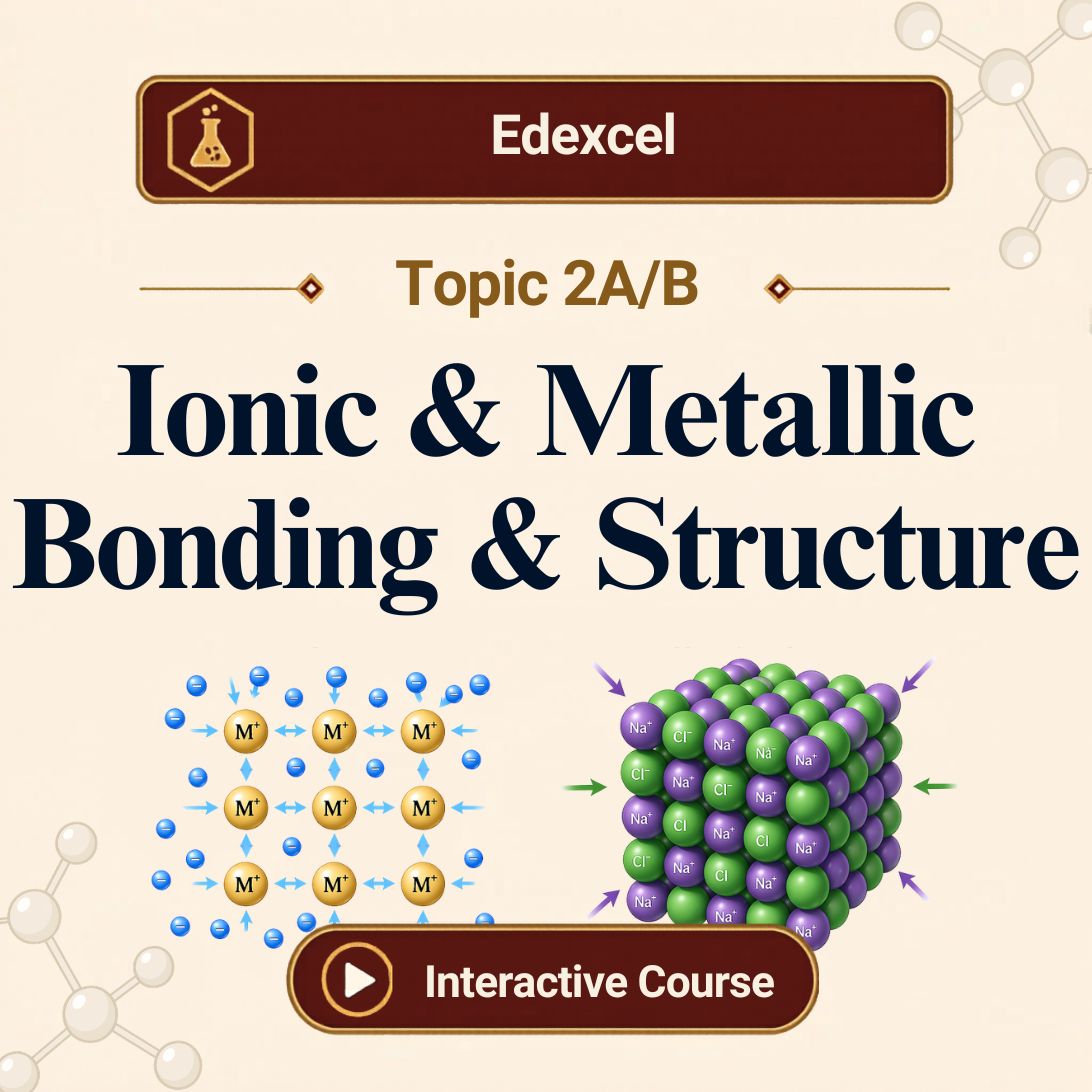
Master Ionic Bonding and Metallic Bonding for Edexcel A Level Chemistry
Continue from these free revision notes into the full Topic 2A/B Ionic and Metallic Bonding course, with guided video teaching, diagnostic MCQ practice, teacher-marked short-answer questions and a specification assignment with a personalised progress report.
Guided video teaching
Learn ions, ionic lattices, polarisation and metallic bonding through structured video lessons with worked examples and walkthroughs.
Instant MCQ feedback
Auto-marked MCQ quizzes provide immediate diagnostic feedback for every answer choice.
Teacher-marked SAQs
Submit written exam responses and receive chemistry specialist feedback with improvement guidance.
Progress tracking
Identify strengths and weaknesses across ions, ionic bonding, ionic radii, polarisation and metallic bonding with targeted reporting.
See how the course works
Click play to start the course preview animation.
Some ionic radii are shown.
| Ion | Ionic radius / nm |
|---|---|
| Na+ | 0.102 |
| K+ | 0.138 |
| F− | 0.133 |
| Cl− | 0.180 |
Which compound has the strongest ionic bonding?
Explain why the metallic bonding in magnesium is much stronger than that in sodium.
Copyright and author footprint: This OLS revision page was written for Online Learning System by Dr. Mohammed Al-Fatah. It is designed for A Level Chemistry revision and should not be copied or redistributed without permission.