Polarisation of Ions
A concise revision guide to polarisation, polarising power, anion polarisability and covalent character for Edexcel A Level Chemistry.
What Is Polarisation?
Polarisation occurs when a positive ion, called a cation, attracts and distorts the electron cloud of a negative ion, called an anion.
The anion is not pulled apart into separate particles. Instead, its electron cloud becomes unevenly distributed because the electrons are attracted towards the cation.
This distortion gives the bond more covalent character, because electron density is drawn between the two ions instead of being held as a completely separate spherical anion cloud.
Definition: Polarising power is the ability of a cation to distort an anion. Polarisability is the ease with which an anion is distorted.
Key idea: Polarisation explains why bonding is not always purely ionic or purely covalent. Many compounds lie on a bonding continuum between the two extremes.
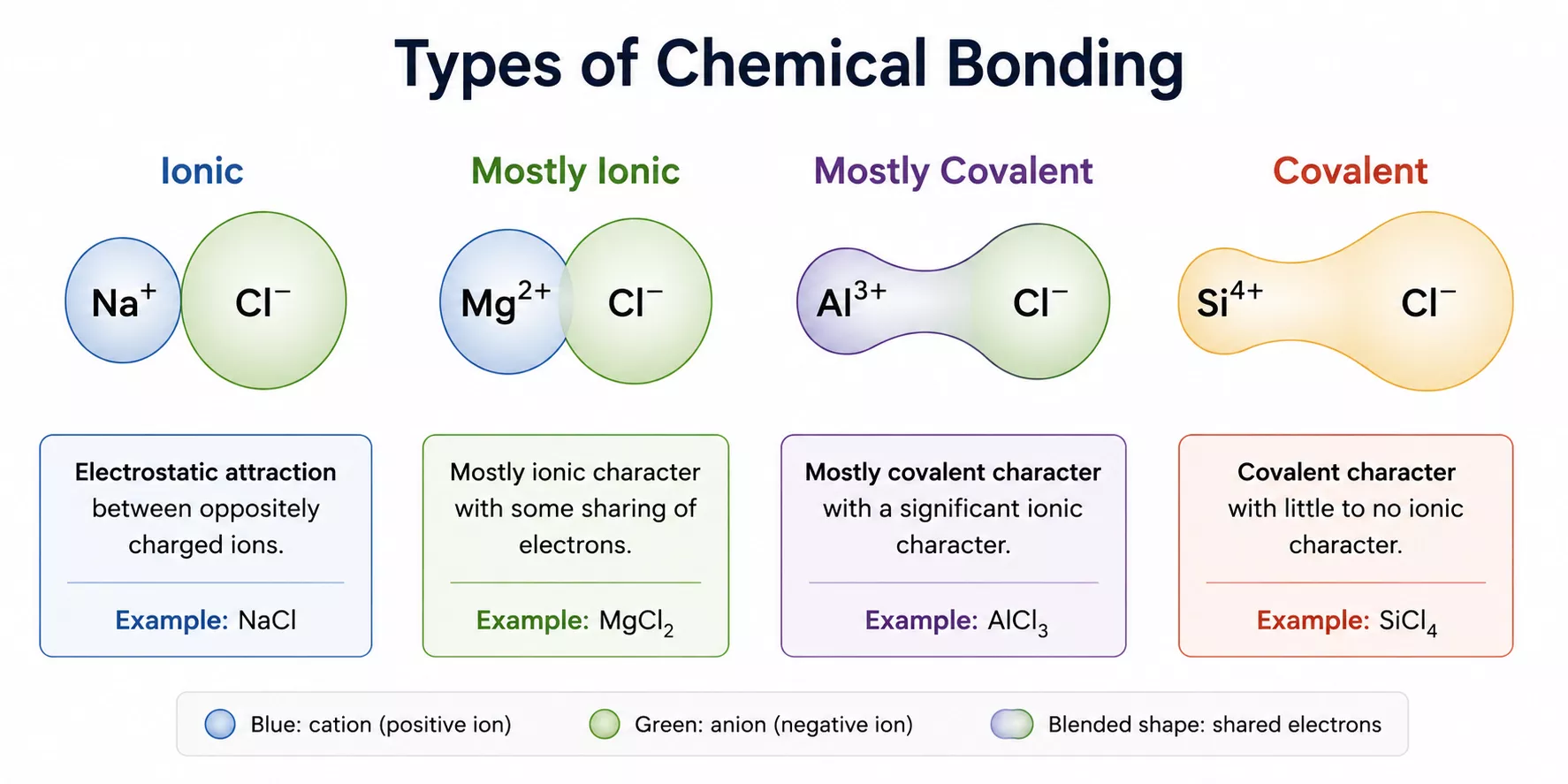
Increasing polarisation changes the electron distribution between ions, so the bonding gains more covalent character.
Cation Polarising Power
The ability of a cation to polarise an anion depends on its charge density. Charge density means charge relative to size.
A cation has greater polarising power when it has a higher positive charge or a smaller ionic radius. Both factors concentrate positive charge into a smaller volume.
| Factor | Effect on polarising power | Example |
|---|---|---|
| Higher cation charge | Increases attraction for the anion’s electrons, so the anion electron cloud is distorted more strongly. | Mg2+ has greater polarising power than Na+ because Mg2+ has a higher positive charge. |
| Smaller cation radius | Increases charge density because the positive charge is concentrated into a smaller volume. | Li+ has greater polarising power than Cs+ because Li+ is much smaller. |
| Charge-to-radius ratio | A cation with a larger charge-to-radius ratio has stronger polarising power. | Ca2+ has greater polarising power than Li+ because its higher charge outweighs its larger size. |
Typical polarising power order: Cs+ < Na+ < Li+ < Ca2+ < Mg2+ < Al3+.
Anion Polarisability
The ease with which an anion is polarised also depends on charge density. Anions are more easily polarised when their electron clouds are easier to distort.
A larger anion is more polarisable because its outer electrons are further from the nucleus and are held less strongly. An anion with a higher negative charge is also more polarisable because electron-electron repulsion is greater.
| Factor | Effect on polarisability | Example |
|---|---|---|
| Higher negative charge | Extra negative charge increases electron-electron repulsion, making the electron cloud easier to distort. | O2- is more easily polarised than F–. |
| Larger anion radius | The outer electrons are further from the nucleus and are held less strongly. | I– is more easily polarised than Cl– because I– is much larger. |
Typical halide polarisability order: F– < Cl– < Br– < I–.
Polarisation in aluminium chloride
A conceptual 3D model showing how a small, highly charged Al³⁺ ion distorts the electron clouds of nearby Cl⁻ ions.
Polarisation and Covalent Character
When polarisation is weak, the compound is closer to the ionic end of the bonding continuum. When polarisation is strong, the anion electron cloud is pulled towards the cation and the compound gains more covalent character.
Small, highly charged cations such as Al3+ and Si4+ can strongly distort the electron cloud of chloride ions. This is why aluminium chloride and silicon chloride bonding is more covalent than simple sodium chloride bonding.
More ionic character
Large or low-charge cations combined with small, low-polarisability anions tend to show more ionic character.
More covalent character
Small, highly charged cations combined with large, polarisable anions tend to show more covalent character.
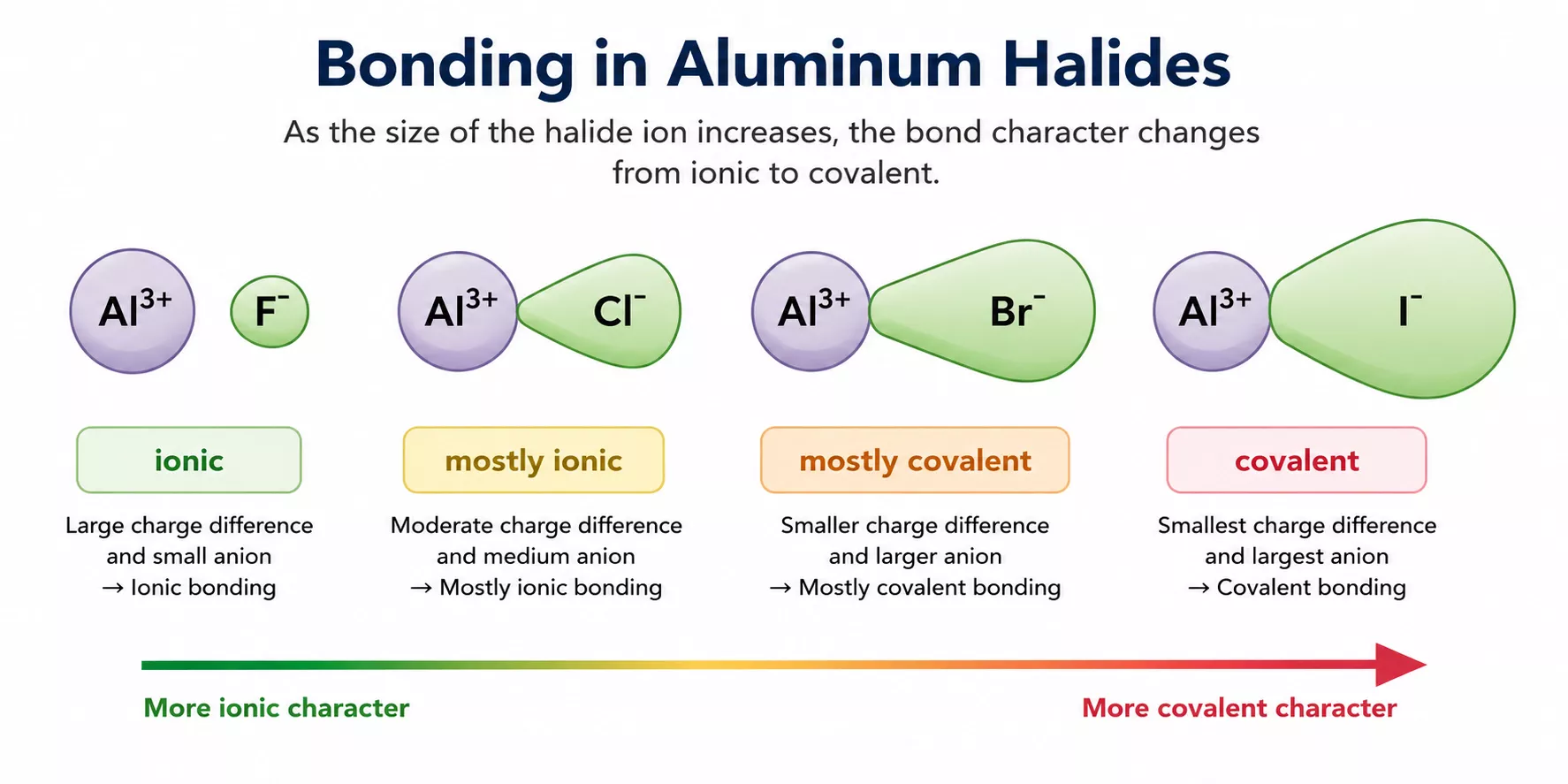
A highly charged Al3+ ion distorts larger halide ions more strongly, increasing covalent character.
Polarisation in aluminium fluoride
A comparison model showing that F⁻ ions are much less easily polarised than Cl⁻ ions. The electron clouds remain smaller, tighter and only slightly distorted towards Al³⁺.
How Polarisation Links to Ionic Bond Strength
Ionic bond strength is affected by the electrostatic attraction between oppositely charged ions. Higher ionic charge and smaller ionic radius usually produce stronger attractions and higher melting points.
Polarisation adds another layer of explanation. If the cation strongly distorts the anion, the bonding may gain covalent character instead of behaving like a simple ionic lattice.
| Comparison | Main reason | Typical consequence |
|---|---|---|
| NaF compared with CaO | CaO contains Ca2+ and O2-, so the ionic charges are larger. | Stronger electrostatic attraction and a much higher melting point. |
| NaF compared with CsF | Na+ is smaller than Cs+, so Na+ and F– ions can sit closer together. | Stronger electrostatic attraction in NaF than in CsF. |
| NaCl compared with AlCl3 | Al3+ is small and highly charged, so it strongly polarises Cl–. | AlCl3 shows greater covalent character than NaCl. |
Check Your Understanding
Complete these short activities to test the core ideas from this polarisation of ions page.
QuickSnap
1. Polarisation
Polarisation is the distortion of an anion’s electron cloud by a nearby cation. The more the electron cloud is distorted, the more covalent character the bonding can show.
2. Cation polarising power
Small, highly charged cations have high charge density and strong polarising power. Al3+ is strongly polarising because it is small and has a 3+ charge.
3. Anion polarisability
Large anions and anions with higher negative charge are more easily polarised because their outer electron clouds are held less strongly.
4. Aluminium halide comparison
F– is small and difficult to polarise, so AlF3 is more ionic. Cl– is larger and more polarisable, so AlCl3 shows greater covalent character.
5. Exam link
When explaining covalent character in ionic compounds, link cation charge density to anion distortion, then link the distortion to increased sharing of electron density.
Master Ionic Bonding and Metallic Bonding for Edexcel A Level Chemistry
Continue from these free revision notes into the full Topic 2A/B Ionic and Metallic Bonding course, with guided video teaching, diagnostic MCQ practice, teacher-marked short-answer questions and a specification assignment with a personalised progress report.
Guided video teaching
Learn ions, ionic lattices, polarisation and metallic bonding through structured video lessons with worked examples and walkthroughs.
Instant MCQ feedback
Auto-marked MCQ quizzes provide immediate diagnostic feedback for every answer choice.
Teacher-marked SAQs
Submit written exam responses and receive chemistry specialist feedback with improvement guidance.
Progress tracking
Identify strengths and weaknesses across ions, ionic bonding, ionic radii, polarisation and metallic bonding with targeted reporting.
See how the course works
Click play to start the course preview animation.
Some ionic radii are shown.
| Ion | Ionic radius / nm |
|---|---|
| Na+ | 0.102 |
| K+ | 0.138 |
| F− | 0.133 |
| Cl− | 0.180 |
Which compound has the strongest ionic bonding?
Explain why the metallic bonding in magnesium is much stronger than that in sodium.
Frequently Asked Questions
Use these quick answers to check the key language needed for polarisation of ions questions.
What is polarisation in ionic bonding?
Polarisation is the distortion of an anion’s electron cloud by a nearby cation. This can make the bonding show greater covalent character.
What increases the polarising power of a cation?
A cation has greater polarising power when it has a higher positive charge and a smaller ionic radius. Both increase charge density.
What makes an anion more polarisable?
An anion is more polarisable when it is larger or has a higher negative charge. Larger anions have outer electrons further from the nucleus, so their electron clouds are easier to distort.
Why does Al3+ have strong polarising power?
Al3+ has a high positive charge and a small ionic radius, giving it a high charge density. This allows it to strongly attract and distort anion electron clouds.
How does polarisation affect bonding?
Greater polarisation increases covalent character because electron density is pulled towards the cation and becomes shared to a greater extent between the ions.
Copyright notice: This OLS revision content, including the explanations, layout, diagrams, tables and embedded learning structure, is authored for Online Learning System by Dr. Mohammed Al-Fatah. It may not be copied, reproduced, redistributed or adapted without written permission.