Physical Properties of Ionic Compounds
A concise revision guide to high melting temperatures, brittleness, electrical conductivity, solubility and experimental evidence for ions for Edexcel A Level Chemistry.

Why Ionic Compounds Have High Melting Temperatures
Ionic solids contain a giant ionic lattice of many oppositely charged ions. The ions are held together by strong electrostatic attractions acting in all directions through the lattice.
A large amount of energy is needed to overcome these attractions. This is why ionic compounds usually have high melting temperatures.
When an ionic solid melts, the ions must gain enough energy to break free from their fixed positions and move past one another.
Key idea: High melting temperature is explained by the strong electrostatic attraction between oppositely charged ions in a giant ionic lattice.
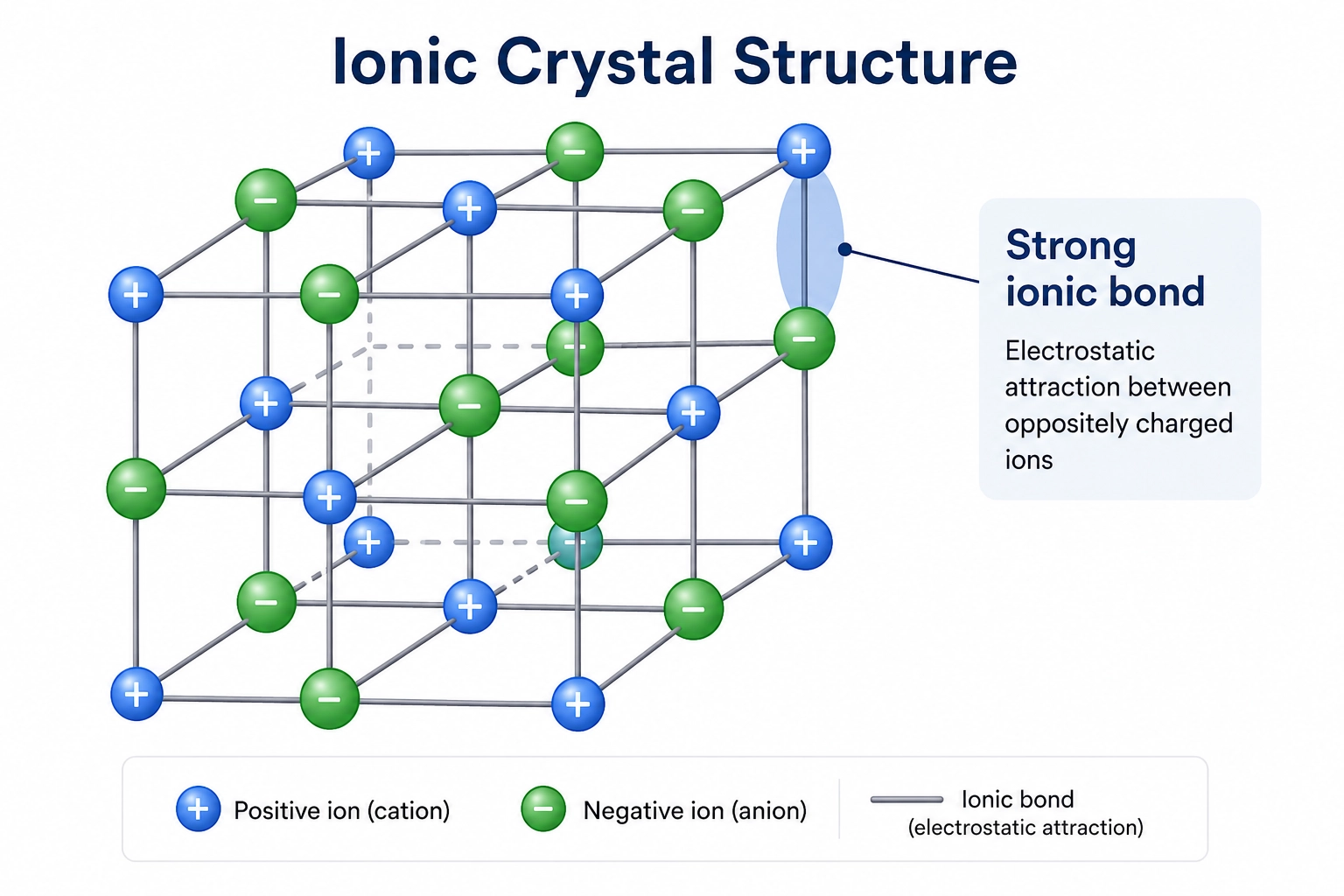
The lattice contains many ions, so many electrostatic attractions must be overcome during melting.
Why Ionic Compounds Are Brittle
Ionic crystals are brittle because their layers can shift when a stress is applied. This movement can bring ions with the same charge next to each other.
Like charges repel strongly. This repulsion disrupts the regular lattice and causes the ionic crystal to break apart rather than bend.
Stress applied
A force causes one layer of ions to slide over another layer.
Same charges align
Positive ions may become aligned with positive ions, while negative ions align with negative ions.
Lattice breaks
Strong repulsion separates the layers, causing cracking or brittle fracture.
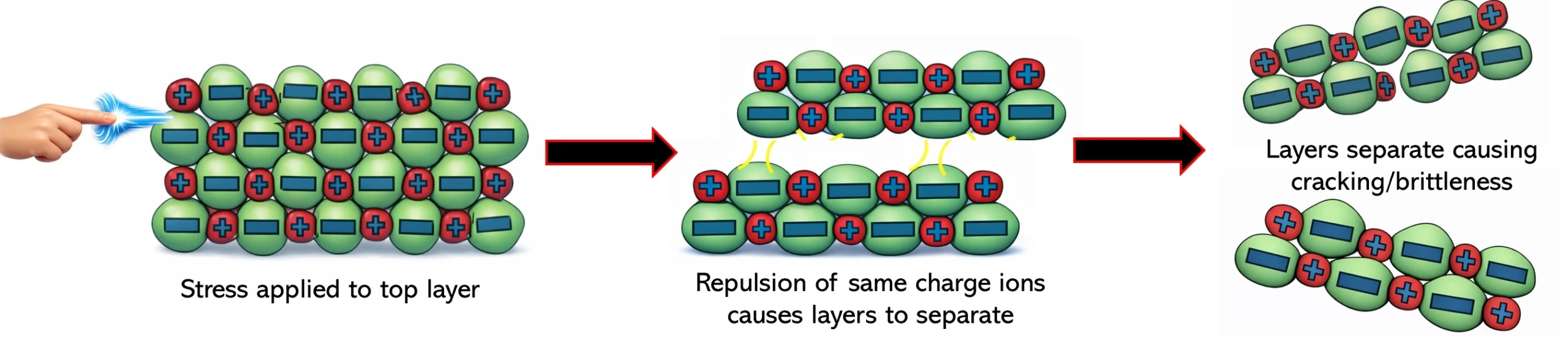
Brittleness occurs when layer movement places ions of the same charge next to one another.
Electrical Conductivity
For a substance to conduct electricity, it must contain mobile charged particles. Ionic compounds contain charged ions, but whether those ions can move depends on the physical state.
| State | Do ionic compounds conduct? | Reason |
|---|---|---|
| Solid | No | The ions are fixed in the lattice and cannot migrate to the electrodes. |
| Molten | Yes | The lattice has broken down, so the ions are free to move. |
| Aqueous | Yes | The ions are separated and mobile in solution. |
In molten or aqueous ionic compounds, positive ions move towards the negative electrode and negative ions move towards the positive electrode when a potential difference is applied. If direct current is used, electrolysis can occur as ions are discharged at the electrodes.
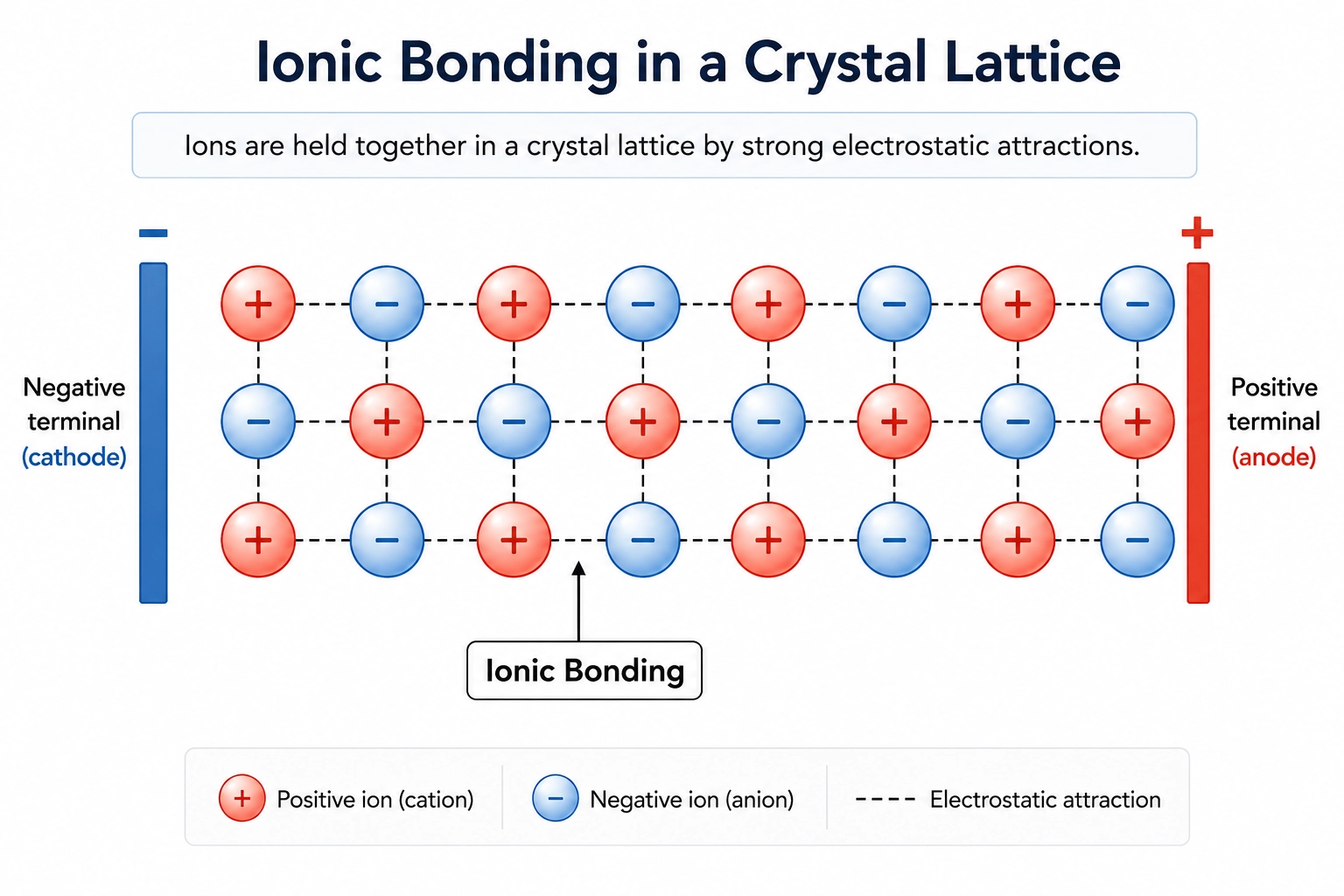
In a solid lattice, ions are charged but not mobile.
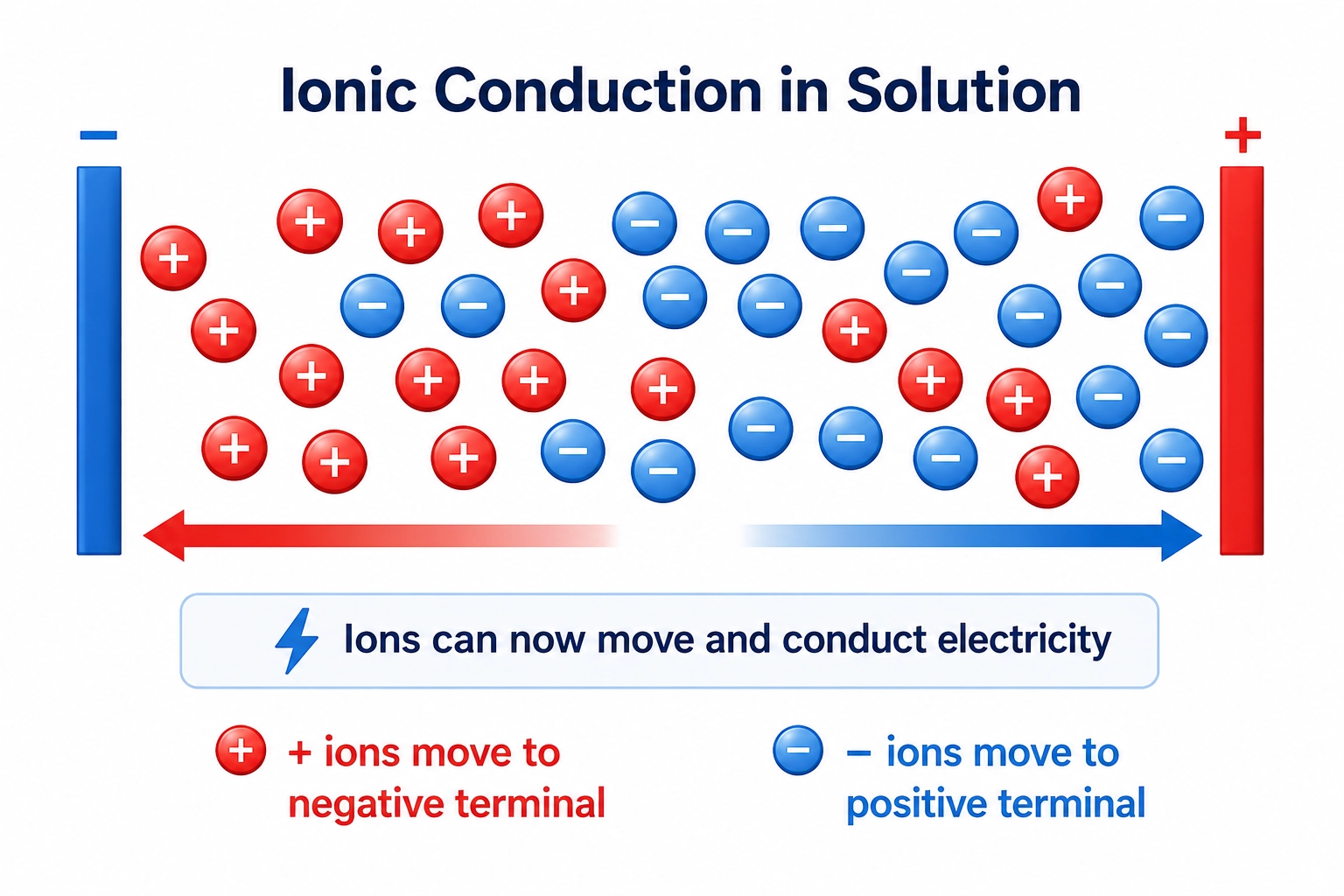
When molten or aqueous, ions can migrate through the liquid.
Solubility in Water
Water molecules are polar. The oxygen end of a water molecule is partially negative, while the hydrogen end is partially positive.
When an ionic compound dissolves, water molecules position themselves between oppositely charged ions in the lattice. The polar water molecules reduce the electrostatic attraction between the ions by surrounding them.
Hydration shells form around separated ions. Oxygen atoms face positive ions, while hydrogen atoms face negative ions. This keeps the ions dispersed in solution and helps prevent them from recombining.
Exam focus: Link solubility to polar water molecules surrounding the ions and reducing the attraction between oppositely charged ions in the lattice.
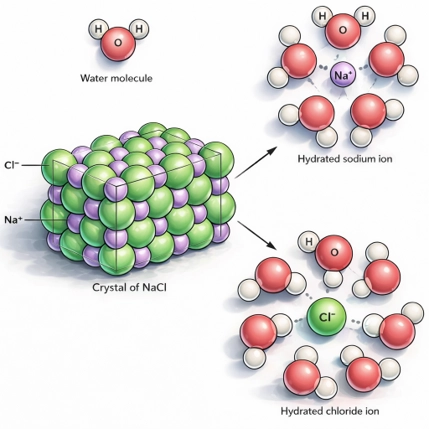
Water molecules orientate around the separated ions according to charge.
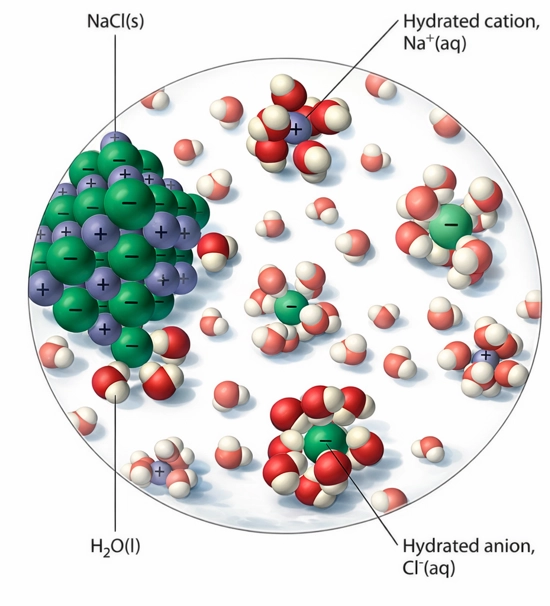
Hydration shells keep Na+ and Cl– ions dispersed in solution.
Evidence for the Existence of Ions
Two important types of evidence support the existence of ions in ionic compounds: X-ray diffraction electron density maps and migration of ions in an electric field.
X-ray diffraction
Electron density maps show a regular, repeating lattice arrangement. For sodium chloride, the maps show larger chloride ions and smaller sodium ions. The electron density falls to zero between neighbouring ions, showing that the ions are discrete and separate.
Ion migration
When a direct current is applied to a solution on moist filter paper or in a U-tube, coloured ions move towards electrodes of opposite charge. This visible migration shows that charged particles are moving.
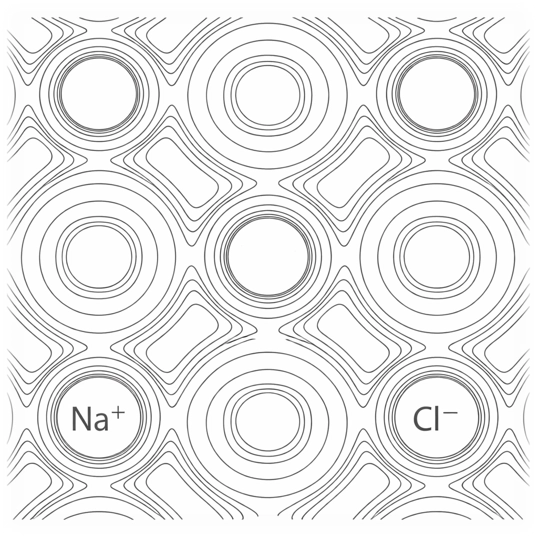
The separated contour regions provide evidence for discrete ions in the sodium chloride lattice.
Copper(II) chromate(VI) migration experiment
A direct current is passed through aqueous copper(II) chromate(VI). The blue Cu2+(aq) ions move towards the negative electrode because they are positively charged. The yellow CrO42-(aq) ions move towards the positive electrode because they are negatively charged. The colour separation provides visible evidence that ions are charged and mobile in solution.

Before current is applied, the coloured ions have not yet separated clearly.

Cu2+(aq) ions migrate to the negative electrode, while CrO42-(aq) ions migrate to the positive electrode.
Potassium manganate(VII) migration experiment
A drop of purple potassium manganate(VII) solution is placed on moist filter paper connected to a direct current supply. The purple MnO4– ions migrate towards the positive electrode. This shows that the manganate(VII) ion is negatively charged and that ions in solution can move under an electric field.
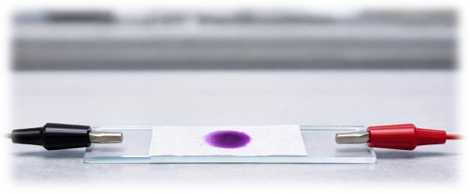
The purple manganate(VII) ion starts near the centre of the moist filter paper.
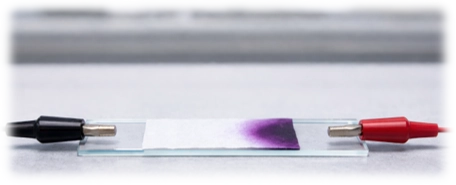
MnO4– ions migrate towards the positive electrode, showing that they are negatively charged.
Common Exam Points
For ionic physical properties questions, the strongest answers connect the property to the structure, the forces and the movement of ions.
Use the phrase giant ionic lattice
Do not describe ionic compounds as simple molecules. The high melting temperature comes from many strong electrostatic attractions in a giant lattice.
Conductivity needs mobile charged particles
Solid ionic compounds do not conduct because their ions are fixed. Molten and aqueous ionic compounds conduct because ions can move.
Brittleness is not weakness of all bonds
Ionic solids are brittle because layer movement brings same charge ions together, producing strong repulsion.
Solubility depends on ion hydration
Water molecules surround ions, reduce attractions within the lattice and form hydration shells.
Check Your Understanding
Use these short activities to check high melting temperatures, brittleness, electrical conductivity, solubility and evidence for ions.
QuickSnap
Physical properties of ionic compounds can be explained by the same underlying idea: ionic compounds contain a giant ionic lattice held together by strong electrostatic attractions between oppositely charged ions.
High melting temperature
Many strong electrostatic attractions must be overcome before ions can move past each other.
Brittleness
Layer movement places ions of the same charge next to each other, causing strong repulsion and fracture.
Electrical conductivity
Solids do not conduct because ions are fixed. Molten and aqueous ionic compounds conduct because ions are mobile.
Solubility
Polar water molecules surround ions, reduce lattice attractions and form hydration shells.
Evidence for ions
Electron density maps show discrete ions, and migration experiments show charged particles moving to opposite electrodes.
Master Ionic Bonding and Metallic Bonding for Edexcel A Level Chemistry
Continue from these free revision notes into the full Topic 2A/B Ionic and Metallic Bonding course, with guided video teaching, diagnostic MCQ practice, teacher-marked short-answer questions and a specification assignment with a personalised progress report.
Guided video teaching
Learn ions, ionic lattices, polarisation and metallic bonding through structured video lessons with worked examples and walkthroughs.
Instant MCQ feedback
Auto-marked MCQ quizzes provide immediate diagnostic feedback for every answer choice.
Teacher-marked SAQs
Submit written exam responses and receive chemistry specialist feedback with improvement guidance.
Progress tracking
Identify strengths and weaknesses across ions, ionic bonding, ionic radii, polarisation and metallic bonding with targeted reporting.
See how the course works
Click play to start the course preview animation.
Some ionic radii are shown.
| Ion | Ionic radius / nm |
|---|---|
| Na+ | 0.102 |
| K+ | 0.138 |
| F− | 0.133 |
| Cl− | 0.180 |
Which compound has the strongest ionic bonding?
Explain why the metallic bonding in magnesium is much stronger than that in sodium.
Frequently Asked Questions
Use these answers to check the most common misconceptions about ionic physical properties.
Why do ionic compounds have high melting temperatures?
Ionic compounds contain a giant ionic lattice with many strong electrostatic attractions between oppositely charged ions. A large amount of energy is needed to overcome these attractions.
Why are ionic compounds brittle?
When a layer of ions is shifted, ions with the same charge can become aligned. These like charges repel strongly, causing the lattice to split apart.
Why do solid ionic compounds not conduct electricity?
The ions are fixed in position in the solid lattice, so there are no mobile charged particles available to carry charge through the structure.
Why do molten and aqueous ionic compounds conduct electricity?
The ions are free to move. Positive ions migrate towards the negative electrode, while negative ions migrate towards the positive electrode.
Why can some ionic compounds dissolve in water?
Polar water molecules surround the ions, reduce the electrostatic attraction between ions in the lattice and form hydration shells around the separated ions.
Copyright notice: This OLS revision content, including the explanations, layout, diagrams, tables and embedded learning structure, is authored for Online Learning System by Dr. Mohammed Al-Fatah. It may not be copied, reproduced, redistributed or adapted without written permission.