Metallic Bonding & Structure
A concise revision guide to metallic bonding, giant metallic lattice structures, positive metal ions, delocalised electrons and the factors that affect metallic bonding strength.
What Is Metallic Bonding?
Metallic bonding is the electrostatic force of attraction between positive metal ions and delocalised electrons.
When metal atoms form a metallic lattice, their outer-shell electrons become delocalised. These electrons are not attached to one particular atom and can move through the structure.
The metal atoms are left as positive ions. The attraction between these positive ions and the delocalised electrons holds the metal lattice together.
Definition: Metallic bonding is the strong electrostatic attraction between a regular lattice of positive metal ions and a sea of delocalised electrons.
Key idea: A metal is not made from separate molecules. It is a giant metallic lattice held together by attraction between positive ions and delocalised electrons.
Giant Metallic Lattice Structure
Metals exist as giant metallic lattice structures. The positive metal ions are arranged in a regular, closely packed lattice.
The outer-shell electrons are delocalised, meaning they are free to move through the lattice. This leaves behind positive metal ions such as Na+, Mg2+ and Al3+.
The structure can be described as layers of positive metal ions surrounded by delocalised electrons.
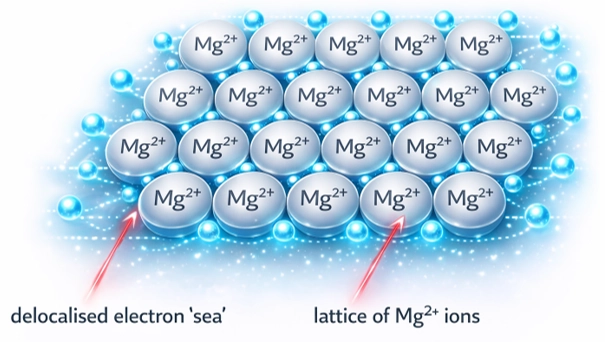
The diagram shows positive metal ions in fixed lattice positions surrounded by delocalised electrons.
Why Delocalised Electrons Matter
In a metal, delocalised electrons can move through the lattice. They are sometimes described as a sea of delocalised electrons.
This electron sea is attracted to many positive ions at the same time, helping to hold the whole giant lattice together rather than forming a small separate molecule.
The delocalised electrons also explain why metals can conduct electricity. When a potential difference is applied, the mobile electrons can move and carry charge through the structure.
Metallic lattice model: positive metal ions + delocalised electrons → giant metallic lattice held by electrostatic attraction.
Exam focus: Use the phrase delocalised electrons, not free electrons by itself. The electrons are free to move through the metallic lattice, but they are still part of the metal structure.
Metallic Bonding Strength Factors
The strength of metallic bonding depends on how strongly the positive metal ions attract the delocalised electrons.
Three main factors are used in exam explanations: nuclear charge, the number of delocalised electrons per atom and the size of the metal ion.
| Factor | Effect on metallic bonding | Exam wording |
|---|---|---|
| Number of protons | More protons means a higher nuclear charge, giving a stronger attraction to delocalised electrons. | More protons lead to a stronger attraction between positive ions and delocalised electrons. |
| Number of delocalised electrons per atom | More delocalised electrons means a greater electron density available for attraction to the metal ions. | More delocalised electrons result in a stronger metallic bond. |
| Size of the metal ion | Smaller ions allow the delocalised electrons to be attracted more strongly because the charge is closer. | Smaller ions produce a stronger attraction and therefore stronger metallic bonding. |
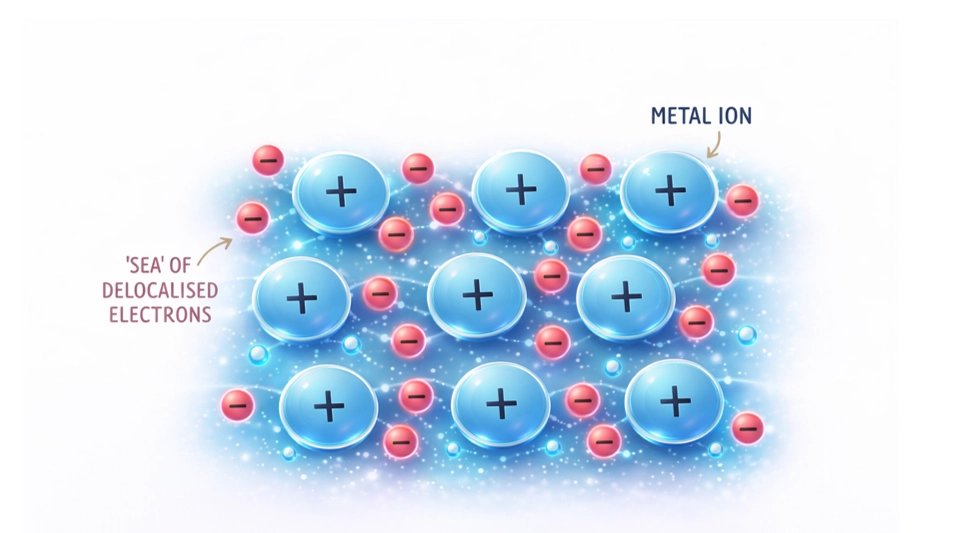
Metallic bonding becomes stronger when the attraction between positive ions and delocalised electrons increases.
Comparing Metallic Bonding Strength
Metallic bonding is often stronger when a metal atom contributes more outer-shell electrons to the delocalised electron sea.
For example, magnesium forms Mg2+ ions and contributes more delocalised electrons per atom than sodium, which forms Na+ ions. Aluminium forms Al3+ ions and contributes even more delocalised electrons per atom.
This is why exam answers often compare the charge on the metal ion, the number of delocalised electrons, and the strength of attraction within the lattice.
| Metal | Ion commonly shown | Delocalised electrons per atom | Expected bonding strength trend |
|---|---|---|---|
| Sodium | Na+ | 1 | Weaker than magnesium and aluminium, because fewer electrons are delocalised per atom. |
| Magnesium | Mg2+ | 2 | Stronger than sodium, because Mg2+ attracts more delocalised electrons. |
| Aluminium | Al3+ | 3 | Usually stronger again, because Al3+ has a higher charge and more delocalised electrons per atom. |
Common Exam Points
Strong answers about metallic bonding must describe the correct particles and the correct force between them.
Say positive metal ions, not atoms
In the metallic lattice, the particles in fixed positions are positive metal ions, not neutral metal atoms.
Say delocalised electrons
The outer-shell electrons are delocalised and can move through the structure. This is central to metallic bonding and electrical conductivity.
Use electrostatic attraction
Metallic bonding is an electrostatic force of attraction between oppositely charged particles: positive metal ions and delocalised electrons.
Link strength to attraction
Stronger metallic bonding means stronger attraction between the positive ions and the delocalised electron sea.
Check Your Understanding
Use these short activities to check metallic bonding, giant metallic lattice structure, delocalised electrons and metallic bonding strength factors.
QuickSnap
Metallic bonding is the strong electrostatic attraction between positive metal ions and delocalised electrons. Metals form giant metallic lattices, not molecules. The stronger the attraction between the ions and electron sea, the stronger the metallic bonding.
Metallic bonding
Electrostatic attraction between positive metal ions and delocalised electrons.
Giant metallic lattice
A regular, closely packed arrangement of positive metal ions surrounded by delocalised electrons.
Delocalised electrons
Outer-shell electrons that are free to move through the metal lattice.
Bonding strength
Increases with stronger attraction, more delocalised electrons per atom, higher nuclear charge and smaller metal ion size.
Master Ionic Bonding and Metallic Bonding for Edexcel A Level Chemistry
Continue from these free revision notes into the full Topic 2A/B Ionic and Metallic Bonding course, with guided video teaching, diagnostic MCQ practice, teacher-marked short-answer questions and a specification assignment with a personalised progress report.
Guided video teaching
Learn ions, ionic lattices, polarisation and metallic bonding through structured video lessons with worked examples and walkthroughs.
Instant MCQ feedback
Auto-marked MCQ quizzes provide immediate diagnostic feedback for every answer choice.
Teacher-marked SAQs
Submit written exam responses and receive chemistry specialist feedback with improvement guidance.
Progress tracking
Identify strengths and weaknesses across ions, ionic bonding, ionic radii, polarisation and metallic bonding with targeted reporting.
See how the course works
Click play to start the course preview animation.
Some ionic radii are shown.
| Ion | Ionic radius / nm |
|---|---|
| Na+ | 0.102 |
| K+ | 0.138 |
| F− | 0.133 |
| Cl− | 0.180 |
Which compound has the strongest ionic bonding?
Explain why the metallic bonding in magnesium is much stronger than that in sodium.
FAQs
These are the key points students often confuse when revising metallic bonding.
What is metallic bonding?
Metallic bonding is the electrostatic force of attraction between positive metal ions and delocalised electrons.
What is a giant metallic lattice?
A giant metallic lattice is a regular, closely packed arrangement of positive metal ions surrounded by delocalised electrons.
Why are electrons in metals called delocalised?
They are called delocalised because they are not fixed to one atom or one bond. They can move through the metallic lattice.
What makes metallic bonding stronger?
Metallic bonding becomes stronger when there is a stronger attraction between positive ions and delocalised electrons. This is affected by nuclear charge, ion size and the number of delocalised electrons per atom.
Why do metals conduct electricity?
Metals conduct electricity because their delocalised electrons are mobile and can carry charge through the lattice when a potential difference is applied.
Copyright notice: This OLS revision page is written for Online Learning System by Dr. Mohammed Al-Fatah. It is intended for A Level Chemistry revision and should not be copied, reproduced or redistributed without permission.