Electron Configuration
A concise revision guide to quantum shells, subshells, s and p orbital shapes, electronic configuration notation, Hund’s rule and the Pauli exclusion principle for Edexcel A Level Chemistry (9CH0).
From the Bohr Model to the Quantum Model
At GCSE level, electrons are often shown moving in circular or spherical shells around the nucleus. This early model is useful because it explains why noble gas arrangements are particularly stable.
At A Level, the model becomes more detailed. Electrons are not treated as tiny particles moving in fixed paths. Instead, an orbital describes a region of space where there is a high probability of finding an electron.
Key idea: The quantum model replaces fixed electron orbits with probability-based orbitals.
Shells, Subshells and Orbitals
The quantum model describes electron arrangement using three linked levels of organisation: shells, subshells and orbitals.
| Term | Meaning | Key notation |
|---|---|---|
| Shell | A principal energy level around the nucleus. | Defined by the principal quantum number, n. |
| Subshell | A subdivision of a shell. Common subshells are s, p, d and f. | Defined by the angular momentum quantum number, l. |
| Orbital | A specific region in a subshell where an electron is most likely to be found. | Each orbital can hold a maximum of 2 electrons. |
Exam focus: Avoid saying that an orbital is a shell. A shell contains subshells, and subshells contain orbitals.
s, p and d Orbital Shapes
Orbitals describe the mathematical probability of locating an electron in a region around the nucleus. Each orbital has a three-dimensional shape, but these shapes are approximations that help us visualise electron distribution.
The s orbital is spherical. The p orbitals are dumbbell-shaped and are arranged at right angles to each other. The d orbitals have more complex shapes, with four of the five d orbitals having a four-lobed cloverleaf arrangement.
Remember: Orbital diagrams are models. They show regions of high electron probability, not solid surfaces or fixed paths.
The s Orbital
This 3D model shows an s orbital. Unlike a p orbital, an s orbital is spherical, meaning the electron density is distributed equally in all directions around the nucleus. It has no directional lobes and no nodal plane.
Shape
The s orbital is spherical, so it looks the same from every direction.
Symmetry
Electron density is spread uniformly around the centre, giving the orbital spherical symmetry.
No nodal plane
Unlike p orbitals, an s orbital does not have two separate lobes or a nodal plane passing through the centre.
Key idea
The s orbital is the simplest atomic orbital and is non-directional because it has the same shape in all spatial directions.
© Dr. Mohammed Al-Fatah · onlinelearningsystem.net
px Orbital Electron Cloud
A px orbital has two lobes of electron density aligned along the x-axis. The blue transparent plane shows the nodal plane where the probability of finding the electron is zero.
Orientation
The px orbital is aligned along the x-axis, so the two lobes point left and right.
Electron cloud density
The red translucent lobes represent regions where electron density is concentrated.
Nodal plane
The blue transparent YZ plane passes through the origin and separates the two lobes.
© Dr. Mohammed Al-Fatah · onlinelearningsystem.net
The Three p Orbitals
This 3D model shows the three p orbitals together. The px orbital is shown in red, the py orbital in purple, and the pz orbital in green. Each orbital consists of two lobes that meet at the origin, and the three orbitals are arranged at right angles to one another.
px orbital
The red orbital lies along the x-axis.
py orbital
The purple orbital lies along the y-axis.
pz orbital
The green orbital lies along the z-axis.
Key idea
All three p orbitals have the same shape and size. They differ only in their orientation in space.
© Dr. Mohammed Al-Fatah · onlinelearningsystem.net
The Five d Orbitals
This 3D model lets you explore the five d orbitals one at a time. Use the colour-coded buttons to switch between dxy, dxz, dyz, dx²−y², and dz². The Cartesian axes are centred at the origin so the orientation of each orbital is visually clear.
Selected orbital
dxy has four lobes lying between the x- and y-axes in the xy plane.
Four-lobed orbitals
The dxy, dxz, dyz, and dx²−y² orbitals each have a four-lobed cloverleaf shape.
dz² shape
The dz² orbital is different. It has two lobes along the z-axis and a torus-shaped ring around the centre.
Key idea
The fixed Cartesian axes help show whether the lobes point along the axes or between them.
© Dr. Mohammed Al-Fatah · onlinelearningsystem.net
Writing Electronic Configuration
An atom’s electronic configuration shows how its electrons are arranged within atomic orbitals. The notation combines the main energy level, the subshell type and the number of electrons in that subshell.
For example, oxygen is written as 1s² 2s² 2p⁴. The large number shows the main energy level, the letter shows the subshell type, and the superscript shows the number of electrons in that subshell.
Electrons fill subshells in order of increasing energy. For the early part of the sequence, the order is 1s → 2s → 2p → 3s → 3p → 4s → 3d → 4p.
Exam focus: The 4s subshell fills before 3d because 4s is lower in energy than 3d before the 3d subshell is occupied.
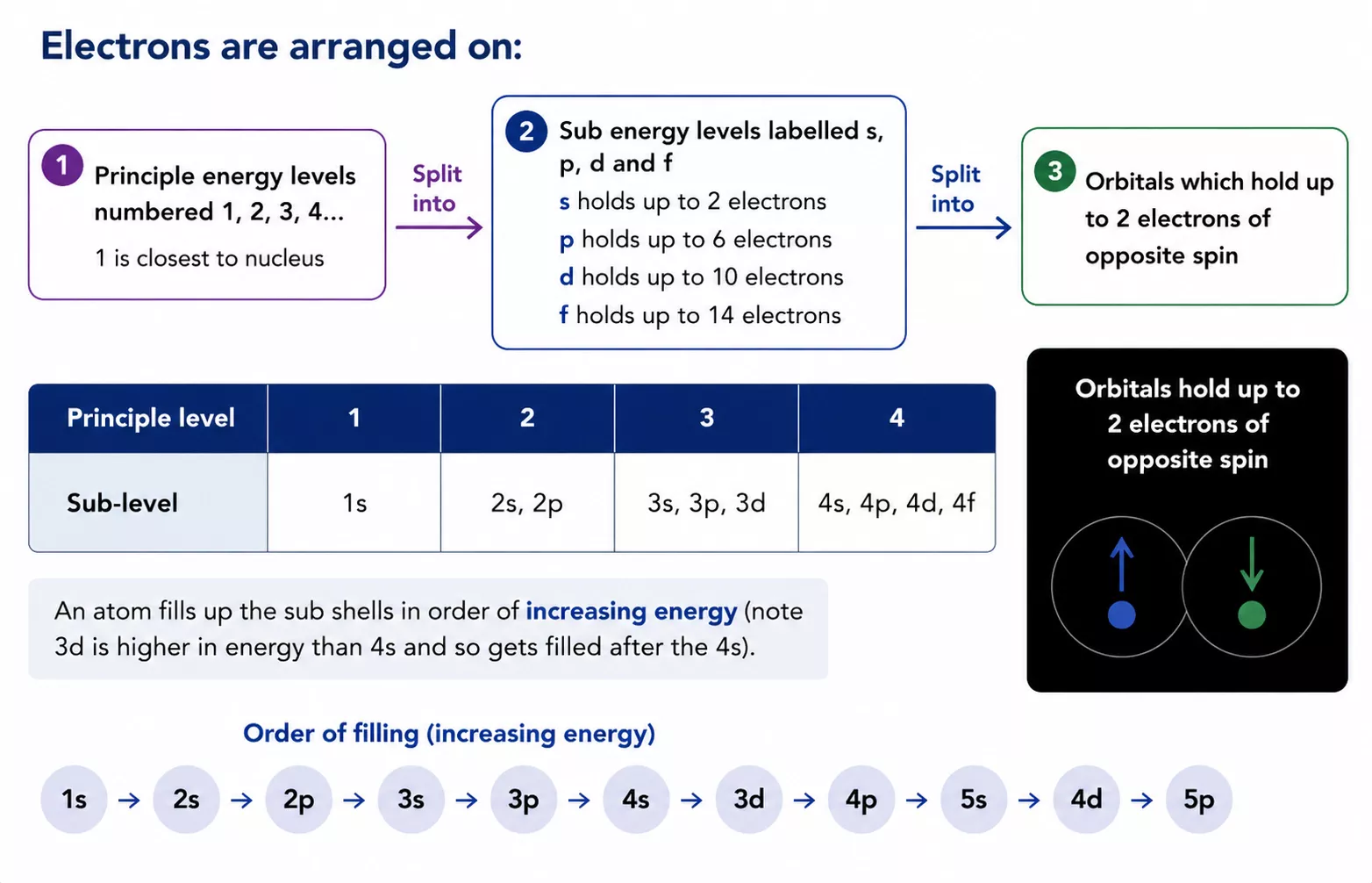
This notation shows the shell number, subshell letter and the number of electrons present in that subshell.
Electronic Configuration of Ions
When ions form, electrons are either lost or gained. A positive ion forms when electrons are lost. A negative ion forms when electrons are gained.
For magnesium, the atom is written as 1s² 2s² 2p⁶ 3s², but Mg²⁺ is written as 1s² 2s² 2p⁶ because two electrons have been lost.
For oxygen, the atom is written as 1s² 2s² 2p⁴, but O²⁻ is written as 1s² 2s² 2p⁶ because two electrons have been gained.
Remember: Ion formation changes the number of electrons, not the number of protons.
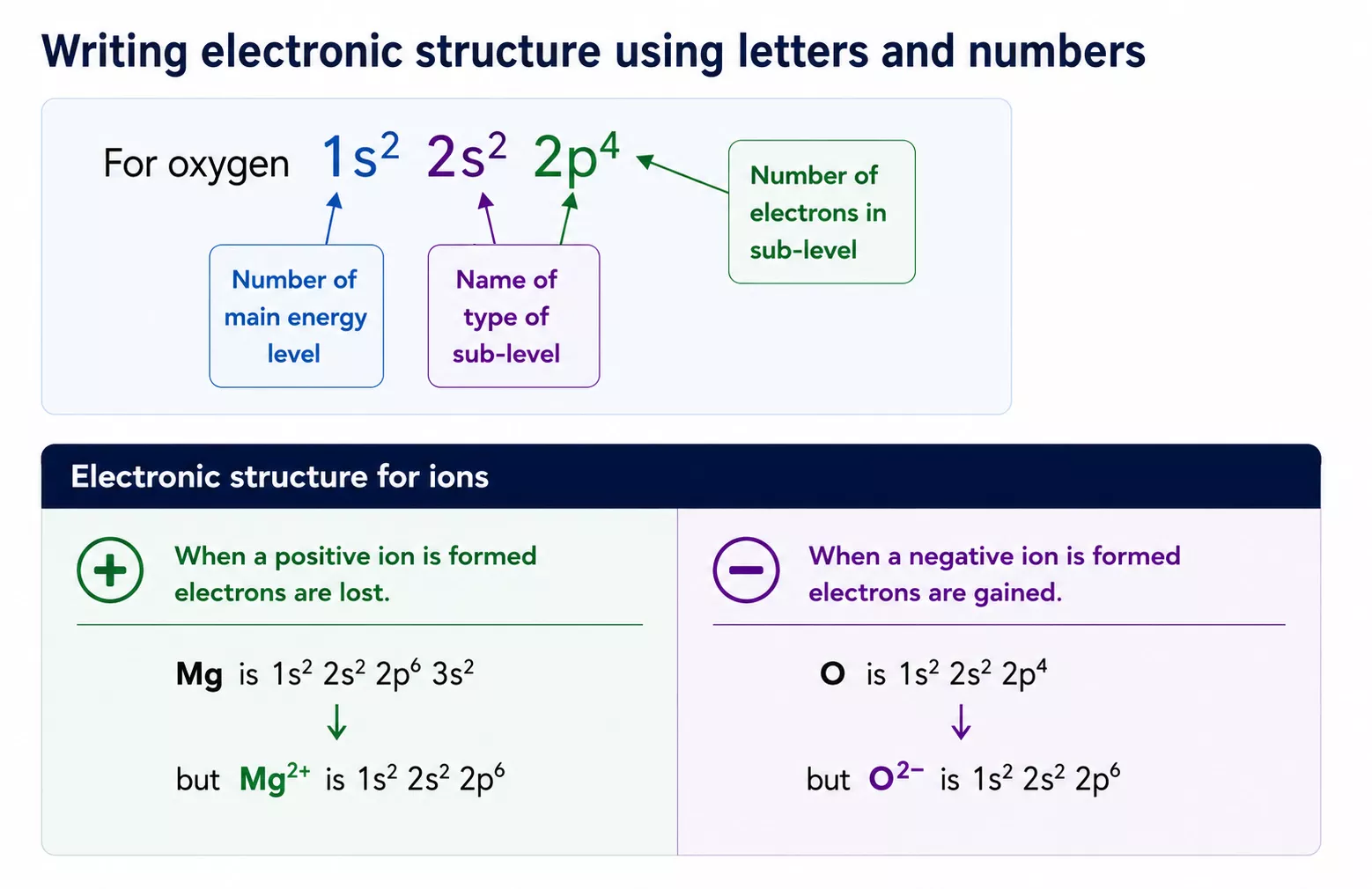
Positive ions have fewer electrons than their atoms. Negative ions have more electrons than their atoms.
Hund’s Rule
Hund’s rule states that electrons occupy orbitals singly before any pairing occurs in orbitals of the same energy.
This minimises electron-electron repulsion. In a p subshell, there are three p orbitals, so one electron enters each p orbital before any two electrons pair up in the same orbital.
Exam focus: When filling p orbitals, show one arrow in each box first, then pair electrons only after each equal-energy orbital contains one electron.
Pauli Exclusion Principle and Spin Diagrams
The Pauli exclusion principle states that no two electrons in the same orbital can have the same spin. This means paired electrons in one orbital must be shown with opposite spins.
In spin diagrams, each box represents one orbital, and each arrow represents one electron. Opposite arrow directions represent opposite electron spins.
Remember: One orbital can hold a maximum of two electrons, and those two electrons must have opposite spin.
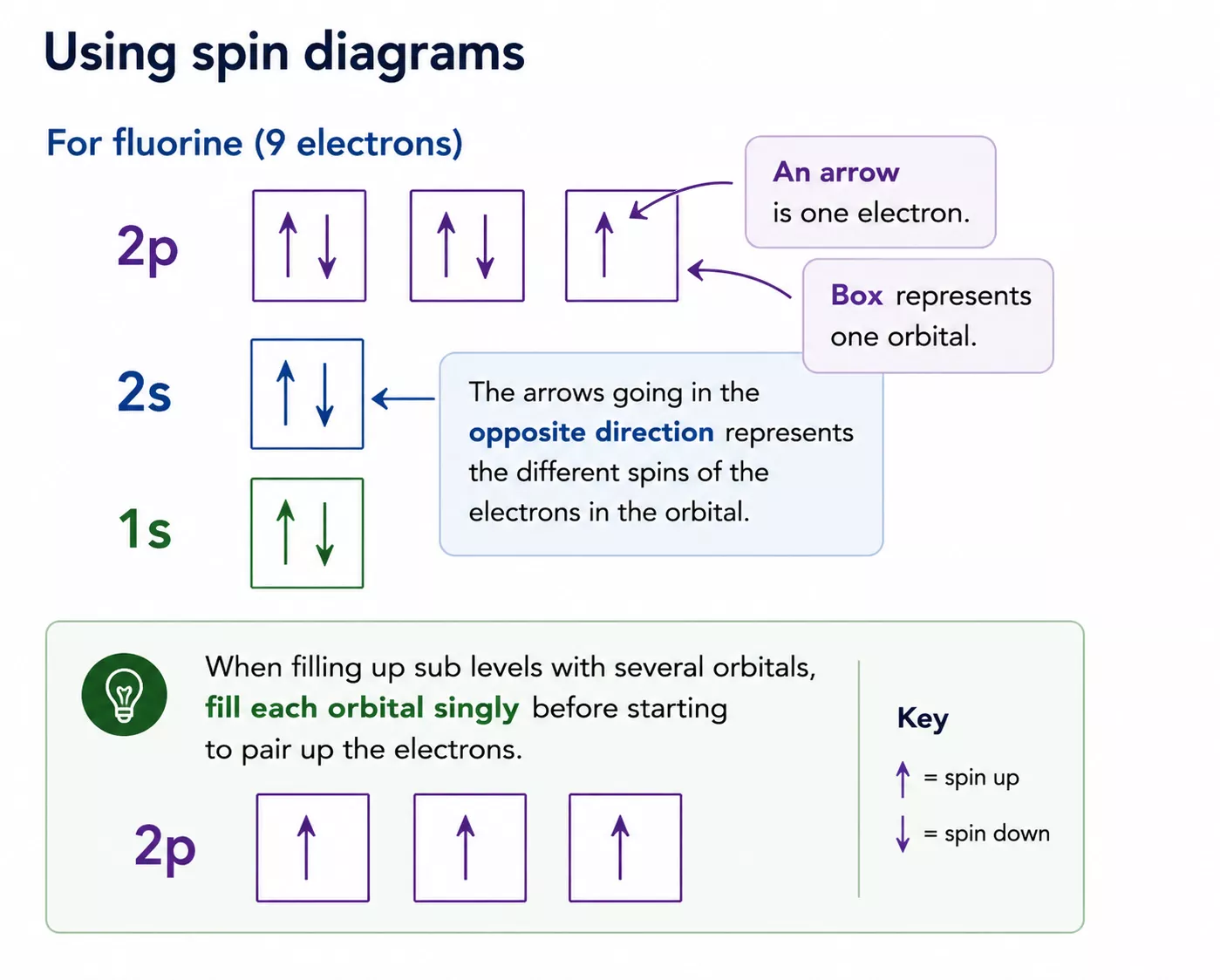
Each box is one orbital. Arrows in opposite directions show paired electrons with opposite spin.
Common Exam Points
Quantum model questions often test precise language about orbitals, correct electronic configurations, and correct use of Hund’s rule and the Pauli exclusion principle.
Define an orbital accurately
An orbital is a region of space where an electron is most likely to be found. It can hold a maximum of two electrons.
Use the correct filling order
Remember that 4s fills before 3d in the usual Aufbau sequence for neutral atoms.
Apply Hund’s rule
Place electrons singly in equal-energy orbitals before pairing them.
Apply Pauli correctly
Two electrons in the same orbital must have opposite spins.
Check Your Understanding
Use these short activities to check shells, subshells, orbitals, electronic configuration, Hund’s rule and the Pauli exclusion principle before moving on.
QuickSnap
The quantum model describes electrons using probability-based orbitals rather than fixed paths. A shell is a main energy level, a subshell is a subdivision of a shell, and an orbital is a region where an electron is most likely to be found. The s orbital is spherical, p orbitals are dumbbell-shaped, and d orbitals have more complex shapes. Electronic configurations show how electrons fill subshells in order of increasing energy. Hund’s rule says electrons occupy equal-energy orbitals singly before pairing, while the Pauli exclusion principle says two electrons in the same orbital must have opposite spins.
Shell
A principal energy level defined by the quantum number n.
Subshell
A subdivision of a shell, such as s, p, d or f.
Orbital
A region of high electron probability that can hold up to two electrons.
Spin diagrams
Boxes represent orbitals, arrows represent electrons, and opposite arrows show opposite spin.
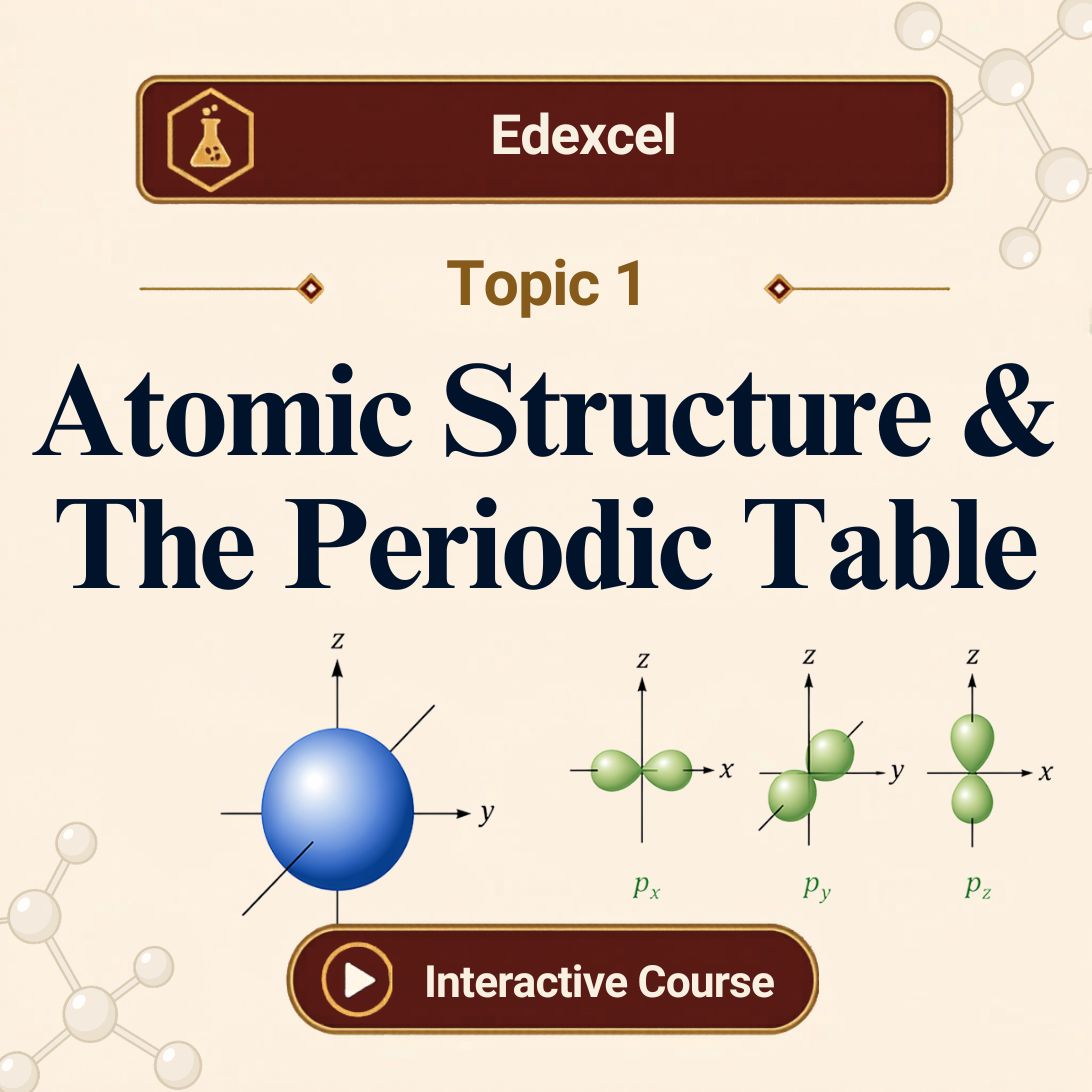
Master Atomic Structure and The Periodic Table for Edexcel A Level Chemistry
Continue from these free revision notes into the full Topic 1 Atomic Structure and The Periodic Table course, with guided video teaching, diagnostic MCQ practice, teacher-marked short-answer questions and a specification assignment with a personalised progress report.
Guided video teaching
Learn atomic structure, isotopes, mass spectrometry, ionisation energy, electron configuration and periodic trends through structured video lessons with worked examples and walkthroughs.
Instant MCQ feedback
Auto-marked MCQ quizzes provide immediate diagnostic feedback for every answer choice.
Teacher-marked SAQs
Submit written exam responses and receive chemistry specialist feedback with improvement guidance.
Progress tracking
Identify strengths and weaknesses across atomic structure, isotopes, mass spectrometry, ionisation energies, electron configuration and periodic trends with targeted reporting.
See how the course works
Click play to start the course preview animation.
Some ionic radii are shown.
| Ion | Ionic radius / nm |
|---|---|
| Na+ | 0.102 |
| K+ | 0.138 |
| F− | 0.133 |
| Cl− | 0.180 |
Which compound has the strongest ionic bonding?
Explain why the metallic bonding in magnesium is much stronger than that in sodium.
Electron Configuration FAQs
Use these quick answers to secure the key wording for Edexcel A Level Chemistry.
What is an orbital?
An orbital is a region of space where an electron is most likely to be found. Each orbital can hold a maximum of two electrons.
What is the difference between a shell and a subshell?
A shell is a principal energy level. A subshell is a subdivision within a shell, such as s, p, d or f.
What shape is an s orbital?
An s orbital is spherical, so it has the same shape in all directions around the nucleus.
What shape are p orbitals?
p orbitals are dumbbell-shaped. The three p orbitals, px, py and pz, are arranged at right angles to each other.
What does Hund’s rule state?
Hund’s rule states that electrons occupy orbitals singly before any pairing occurs in orbitals of the same energy.
What does the Pauli exclusion principle state?
No two electrons in the same orbital can have the same spin. Two electrons in the same orbital must have opposite spins.
Copyright notice: This OLS revision content, including the explanations, layout, diagrams, tables and embedded learning structure, is authored for Online Learning System by Dr. Mohammed Al-Fatah. It may not be copied, reproduced, redistributed or adapted without written permission.