Predicting Diatomic Mass Spectra
A concise revision guide to predicting the molecular ion peaks for diatomic molecules from isotope abundance data, using chlorine, Cl2, as the key example.
- 1.9-a
- 1.9-b
What these spec points say
- 1.9-a be able to predict mass spectra for diatomic molecules, including chlorine, given isotopic abundances
- 1.9-b be able to predict relative peak heights for diatomic molecules, including chlorine, given isotopic abundances
GCSE Recap: Isotopes and Diatomic Molecules
Before you start, check what you remember about diatomic elements and isotopes.
Why Diatomic Molecules Give Several Peaks
A diatomic molecule contains two atoms joined together. If the element has more than one isotope, different isotope pairings are possible in the molecule.
For chlorine, the two main isotopes are 35Cl and 37Cl. This means a molecule of Cl2 can contain two 35Cl atoms, one of each isotope, or two 37Cl atoms.
Key idea: each possible isotope pairing gives a different molecular mass, so the molecular ion region of the mass spectrum shows more than one peak.
Watch: from chlorine atoms to Cl2 molecules
A chlorine atom gives two peaks. A Cl2 molecule is two atoms, each 35 or 37. Which molecules can form?
List Every Possible Isotope Pair
Start by listing the possible combinations. This prevents you from missing the mixed molecule, which is the most common exam error in this calculation.
| Combination | Molecule | Molecular mass | Expected m/z for 1+ ion |
|---|---|---|---|
| Light + light | 35Cl-35Cl | 35 + 35 = 70 | 70 |
| Light + heavy | 35Cl-37Cl | 35 + 37 = 72 | 72 |
| Heavy + light | 37Cl-35Cl | 37 + 35 = 72 | 72 |
| Heavy + heavy | 37Cl-37Cl | 37 + 37 = 74 | 74 |
Exam focus: the two mixed arrangements have the same molecular mass, so they contribute to the same m/z peak.
Quick Check: List the Pairs for a New Element
Write out every isotope pair on paper, then type the m/z values.
Multiply the Isotopic Abundances
Convert the percentage abundances into decimals, then multiply the two isotope abundances for each possible molecule.
For chlorine: 35Cl = 75% = 0.75 and 37Cl = 25% = 0.25. These are the rounded values used in exam questions: a 3:1 ratio, which gives Ar = 35.5.
| Molecule | Relative abundance calculation | Relative abundance |
|---|---|---|
| 35Cl-35Cl | 0.75 × 0.75 | 0.5625 |
| 35Cl-37Cl | 0.75 × 0.25 | 0.1875 |
| 37Cl-35Cl | 0.25 × 0.75 | 0.1875 |
| 37Cl-37Cl | 0.25 × 0.25 | 0.0625 |
Remember: do not add the isotope abundances for a molecule. Multiply them, because both atoms must be chosen together.
Quick Check: Half the Atoms, Half the Molecules?
Decide whether the statement about bromine molecules is true or false.
Combine Equivalent Mixed Isotope Molecules
The molecules 35Cl-37Cl and 37Cl-35Cl have the same molecular mass. Both have molecular mass 72, so their abundances are added together.
0.1875 + 0.1875 = 0.375
This gives the total relative abundance of the m/z 72 peak.| Molecular ion | m/z | Total relative abundance |
|---|---|---|
| 35Cl-35Cl+ | 70 | 0.5625 |
| 35Cl-37Cl+ and 37Cl-35Cl+ | 72 | 0.375 |
| 37Cl-37Cl+ | 74 | 0.0625 |
Quick Check: The Mixed Isotope Peak
Work out the total abundance of the mixed molecules for an element with 60% and 40% isotopes.
Convert Relative Abundances into a Peak Ratio
To find the simplest whole number ratio, divide all of the relative abundances by the smallest value.
m/z 70
0.5625 ÷ 0.0625 = 9
m/z 72
0.375 ÷ 0.0625 = 6
m/z 74
0.0625 ÷ 0.0625 = 1
Cl2 molecular ion peaks: m/z 70 : 72 : 74 = 9 : 6 : 1
The middle peak is larger than the m/z 74 peak because there are two ways to make a mixed isotope molecule.A real spectrum of Cl2 shows two more peaks at lower m/z.
Some Cl2+ ions break apart in the instrument and give atomic ions: 35Cl+ at m/z 35 and 37Cl+ at m/z 37.
Their heights are in the ratio 3:1, the same as the isotope abundances.
Exam focus: the full spectrum of chlorine has five peaks. m/z 35 and 37 (3:1) are atomic ions, Cl+. m/z 70, 72 and 74 (9:6:1) are molecular ions, Cl2+.
Quick Check: Predict the Whole Pattern
Predict the m/z values and the simplest peak ratio on paper before you flip each card.
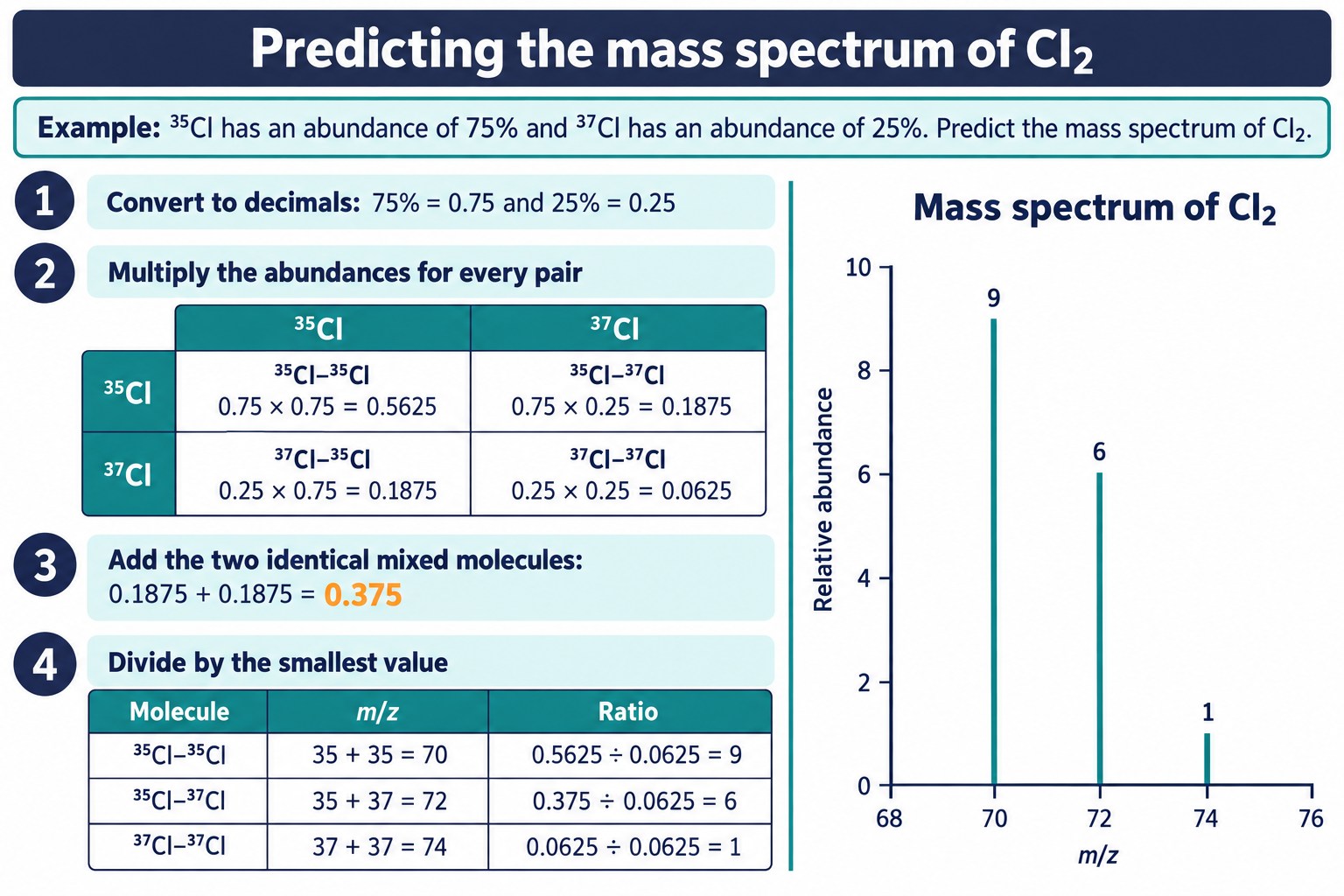
The m/z 70, 72 and 74 peaks arise from the three possible molecular masses of Cl2+.
Use the Pattern to Check Your Answer
The 9:6:1 peak ratio is not random. It comes from the isotope abundance ratio of chlorine, which is approximately 3:1 for 35Cl:37Cl.
For a diatomic molecule, the combinations follow the pattern:
3 × 3 : 2 × 3 × 1 : 1 × 1 = 9 : 6 : 1
The factor of 2 appears because the mixed molecule can form in two equivalent orders.Exam focus: if the chlorine molecular ion peaks are in a 9:6:1 ratio, this supports the presence of two chlorine atoms in the molecule.
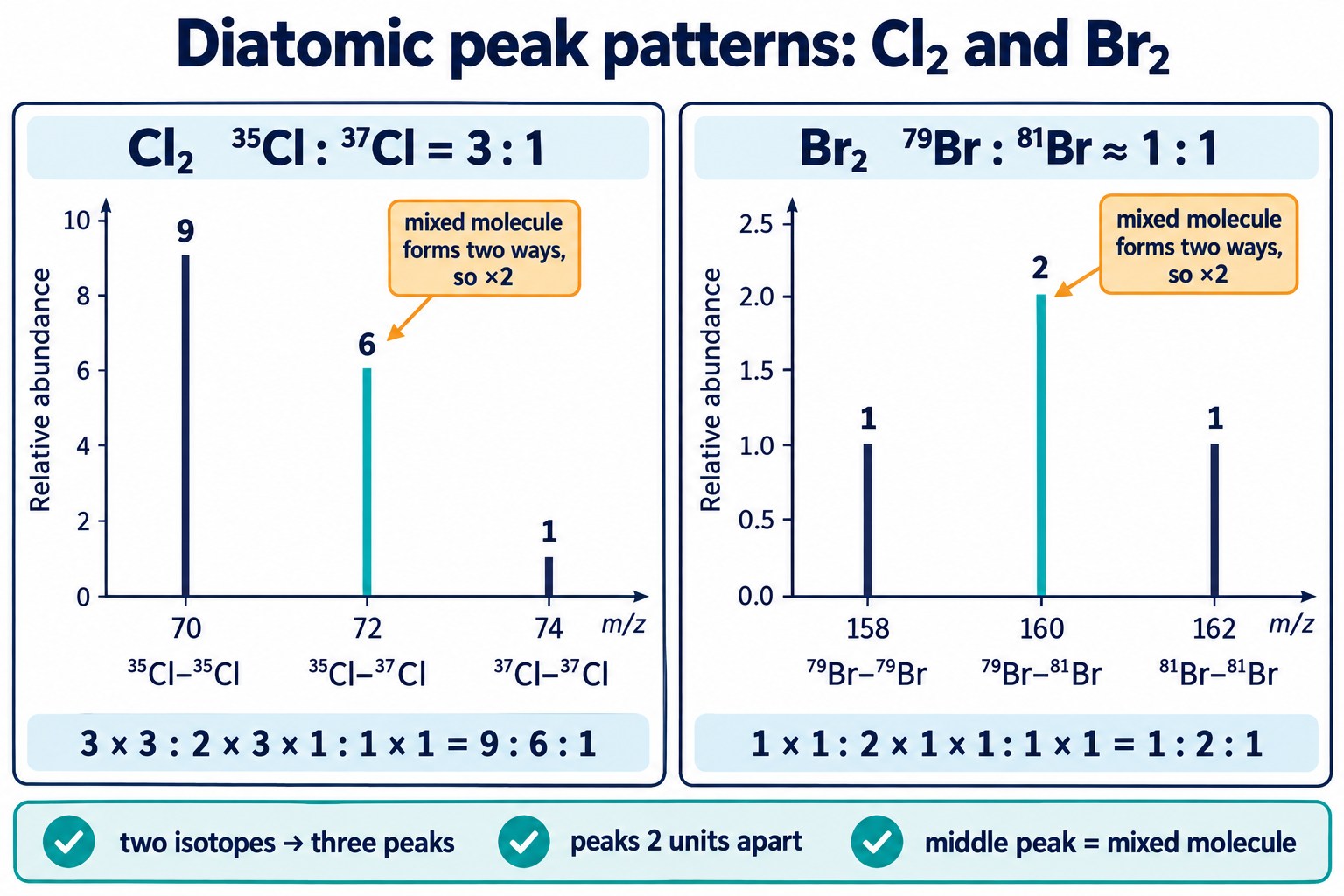
Two isotopes give three molecular ion peaks 2 units apart: 9 : 6 : 1 for Cl₂ and 1 : 2 : 1 for Br₂.
Quick Check: Patterns Beyond Chlorine
In each round, pick the one statement that is accurate.
Common Exam Points
These points help avoid the most frequent mistakes when predicting molecular mass spectra for diatomic molecules.
Use molecular mass, not atomic mass
For Cl2, the molecular ion peaks are at m/z 70, 72 and 74. The peaks at m/z 35 and 37 come from Cl+ atomic ions, not from molecules.
Remember the mixed molecule twice
35Cl-37Cl and 37Cl-35Cl are equivalent but both contribute to the m/z 72 peak.
Multiply probabilities
To find the relative abundance of a molecule, multiply the abundances of the two isotopes used to form it.
Use 1+ ions carefully
When the molecular ion has a single positive charge, the m/z value is equal to the relative molecular mass of that ion.
QuickSnap Summary
Predicting a diatomic mass spectrum means combining isotope masses and isotope abundances to find the expected molecular ion peaks.
List every possible isotope pair in the diatomic molecule.
Add the isotope mass numbers to find each molecular ion m/z value.
Multiply isotope abundances to calculate the relative abundance of each pairing.
Add equivalent mixed pair abundances, then divide by the smallest value to get the simplest ratio.
FAQs
These common questions summarise the key calculation ideas for predicting diatomic molecular mass spectra.
Why does Cl2 give peaks at m/z 70, 72 and 74?
Chlorine has two isotopes, 35Cl and 37Cl. The possible Cl2 molecules have masses 35 + 35 = 70, 35 + 37 = 72, and 37 + 37 = 74.
Why is the middle Cl2 peak larger than expected?
The middle peak includes two equivalent mixed isotope arrangements: 35Cl-37Cl and 37Cl-35Cl. Their abundances must be added together.
How do you calculate the relative abundance of a diatomic molecule?
Convert the isotope abundances into decimals, then multiply the two isotope abundances for the atoms in that molecule.
What is the predicted Cl2 molecular ion peak ratio?
Using 75% 35Cl and 25% 37Cl, the predicted molecular ion peaks at m/z 70, 72 and 74 have a ratio of 9:6:1.
Why does a real chlorine spectrum also show peaks at m/z 35 and 37?
Some Cl2+ ions break apart in the instrument to give 35Cl+ and 37Cl+. These atomic ion peaks are in the 3:1 isotope ratio and are not part of the 9:6:1 molecular ion pattern.
Copyright notice: This OLS revision content, including the explanations, layout, diagrams, tables and embedded learning structure, is authored for Online Learning System by Dr. Mohammed Al-Fatah. It may not be copied, reproduced, redistributed or adapted without written permission.
Keep this note — free
Save your progress across every Edexcel topic. A free account remembers which topics you have covered, saves your question scores, and syncs across your phone and laptop.
- Track every topic you have finished
- Keep your practice-question scores
- No payment, no card, free forever
Already registered? Log in