Introduction to Ionisation Energy
A concise revision guide to first ionisation energy, second ionisation energy and the three main factors that affect how strongly an outer electron is attracted to the nucleus.
- 1.11-a
- 1.12-a
- 1.12-b
What these spec points say
- 1.11-a be able to define the term 'first ionisation energy'
- 1.12-a understand how ionisation energies are influenced by the number of protons
- 1.12-b understand how ionisation energies are influenced by electron shielding
GCSE Recap: Forming Positive Ions
Before you start, check that you remember how atoms become positive ions.
Watch: what first ionisation energy really means
One mole of gaseous hydrogen atoms, each losing one electron. Does that take in energy or give it out?
What Is First Ionisation Energy?
First ionisation energy is the energy required when one mole of gaseous atoms forms one mole of gaseous ions with a single positive charge.
The electron is removed from each gaseous atom. Because an electron is removed, a positive ion forms.
The atoms must be gaseous so that they are separate from each other.
There are then no bonds or forces between particles to overcome, so the energy measured is only the energy needed to remove the electron.
This is why the equation for oxygen starts from O(g) atoms, not O₂(g) molecules.
The value is quoted for one mole of atoms, in kJ mol⁻¹. This gives a convenient number and lets different elements be compared on the same basis.
Key idea: The definition must include one mole, gaseous atoms, gaseous ions and a single positive charge.
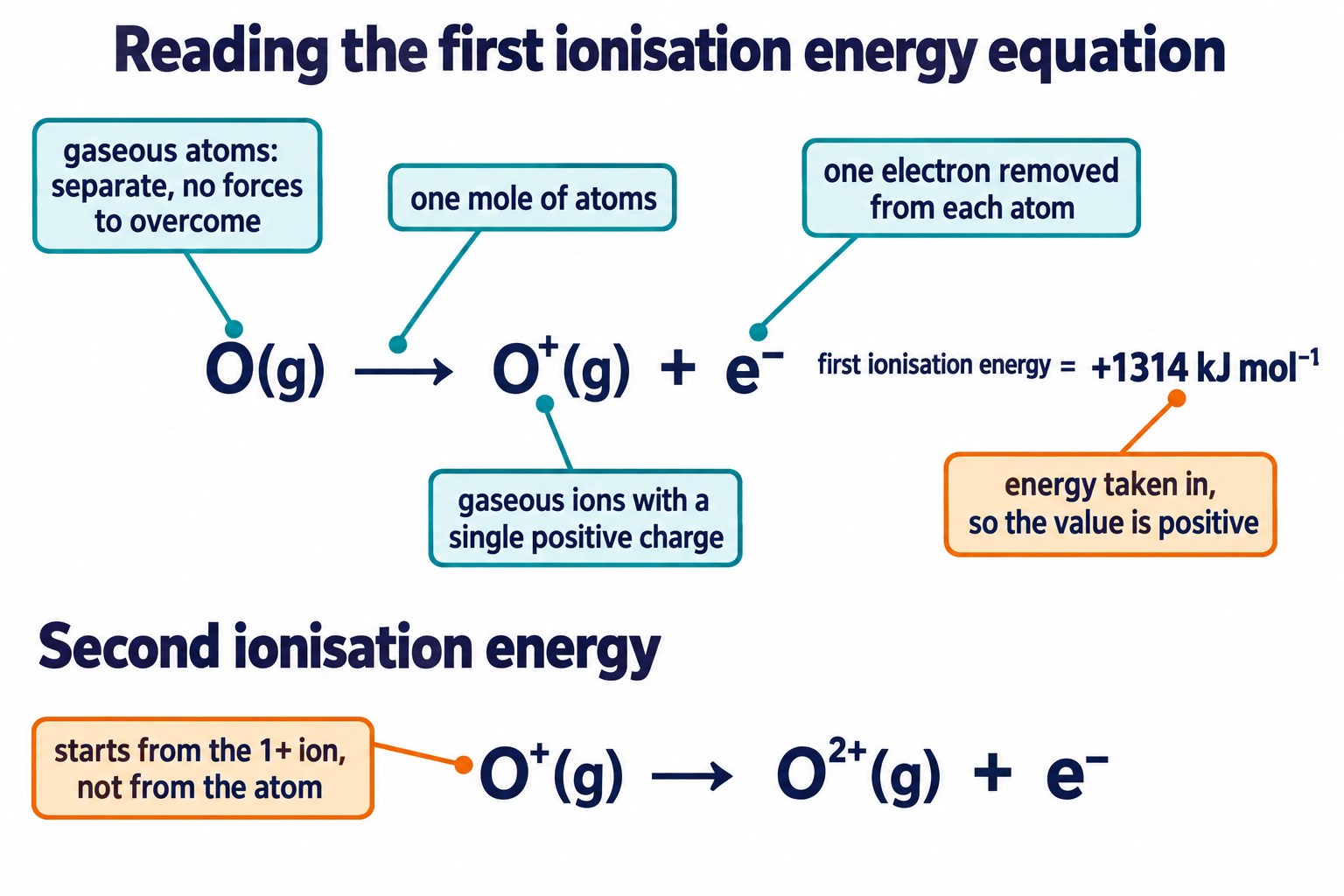
Each part of the equation matches a part of the definition: one mole of gaseous atoms forming one mole of gaseous 1+ ions.
Second Ionisation Energy
Second ionisation energy is the energy required when one mole of gaseous ions with a single positive charge forms one mole of gaseous ions with a double positive charge.
This means the second electron is removed from an ion that is already positive. This normally requires more energy than removing the first electron because the remaining electrons are attracted more strongly to the positively charged species.
Third and later ionisation energies follow the same pattern. The nth ionisation energy removes one electron from each ion in one mole of gaseous ions with a charge of (n − 1)+.
Exam focus: Do not define second ionisation energy using neutral atoms. It starts with gaseous 1+ ions and forms gaseous 2+ ions.
Quick Check: Choose the Ionisation Equation
Pick the equation that matches each ionisation energy.
Why Ionisation Energy Is Positive
Ionisation energy is positive because energy must be supplied to overcome the attraction between the negatively charged electron and the positively charged nucleus.
A high ionisation energy indicates a strong attraction between the electron and the nucleus. As a result, more energy is needed to remove the electron from the atom or ion.
Remember: Removing an electron requires energy input, so ionisation energies are endothermic and usually shown with a positive sign.
Quick Check: Moles and Signs
Use the two ionisation energies given to work out each number.
Three Factors That Affect Ionisation Energy
Ionisation energy depends on how strongly the outer electron is attracted to the nucleus. Three factors are most important: nuclear charge, distance from the nucleus and shielding.
| Factor | Effect on attraction | Effect on ionisation energy |
|---|---|---|
| Nuclear charge | More protons in the nucleus make the nucleus more positively charged, so attraction for outer electrons increases. | Higher nuclear charge usually increases ionisation energy. |
| Distance from the nucleus | Attraction falls rapidly with distance. An electron in a shell closer to the nucleus is more strongly attracted. | Greater distance from the nucleus usually decreases ionisation energy. |
| Shielding | Inner shells of electrons repel outer electrons and reduce the attraction from the nucleus. | More shielding usually decreases ionisation energy. |
Key idea: Many ionisation energy questions can be answered by applying these three factors carefully.
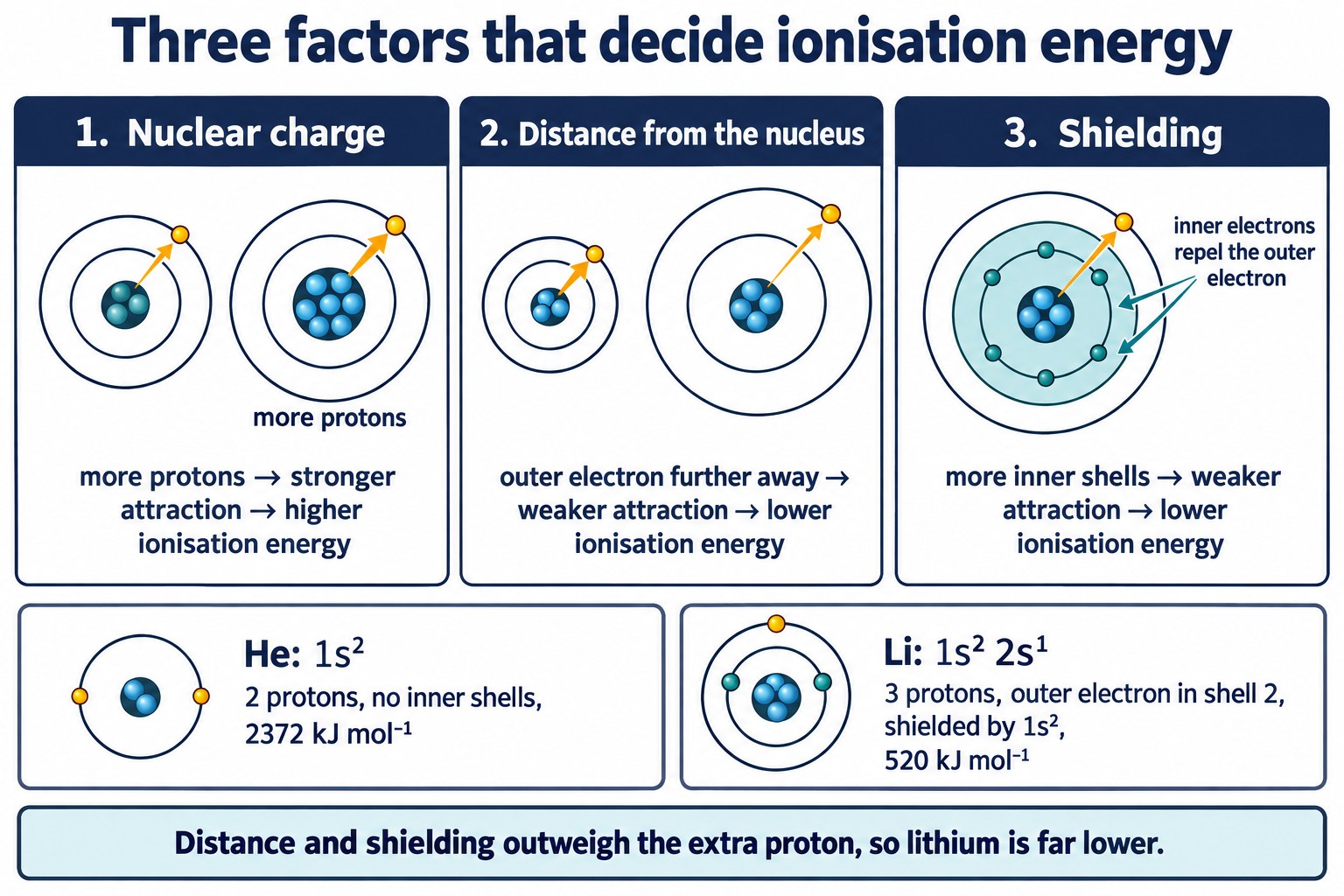
Nuclear charge raises ionisation energy; greater distance and more shielding lower it.
Quick Check: Do Neutrons Matter?
Use the three factors to compare two isotopes of the same element.
How to Apply the Factors
When comparing ionisation energies, start by asking which electron is being removed and how strongly it is attracted to the nucleus.
More protons usually means stronger attraction
If shielding and distance are similar, a higher nuclear charge increases attraction for the outer electron.
More shells usually means weaker attraction
If the outer electron is in a shell further from the nucleus, it experiences weaker attraction.
More shielding lowers the effective nuclear attraction
Inner electrons repel outer electrons, so the outer electron feels less of the full nuclear charge.
Quick Check: Explain Lithium and Helium
Write a short explanation, then compare it with the mark points and the model answer.
Quick Check: Pick the Accurate Statement
In each round, choose the one statement that is accurate.
Common Exam Points
- Always state gaseous atoms or gaseous ions in ionisation energy definitions.
- Always refer to one mole, not one atom, when giving the formal definition.
- For first ionisation energy, the product is gaseous 1+ ions.
- For second ionisation energy, the reactant is already a gaseous 1+ ion.
- When explaining trends, use nuclear charge, distance from the nucleus and shielding.
- Do not just say attraction is stronger or weaker. State why the attraction changes.
QuickSnap
This text summary condenses the page into the essential exam ideas.
- First ionisation energy: energy required when one mole of gaseous atoms forms one mole of gaseous 1+ ions.
- Second ionisation energy: energy required when one mole of gaseous 1+ ions forms one mole of gaseous 2+ ions.
- Why gaseous: the atoms are separate, so no bonds or forces between particles are included in the energy.
- nth ionisation energy: X(n−1)+(g) → Xn+(g) + e−.
- High ionisation energy: strong attraction between the electron and the nucleus.
- Main factors: nuclear charge, distance of the outer electron from the nucleus and shielding by inner electron shells.
- Exam method: explain attraction, then link the strength of attraction to the energy needed to remove the electron.
FAQs: Introduction to Ionisation Energy
These frequently asked questions target the wording and reasoning students commonly need for exam answers.
What is first ionisation energy?
First ionisation energy is the energy required when one mole of gaseous atoms forms one mole of gaseous ions with a single positive charge.
Why must the atoms be gaseous?
The definition uses gaseous atoms so the energy change refers only to removing electrons from separate atoms, not to overcoming forces between particles in a solid or liquid.
Why is ionisation energy positive?
Energy must be supplied to overcome the attraction between the negatively charged electron and the positively charged nucleus, so ionisation is endothermic.
What are the three main factors affecting ionisation energy?
The three main factors are nuclear charge, distance of the electron from the nucleus and shielding by inner electron shells.
Why does shielding lower ionisation energy?
Inner shell electrons repel outer electrons and reduce the attraction between the outer electron and the nucleus. Less attraction means less energy is needed to remove the electron.
Copyright notice: This OLS revision content, including the explanations, layout, diagrams, tables and embedded learning structure, is authored for Online Learning System by Dr. Mohammed Al-Fatah. It may not be copied, reproduced, redistributed or adapted without written permission.
Keep this note — free
Save your progress across every Edexcel topic. A free account remembers which topics you have covered, saves your question scores, and syncs across your phone and laptop.
- Track every topic you have finished
- Keep your practice-question scores
- No payment, no card, free forever
Already registered? Log in