Periodic Trends
A concise revision guide to periodicity: atomic radius and ionisation energy trends across a period and down a group, melting and boiling temperature trends across Period 3, and how physical properties link to bonding and structure for Edexcel A Level Chemistry (9CH0).
- 1.24
- 1.25i-a
- 1.25i-b
- 1.25ii-a
- 1.26-a
- 1.26-b
- 1.26-c
- 1.26-d
- 1.26-e
What these spec points say
- 1.24 understand periodicity in terms of a repeating pattern across different periods
- 1.25i-a understand reasons for trends in melting temperatures of elements from periods 2 and 3 based on given data in terms of structure and bonding
- 1.25i-b understand reasons for trends in boiling temperatures of elements from periods 2 and 3 based on given data in terms of structure and bonding
- 1.25ii-a understand reasons for trends in ionisation energy of elements from periods 2 and 3 based on given data
- 1.26-a be able to illustrate periodicity using electronic configuration data
- 1.26-b be able to illustrate periodicity using atomic radii data
- 1.26-c be able to illustrate periodicity using melting temperature data
- 1.26-d be able to illustrate periodicity using boiling temperature data
- 1.26-e be able to illustrate periodicity using first ionisation energy data
GCSE Recap: Groups, Periods and Outer Electrons
Three quick GCSE questions on the layout of the periodic table before you meet the trends that layout produces.
What Is Periodicity?
Periodicity refers to the repeating pattern of chemical and physical properties seen across different periods of the periodic table. The same pattern appears in Period 2 and Period 3 because electrons are added to the same types of subshells in the same sequence.
The specification requires you to understand periodicity in terms of a repeating pattern, and to explain trends in melting and boiling temperatures, ionisation energy and atomic radius across periods 2 and 3.
Key idea: periodic trends repeat because the electronic structure of each period follows the same pattern of subshell filling.
Atomic Radius Across a Period
Atomic radius generally decreases across a period. As proton number increases, nuclear charge increases. Electrons are added to the same main shell, so shielding remains similar. The stronger nuclear attraction pulls the electron cloud closer to the nucleus.
Nuclear charge increases
More protons in the nucleus attract the outer electrons more strongly, pulling them closer.
Shielding stays similar
Electrons enter the same main shell, so no significant extra inner-shell shielding is added.
Atomic radius decreases
The stronger attraction reduces the distance between the nucleus and the outer electrons.
Quick Check: Atomic Radius in Period 4
Take the reasoning of this card into a period the page has not used.
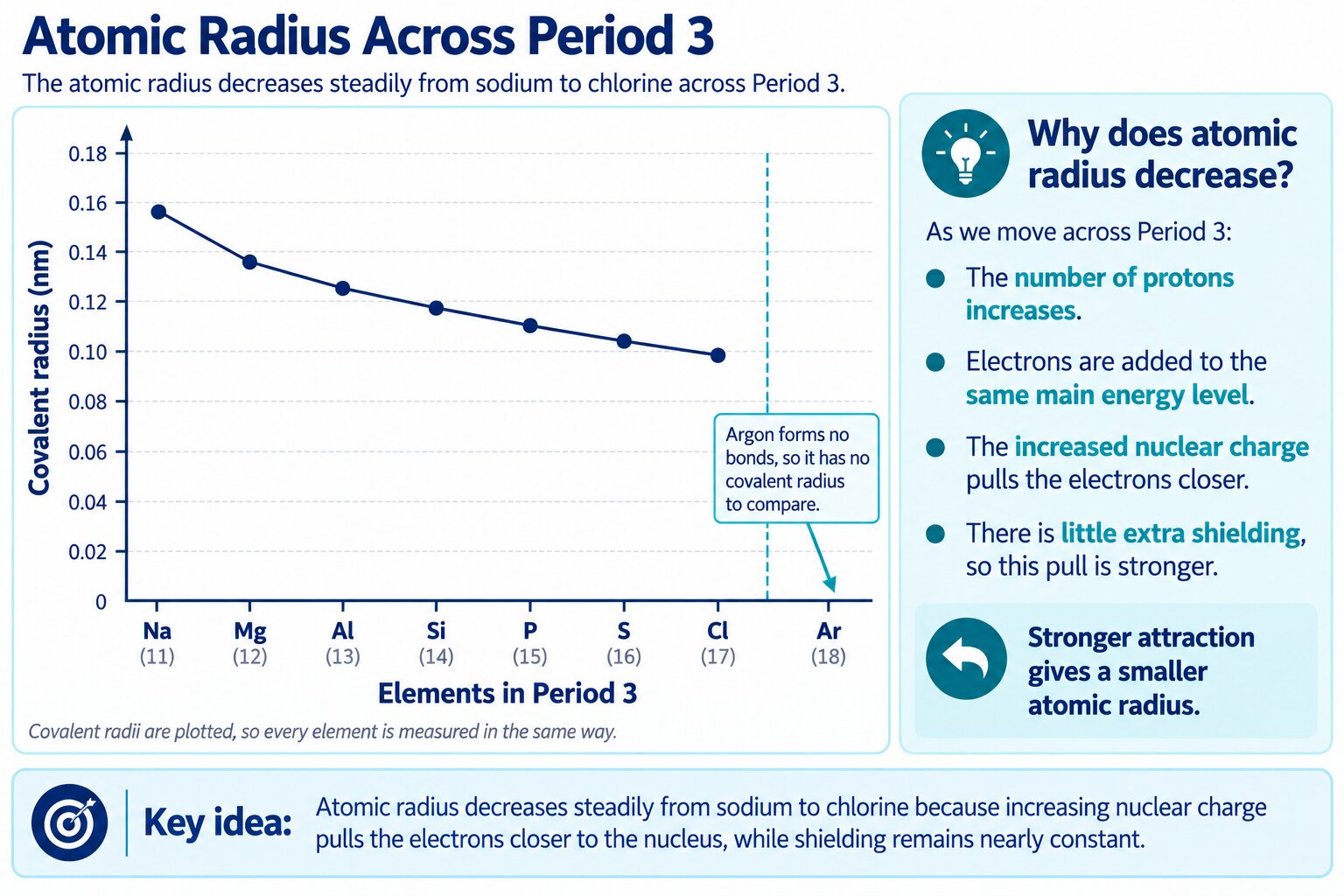
Across a period, atomic radius decreases because nuclear charge increases while shielding remains similar.
Ionisation Energy Compared Across a Period and Down a Group
It is useful to separate the two directions clearly. Across a period, electrons are added to the same main shell, so shielding remains similar and atomic radius decreases. First ionisation energy generally increases.
Down a group, electrons are added to new shells. This gives a larger atomic radius and more shielding, so first ionisation energy decreases.
| Direction | Atomic radius | Shielding | First ionisation energy |
|---|---|---|---|
| Across a period (left to right) | Decreases | Similar | Generally increases |
| Down a group | Increases | Increases | Decreases |
Quick Check: Going Down a Group
Build the explanation for the direction the page gives no data for.
Quick Check: Five Pairs of Elements
Decide each pair quickly, using both directions of the table.
Melting and Boiling Temperature Trends Across Period 3
Across Period 3, melting and boiling temperatures do not follow the same pattern as ionisation energy. This is because melting and boiling temperatures depend on bonding and structure, not on how tightly electrons are held.
Sodium, magnesium and aluminium are metallic solids with giant metallic structures.
Silicon has a giant covalent structure with very strong bonds throughout.
Phosphorus, sulfur, chlorine and argon are simple molecular or monatomic, so their melting and boiling temperatures are low and depend on weak intermolecular forces.
Exam focus: do not explain melting temperature trends using ionisation energy arguments. Melting temperature depends on the type of bonding and structure, not on the energy needed to remove an electron.
Period 3 Structures and Melting
Choose a step to watch each Period 3 structure, then see how much energy each element needs to melt.
© Dr. Mohammed Al-Fatah – onlinelearningsystem.net
Quick Check: Order a Period by Melting Temperature
Rank five Period 2 elements by structure, lowest melting temperature first.
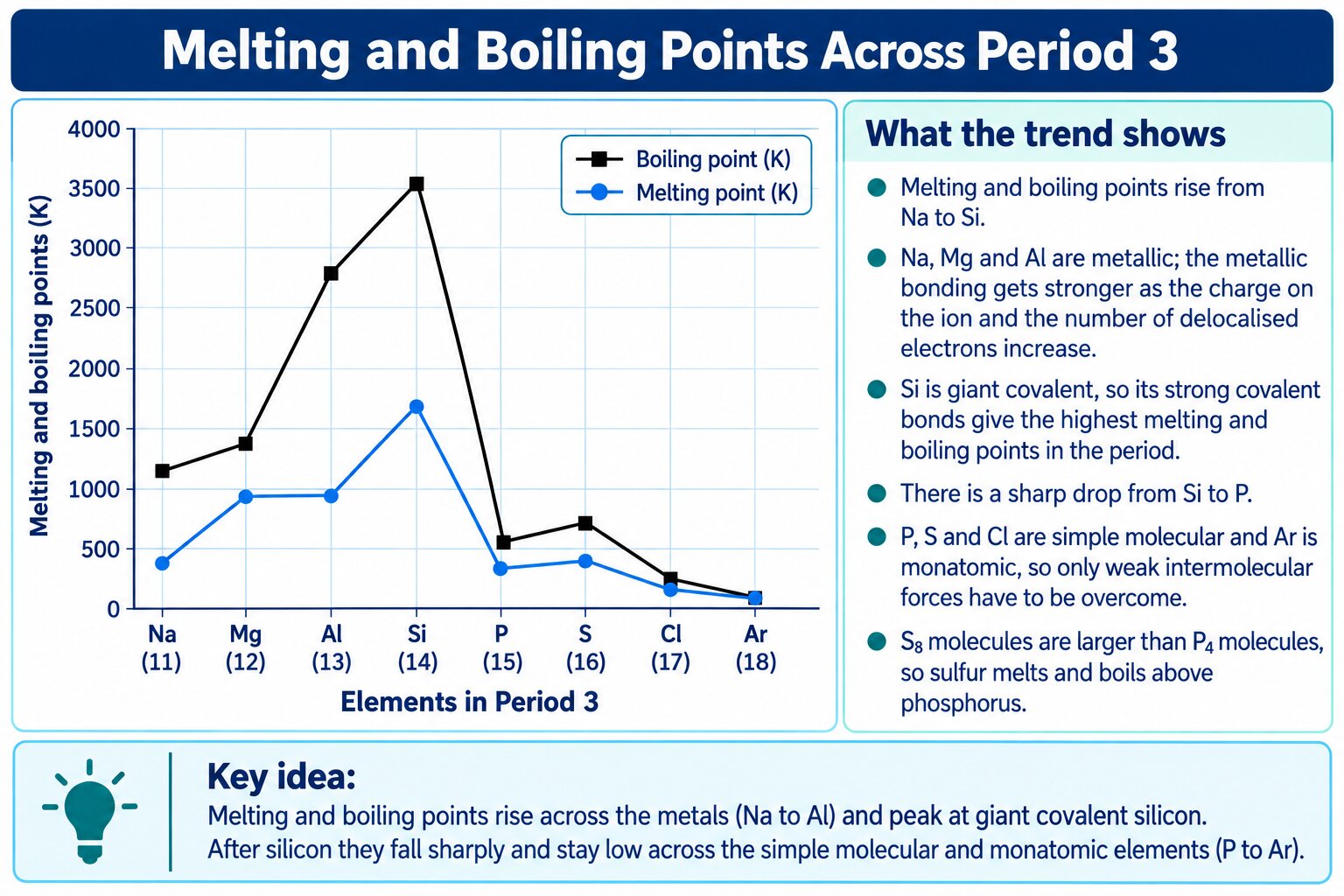
Physical property trends depend on bonding and structure, so they should not be explained using ionisation energy arguments alone.
Using Data to Illustrate Periodicity
You need to illustrate periodicity using data, including electronic configurations, atomic radii, melting and boiling temperatures and first ionisation energies.
When answering these questions, state the trend clearly, identify the direction (across a period or down a group) and explain the cause using nuclear charge, shielding, atomic radius and the type of bonding or structure.
Electronic configuration
Repeating pattern of subshell filling from s to p explains why properties repeat across periods.
Atomic radius
Decreases across a period (nuclear charge dominates), increases down a group (extra shells).
Melting and boiling temperatures
Determined by structure: metallic, giant covalent, or simple molecular/monatomic.
First ionisation energies
Generally increase across a period; decrease down a group. Small exceptions occur between Group 2 and Group 3, and between Group 5 and Group 6.
Quick Check: Matching the Argument to the Trend
Pick the one accurate statement in each round to finish the page.
Common Exam Points
- Across a period, nuclear charge increases while shielding stays similar, so atomic radius decreases.
- Down a group, the extra shells and extra shielding make atomic radius increase and first ionisation energy decrease.
- Explain the melting temperature trend using structure and bonding, never ionisation energy.
- Silicon has the highest melting temperature in Period 3 because its giant covalent lattice has many strong covalent bonds to break.
- The melting temperature rises from sodium to aluminium because metallic bonding gets stronger: more delocalised electrons per atom and a smaller, more highly charged ion.
- Among the simple molecular elements, S8 has the most electrons, so it has the strongest London forces and the highest melting temperature.
QuickSnap
This text summary condenses the page into the essential exam ideas.
- Periodicity is the repeating pattern of properties across each period, caused by the repeating pattern of subshell filling.
- Atomic radius decreases across a period and increases down a group.
- First ionisation energy generally increases across a period and decreases down a group, with small dips at Group 3 and Group 6.
- Melting temperatures rise from sodium to silicon, then fall sharply to the simple molecular elements and argon.
FAQs: Periodic Trends
Use these questions to secure the key reasoning for periodic trend exam answers.
What is periodicity?
Periodicity is the repeating pattern of physical and chemical properties seen across different periods of the periodic table, caused by the repeated pattern of subshell filling.
Why does atomic radius decrease across a period?
Nuclear charge increases while electrons are added to the same main shell, so shielding remains similar and the stronger nuclear attraction pulls the electron cloud closer to the nucleus.
Why do melting and boiling temperatures not follow the same trend as ionisation energy across a period?
Melting and boiling temperatures depend on bonding and structure. Metallic elements have giant metallic structures, silicon has a giant covalent structure, and the other Period 3 elements are simple molecular or monatomic with weak intermolecular forces.
Why does first ionisation energy generally increase across a period?
As proton number increases, nuclear charge increases but shielding remains similar because electrons enter the same main shell. The stronger attraction between the nucleus and the outer electron means more energy is needed to remove it.
Why does first ionisation energy decrease down a group?
Going down a group, atoms have more occupied electron shells. The outer electron is further from the nucleus and shielded more strongly by inner shells, so less energy is needed to remove it.

Copyright notice: This OLS revision content, including the explanations, layout, diagrams, tables and embedded learning structure, is authored for Online Learning System by Dr. Mohammed Al-Fatah. It may not be copied, reproduced, redistributed or adapted without written permission.
Keep this note — free
Save your progress across every Edexcel topic. A free account remembers which topics you have covered, saves your question scores, and syncs across your phone and laptop.
- Track every topic you have finished
- Keep your practice-question scores
- No payment, no card, free forever
Already registered? Log in