Predicting Diatomic Mass Spectra
A concise revision guide to predicting the molecular ion peaks for diatomic molecules from isotope abundance data, using chlorine, Cl2, as the key example.
Why Diatomic Molecules Give Several Peaks
A diatomic molecule contains two atoms joined together. If the element has more than one isotope, different isotope pairings are possible in the molecule.
For chlorine, the two main isotopes are 35Cl and 37Cl. This means a molecule of Cl2 can contain two 35Cl atoms, one of each isotope, or two 37Cl atoms.
Key idea: each possible isotope pairing gives a different molecular mass, so the molecular ion region of the mass spectrum shows more than one peak.
List Every Possible Isotope Pair
Start by listing the possible combinations. This prevents you from missing the mixed molecule, which is the most common exam error in this calculation.
| Combination | Molecule | Molecular mass | Expected m/z for 1+ ion |
|---|---|---|---|
| Light + light | 35Cl-35Cl | 35 + 35 = 70 | 70 |
| Light + heavy | 35Cl-37Cl | 35 + 37 = 72 | 72 |
| Heavy + light | 37Cl-35Cl | 37 + 35 = 72 | 72 |
| Heavy + heavy | 37Cl-37Cl | 37 + 37 = 74 | 74 |
Exam focus: the two mixed arrangements have the same molecular mass, so they contribute to the same m/z peak.
Multiply the Isotopic Abundances
Convert the percentage abundances into decimals, then multiply the two isotope abundances for each possible molecule.
For chlorine: 35Cl = 75% = 0.75 and 37Cl = 25% = 0.25.
| Molecule | Relative abundance calculation | Relative abundance |
|---|---|---|
| 35Cl-35Cl | 0.75 × 0.75 | 0.5625 |
| 35Cl-37Cl | 0.75 × 0.25 | 0.1875 |
| 37Cl-35Cl | 0.25 × 0.75 | 0.1875 |
| 37Cl-37Cl | 0.25 × 0.25 | 0.0625 |
Remember: do not add the isotope abundances for a molecule. Multiply them, because both atoms must be chosen together.
Combine Equivalent Mixed Isotope Molecules
The molecules 35Cl-37Cl and 37Cl-35Cl have the same molecular mass. Both have molecular mass 72, so their abundances are added together.
0.1875 + 0.1875 = 0.375
This gives the total relative abundance of the m/z 72 peak.| Molecular ion | m/z | Total relative abundance |
|---|---|---|
| 35Cl-35Cl+ | 70 | 0.5625 |
| 35Cl-37Cl+ and 37Cl-35Cl+ | 72 | 0.375 |
| 37Cl-37Cl+ | 74 | 0.0625 |
Convert Relative Abundances into a Peak Ratio
To find the simplest whole number ratio, divide all of the relative abundances by the smallest value.
m/z 70
0.5625 ÷ 0.0625 = 9
m/z 72
0.375 ÷ 0.0625 = 6
m/z 74
0.0625 ÷ 0.0625 = 1
Cl2 molecular ion peaks: m/z 70 : 72 : 74 = 9 : 6 : 1
The middle peak is larger than the m/z 74 peak because there are two ways to make a mixed isotope molecule.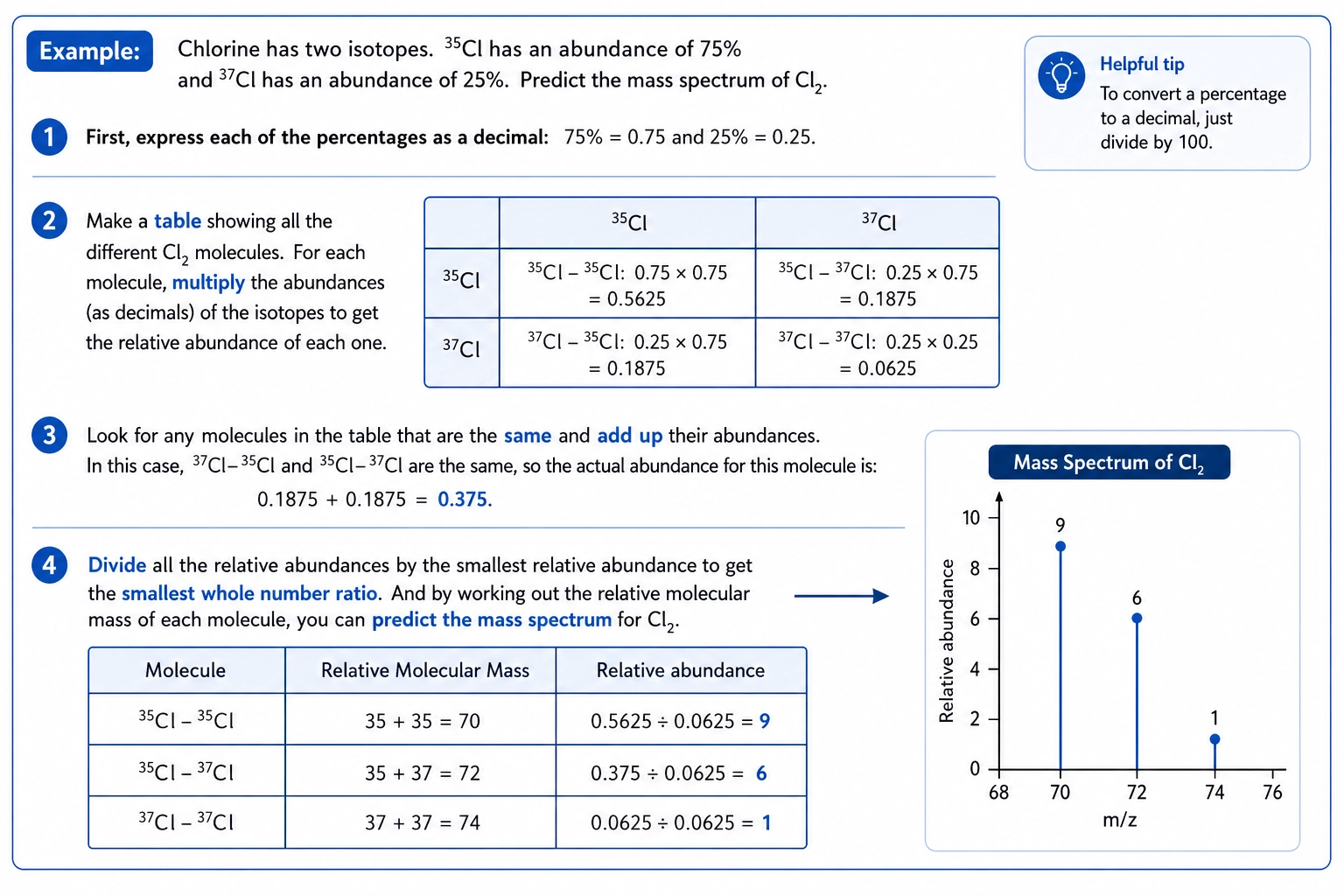
The m/z 70, 72 and 74 peaks arise from the three possible molecular masses of Cl2+.
Use the Pattern to Check Your Answer
The 9:6:1 peak ratio is not random. It comes from the isotope abundance ratio of chlorine, which is approximately 3:1 for 35Cl:37Cl.
For a diatomic molecule, the combinations follow the pattern:
3 × 3 : 2 × 3 × 1 : 1 × 1 = 9 : 6 : 1
The factor of 2 appears because the mixed molecule can form in two equivalent orders.Exam focus: if the chlorine molecular ion peaks are in a 9:6:1 ratio, this supports the presence of two chlorine atoms in the molecule.
Common Exam Points
These points help avoid the most frequent mistakes when predicting molecular mass spectra for diatomic molecules.
Use molecular mass, not atomic mass
For Cl2, the peaks are at m/z 70, 72 and 74, not just 35 and 37.
Remember the mixed molecule twice
35Cl-37Cl and 37Cl-35Cl are equivalent but both contribute to the m/z 72 peak.
Multiply probabilities
To find the relative abundance of a molecule, multiply the abundances of the two isotopes used to form it.
Use 1+ ions carefully
When the molecular ion has a single positive charge, the m/z value is equal to the relative molecular mass of that ion.
Check Your Understanding
Use these short H5P tasks to test how isotope combinations lead to molecular ion peaks and peak ratios.
QuickSnap Summary
Predicting a diatomic mass spectrum means combining isotope masses and isotope abundances to find the expected molecular ion peaks.
List every possible isotope pair in the diatomic molecule.
Add the isotope mass numbers to find each molecular ion m/z value.
Multiply isotope abundances to calculate the relative abundance of each pairing.
Add equivalent mixed pair abundances, then divide by the smallest value to get the simplest ratio.
Master Atomic Structure and The Periodic Table for Edexcel A Level Chemistry
Continue from these free revision notes into the full Topic 1 Atomic Structure and The Periodic Table course, with guided video teaching, diagnostic MCQ practice, teacher-marked short-answer questions and a specification assignment with a personalised progress report.
Guided video teaching
Learn atomic structure, isotopes, mass spectrometry, ionisation energy, electron configuration and periodic trends through structured video lessons with worked examples and walkthroughs.
Instant MCQ feedback
Auto-marked MCQ quizzes provide immediate diagnostic feedback for every answer choice.
Teacher-marked SAQs
Submit written exam responses and receive chemistry specialist feedback with improvement guidance.
Progress tracking
Identify strengths and weaknesses across atomic structure, isotopes, mass spectrometry, ionisation energies, electron configuration and periodic trends with targeted reporting.
See how the course works
Click play to start the course preview animation.
Some ionic radii are shown.
| Ion | Ionic radius / nm |
|---|---|
| Na+ | 0.102 |
| K+ | 0.138 |
| F− | 0.133 |
| Cl− | 0.180 |
Which compound has the strongest ionic bonding?
Explain why the metallic bonding in magnesium is much stronger than that in sodium.
FAQs
These common questions summarise the key calculation ideas for predicting diatomic molecular mass spectra.
Why does Cl2 give peaks at m/z 70, 72 and 74?
Chlorine has two isotopes, 35Cl and 37Cl. The possible Cl2 molecules have masses 35 + 35 = 70, 35 + 37 = 72, and 37 + 37 = 74.
Why is the middle Cl2 peak larger than expected?
The middle peak includes two equivalent mixed isotope arrangements: 35Cl-37Cl and 37Cl-35Cl. Their abundances must be added together.
How do you calculate the relative abundance of a diatomic molecule?
Convert the isotope abundances into decimals, then multiply the two isotope abundances for the atoms in that molecule.
What is the predicted Cl2 molecular ion peak ratio?
Using 75% 35Cl and 25% 37Cl, the predicted molecular ion peaks at m/z 70, 72 and 74 have a ratio of 9:6:1.
Copyright notice: This revision page and its explanations are original OLS teaching resources written for Online Learning System by Dr. Mohammed Al-Fatah. They are provided for student revision and may not be copied, republished or redistributed without permission.
Copyright notice: This OLS revision content, including the explanations, layout, diagrams, tables and embedded learning structure, is authored for Online Learning System by Dr. Mohammed Al-Fatah. It may not be copied, reproduced, redistributed or adapted without written permission.