Trends in a Period
A concise revision guide to atomic radius and ionisation energy trends across a period, including the key exceptions from Group 2 to Group 3 and Group 5 to Group 6.
What Changes Across a Period?
Across a period, the number of protons increases. This increases the nuclear charge and gives the nucleus a stronger attraction for the outer electrons.
At the same time, new electrons are added to the same main energy level. They are not being added to new inner shells, so the amount of shielding remains roughly constant across the period.
Core idea: across a period, increasing nuclear charge has a greater effect than the small increase in electron-electron repulsion.
Atomic Radius Decreases Across a Period
Atomic radius decreases across a period because the nucleus becomes more positively charged as proton number increases.
The added electrons enter the same outer energy level, so there is no major increase in shielding from additional inner shells. The stronger nuclear attraction pulls the electron cloud closer to the nucleus.
Increased nuclear charge
More protons give a stronger positive charge in the nucleus, so electrons are pulled closer.
No extra inner-shell shielding
Electrons are added to the same main energy level, not to new inner shells.
Smaller atomic radius
The outer electrons are attracted more strongly, so the radius decreases across the period.
First Ionisation Energy Generally Increases Across a Period
First ionisation energy generally increases across a period. The outer electron is harder to remove because the nucleus has more protons and therefore exerts a stronger attraction.
Although each extra electron is added to the same shell and increases repulsion slightly, the increase in nuclear charge is more important. This is why the overall trend is an increase.
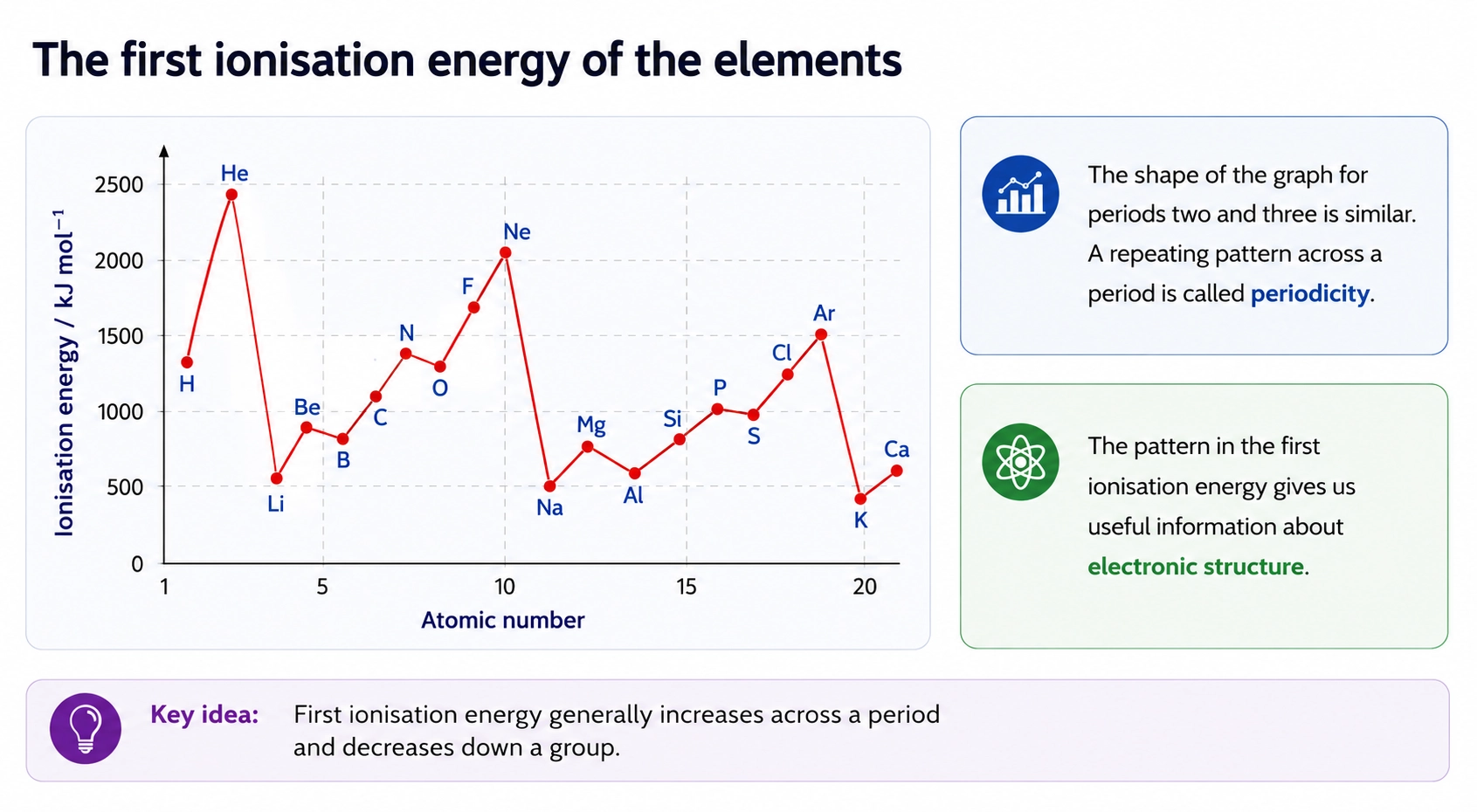
The graph shows the overall rise in first ionisation energy across a period, with small dips caused by subshell and electron-pairing effects.
Exception from Group 2 to Group 3
A small drop in first ionisation energy occurs from Group 2 to Group 3. In Period 3, this is the drop from magnesium to aluminium.
Magnesium loses an electron from the 3s subshell, whereas aluminium loses an electron from the 3p subshell. The 3p electron is higher in energy and is slightly shielded by the 3s electrons, so it is easier to remove.
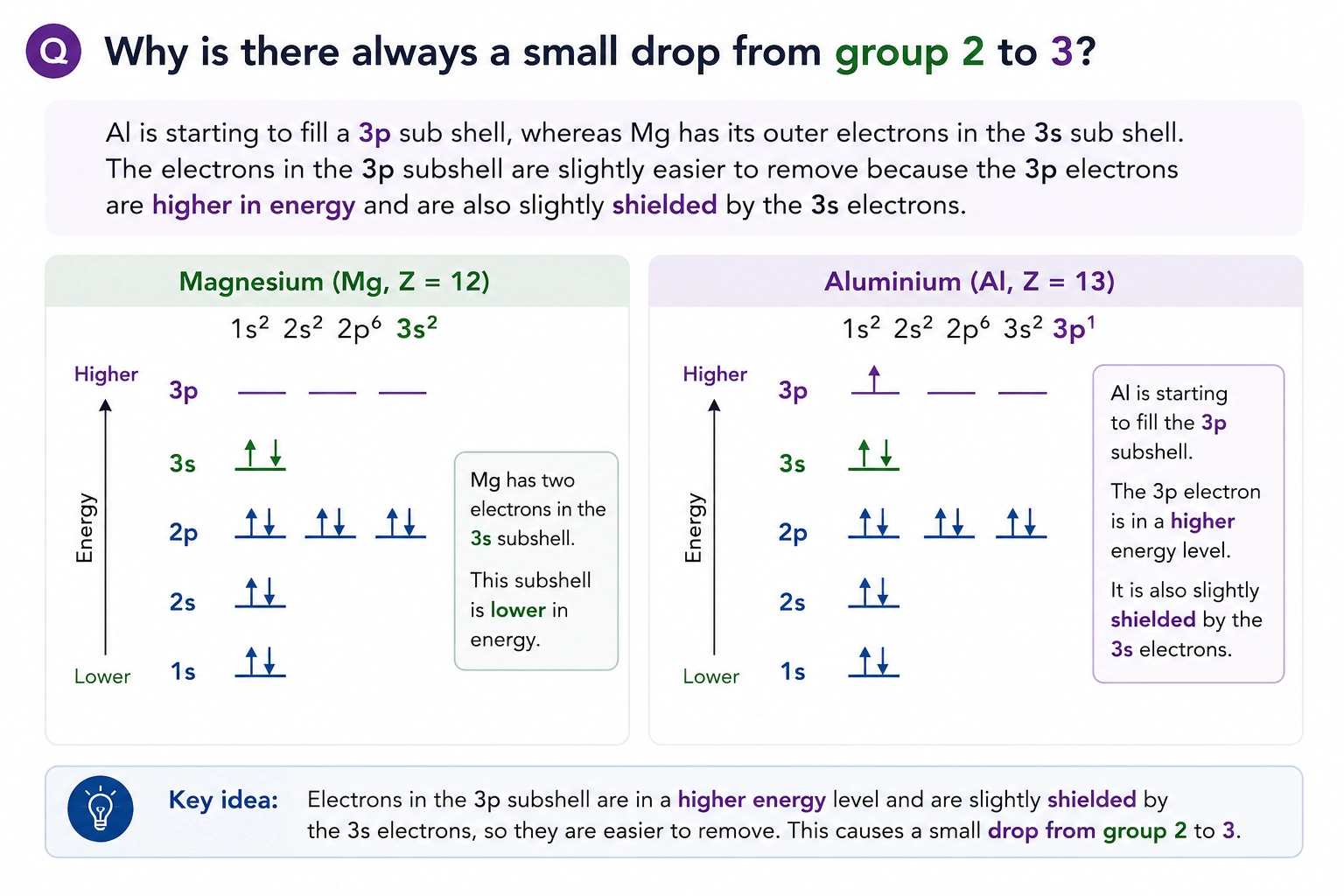
The first electron removed from aluminium is in a higher-energy 3p subshell rather than the 3s subshell.
Exception from Group 5 to Group 6
A second small drop occurs from Group 5 to Group 6. In Period 3, this is the drop from phosphorus to sulfur.
Phosphorus has three 3p electrons, each in a separate 3p orbital. Sulfur has four 3p electrons, so one 3p orbital contains a pair of electrons. Repulsion between the paired electrons makes one of them easier to remove.
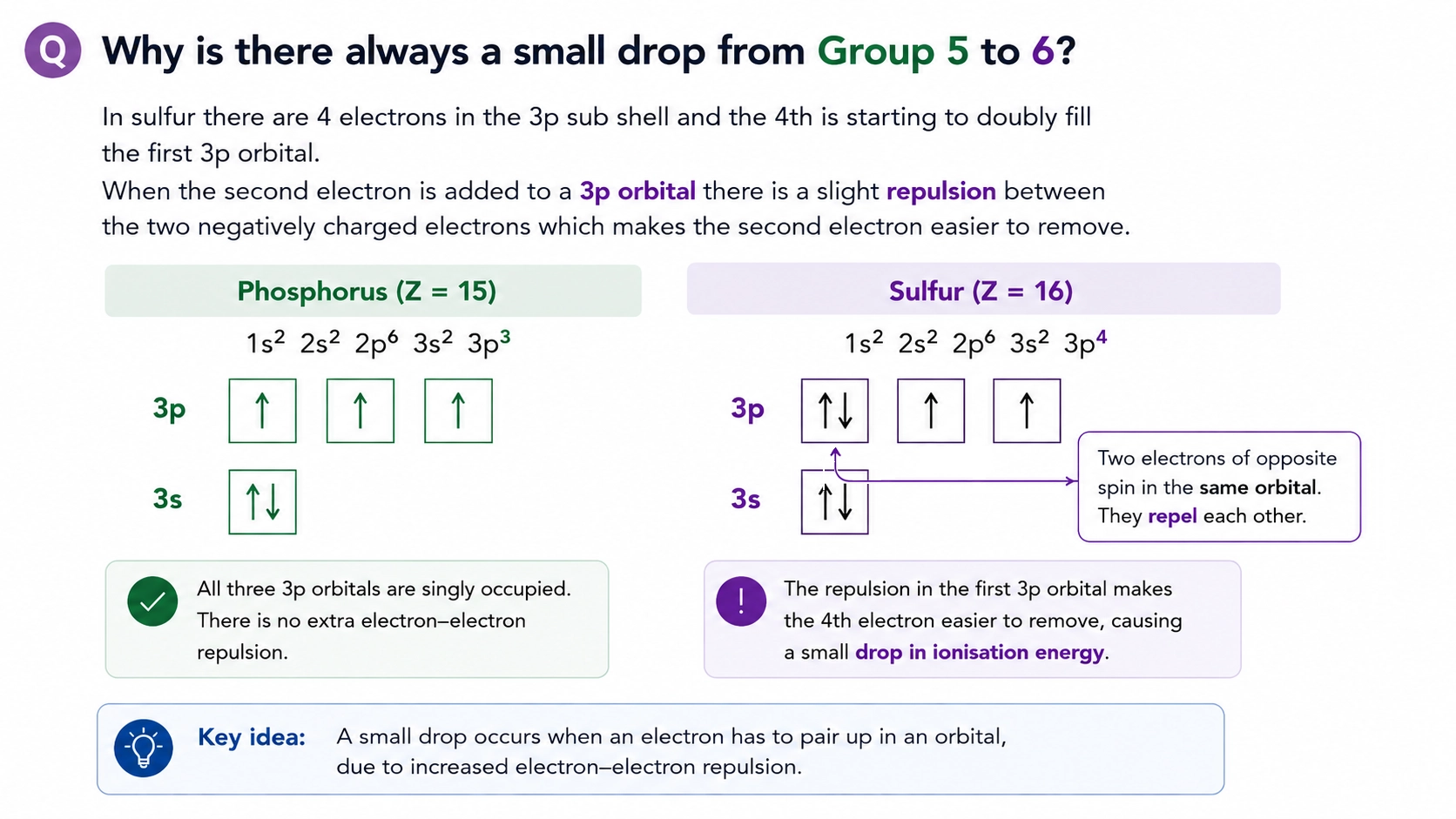
The paired 3p electrons in sulfur repel each other, lowering the energy needed to remove one electron.
Second Ionisation Energy Across Period 3
The pattern in second ionisation energy is similar to the pattern in first ionisation energy, but it appears shifted one place to the left.
This is because the second ionisation energy removes an electron from a 1+ ion. For example, sodium has a very high second ionisation energy because its second electron is removed from an inner shell closer to the nucleus.
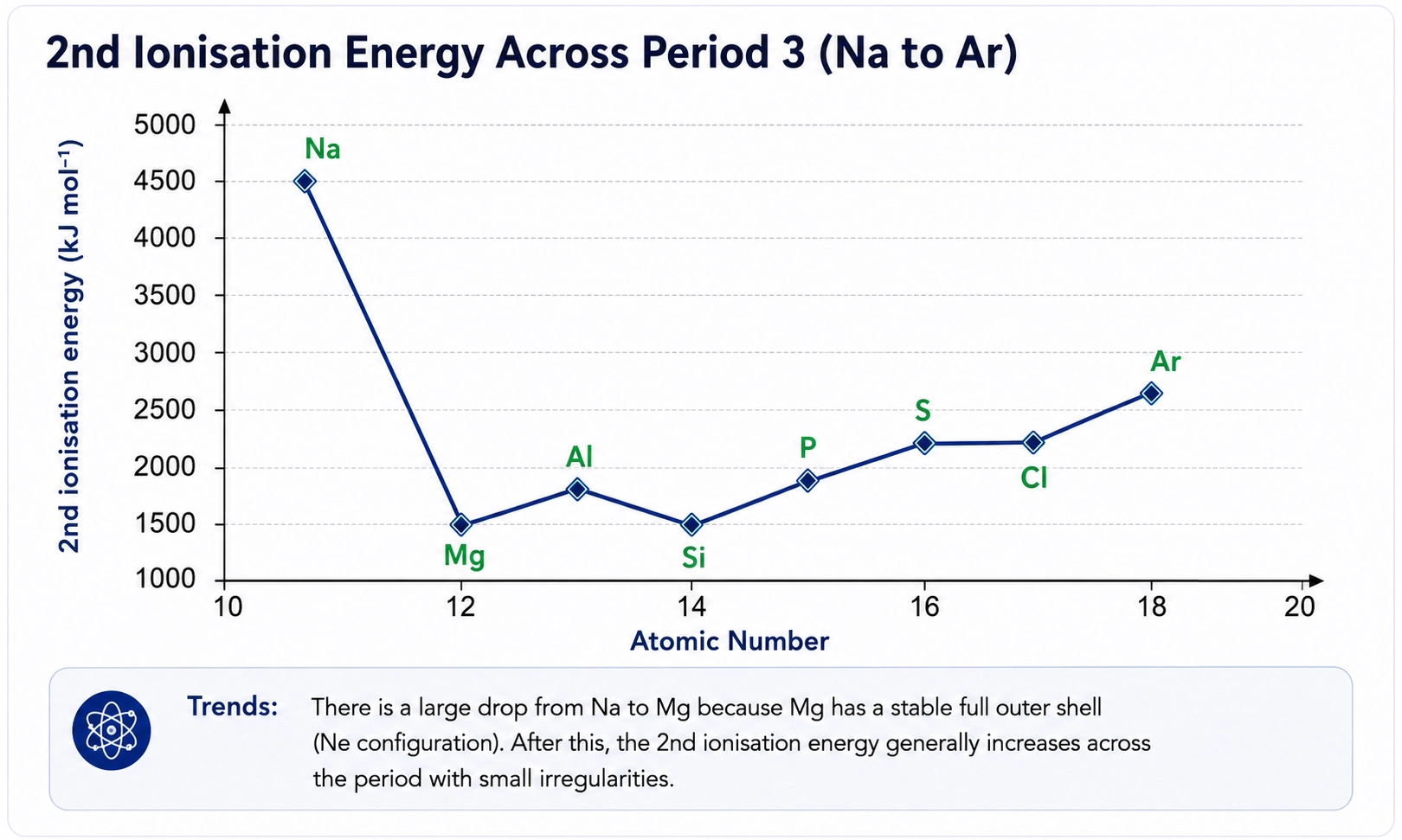
Group 1 elements appear at high points for second ionisation energy because the second electron is removed from an inner shell.
Second Ionisation Energy Across Period 3
The pattern in second ionisation energy is similar to the pattern in first ionisation energy, but it appears shifted one place to the left.
This is because the second ionisation energy removes an electron from a 1+ ion. For example, sodium has a very high second ionisation energy because its second electron is removed from an inner shell closer to the nucleus.
| Trend | Reason | Exam phrase to use |
|---|---|---|
| First ionisation energy generally increases across a period | Nuclear charge increases while shielding remains similar. | Stronger attraction between the nucleus and the outer electron. |
| Small drop from Group 2 to Group 3 | The electron removed is from a higher-energy p subshell. | The 3p electron is higher in energy and slightly shielded by 3s electrons. |
| Small drop from Group 5 to Group 6 | A paired p electron experiences extra repulsion. | Repulsion between paired electrons makes one electron easier to remove. |
| Second ionisation energy graph is shifted | Electrons are removed from 1+ ions rather than neutral atoms. | The next electron may be removed from an inner shell closer to the nucleus. |
Common Exam Points
- Across a period, proton number increases, so nuclear charge increases.
- Electrons are added to the same main energy level, so shielding remains roughly constant.
- Atomic radius decreases because the outer electrons are pulled closer to the nucleus.
- First ionisation energy generally increases because the outer electron is more strongly attracted.
- The Group 2 to Group 3 drop is caused by removal from a higher-energy p subshell.
- The Group 5 to Group 6 drop is caused by repulsion between paired p electrons.
- For second ionisation energy, remember that electrons are removed from positive ions, not neutral atoms.
Check Your Understanding
Use these short tasks to test the key trends and exceptions before moving on to ionisation energy trends down a group.
QuickSnap
This text summary condenses the page into the essential exam ideas.
- Atomic radius decreases across a period because nuclear charge increases while shielding remains similar.
- First ionisation energy generally increases because the outer electron is more strongly attracted to the nucleus.
- Group 2 to Group 3 drop: the electron is removed from a higher-energy p subshell.
- Group 5 to Group 6 drop: a paired p electron experiences extra repulsion and is easier to remove.
- Second ionisation energy follows a related pattern, but the graph is shifted because electrons are removed from 1+ ions.
- Best exam answers use the terms nuclear charge, shielding, distance from the nucleus and electron-electron repulsion accurately.
Master Atomic Structure and The Periodic Table for Edexcel A Level Chemistry
Continue from these free revision notes into the full Topic 1 Atomic Structure and The Periodic Table course, with guided video teaching, diagnostic MCQ practice, teacher-marked short-answer questions and a specification assignment with a personalised progress report.
Guided video teaching
Learn atomic structure, isotopes, mass spectrometry, ionisation energy, electron configuration and periodic trends through structured video lessons with worked examples and walkthroughs.
Instant MCQ feedback
Auto-marked MCQ quizzes provide immediate diagnostic feedback for every answer choice.
Teacher-marked SAQs
Submit written exam responses and receive chemistry specialist feedback with improvement guidance.
Progress tracking
Identify strengths and weaknesses across atomic structure, isotopes, mass spectrometry, ionisation energies, electron configuration and periodic trends with targeted reporting.
See how the course works
Click play to start the course preview animation.
Some ionic radii are shown.
| Ion | Ionic radius / nm |
|---|---|
| Na+ | 0.102 |
| K+ | 0.138 |
| F− | 0.133 |
| Cl− | 0.180 |
Which compound has the strongest ionic bonding?
Explain why the metallic bonding in magnesium is much stronger than that in sodium.
FAQs
Use these questions to secure the wording needed for written ionisation energy explanations.
Why does first ionisation energy generally increase across a period?
Proton number increases across a period, so nuclear charge increases. Electrons are added to the same main energy level, so shielding remains similar. The attraction between the nucleus and the outer electron becomes stronger.
Why does atomic radius decrease across a period?
The increasing nuclear charge pulls the electron cloud closer to the nucleus. Since the added electrons enter the same main energy level, there is no major extra inner-shell shielding.
Why is aluminium lower than magnesium in first ionisation energy?
Aluminium loses a 3p electron, while magnesium loses a 3s electron. The 3p electron is higher in energy and is slightly shielded by the 3s electrons, so it is easier to remove.
Why is sulfur lower than phosphorus in first ionisation energy?
Sulfur has a pair of electrons in one 3p orbital. Repulsion between the paired electrons makes one electron easier to remove, so the first ionisation energy is slightly lower.
Why is sodium’s second ionisation energy very high?
After sodium loses its first electron, the next electron would be removed from an inner shell closer to the nucleus. It is less shielded and more strongly attracted, so much more energy is needed.
Copyright notice: This OLS revision content, including the explanations, layout, diagrams, tables and embedded learning structure, is authored for Online Learning System by Dr. Mohammed Al-Fatah. It may not be copied, reproduced, redistributed or adapted without written permission.