Trends in a Group
A concise revision guide to first ionisation energy trends down a group, including atomic radius, shielding, nuclear charge and why outer electrons become easier to remove.

What Does Going Down a Group Mean?
A group is a vertical column in the periodic table. Elements in the same group have the same number of outer-shell electrons, so they often show similar chemical behaviour.
When you go down a group, each element has one more occupied electron shell than the element above it. This increases the distance between the nucleus and the outer electron.
Core idea: down a group, the outer electron is further from the nucleus and is shielded by more inner electron shells.
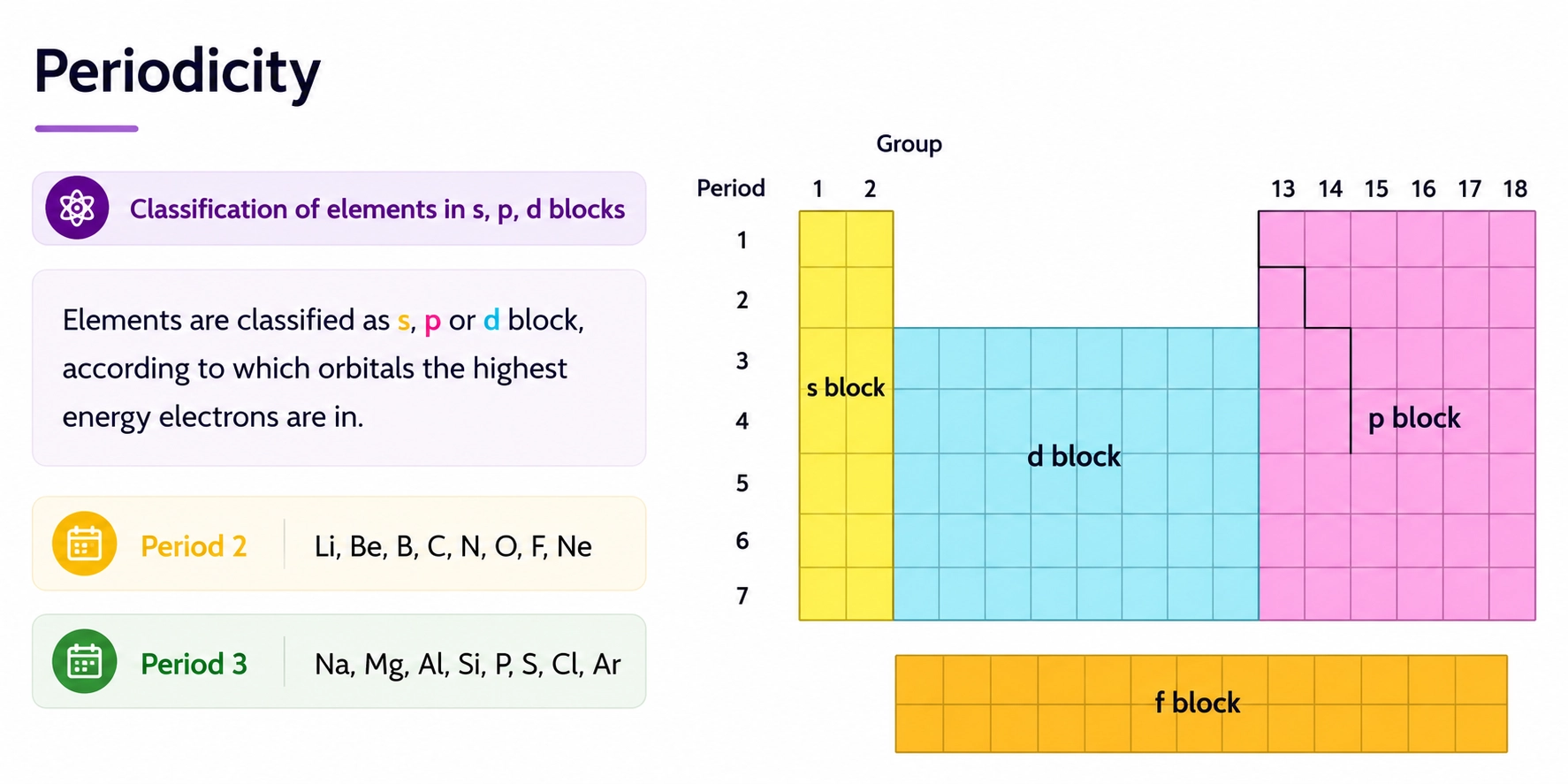
Groups are vertical columns in the periodic table. The block also helps identify which subshell receives the outer electrons.
Atomic Radius Increases Down a Group
Atomic radius increases down a group because each element has an additional main electron shell.
The outer electron is further from the nucleus, so the attraction between the nucleus and the outer electron becomes weaker. This increased distance is one of the main reasons ionisation energy decreases down a group.
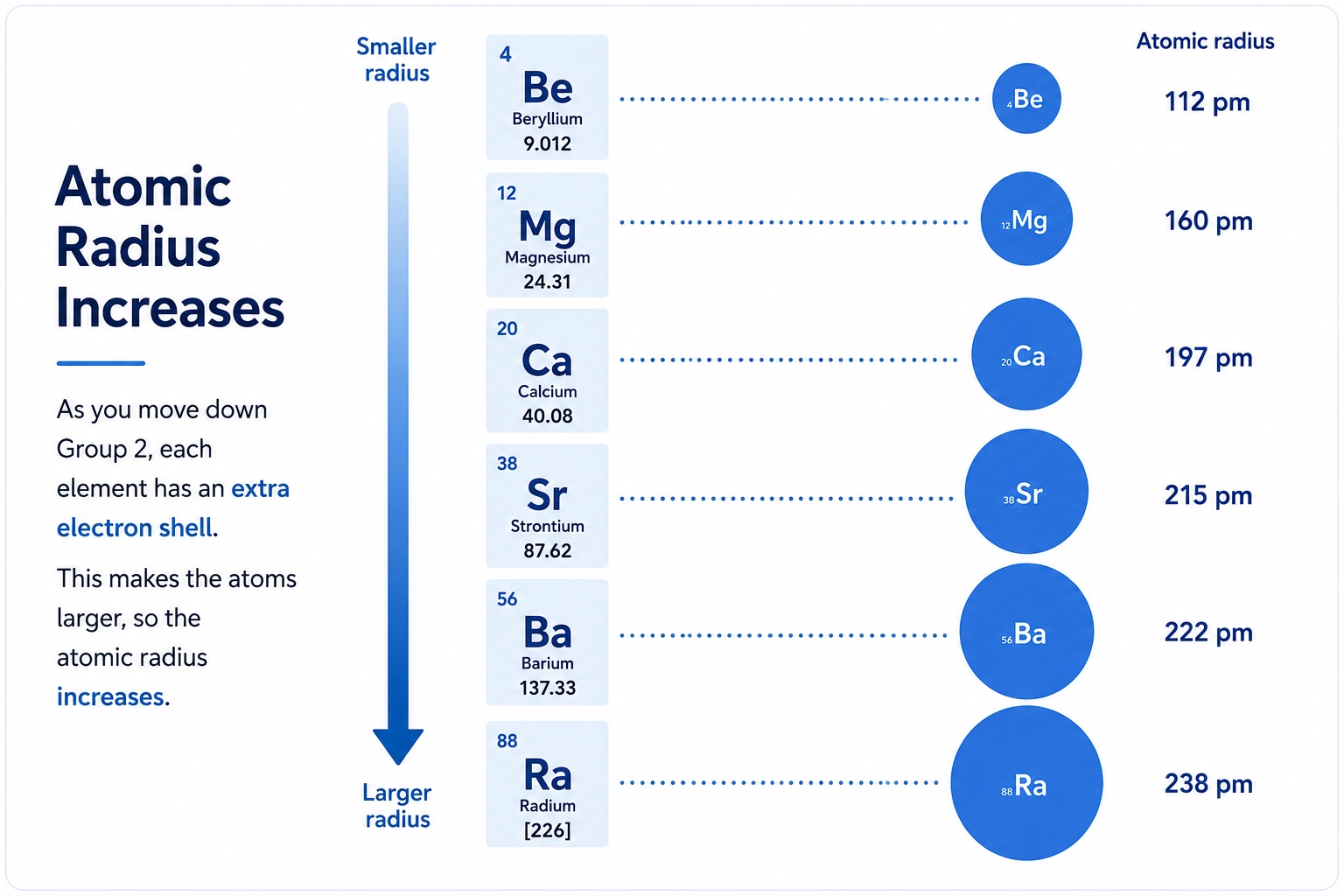
Each element lower in Group 2 has an extra occupied electron shell, so its outer electron is further from the nucleus.
Shielding Increases Down a Group
As atoms get larger down a group, there are more inner shells between the nucleus and the outer electron. These inner shells shield the outer electron from the full attraction of the nucleus.
This means the outer electron experiences a lower effective nuclear attraction, even though the total number of protons in the nucleus has increased.
Shielding: the reduction in attraction between the nucleus and an outer electron due to repulsion from inner-shell electrons.
| Factor down a group | What happens? | Effect on the outer electron |
|---|---|---|
| Number of shells | Increases | Outer electron is further from the nucleus. |
| Shielding | Increases | Inner shells reduce the attraction felt by the outer electron. |
| Nuclear charge | Increases | More protons increase attraction, but this is outweighed by extra shells and shielding. |
| First ionisation energy | Decreases | Less energy is needed to remove the outer electron. |
First Ionisation Energy Decreases Down a Group
First ionisation energy generally decreases down a group. This means it becomes easier to remove the outer electron from atoms lower in the group.
The nuclear charge does increase because atoms lower in the group have more protons. However, the effect of the extra shells and increased shielding is greater. The outer electron is less strongly attracted to the nucleus, so less energy is needed to remove it.
Best exam answer: down a group, there are more occupied shells, the outer electron is further from the nucleus and shielding increases. These effects outweigh the increased nuclear charge.
Check Your Understanding
Use these short tasks to test the key reasons why first ionisation energy decreases down a group.
QuickSnap
This text summary condenses the page into the essential exam ideas.
- Down a group, atomic radius increases because each element has an additional occupied electron shell.
- The outer electron is further from the nucleus, so the attraction between the nucleus and the outer electron is weaker.
- Shielding increases because there are more inner shells between the nucleus and the outer electron.
- Nuclear charge increases, but the effect of extra shells and shielding outweighs this.
- First ionisation energy decreases, so less energy is needed to remove the outer electron.
- Best exam answers explicitly use distance from the nucleus, shielding, nuclear charge and attraction.
Master Atomic Structure and The Periodic Table for Edexcel A Level Chemistry
Continue from these free revision notes into the full Topic 1 Atomic Structure and The Periodic Table course, with guided video teaching, diagnostic MCQ practice, teacher-marked short-answer questions and a specification assignment with a personalised progress report.
Guided video teaching
Learn atomic structure, isotopes, mass spectrometry, ionisation energy, electron configuration and periodic trends through structured video lessons with worked examples and walkthroughs.
Instant MCQ feedback
Auto-marked MCQ quizzes provide immediate diagnostic feedback for every answer choice.
Teacher-marked SAQs
Submit written exam responses and receive chemistry specialist feedback with improvement guidance.
Progress tracking
Identify strengths and weaknesses across atomic structure, isotopes, mass spectrometry, ionisation energies, electron configuration and periodic trends with targeted reporting.
See how the course works
Click play to start the course preview animation.
Some ionic radii are shown.
| Ion | Ionic radius / nm |
|---|---|
| Na+ | 0.102 |
| K+ | 0.138 |
| F− | 0.133 |
| Cl− | 0.180 |
Which compound has the strongest ionic bonding?
Explain why the metallic bonding in magnesium is much stronger than that in sodium.
FAQs
These questions target the most common exam wording for ionisation energy trends down a group.
Why does first ionisation energy decrease down a group?
First ionisation energy decreases down a group because atoms have more occupied electron shells. The outer electron is further from the nucleus and is shielded more strongly by inner shells, so the attraction to the nucleus is weaker.
Why does atomic radius increase down a group?
Atomic radius increases down a group because each element has an additional main electron shell. This places the outer electron further from the nucleus.
What is shielding in ionisation energy?
Shielding is the reduction in attraction between the nucleus and the outer electron due to repulsion from inner-shell electrons. More inner shells mean greater shielding.
Why does increased nuclear charge not make ionisation energy increase down a group?
Nuclear charge increases down a group because there are more protons. However, the extra occupied shells and increased shielding have a greater effect, so the outer electron is less strongly attracted overall.
What wording should I use in an exam answer?
Use this sequence: more occupied shells, larger atomic radius, more shielding, weaker attraction between the nucleus and the outer electron, less energy needed to remove the electron.
Copyright notice: This OLS revision content, including the explanations, layout, diagrams, tables and embedded learning structure, is authored for Online Learning System by Dr. Mohammed Al-Fatah. It may not be copied, reproduced, redistributed or adapted without written permission.