Giant Covalent Structures
A concise revision guide to giant covalent structures: how diamond, graphite and graphene are bonded, why their properties differ so much, and how the structure explains melting point, hardness and electrical conductivity.
GCSE Recap: Covalent Bonds and Small Molecules
Before you start, check three GCSE ideas that this page builds on.
What Is a Giant Covalent Structure?
In a giant covalent structure (also called a macromolecular or giant molecular structure) every atom is joined to its neighbours by strong covalent bonds that extend throughout the whole crystal. There are no separate molecules: a single crystal of diamond is, in effect, one enormous molecule. Compare this with a simple molecular substance such as iodine, where strong covalent bonds hold each I2 molecule together but only weak intermolecular forces act between the molecules.
| Feature | Giant covalent (diamond, graphite, graphene) | Simple molecular (iodine, ice, carbon dioxide) |
|---|---|---|
| Particles | Atoms in a continuous network | Discrete molecules |
| Forces broken on melting | Strong covalent bonds | Weak intermolecular forces |
| Melting point | Very high (diamond sublimes above 3600 °C) | Low |
| Solubility in water | Insoluble | Usually low; some polar molecules dissolve |
| Electrical conductivity | Usually none; graphite and graphene conduct | None |
Key idea: Melting a giant covalent structure means breaking covalent bonds, which needs a great deal of energy, so these substances have very high melting points and are hard or, in the case of graphite, strongly bonded within each layer.
Quick Check: Identify the Structure from Data
Use the data to decide which type of structure the solid has.
Diamond
In diamond each carbon atom forms four single covalent bonds to four other carbon atoms arranged tetrahedrally around it, with bond angles of 109.5°. The result is a rigid three-dimensional network in which every atom is locked in place by strong C-C bonds.
| Property | Explanation from the structure |
|---|---|
| Very high melting and sublimation point | Many strong covalent bonds must be broken |
| Extremely hard | The rigid tetrahedral network resists any distortion; diamond is used in cutting tools and drill tips |
| Does not conduct electricity | All four outer electrons of each carbon are used in bonding, so there are no delocalised electrons |
| Insoluble in all solvents | No solvent interaction can compete with the covalent bonds |
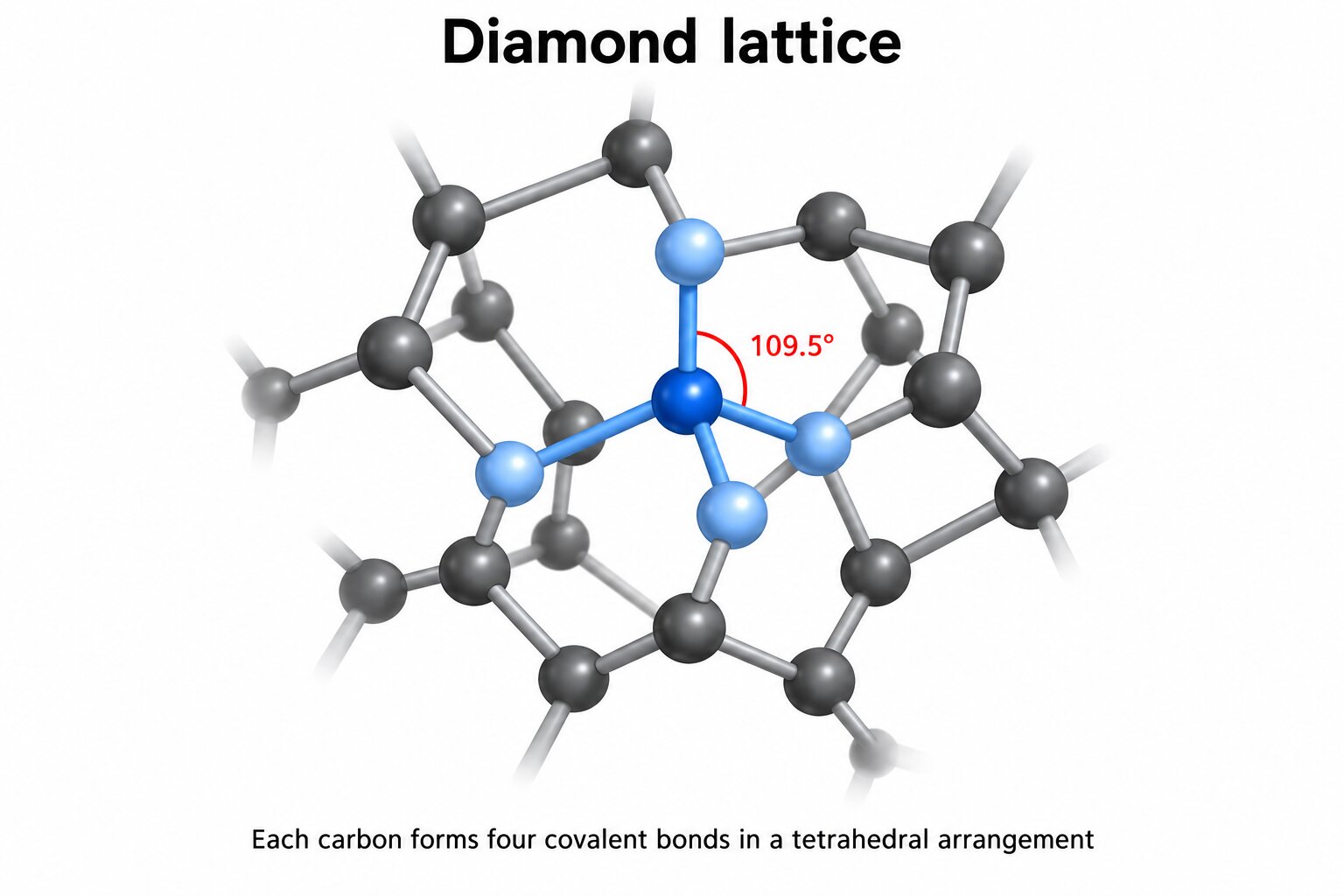
Diamond: every carbon atom is bonded tetrahedrally to four others in a rigid three-dimensional network.
Silicon has the same structure as diamond, which is why it is also a hard, high-melting solid, although its Si-Si bonds are weaker than C-C bonds.
Exam sentence: Diamond has a giant covalent structure in which each carbon atom is bonded to four others by strong covalent bonds, so a large amount of energy is needed to break the bonds and it has a very high melting point.
Quick Check: Predict the Properties of Silicon Carbide
Use the structure described to predict the properties of a compound you have not met on this page.
Quick Check: Explain Silicon and Phosphorus
Write a short explanation, then compare it with the mark points and the model answer.
Graphite
In graphite each carbon atom forms three covalent bonds to three other carbon atoms, giving flat hexagonal layers with bond angles of 120°. The fourth outer electron of each carbon is not used in a localised bond; it sits in a p orbital above and below the layer and becomes delocalised across the whole sheet. The layers are held to each other only by weak intermolecular forces (induced dipole-dipole or van der Waals forces), and are relatively far apart.
| Property | Explanation from the structure |
|---|---|
| Very high melting point | The strong covalent bonds within the layers must be broken |
| Soft and slippery | The weak forces between layers let them slide over each other; graphite is used as a lubricant and in pencils |
| Conducts electricity | The delocalised electrons can move along the layers when a voltage is applied |
| Low density compared with diamond | The layers are widely spaced |
| Insoluble | Covalent bonding throughout the layers |
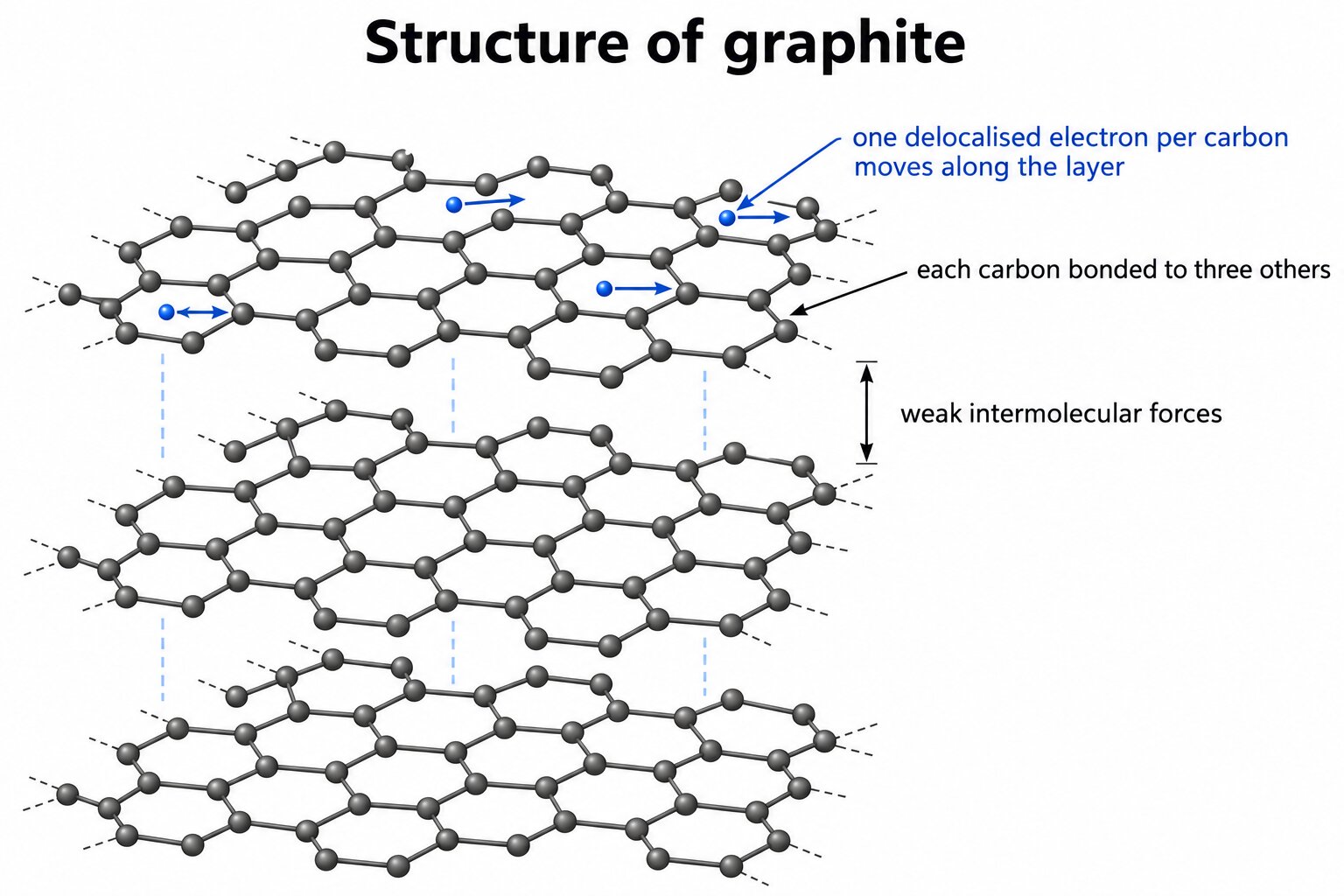
Graphite: strong covalent bonds within hexagonal layers, weak forces between them, and delocalised electrons that conduct electricity.
Exam focus: Graphite conducts because it has delocalised electrons; it is soft because the layers are held together only by weak intermolecular forces. Do not say the layers are held by covalent bonds, and do not say graphite conducts because it is a metal.
Quick Check: Which Way Does Graphite Conduct?
Predict what happens when the conductivity of a graphite crystal is measured in two directions.
Graphene
Graphene is a single layer of graphite: a sheet of carbon atoms one atom thick, each bonded covalently to three others in a hexagonal pattern, with one delocalised electron per carbon spread over the sheet. It is described as a two-dimensional giant covalent structure.
| Property | Explanation | Application |
|---|---|---|
| Extremely strong for its thickness | Strong covalent bonds throughout the sheet | Reinforcing composites and lightweight materials |
| Excellent electrical conductor | Delocalised electrons move freely across the sheet | Flexible electronics, touchscreens, sensors |
| Very good thermal conductor | Vibrations pass easily through the rigid covalent network | Heat management in electronic devices |
| Transparent and flexible | A single atomic layer absorbs little light and can bend without breaking bonds | Transparent conducting films |
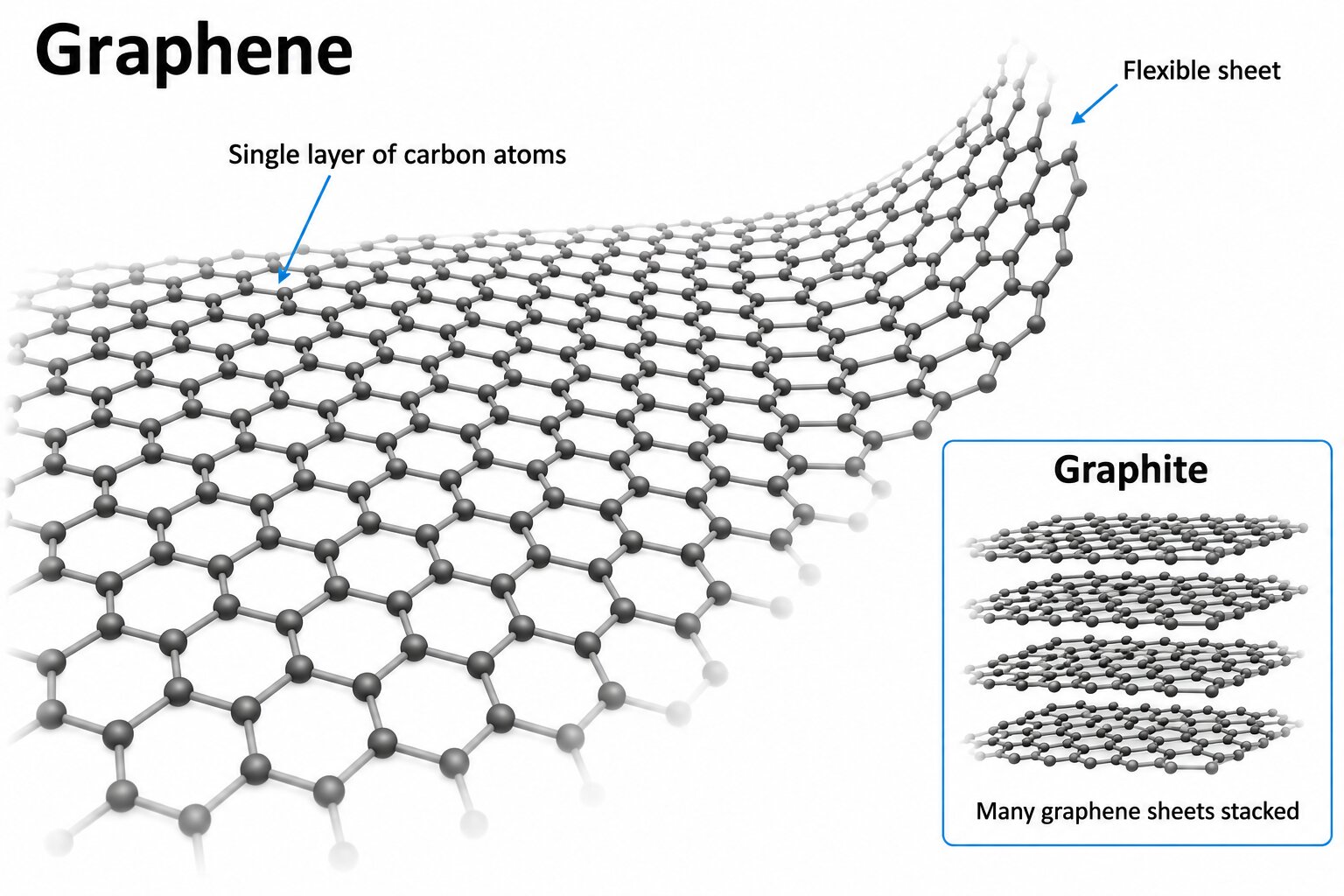
Graphene: one layer of graphite, a two-dimensional giant covalent structure that is strong, flexible and conducting.
Exam sentence: Graphene is a single layer of graphite in which each carbon atom is covalently bonded to three others; the delocalised electrons make it an excellent conductor and the covalent network makes it very strong.
Quick Check: From Graphene to Nanotubes
Apply what you know about graphene to two related materials, answering each question as quickly as you can.
Comparing the Three Carbon Structures
| Diamond | Graphite | Graphene | |
|---|---|---|---|
| Bonds per carbon atom | 4 | 3 | 3 |
| Arrangement | Tetrahedral, 109.5°, three-dimensional | Hexagonal layers, 120° | One hexagonal layer, 120° |
| Delocalised electrons | None | One per carbon, within each layer | One per carbon, across the sheet |
| Electrical conductivity | None | Along the layers | Excellent |
| Hardness | Extremely hard | Soft, layers slide | Very strong sheet |
| Melting point | Very high | Very high | Very high |
Key idea: The same element gives three very different materials because the bonding arrangement differs: four localised bonds give hardness and no conduction; three bonds plus a delocalised electron give layers that conduct.
Quick Check: Two Forms of Boron Nitride
Drag the words into place to compare the two forms of another giant covalent substance.
Where This Sits in the AQA Specification
AQA 3.1.3.4 lists macromolecular (giant covalent) crystals alongside ionic, metallic and molecular crystals, and names diamond and graphite as the examples to know. You should be able to relate their melting points and conductivity to the structure and bonding, and to draw diagrams of the structures with a specified number of atoms: for diamond, draw a central carbon with its four tetrahedral neighbours and continue outwards; for graphite, draw part of one hexagonal layer and a second layer beneath it. Graphene is not named by AQA but follows directly from graphite.
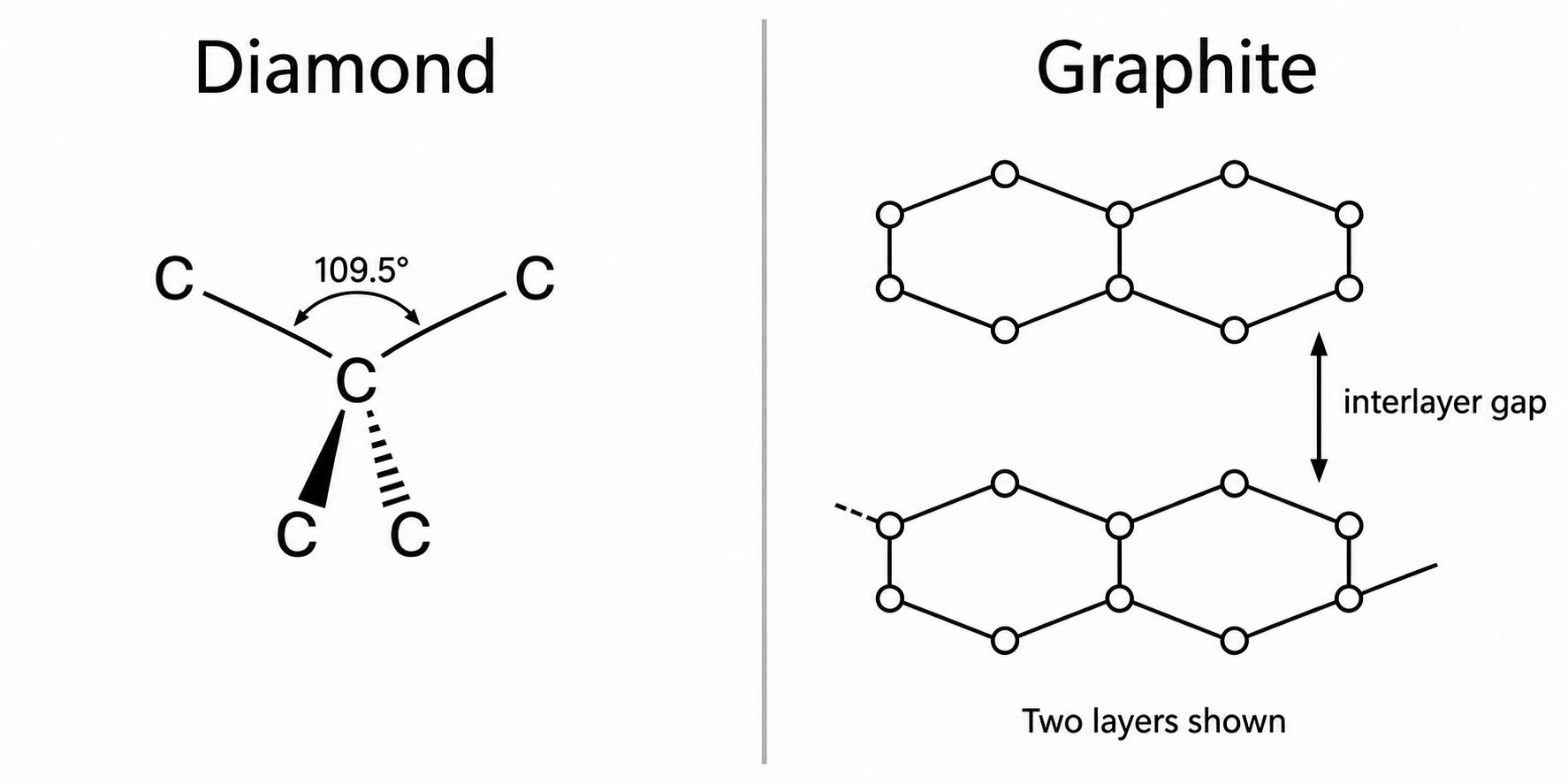
AQA asks for diagrams with a specified number of particles: a five-atom diamond fragment and a two-layer graphite fragment.
Common Exam Mistakes
- Saying graphite is soft because its covalent bonds are weak. The covalent bonds are strong; it is the forces between layers that are weak.
- Saying diamond conducts electricity, or that graphite conducts because it contains ions or is metallic. Only delocalised electrons explain the conduction.
- Describing melting as breaking intermolecular forces. In a giant covalent structure the covalent bonds themselves must be broken.
- Forgetting the bond angle: 109.5° in diamond, 120° in graphite and graphene.
- Drawing a diamond fragment with carbon atoms that have only three bonds, or a graphite layer with four bonds per carbon.
Exam sentence: Giant covalent structures have very high melting points because many strong covalent bonds must be broken; only those with delocalised electrons, graphite and graphene, conduct electricity.
Master Covalent Bonding and Shapes of Molecules for AQA A Level Chemistry
Continue from these free revision notes into the full 3.1.3 Covalent Bonding and Shapes of Molecules course. The three guided video lessons are ready now; the AQA MCQ bank, teacher-marked short-answer questions, supplementary lessons and KASP spec-point report are being written, and the course opens for enrolment as soon as they are complete.
Guided video teaching
Learn the chemistry and exam technique through structured video lessons with worked examples and walkthroughs.
Instant MCQ feedback
Auto-marked MCQ quizzes provide immediate diagnostic feedback for every answer choice.
Teacher-marked SAQs
Submit written exam responses and receive chemistry specialist feedback with improvement guidance.
Progress tracking
Identify strengths and weaknesses across the full 3.1.3 specification with targeted reporting.
See how the course works
Click play to start the course preview animation.
Some ionic radii are shown.
| Ion | Ionic radius / nm |
|---|---|
| Na+ | 0.102 |
| K+ | 0.138 |
| F− | 0.133 |
| Cl− | 0.180 |
Which compound has the strongest ionic bonding?
Explain why the metallic bonding in magnesium is much stronger than that in sodium.
Copyright and author footprint: This OLS revision page was written for Online Learning System by Dr. Mohammed Al-Fatah. It is designed for A Level Chemistry revision and should not be copied or redistributed without permission.
Keep this note — free
Save your progress across every AQA topic. A free account remembers which topics you have covered, saves your question scores, and syncs across your phone and laptop.
- Track every topic you have finished
- Keep your practice-question scores
- No payment, no card, free forever
Already registered? Log in