Hydrogen Bonding
A concise revision guide to hydrogen bonding: the N-H, O-H and H-F requirement, the four features of the exam diagram, hydrogen bonding in water, ammonia and hydrogen fluoride, and predicting it in other molecules, for AQA A Level Chemistry.
What a Hydrogen Bond Is
A hydrogen bond is a strong intermolecular attraction between a hydrogen atom that is covalently bonded to nitrogen, oxygen or fluorine in one molecule and a lone pair of electrons on a nitrogen, oxygen or fluorine atom in a neighbouring molecule. It is the strongest of the three intermolecular forces, but it is still far weaker than a covalent bond.
Three things make the bond possible. Nitrogen, oxygen and fluorine are the three most electronegative elements, so the H atom bonded to one of them carries a large δ+ charge. The hydrogen atom is tiny and has no inner electrons, so its δ+ charge is concentrated and can approach a neighbouring atom very closely. The N, O or F atom on the neighbour has a lone pair that points its negative charge directly at the δ+ hydrogen. The result is a directional attraction, with the X-H···Y atoms in a straight line, that is much stronger than an ordinary permanent dipole-dipole attraction.
Definition: A hydrogen bond forms between a δ+ hydrogen atom bonded to N, O or F and a lone pair on N, O or F in another molecule.
The Exam Diagram
Questions that ask you to show hydrogen bonding are marked on four features, and a diagram that misses any of them loses marks:
- The lone pair drawn on the N, O or F atom that accepts the bond.
- δ+ on the hydrogen and δ- on the electronegative atom in both molecules.
- The hydrogen bond drawn as a dashed line from the δ+ H to the lone pair, and labelled.
- The three atoms X-H···Y in a straight line (a 180° arrangement), with the water molecule kept bent.
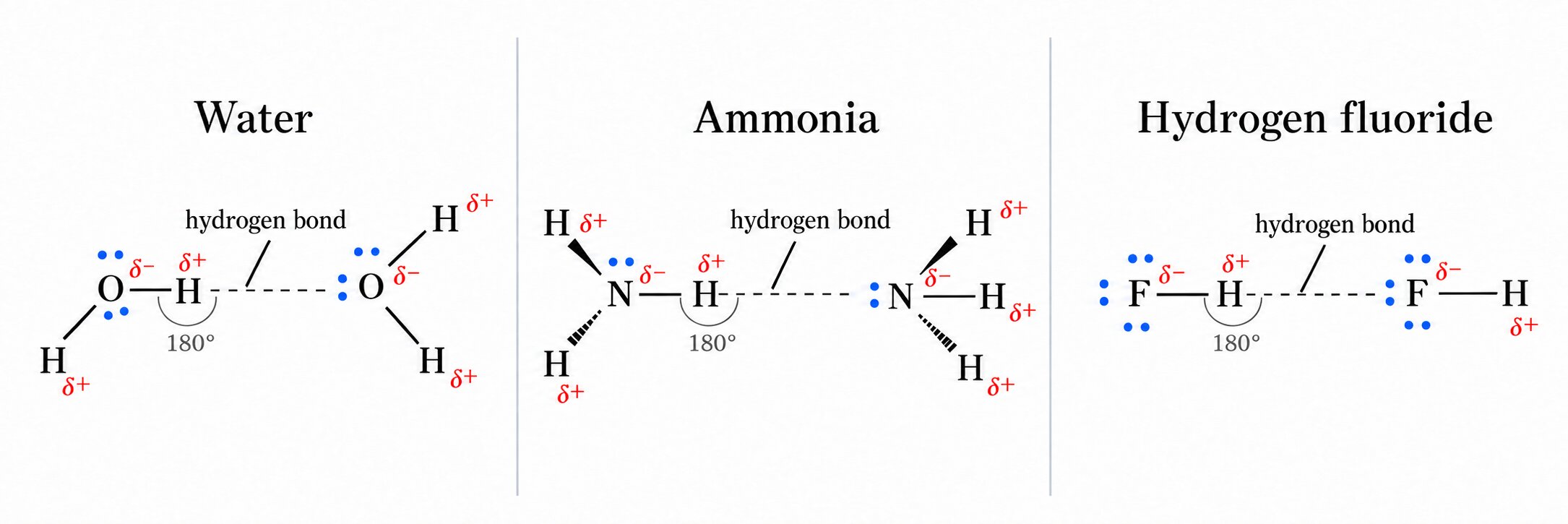
The four marked features of a hydrogen bond diagram: lone pair, δ charges, a labelled dashed line and a straight X-H···Y arrangement.
Exam trap: The dashed line must start at the hydrogen atom and end at the lone pair, not at the O, N or F atom in general. Draw the lone pair first, then the line to it.
Hydrogen Bonding in Water
Each water molecule has two O-H bonds and two lone pairs on the oxygen, so each molecule can form up to four hydrogen bonds: two through its own hydrogen atoms and two through its lone pairs. In liquid water the molecules form a constantly changing network of hydrogen bonds; in ice the network becomes a fixed, open lattice (see the Anomalous Properties of Water page).
Hydrogen Bonding in Water: Four Neighbours in a Tetrahedral Arrangement
Drag to rotate, scroll or pinch to zoom. Start with one water molecule and its two lone pairs, then add the four neighbours it can hydrogen bond to. The four bonds point to the corners of a tetrahedron.
© Dr. Mohammed Al-Fatah – onlinelearningsystem.net
Because water forms so many hydrogen bonds per molecule, its boiling point is far higher than that of any hydride of similar size, and it takes a great deal of energy to boil.
Key idea: Two O-H bonds plus two lone pairs give water the maximum of four hydrogen bonds per molecule; this is the root of every anomalous property of water.
Hydrogen Bonding in Ammonia and Hydrogen Fluoride
Ammonia, NH₃, has three N-H bonds but only one lone pair on nitrogen. Each molecule can therefore be involved in hydrogen bonds through its hydrogens, but only one neighbour at a time can bond to its lone pair, so on average liquid ammonia has about one hydrogen bond per molecule. Nitrogen is also less electronegative than oxygen, so the N-H hydrogen is less δ+ and the bond is weaker. Ammonia boils at -33 °C.
Hydrogen fluoride, HF, has three lone pairs on fluorine but only one hydrogen, so again each molecule averages one hydrogen bond, forming zig-zag chains of molecules. Fluorine is the most electronegative element, so each individual F-H···F bond is the strongest hydrogen bond of all, and HF boils at 20 °C, far above HCl at -85 °C.
| Liquid | H atoms on N, O or F | Lone pairs | Hydrogen bonds per molecule (average) | boiling point / °C |
|---|---|---|---|---|
| H₂O | 2 | 2 | up to 4, about 3.5 in the liquid | 100 |
| HF | 1 | 3 | about 1 (chains) | 20 |
| NH₃ | 3 | 1 | about 1 | -33 |
The order of boiling points, H₂O > HF > NH₃, follows the number of hydrogen bonds each molecule can make more closely than the strength of each bond. The number of hydrogen bonds is limited by whichever is fewer: suitable hydrogens or lone pairs.
Exam sentence: Water has a higher boiling point than ammonia because each water molecule can form more hydrogen bonds (two O-H bonds and two lone pairs) and O-H···O hydrogen bonds are stronger than N-H···N bonds, so more energy is needed to separate the molecules.
Predicting Hydrogen Bonding in Other Molecules
The test is simple and should be applied literally: is there a hydrogen atom bonded directly to N, O or F? If yes, the substance forms hydrogen bonds between its molecules. If the only N, O or F atoms are bonded to carbon, the molecule may accept a hydrogen bond from water but cannot form one with its own kind.
| Molecule | H on N, O or F? | Hydrogen bonds between its own molecules? |
|---|---|---|
| Methanol, CH₃OH | yes (O-H) | yes |
| Methylamine, CH₃NH₂ | yes (N-H) | yes |
| Ethanoic acid, CH₃COOH | yes (O-H) | yes, in pairs (dimers) |
| Fluoromethane, CH₃F | no (F on C, H on C) | no |
| Methoxymethane, CH₃OCH₃ | no | no, but accepts from water |
| Ethanal, CH₃CHO | no | no, but accepts from water |
| Hydrogen chloride, HCl | no (Cl is not N, O or F) | no |
Molecules of biological importance rely on this bond: the two strands of DNA are held together by hydrogen bonds between base pairs, proteins fold because of hydrogen bonds between N-H and C=O groups, and the hydroxyl groups of sugars make them soluble in water.
Common mistake: Assuming any molecule that contains oxygen forms hydrogen bonds. Propanone and ethers contain oxygen but no O-H, so they do not hydrogen bond with each other.
Hydrogen Bonds Compared With Other Forces
A hydrogen bond typically needs 10 to 40 kJ mol⁻¹ to break, roughly ten times a small permanent dipole-dipole attraction and a tenth of a covalent bond. It is still an intermolecular force: when water boils, hydrogen bonds break and the O-H covalent bonds do not.
Hydrogen bonds act in addition to permanent dipole-dipole forces and induced dipole-dipole forces, so a hydrogen-bonded liquid has all three forces between its molecules. In a small molecule such as water the hydrogen bonds dominate; in a large molecule such as hexan-1-ol the induced dipole-dipole forces along the carbon chain contribute as much or more.
Exam wording: Call it a hydrogen bond, not a “hydrogen bonding force” or a “covalent hydrogen bond”. State that it is intermolecular.
Common Exam Points
Draw hydrogen bonding between two molecules of X
Lone pair on N, O or F; δ+ and δ-; dashed line labelled hydrogen bond from H to the lone pair; straight X-H···Y arrangement.
Explain why HF boils higher than HCl
HF forms hydrogen bonds (F is highly electronegative and has lone pairs); HCl cannot; hydrogen bonds are stronger than the permanent dipole-dipole forces in HCl, so more energy is needed.
Does molecule X form hydrogen bonds?
Only if it has H bonded directly to N, O or F. Oxygen bonded to carbon alone is not enough.
Do not say
“Hydrogen bonds are covalent”; “hydrogen bonds form between hydrogen atoms”; “the O-H bond breaks when water boils”.
Check Your Understanding
Check that you can spot hydrogen bonding and draw it correctly for molecules other than water, ammonia and hydrogen fluoride.
FAQs
Use these quick answers to check the hydrogen bonding rules and the diagram marks in AQA A Level Chemistry questions.
When does hydrogen bonding occur?
Only when a hydrogen atom is bonded directly to nitrogen, oxygen or fluorine, and there is a lone pair on an N, O or F atom in a neighbouring molecule to accept it. Those three elements are electronegative enough to leave the hydrogen strongly δ+.
What must a hydrogen bond diagram show?
Four things: the lone pair on the accepting atom, δ+ and δ- labels, a dashed line drawn from the δ+ hydrogen to that lone pair, and the three atoms X-H···Y in a straight line.
How many hydrogen bonds can one water molecule form?
Four: two through its own hydrogen atoms and two through the two lone pairs on its oxygen. This is more than ammonia or hydrogen fluoride can manage and explains why water is the most anomalous of the three.
Does a molecule that contains oxygen always hydrogen bond?
No. Propanone and methoxymethane contain oxygen but have no O-H group, so their molecules cannot hydrogen bond with each other. They can still accept a hydrogen bond from water, which is why they dissolve in it.
Is a hydrogen bond a covalent bond?
No. It is an intermolecular force, roughly a tenth the strength of a covalent bond. When water boils the hydrogen bonds break and every O-H covalent bond stays intact.
Copyright and author footprint: This OLS revision page was written for Online Learning System by Dr. Mohammed Al-Fatah. It is designed for A Level Chemistry revision and should not be copied or redistributed without permission.
Keep this note — free
Save your progress across every AQA topic. A free account remembers which topics you have covered, saves your question scores, and syncs across your phone and laptop.
- Track every topic you have finished
- Keep your practice-question scores
- No payment, no card, free forever
Already registered? Log in