Tetrahedral Molecular Shape
A focused revision guide to the tetrahedral molecular shape, using CH4 as the key example. This page explains why four bonding pairs and no lone pairs around a central atom give a three-dimensional tetrahedral arrangement with bond angles of 109.5°.
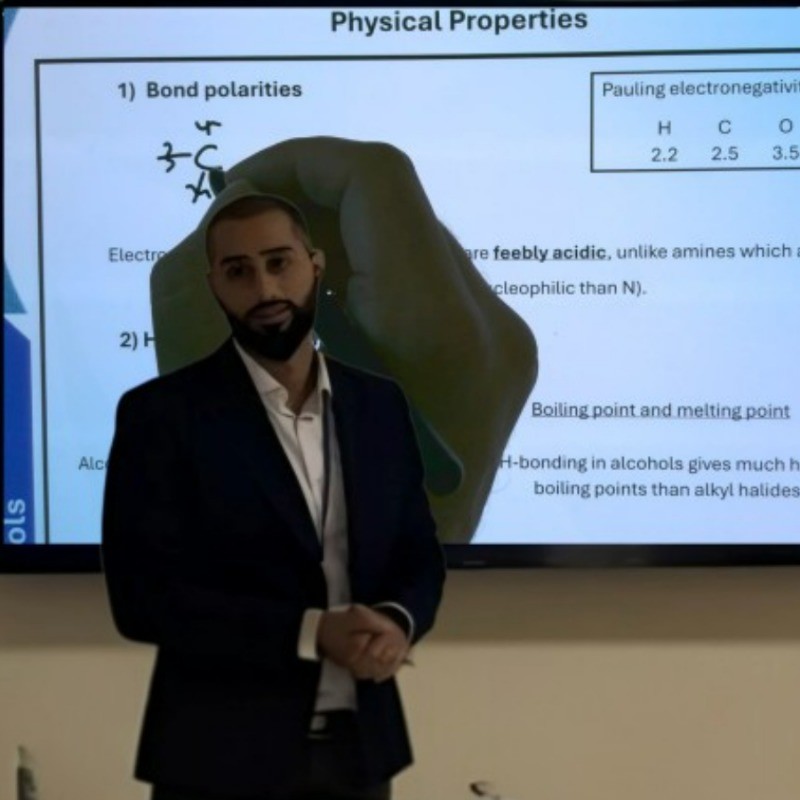
GCSE Recap: Flat Drawings and 3D Structures
Before you start, check what you remember about four bonds on one atom and about what a flat drawing can and cannot show.
What Tetrahedral Means
A tetrahedral molecule has four atoms or groups arranged around a central atom in a three-dimensional shape. The four bonding regions point towards the corners of a tetrahedron.
The key example for this page is CH4. Carbon is the central atom and each hydrogen atom is attached to carbon by a covalent bond.
Key idea: four bonding regions and no lone pairs around a central atom give a tetrahedral shape with 109.5° bond angles.
Why CH4 Is Tetrahedral
In CH4, the central carbon atom is surrounded by four C-H bonding pairs. These bonding pairs are regions of negative charge, so they repel one another and move as far apart as possible.
With four equal bonding regions and no lone pairs, the maximum separation is achieved in three dimensions. This gives a tetrahedral arrangement with H-C-H bond angles of 109.5°.
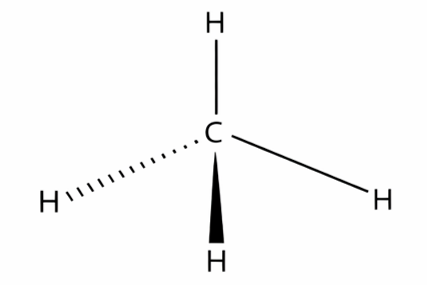
A tetrahedral species has four bonding regions around the central atom and no lone pairs, giving a 109.5° bond angle.
Quick Check: Why Not Flat?
Drag the words and values into the gaps to explain why four bonding pairs do not lie in one plane.
Tetrahedral Shape of CH4
In methane, the central carbon atom forms four covalent bonds to hydrogen atoms. These four bonding pairs repel one another and spread out into three-dimensional space as far apart as possible, giving a tetrahedral shape with bond angles of 109.5°.
Bonding Pairs, Lone Pairs and Bond Angle
The shape is decided by the number of electron domains around the central atom. In a simple molecular shape question, each single bond counts as one bonding region. CH4 has four bonding regions around carbon and no lone pair regions on carbon.
| Feature | Tetrahedral value | Meaning in CH4 |
|---|---|---|
| Number of bonding pairs | 4 | Four C-H bonding pairs repel each other equally. |
| Number of lone pairs | 0 | No lone pair compression occurs, so the ideal tetrahedral angle is maintained. |
| Bond angle | 109.5° | The four bonds are arranged as far apart as possible in three-dimensional space. |
| Molecular shape | Tetrahedral | The surrounding atoms point towards the corners of a tetrahedron. |
Quick Check: Count the Pairs
Work out the electron count for two species with four bonded atoms and type each answer.
Examples of Tetrahedral Species
Several molecules and ions use the same four-region arrangement around the central atom. The examples from this shape table include SiCl4, SO42-, ClO4– and NH4+.
For exam purposes, focus on the central atom, count the electron domains around it, then state the shape and bond angle.
| Species | Central atom | Electron regions around central atom | Shape | Bond angle |
|---|---|---|---|---|
| CH4 | C | 4 bonding regions, 0 lone pairs | Tetrahedral | 109.5° |
| SiCl4 | Si | 4 bonding regions, 0 lone pairs | Tetrahedral | 109.5° |
| SO42- | S | 4 bonding regions, 0 lone pairs | Tetrahedral | 109.5° |
| ClO4– | Cl | 4 bonding regions, 0 lone pairs | Tetrahedral | 109.5° |
| NH4+ | N | 4 bonding regions, 0 lone pairs | Tetrahedral | 109.5° |
Quick Check: Which Are Tetrahedral?
Count the electrons left over on each central atom, then click every species that is tetrahedral.
How to Explain Tetrahedral Shape in an Exam
A full exam explanation should name the electron pairs around the central atom and connect this directly to repulsion and angle.
1. Identify the central atom
For CH4, the central atom is carbon.
2. Count bonding pairs and lone pairs
Carbon has four bonding pairs and no lone pairs around it.
3. Apply electron-pair repulsion
The four bonding pairs repel equally and move as far apart as possible.
4. State the shape and angle
The molecule is tetrahedral with bond angles of 109.5°.
Exam answer model: CH4 has four bonding pairs and no lone pairs around the central carbon atom. The bonding pairs repel equally and arrange themselves as far apart as possible in three-dimensional space. Therefore, CH4 is tetrahedral with bond angles of 109.5°.
Quick Check: Whose Reasoning Is Right?
In each round, choose the one student statement that an examiner would accept.
Common Exam Points
Tetrahedral questions often test whether you can distinguish a four-domain arrangement from trigonal planar or shapes affected by lone pairs.
Do not write 120°
120° is the trigonal planar angle. Tetrahedral species have four electron regions and an ideal angle of 109.5°.
Do not flatten the shape
Tetrahedral molecules are three-dimensional, not planar. Wedge and dashed bonds are often used to show this 3D arrangement.
Check for lone pairs
Four bonding pairs and no lone pairs gives tetrahedral. If lone pairs are present, the molecular shape and bond angle may change.
Use electron-pair repulsion language
Marks usually require the idea that bonding pairs repel and arrange themselves as far apart as possible.
QuickSnap
The tetrahedral shape is produced when a central atom has four bonding pairs and no lone pairs. The bonding pairs repel equally and spread out in three-dimensional space, giving 109.5° bond angles.
Memory line: 4 bonding pairs + 0 lone pairs = tetrahedral = 109.5°.
Master Covalent Bonding and Shapes of Molecules for AQA A Level Chemistry
Continue from these free revision notes into the full 3.1.3 Covalent Bonding and Shapes of Molecules course. The three guided video lessons are ready now; the AQA MCQ bank, teacher-marked short-answer questions, supplementary lessons and KASP spec-point report are being written, and the course opens for enrolment as soon as they are complete.
Guided video teaching
Learn the chemistry and exam technique through structured video lessons with worked examples and walkthroughs.
Instant MCQ feedback
Auto-marked MCQ quizzes provide immediate diagnostic feedback for every answer choice.
Teacher-marked SAQs
Submit written exam responses and receive chemistry specialist feedback with improvement guidance.
Progress tracking
Identify strengths and weaknesses across the full 3.1.3 specification with targeted reporting.
See how the course works
Click play to start the course preview animation.
Some ionic radii are shown.
| Ion | Ionic radius / nm |
|---|---|
| Na+ | 0.102 |
| K+ | 0.138 |
| F− | 0.133 |
| Cl− | 0.180 |
Which compound has the strongest ionic bonding?
Explain why the metallic bonding in magnesium is much stronger than that in sodium.
FAQs
These questions target the common points students confuse when learning the tetrahedral molecular shape.
What makes a molecule tetrahedral?
A molecule is tetrahedral when the central atom has four bonding regions and no lone pairs. The bonding pairs repel equally and arrange themselves as far apart as possible in three-dimensional space.
Why is CH4 tetrahedral?
CH4 has four C-H bonding pairs around the central carbon atom and no lone pairs on carbon. The four bonding pairs repel equally, so the molecule is tetrahedral with 109.5° bond angles.
What is the bond angle in a tetrahedral molecule?
The ideal bond angle in a tetrahedral molecule is 109.5°.
Is a tetrahedral molecule flat?
No. A tetrahedral molecule is three-dimensional. The bonds point towards the corners of a tetrahedron rather than lying in one flat plane.
© Online Learning System. This revision page was written and produced for OLS by Dr. Mohammed Al-Fatah. All diagrams, explanations, interactive cards and revision resources on this page are protected by copyright and are provided for student revision and teaching use only.
Keep this note — free
Save your progress across every AQA topic. A free account remembers which topics you have covered, saves your question scores, and syncs across your phone and laptop.
- Track every topic you have finished
- Keep your practice-question scores
- No payment, no card, free forever
Already registered? Log in