Linear Molecular Shape
A focused revision guide to the linear molecular shape, using BeCl2 as the key example. This page explains why two bonding pairs and no lone pairs around a central atom give a 180° bond angle.
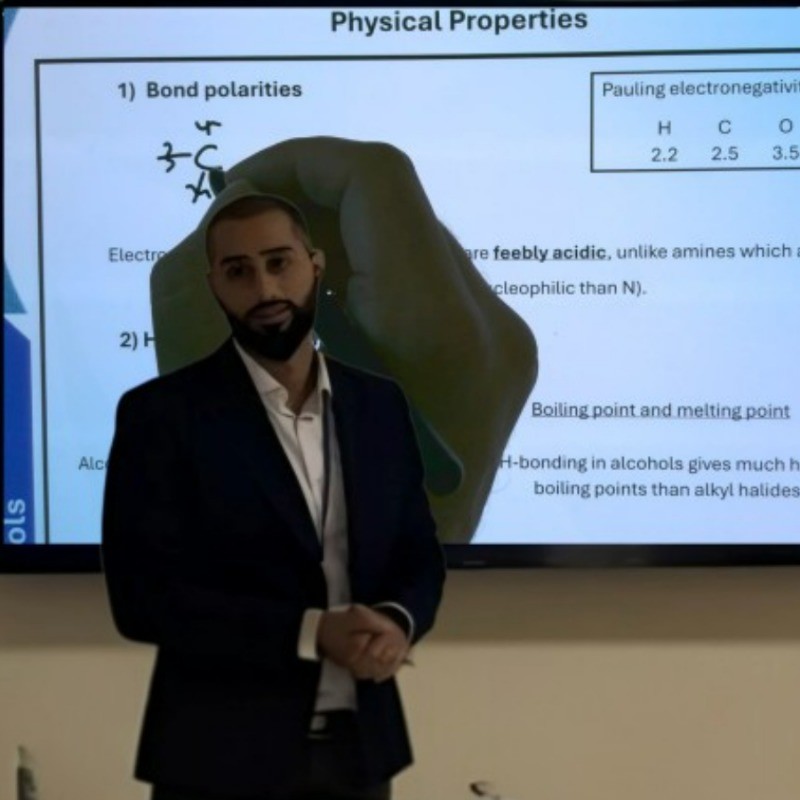
GCSE Recap: Shared Pairs and Lone Pairs
Before you start, check that you can tell bonding pairs from lone pairs in a dot-and-cross diagram.
Why Electron Pairs Repel
All electrons carry a negative charge. Electron pairs therefore repel one another and arrange themselves as far apart as possible around a central atom.
This is the basis of the electron-pair repulsion model used to explain molecular shapes. The shape depends on how many bonding pairs and lone pairs of electrons surround the central atom.
Key idea: molecular shape is controlled by electron-pair repulsion. Electron pairs move to positions of minimum repulsion.
Electron Domains Move as Far Apart as Possible
This model introduces the geometric idea behind molecular shapes. Two negatively charged electron domains repel each other, so the most stable arrangement places them opposite each other on a circle.
What the model shows
Electron domains are negatively charged, so they repel one another. With only two electron domains around a central atom, the lowest repulsion arrangement is a straight line, with the two domains separated by 180°.
From Electron Domains to Molecular Shape
A simple two-dimensional circle helps show why two electron domains become opposite each other. Real molecules, however, exist in three-dimensional space.
When electron domains are allowed to arrange themselves in three dimensions, they spread out around an imaginary sphere centred on the central atom. With only two electron domains, the furthest-apart arrangement is still opposite sides of the central atom.
Electron domain: a region of electron density around a central atom. A single bond, double bond, triple bond or lone pair each counts as one electron domain for shape prediction.
Quick Check: Count the Electron Domains
Count the electron domains around each central atom, remembering how multiple bonds and lone pairs are counted.
From a 2D Circle to a 3D Sphere
Real atoms are three-dimensional. Electron domains are not restricted to a flat circle, so they can spread out in the x, y and z directions. With two electron domains, the maximum separation is still 180°.
The Linear Shape
A molecule is linear when there are two bonding pairs and no lone pairs around the central atom.
The two bonding pairs repel equally. The lowest-repulsion arrangement places the two bonds in opposite directions, giving a bond angle of 180°.
| Shape | Bonding pairs | Lone pairs | Bond angle | Examples |
|---|---|---|---|---|
| Linear | 2 | 0 | 180° | CO2, CS2, HCN, BeF2, BeCl2 |
Quick Check: Which Species Are Linear?
Work out the lone pairs on each central atom, then click every species that is linear.
Linear Shape in BeCl2
In BeCl2, beryllium is the central atom and chlorine atoms are bonded on either side. The central beryllium atom has two bonding pairs and no lone pairs in the shape model.
The two Be-Cl bonding pairs repel equally and move as far apart as possible. This gives a linear molecule with a Cl-Be-Cl bond angle of 180°.
Exam sentence: BeCl2 has two bonding pairs and no lone pairs around Be. The bonding pairs repel equally and move as far apart as possible, so the molecule is linear with a 180° bond angle.
Quick Check: Who Has Predicted NO₂⁺ Correctly?
Pick the student whose shape and reasoning are both right.

BeCl2 is linear because the two bonding pairs around the central Be atom repel equally and sit opposite one another.
Linear Shape of BeCl2
The centre of the sphere represents the nucleus of the central atom, beryllium. The two electron domains are now shown as two covalent bonds to chlorine atoms. Each bonding pair is negatively charged, so the bonds repel each other and spread out to 180°, giving a linear molecule.
How to Explain Shape in an Exam
Shape explanations need a clear sequence. State the number of electron pairs first, then explain repulsion, then give the shape and bond angle.
1. Count electron pairs
State the number of bonding pairs and lone pairs around the central atom.
2. Use repulsion language
State that electron pairs repel and arrange themselves as far apart as possible.
3. Compare pair types where needed
If there are no lone pairs, state that the bonding pairs repel equally. If there are lone pairs, state that lone pairs repel more strongly than bonding pairs.
4. Give the final shape and angle
For BeCl2, the final answer is linear, 180°.
BeCl2 Exam Answer Model
Use the exam-answer structure from Part 5, then change only the molecule-specific information. The black wording is the reusable sentence frame. The coloured wording is the part that changes for each molecule.
Model answer for BeCl2
There are two bonding pairs and no lone pairs around the central beryllium atom.
Electron pairs repel each other and arrange themselves as far apart as possible to minimise repulsion.
Because there are no lone pairs, the two bonding pairs repel equally.
The molecule is therefore linear with a bond angle of 180°.
Reusable sentence frame
There are [number of bonding pairs] and [number of lone pairs] around the central [central atom].
Electron pairs repel each other and arrange themselves as far apart as possible to minimise repulsion.
If there are [no lone pairs], the bonding pairs repel equally. If there are lone pairs, the lone pairs repel more strongly than bonding pairs.
The molecule is therefore [shape] with a bond angle of [bond angle].
Colour key
Blue = bonding-pair information. Red = lone-pair information. Gold = central atom. Green = final shape and bond angle.
Quick Check: Explain a New Pair of Molecules
Write a short explanation in exam style, then compare it with the mark points and the model answer.
Common Exam Points
Linear shape questions are usually straightforward, but marks are often lost when students describe the atoms moving apart instead of the electron pairs repelling.
Focus on electron pairs
The cause of the shape is repulsion between regions of electron density, not a simple repulsion between atoms.
State no lone pairs clearly
For BeCl2, the central Be atom has two bonding pairs and no lone pairs in the molecular shape model.
Use the exact angle
The bond angle in a linear molecule is 180°. Do not write approximately 180° unless the question specifically allows approximation.
Do not confuse linear with bent
A bent molecule has lone pairs on the central atom. A linear molecule with two bonding regions and no lone pairs has a 180° angle.
Linear Shape of XeF2
Xenon difluoride is linear even though the central xenon atom has lone pairs. XeF2 has two Xe-F bonding pairs and three lone pairs. The five electron regions arrange themselves as a trigonal bipyramidal electron-pair arrangement, with the three lone pairs in equatorial positions and the two Xe-F bonds in opposite axial positions.
QuickSnap
The linear shape is produced when a central atom has two bonding pairs and no lone pairs. The two bonding pairs repel equally and move to opposite sides of the central atom.
Electron-pair repulsion
Electron pairs repel because electrons are negatively charged.
Linear condition
Two bonding pairs and no lone pairs around the central atom.
Bond angle
The bonding pairs are furthest apart at 180°.
Example
BeCl2 is linear, with a Cl-Be-Cl bond angle of 180°.
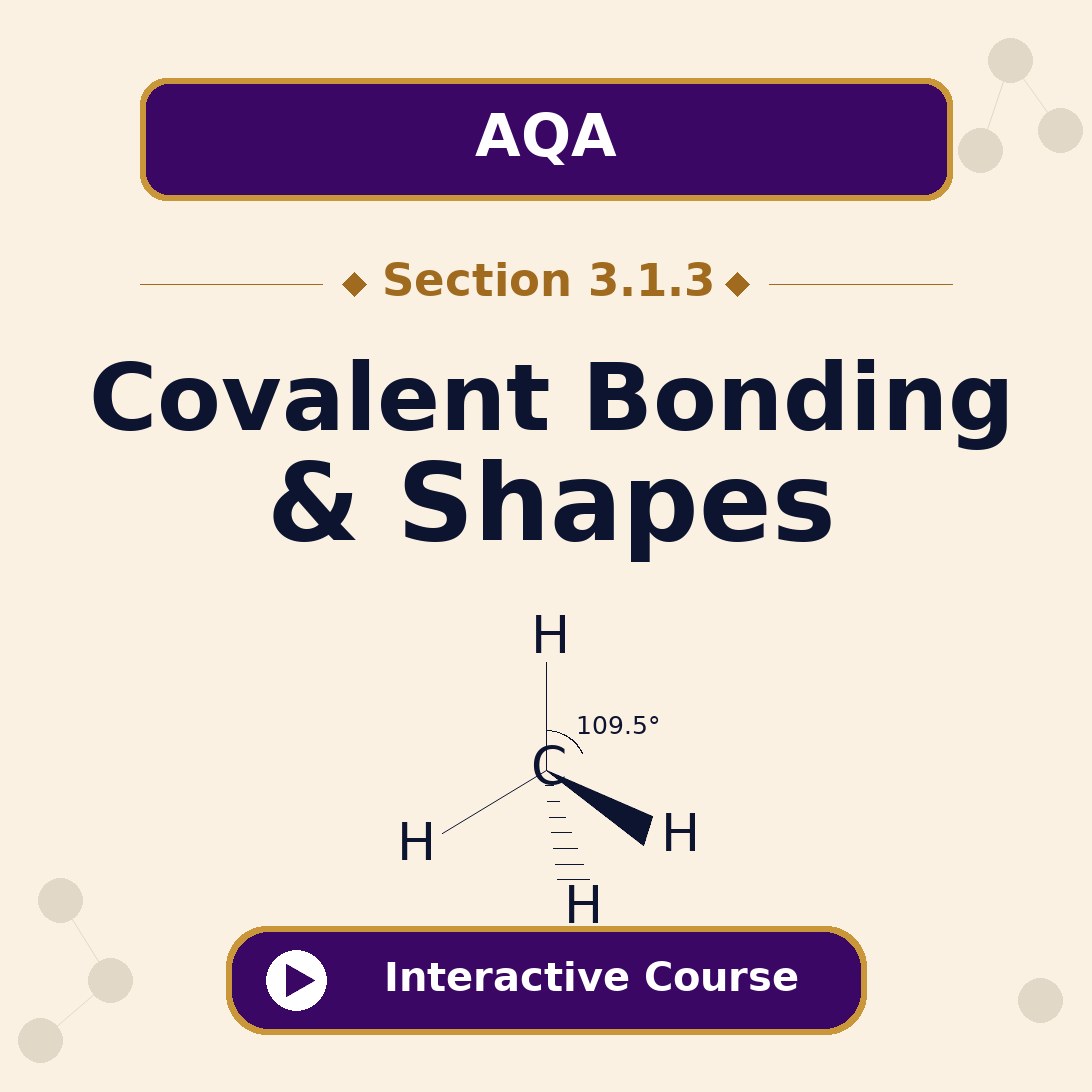
Master Covalent Bonding and Shapes of Molecules for AQA A Level Chemistry
Continue from these free revision notes into the full 3.1.3 Covalent Bonding and Shapes of Molecules course. The three guided video lessons are ready now; the AQA MCQ bank, teacher-marked short-answer questions, supplementary lessons and KASP spec-point report are being written, and the course opens for enrolment as soon as they are complete.
Guided video teaching
Learn the chemistry and exam technique through structured video lessons with worked examples and walkthroughs.
Instant MCQ feedback
Auto-marked MCQ quizzes provide immediate diagnostic feedback for every answer choice.
Teacher-marked SAQs
Submit written exam responses and receive chemistry specialist feedback with improvement guidance.
Progress tracking
Identify strengths and weaknesses across the full 3.1.3 specification with targeted reporting.
See how the course works
Click play to start the course preview animation.
Some ionic radii are shown.
| Ion | Ionic radius / nm |
|---|---|
| Na+ | 0.102 |
| K+ | 0.138 |
| F− | 0.133 |
| Cl− | 0.180 |
Which compound has the strongest ionic bonding?
Explain why the metallic bonding in magnesium is much stronger than that in sodium.
FAQs
These questions target the common points students confuse when learning the linear molecular shape.
What makes a molecule linear?
A molecule is linear when the central atom has two bonding regions and no lone pairs. The bonding pairs repel equally and arrange themselves 180° apart.
Why is BeCl2 linear?
BeCl2 has two Be-Cl bonding pairs around the central Be atom and no lone pairs in the shape model. The two bonding pairs repel equally, so the Cl-Be-Cl bond angle is 180°.
Do lone pairs affect the linear shape?
Yes. Lone pairs repel more strongly than bonding pairs and can reduce bond angles. BeCl2 is linear because there are no lone pairs on the central atom in the shape model.
What bond angle should I write for a linear molecule?
The bond angle for a linear molecule is 180°.
Copyright notice: This OLS revision content, including the explanations, layout, diagrams, tables and embedded learning structure, is authored for Online Learning System by Dr. Mohammed Al-Fatah. It may not be copied, reproduced, redistributed or adapted without written permission.
Keep this note — free
Save your progress across every AQA topic. A free account remembers which topics you have covered, saves your question scores, and syncs across your phone and laptop.
- Track every topic you have finished
- Keep your practice-question scores
- No payment, no card, free forever
Already registered? Log in