Dative Covalent Bonding
A concise revision guide to dative covalent bonds, lone pair donation, coordinate bonding, hydronium ions and aluminium chloride dimer formation for AQA A Level Chemistry.
GCSE Recap: Lone Pairs and the Hydrogen Ion
Before you start, check that you can count lone pairs and that you know what an H⁺ ion is.
What Is a Dative Covalent Bond?
A dative covalent bond forms when the shared electron pair in a covalent bond is donated entirely by one atom.
The atom donating the electron pair must have a lone pair. The other atom accepts the pair but does not contribute any electrons to that bond.
This is also called a coordinate bond or co-ordinate bond. Once the bond has formed, it behaves like a normal covalent bond.
Definition: A dative covalent bond is a covalent bond in which both electrons in the shared pair are supplied by the same atom.
Key idea: The bond is still covalent because a pair of electrons is shared. The special feature is where the shared pair originally came from.
Normal Covalent Bonds Compared With Dative Bonds
In a normal covalent bond, each bonded atom contributes one electron to the shared pair. In a dative covalent bond, one atom contributes both electrons.
After formation, the distinction is only about the origin of the electron pair. The resulting bond is still a covalent bond involving shared electron density between nuclei.
| Feature | Normal covalent bond | Dative covalent bond |
|---|---|---|
| Electron contribution | Each atom contributes one electron. | One atom contributes both electrons. |
| Bond type after formation | A covalent bond with shared electron density. | Also a covalent bond with shared electron density. |
| Typical requirement | Usually requires one unpaired electron from each atom. | Requires a lone pair donor and an electron-pair acceptor. |
Exam focus: Do not describe a dative covalent bond as ionic bonding or electron transfer. It is still a shared-pair covalent bond.
Quick Check: Normal or Dative?
Decide which of four changes forms its new bond as a dative covalent bond.
Hydronium Ion: Lone Pair Donation by Water
Water can form a dative covalent bond because oxygen has lone pairs of electrons. A hydrogen ion, H+, has no electrons and can accept a lone pair.
When water donates one lone pair to H+, the hydronium ion, H3O+, forms. The new O-H bond is drawn as a dative covalent bond because both bonding electrons came from oxygen.
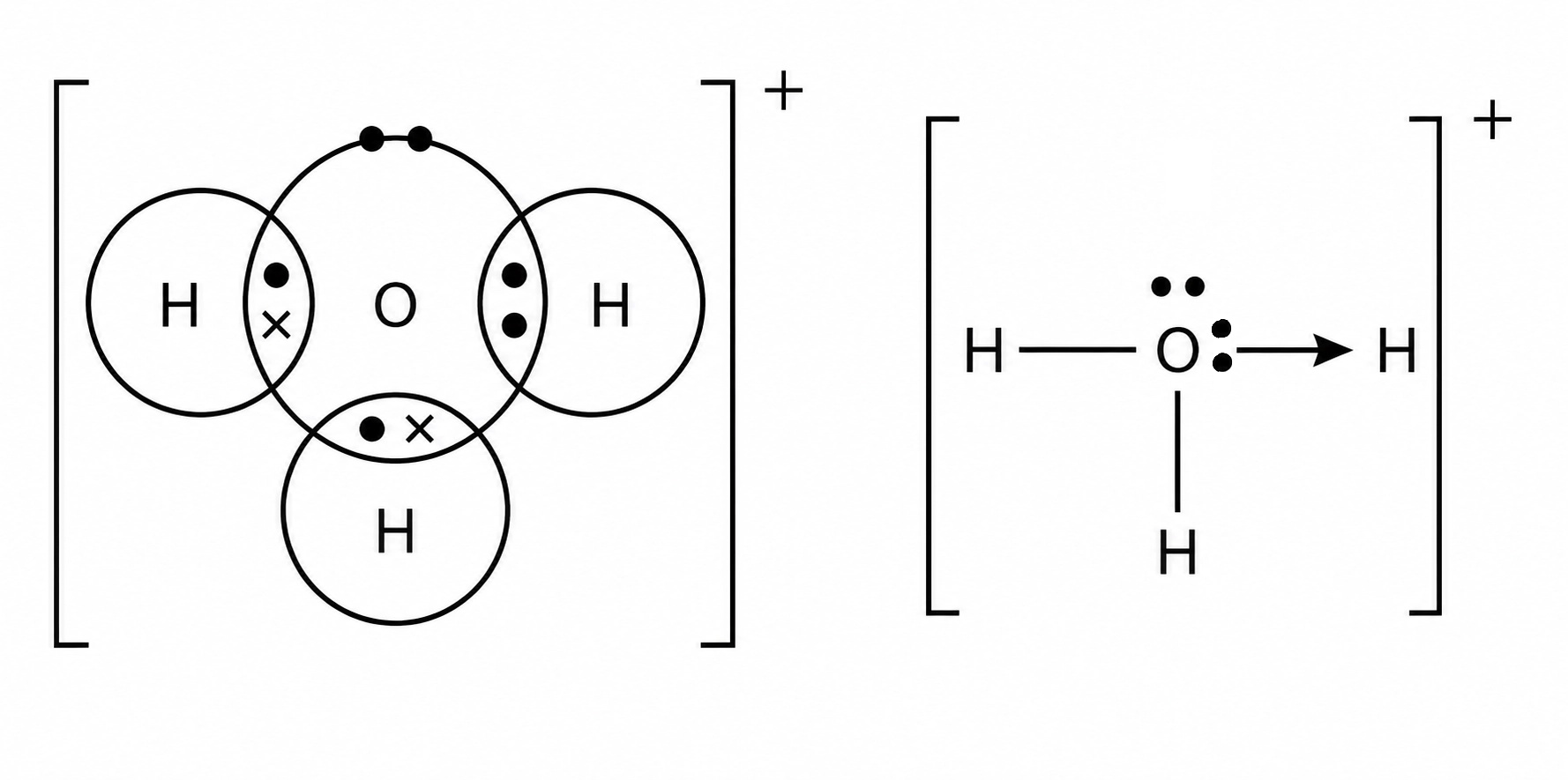
Oxygen donates a lone pair to H+, forming H3O+ with a dative covalent O-H bond.
Remember: H+ accepts an electron pair because it has no electron of its own to contribute to the bond.
Quick Check: The Ammonium Ion
Apply what you have just read about water and H⁺ to ammonia and H⁺.
Aluminium Chloride and Dimer Formation
Aluminium chloride, AlCl3, is a covalent compound in which the central aluminium atom has only six electrons in its outer shell.
Because aluminium does not have a full outer shell in AlCl3, it can accept a lone pair from a chlorine atom in another AlCl3 molecule.
Under suitable conditions, two AlCl3 molecules combine to form Al2Cl6. In this dimer, one chlorine atom from each AlCl3 molecule donates a lone pair to the aluminium atom in the other molecule.
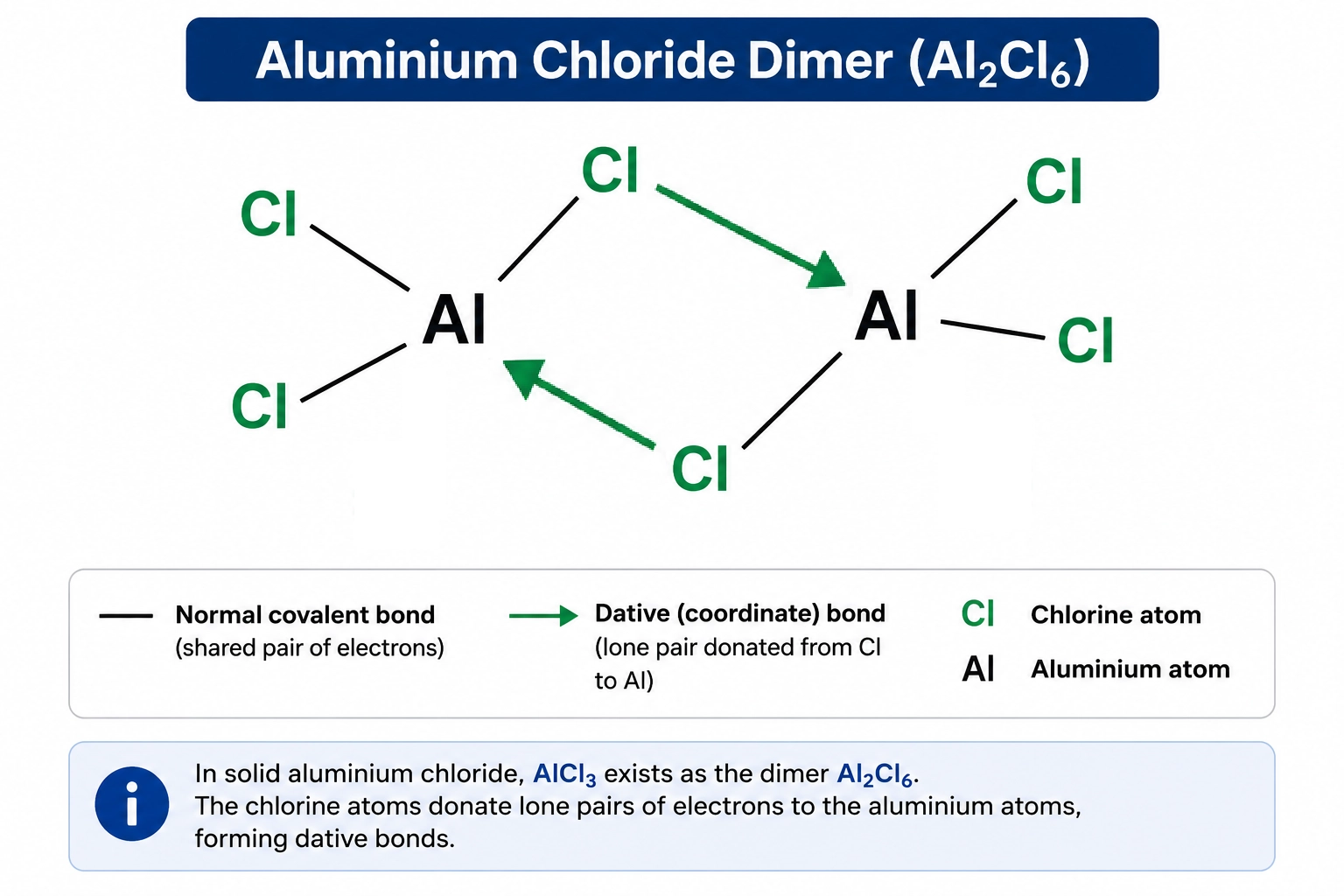
Al2Cl6 contains two dative covalent bonds, allowing each aluminium atom to reach a full outer shell.
Exam focus: In Al2Cl6, the chlorine atoms act as lone pair donors and the aluminium atoms act as electron-pair acceptors.
Quick Check: Explain a New Dative Bond
Write a short explanation, then compare it with the mark points and the model answer.
How Dative Bonds Are Represented
Dative covalent bonds are often shown using an arrow. The arrow starts at the atom donating the lone pair and points towards the atom accepting the electron pair.
For example, in H3O+, the arrow would point from oxygen towards H+. In Al2Cl6, the arrows point from chlorine atoms towards aluminium atoms.
Arrow tail
The tail begins at the atom donating the lone pair.
Arrow head
The arrow points towards the atom accepting the electron pair.
After formation
The bond behaves like an ordinary covalent bond even though both electrons originally came from one atom.
Quick Check: Which Way Does the Arrow Point?
Answer six quick questions on arrows, donors and acceptors in species this page has not drawn.
Quick Check: Spot the Accurate Statement
In each round, pick the one statement about dative covalent bonding that is accurate.
Common Exam Points
Strong answers identify the electron-pair donor, the electron-pair acceptor and the origin of the shared pair.
Use the phrase lone pair
The donor must provide a lone pair of electrons to form the dative bond.
State that both electrons come from one atom
This is the key difference between a dative covalent bond and a normal covalent bond.
Do not change the bond type after formation
Once formed, the dative bond behaves like a regular covalent bond.
Use correct examples
H3O+ forms when water donates a lone pair to H+. Al2Cl6 forms when chlorine atoms donate lone pairs to electron-deficient aluminium atoms.
QuickSnap
A dative covalent bond is a covalent bond where both electrons in the shared pair are donated by the same atom.
Dative covalent bond
A shared electron pair supplied entirely by one atom.
Donor
The atom or ion that supplies the lone pair.
Acceptor
The atom or ion that accepts the lone pair.
Hydronium ion
Water donates a lone pair from oxygen to H+, forming H3O+.
Aluminium chloride dimer
Two AlCl3 molecules combine to form Al2Cl6 using two dative covalent bonds.
Master Covalent Bonding and Shapes of Molecules for AQA A Level Chemistry
Continue from these free revision notes into the full 3.1.3 Covalent Bonding and Shapes of Molecules course. The three guided video lessons are ready now; the AQA MCQ bank, teacher-marked short-answer questions, supplementary lessons and KASP spec-point report are being written, and the course opens for enrolment as soon as they are complete.
Guided video teaching
Learn the chemistry and exam technique through structured video lessons with worked examples and walkthroughs.
Instant MCQ feedback
Auto-marked MCQ quizzes provide immediate diagnostic feedback for every answer choice.
Teacher-marked SAQs
Submit written exam responses and receive chemistry specialist feedback with improvement guidance.
Progress tracking
Identify strengths and weaknesses across the full 3.1.3 specification with targeted reporting.
See how the course works
Click play to start the course preview animation.
Some ionic radii are shown.
| Ion | Ionic radius / nm |
|---|---|
| Na+ | 0.102 |
| K+ | 0.138 |
| F− | 0.133 |
| Cl− | 0.180 |
Which compound has the strongest ionic bonding?
Explain why the metallic bonding in magnesium is much stronger than that in sodium.
FAQs
Common questions students ask about dative covalent bonding.
What is a dative covalent bond?
A dative covalent bond is a covalent bond in which both electrons in the shared pair are donated by the same atom.
Is a dative covalent bond different from a normal covalent bond after it forms?
No. Once a dative covalent bond has formed, it behaves like a normal covalent bond. The difference is that both bonding electrons originally came from one atom.
Why can water form a dative covalent bond with H+?
Water has lone pairs on oxygen, while H+ can accept an electron pair. Oxygen donates a lone pair to H+, forming H3O+.
Why does AlCl3 form Al2Cl6?
In AlCl3, aluminium has only six electrons in its outer shell. Chlorine atoms can donate lone pairs to aluminium atoms in another AlCl3 molecule, forming Al2Cl6.
Which way does the arrow point in a dative covalent bond?
The arrow starts at the lone pair donor and points towards the electron-pair acceptor.
Copyright and author footprint: This OLS revision page was written for Online Learning System by Dr. Mohammed Al-Fatah. It is designed for A Level Chemistry revision and should not be copied or redistributed without permission.
Keep this note — free
Save your progress across every AQA topic. A free account remembers which topics you have covered, saves your question scores, and syncs across your phone and laptop.
- Track every topic you have finished
- Keep your practice-question scores
- No payment, no card, free forever
Already registered? Log in