Nature of Ionic Bonding
A concise revision guide to ionic bonding, electron transfer, giant ionic lattice structure, ionic bonding strength and ionic radii for AQA A Level Chemistry.
GCSE Recap: Ions and Electron Transfer
Before you start, check that you can still predict ionic compounds and electron transfer the GCSE way.
What Is Ionic Bonding?
Ionic bonding is the strong electrostatic force of attraction between oppositely charged ions formed by electron transfer.
In sodium chloride, a sodium atom transfers one electron to a chlorine atom. Sodium becomes a positive ion, Na+, and chlorine becomes a negative ion, Cl–.
The attraction between the Na+ cation and the Cl– anion is an ionic bond.
Key idea: Ionic bonding is not the transfer of electrons itself. The bond is the electrostatic attraction between the oppositely charged ions after transfer has occurred.
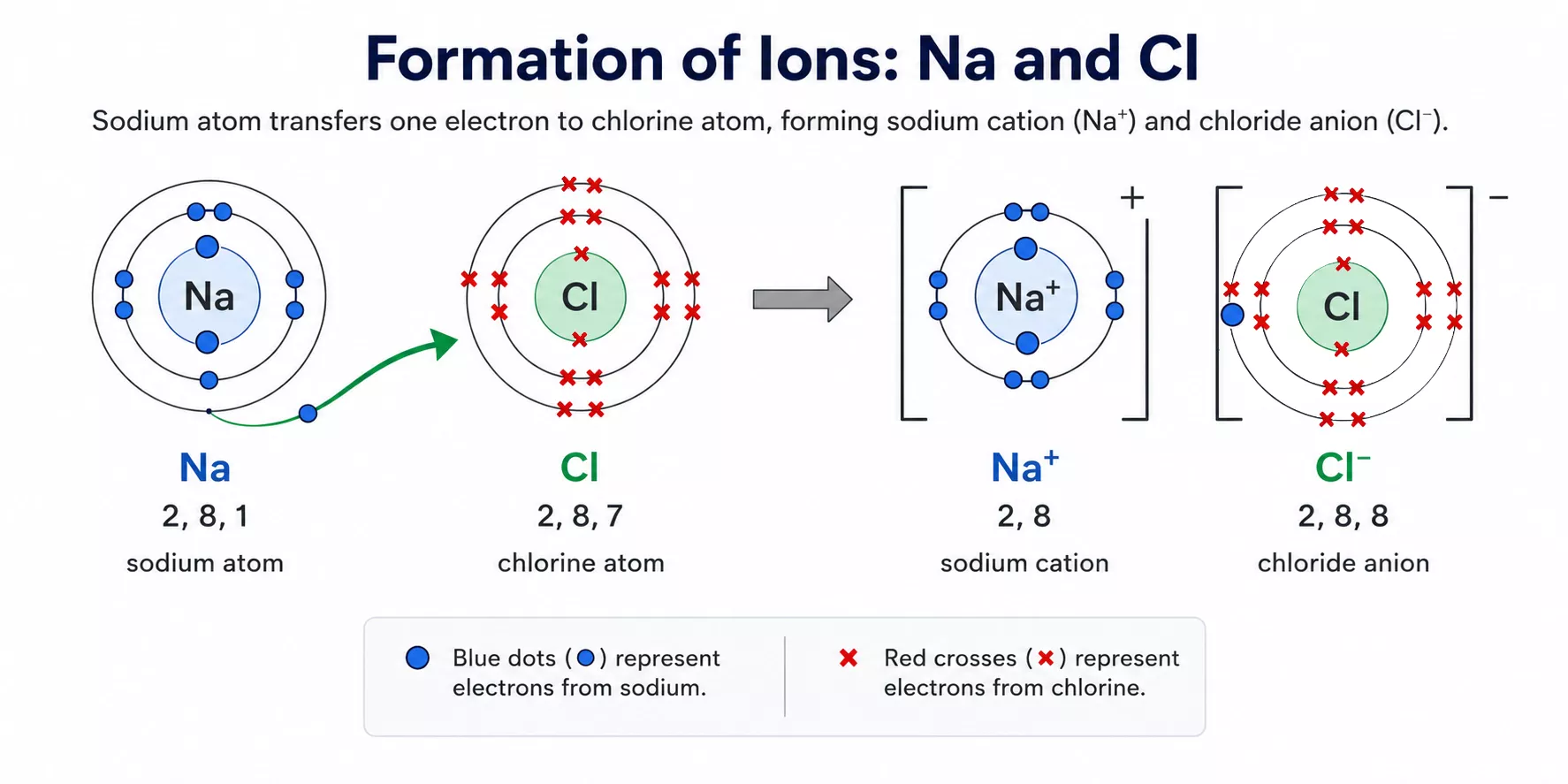
Sodium loses one outer electron to form Na+, while chlorine gains one electron to form Cl–.
Quick Check: Predicting the Ions Formed
Answer six quick questions on compounds that this page has not mentioned.
Giant Ionic Lattice Structure
Ionic solids, such as sodium chloride, contain a giant ionic lattice. This means the ions are arranged in a repeating, ordered three-dimensional structure.
In sodium chloride, Na+ and Cl– ions alternate in a regular pattern. Each ion is attracted to neighbouring ions with the opposite charge.
The electrostatic forces act in all possible directions through the lattice, so ionic bonding is not limited to one isolated pair of ions.
| Term | Meaning | Exam focus |
|---|---|---|
| Giant | A very large repeating structure containing many ions. | Avoid describing NaCl as a small molecule. |
| Lattice | A regular, repeating arrangement of particles. | Refer to a three-dimensional ionic lattice. |
| Ionic bond | Electrostatic attraction between oppositely charged ions. | Attractions act in all directions. |
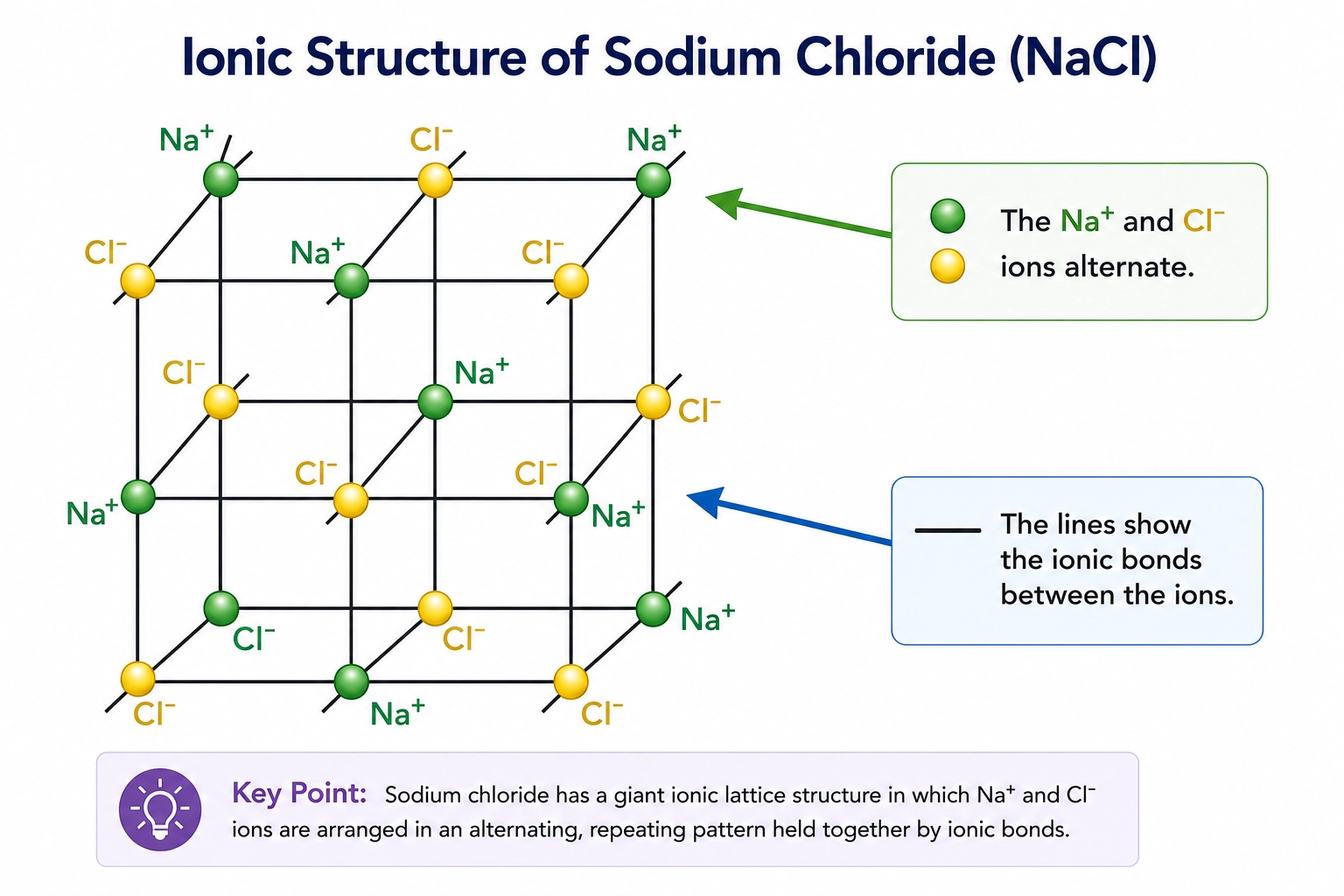
The alternating arrangement of Na+ and Cl– ions produces a regular cubic lattice in sodium chloride.
Quick Check: Lattice or Molecule?
In each round, pick the one statement that is accurate.
Sodium chloride: one repeat unit cell
This interactive model shows the rock-salt arrangement of sodium chloride. The central Na+ ion is highlighted with its six nearest Cl− neighbours in the x, y and z directions.
Ionic Bonding Strength
Ionic bonds become stronger when the ions are smaller and/or carry greater charges.
Smaller ions allow oppositely charged ions to get closer together, increasing electrostatic attraction. Higher ionic charges also increase the attraction between ions.
This is why magnesium oxide, MgO, has a much higher melting temperature than sodium chloride, NaCl. The ions in MgO, Mg2+ and O2-, are smaller and more highly charged than Na+ and Cl–.
| Compound | Ions involved | Ion size | Ion charge | Relative melting point |
|---|---|---|---|---|
| NaCl | Na+ and Cl– | Larger | ±1 | 801 °C |
| MgO | Mg2+ and O2- | Smaller | ±2 | 2852 °C |
Exam focus: When comparing ionic bonding strength, refer to both charge and ionic radius where relevant.
Quick Check: Explain a Melting Temperature Difference
Write a short explanation, then compare it with the mark points and the model answer.
Ionic Radii
Positive ions, called cations, are smaller than their parent atoms. This is often because an entire outer electron shell is lost and the remaining electrons are pulled in more strongly by the nucleus.
Negative ions, called anions, are larger than their parent atoms. Extra electrons are added while the number of protons stays the same, so the nuclear attraction is spread over more electrons.
| Ion | Li+ | Na+ | K+ | Rb+ |
|---|---|---|---|---|
| Ionic radius / nm | 0.060 | 0.095 | 0.133 | 0.148 |
| Ion | N3- | O2- | F– | Na+ | Mg2+ | Al3+ |
|---|---|---|---|---|---|---|
| No. of electrons | 10 | 10 | 10 | 10 | 10 | 10 |
| No. of protons | 7 | 8 | 9 | 11 | 12 | 13 |
| Ionic radius / nm | 0.171 | 0.140 | 0.136 | 0.095 | 0.065 | 0.050 |
Key idea: In an isoelectronic series, the ions have the same number of electrons. As the number of protons increases, the attraction for those electrons increases and the ionic radius decreases.
Quick Check: Ions with 18 Electrons
Count protons and electrons, then complete the sentences about a new isoelectronic series.
Quick Check: Rank the Melting Temperatures
Use ion charge first and ionic radius second to put six compounds in order.
Common Exam Points
For ionic bonding and structure questions, exam answers usually need precise language. The most important phrases are oppositely charged ions, strong electrostatic attraction, giant ionic lattice and attraction in all directions.
Do not call ionic compounds molecules
NaCl is normally described as a giant ionic lattice, not as individual NaCl molecules.
Separate electron transfer from bonding
Electron transfer forms ions. The ionic bond is the electrostatic attraction between those ions.
Use charge and radius in explanations
Greater charge and smaller ionic radius generally produce stronger ionic attractions and higher melting temperatures.
QuickSnap
For this page, the essential idea is that electron transfer forms ions, but the ionic bond is the strong electrostatic attraction between those oppositely charged ions.
Formation of ions
Metals lose electrons to form positive cations, while non-metals gain electrons to form negative anions. For example, sodium forms Na+ and chlorine forms Cl–.
Giant ionic lattice
Ionic compounds form regular, repeating three-dimensional lattices. The attractions act in all directions between neighbouring oppositely charged ions.
Bond strength
Ionic bonding is stronger when ions are smaller and/or more highly charged. This explains why MgO has a much higher melting point than NaCl.
Ionic radius
Cations are smaller than their parent atoms because electrons are lost. Anions are larger because extra electrons are added and electron-electron repulsion increases.
Master Ionic and Metallic Bonding for AQA A Level Chemistry
Continue from these free revision notes into the full 3.1.3 Ionic and Metallic Bonding course. The three guided video lessons are ready now; the AQA MCQ bank, teacher-marked short-answer questions, supplementary lessons and KASP spec-point report are being written, and the course opens for enrolment as soon as they are complete.
Guided video teaching
Learn the chemistry and exam technique through structured video lessons with worked examples and walkthroughs.
Instant MCQ feedback
Auto-marked MCQ quizzes provide immediate diagnostic feedback for every answer choice.
Teacher-marked SAQs
Submit written exam responses and receive chemistry specialist feedback with improvement guidance.
Progress tracking
Identify strengths and weaknesses across the full 3.1.3 specification with targeted reporting.
See how the course works
Click play to start the course preview animation.
Some ionic radii are shown.
| Ion | Ionic radius / nm |
|---|---|
| Na+ | 0.102 |
| K+ | 0.138 |
| F− | 0.133 |
| Cl− | 0.180 |
Which compound has the strongest ionic bonding?
Explain why the metallic bonding in magnesium is much stronger than that in sodium.
Frequently Asked Questions
Use these quick answers to check the core language needed for ionic bonding and structure questions.
What is ionic bonding?
Ionic bonding is the strong electrostatic force of attraction between oppositely charged ions formed by electron transfer.
Is ionic bonding the same as electron transfer?
No. Electron transfer forms positive and negative ions. The ionic bond is the electrostatic attraction between those oppositely charged ions.
What is a giant ionic lattice?
A giant ionic lattice is a regular, repeating three-dimensional arrangement of ions held together by electrostatic attractions in all directions.
Why does MgO have a higher melting point than NaCl?
MgO contains Mg2+ and O2- ions, which are more highly charged and smaller than Na+ and Cl– ions. This creates stronger electrostatic attractions, so more energy is needed to melt MgO.
Why are cations smaller than their parent atoms?
Cations are smaller because electrons are lost. Often an entire electron shell is removed, and the remaining electrons experience a stronger attraction from the nucleus.
Why are anions larger than their parent atoms?
Anions are larger because extra electrons are added while the number of protons stays the same. The nuclear attraction is spread over more electrons, so the outer electrons are held less tightly.
Copyright notice: This OLS revision content, including the explanations, layout, diagrams, tables and embedded learning structure, is authored for Online Learning System by Dr. Mohammed Al-Fatah. It may not be copied, reproduced, redistributed or adapted without written permission.
Keep this note — free
Save your progress across every AQA topic. A free account remembers which topics you have covered, saves your question scores, and syncs across your phone and laptop.
- Track every topic you have finished
- Keep your practice-question scores
- No payment, no card, free forever
Already registered? Log in