London Forces
A concise revision guide to induced dipole-dipole forces (also called van der Waals, dispersion or London forces): how instantaneous dipoles induce dipoles in neighbouring molecules, why every molecule has them, and how the number of electrons and molecular shape control their strength, for AQA A Level Chemistry.
What London Forces Are
Induced dipole-dipole forces (also called van der Waals, dispersion or London forces) are weak attractions between every molecule and every separate atom, caused by the constant movement of electrons. They are the only intermolecular force that exists between non-polar molecules such as N₂, CH₄ and I₂, and between the atoms of the noble gases.
The electrons in a molecule are never still. At any instant the electron cloud can be slightly denser on one side than the other, so that side is momentarily δ- and the opposite side δ+. This is an instantaneous dipole. It lasts only for a fraction of a second, but while it exists it pushes the electrons of a neighbouring molecule away from the δ- end and pulls them towards the δ+ end, creating an induced dipole in the neighbour. The two dipoles then attract each other.
Because the instantaneous dipole keeps changing, the induced dipole changes with it, so the attraction is always there on average even though no single dipole is permanent. This is why students should describe the force as instantaneous dipole-induced dipole rather than as a fixed charge on the molecule.
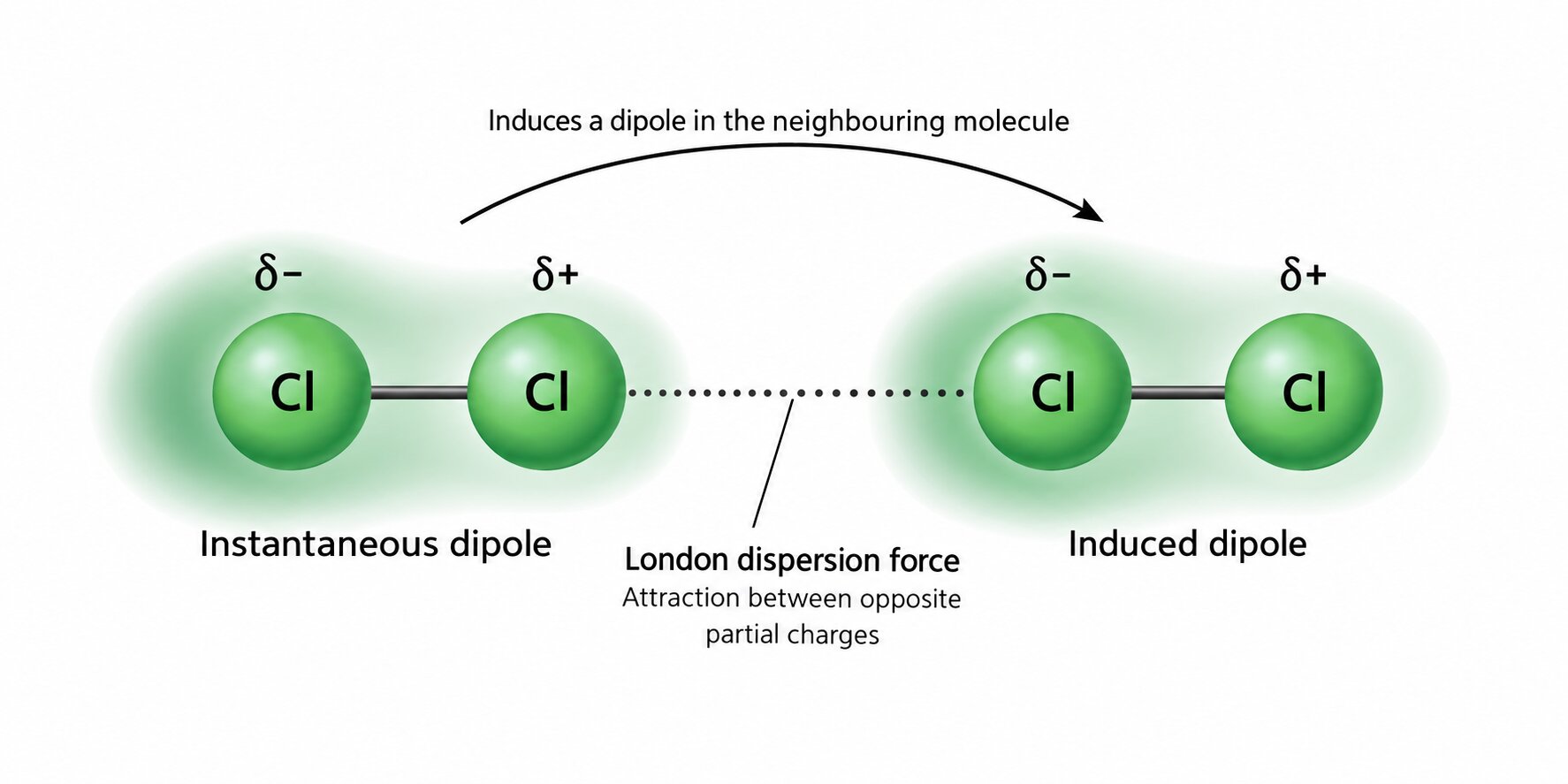
An instantaneous dipole in one molecule induces a dipole in its neighbour; the δ- end of one attracts the δ+ end of the other.
Definition: Induced dipole-dipole forces are attractions between an instantaneous dipole in one molecule and the dipole it induces in a neighbouring molecule.
Why Every Molecule Has Them
Any particle with electrons can have an instantaneous dipole, so induced dipole-dipole forces act between all molecules and atoms, polar or not. A polar molecule such as HCl has induced dipole-dipole forces as well as the attraction between its permanent dipoles; the two forces add together.
This is the point most often missed in exam answers. When a question asks for the intermolecular forces in a polar molecule, the answer must include induced dipole-dipole forces alongside the stronger force, because they never switch off.
Common mistake: Writing that “polar molecules have permanent dipole forces instead of induced dipole-dipole forces”. They have both. The word to use is in addition to.
What Decides Their Strength: Number of Electrons
The more electrons a molecule has, the larger and more polarisable its electron cloud, so the larger the instantaneous and induced dipoles and the stronger the induced dipole-dipole forces. Molecules with many electrons therefore need more energy to separate and have higher boiling points.
The noble gases show the effect with no other force present. Each is a single atom, so the only attraction between the atoms is the induced dipole-dipole forces between them, and the boiling point rises steadily as the number of electrons rises.
| Noble gas | Electrons per atom | boiling point / °C |
|---|---|---|
| Helium, He | 2 | -269 |
| Neon, Ne | 10 | -246 |
| Argon, Ar | 18 | -186 |
| Krypton, Kr | 36 | -153 |
| Xenon, Xe | 54 | -108 |
The halogens follow the same pattern. Fluorine and chlorine are gases at room temperature, bromine is a liquid and iodine is a solid, because the number of electrons per molecule rises from 18 in F₂ to 106 in I₂ and the induced dipole-dipole forces between the molecules strengthen down the group.
| Halogen | Electrons per molecule | boiling point / °C | State at 25 °C |
|---|---|---|---|
| F₂ | 18 | -188 | gas |
| Cl₂ | 34 | -34 | gas |
| Br₂ | 70 | 59 | liquid |
| I₂ | 106 | 184 | solid |
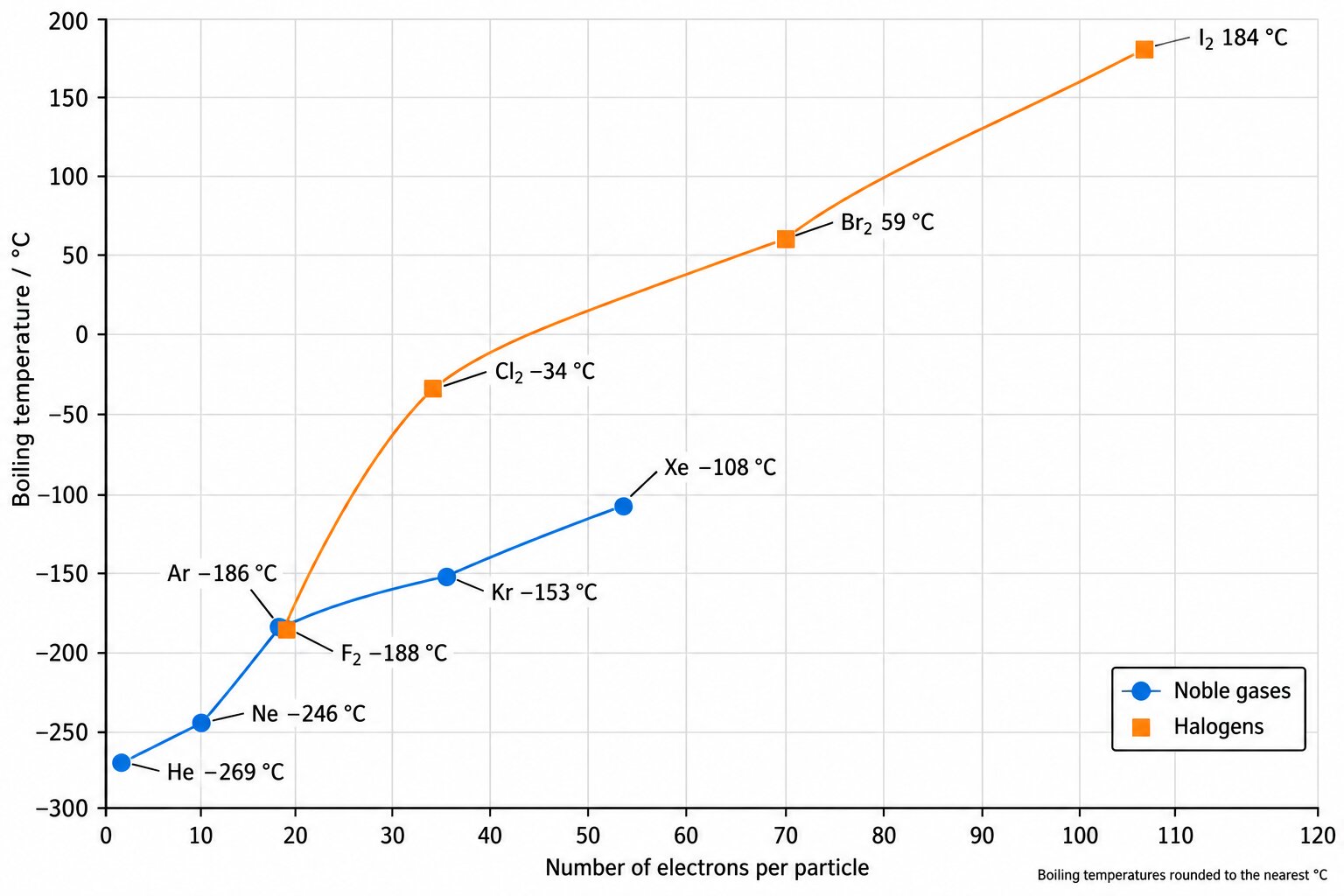
Boiling point rises with the number of electrons for both series because the induced dipole-dipole forces between the particles become stronger.
Exam sentence: I₂ has a higher boiling point than Cl₂ because I₂ molecules have more electrons, so the induced dipole-dipole forces between the molecules are stronger and more energy is needed to overcome them.
What Decides Their Strength: Shape and Surface Contact
Molecules with the same number of electrons can still differ, because the attraction depends on how closely the electron clouds of neighbouring molecules can approach. Long, straight molecules can lie alongside each other with a large area of contact, so their induced dipole-dipole forces are stronger than those between compact, branched molecules of the same formula.
Pentane and 2,2-dimethylpropane both have the formula C₅H₁₂ and 42 electrons. Pentane is a straight chain and boils at 36 °C; 2,2-dimethylpropane is almost spherical and boils at 10 °C. The branched molecule cannot get as close to its neighbours, so less energy is needed to separate them. The Boiling Temperature Trends page uses this idea for the whole alkane series.
Key idea: Two factors set the size of induced dipole-dipole forces: the number of electrons (the larger factor) and the surface area of contact between neighbouring molecules.
How Weak Is Weak?
Induced dipole-dipole forces are the weakest of the three intermolecular forces for molecules of a similar size, but “weak” is relative to covalent bonds, not to nothing. Roughly, a covalent bond needs 150 to 1000 kJ mol⁻¹ to break, a hydrogen bond 10 to 40 kJ mol⁻¹, and the induced dipole-dipole forces between two small molecules only a few kJ mol⁻¹. For a very large molecule such as a polymer chain or I₂, however, the induced dipole-dipole forces add up along the whole molecule and can exceed a hydrogen bond in total.
| Interaction | Typical energy to break / kJ mol⁻¹ | Acts between |
|---|---|---|
| Covalent bond | 150 to 1000 | atoms within a molecule |
| Ionic bond (lattice) | 600 to 4000 per mole of lattice | ions |
| Metallic bond | 80 to 900 | metal ions and delocalised electrons |
| Hydrogen bond | 10 to 40 | molecules with N-H, O-H or H-F |
| permanent dipole-dipole forces | 3 to 20 | polar molecules |
| Induced dipole-dipole forces | 1 to 20, rising with size | all molecules and atoms |
This ladder explains why simple molecular substances melt and boil at low temperatures: only the intermolecular forces are overcome, never the covalent bonds inside the molecules. When ice melts or water boils, every O-H bond stays intact.
Exam trap: Never write that covalent bonds break when a molecular substance boils. The molecules separate; the bonds within them do not.
Names You Will See
AQA accepts the names induced dipole-dipole forces, van der Waals forces, dispersion forces and London forces for the weakest interaction; use one name and keep to it in an answer.
Whatever name the question uses, the explanation is the same: moving electrons, an instantaneous dipole, an induced dipole in the neighbour, and an attraction whose size grows with the number of electrons and the area of contact.
Exam wording: Use the name your specification uses: “induced dipole-dipole forces”. Then say what causes them, because the name alone earns no marks.
Common Exam Points
Explain why boiling point rises down Group 7
More electrons per molecule, larger instantaneous and induced dipoles, stronger induced dipole-dipole forces, more energy needed to separate the molecules.
Explain why a branched isomer boils lower
Same number of electrons, but a smaller surface area of contact between molecules, so weaker induced dipole-dipole forces.
State the forces between molecules of a polar substance
Permanent dipole-dipole forces in addition to induced dipole-dipole forces; if the molecule has N-H, O-H or H-F, hydrogen bonds as well.
Do not say
“The bonds break” for boiling; “induced dipole-dipole forces only occur in non-polar molecules”; “the dipole is permanent”.
Check Your Understanding
Test whether you can explain the origin and size of the weakest intermolecular force with molecules that are not on this page.
FAQs
Use these quick answers to check the induced dipole-dipole forces ideas that appear most often in AQA A Level Chemistry questions.
What are induced dipole-dipole forces?
They are attractions between an instantaneous dipole in one molecule and the dipole it induces in a neighbouring molecule. The electrons in any particle are constantly moving, so at any instant the electron cloud can be uneven, and that temporary dipole induces an opposite dipole in the neighbour.
Do induced dipole-dipole forces act between all molecules?
Yes. Every molecule and every separate atom has electrons, so every one of them has induced dipole-dipole forces. A polar molecule has them in addition to its permanent dipole-dipole forces, never instead of them.
What makes them stronger?
Two things. The number of electrons is the larger factor: more electrons mean a bigger, more polarisable cloud and larger induced dipoles. The shape matters too, because long straight molecules touch their neighbours over a larger area than compact branched ones.
Why does boiling point increase down Group 7?
The number of electrons per molecule rises from 18 in F₂ to 106 in I₂, so the induced dipole-dipole forces between the molecules get stronger and more energy is needed to separate them. That is why iodine is a solid and chlorine a gas at room temperature.
Are van der Waals forces the same thing?
AQA accepts the names induced dipole-dipole forces, van der Waals forces, dispersion forces and London forces for the weakest interaction; use one name and keep to it in an answer.
Copyright and author footprint: This OLS revision page was written for Online Learning System by Dr. Mohammed Al-Fatah. It is designed for A Level Chemistry revision and should not be copied or redistributed without permission.
Keep this note — free
Save your progress across every AQA topic. A free account remembers which topics you have covered, saves your question scores, and syncs across your phone and laptop.
- Track every topic you have finished
- Keep your practice-question scores
- No payment, no card, free forever
Already registered? Log in