Permanent Dipole-Dipole Forces
A concise revision guide to permanent dipole-dipole forces: which molecules have a permanent dipole, how polar molecules attract each other, why the attraction adds to induced dipole-dipole forces, and how to decide the forces in an unfamiliar molecule, for AQA A Level Chemistry.
Polar Molecules and Permanent Dipoles
A permanent dipole exists in a molecule that contains polar bonds whose dipoles do not cancel, so one end of the molecule is always δ+ and the other always δ-. Permanent dipole-dipole forces are the attractions between the δ+ end of one such molecule and the δ- end of a neighbour.
Two conditions must both hold. First, the molecule must contain a bond between atoms of different electronegativity, such as H-Cl, C-Cl, C-F or C=O. Second, the shape of the molecule must leave an overall dipole. CO₂ has two very polar C=O bonds, but the molecule is linear and the two bond dipoles cancel, so CO₂ has no permanent dipole and only induced dipole-dipole forces act between its molecules. The same applies to CCl₄ and BF₃.
| Molecule | Polar bonds? | Shape | Overall dipole? | Strongest intermolecular force |
|---|---|---|---|---|
| HCl | yes | linear, two atoms | yes | permanent dipole-dipole forces |
| CH₃Cl | yes | tetrahedral, one Cl | yes | permanent dipole-dipole forces |
| CO₂ | yes | linear, symmetric | no | induced dipole-dipole forces |
| CCl₄ | yes | tetrahedral, symmetric | no | induced dipole-dipole forces |
| SO₂ | yes | bent | yes | permanent dipole-dipole forces |
| N₂ | no | linear | no | induced dipole-dipole forces |
Key idea: Polar bonds are necessary but not sufficient. Ask whether the bond dipoles cancel in three dimensions before deciding that a molecule is polar.
How the Molecules Line Up
In a liquid such as hydrogen chloride the molecules tumble constantly, but on average they spend more time with their δ+ hydrogen close to the δ- chlorine of a neighbour than in any other arrangement. This partial alignment produces a net attraction that is stronger than induced dipole-dipole forces alone for molecules of similar size, so more energy is needed to pull the molecules apart.
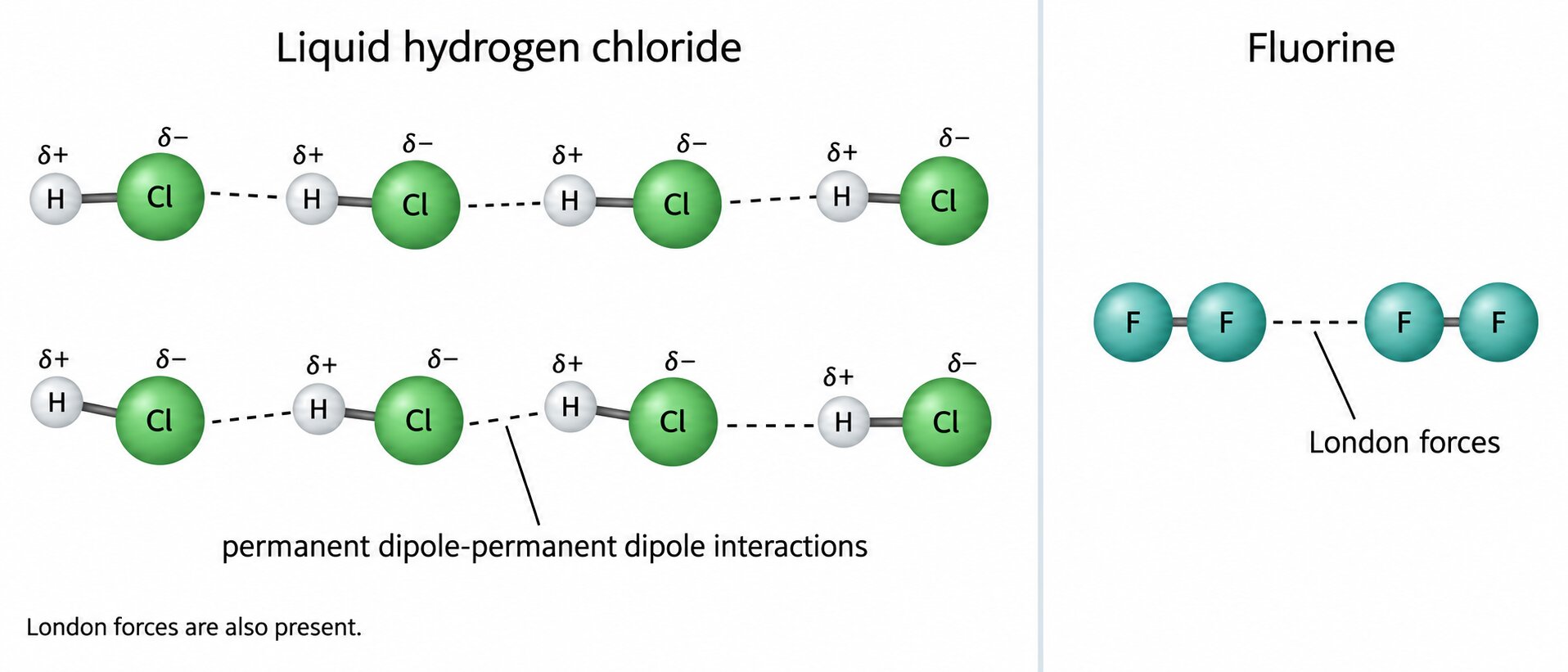
Polar molecules attract each other by the alignment of their permanent dipoles; this attraction acts in addition to the induced dipole-dipole forces that every molecule has.
The alignment is never perfect, because thermal motion keeps disturbing it, which is why permanent dipole-dipole forces are still weak compared with covalent bonds and why polar liquids such as HCl still boil far below room temperature.
Remember: Permanent dipole-dipole forces act in addition to induced dipole-dipole forces, never instead of them.
Comparing Molecules With Similar Numbers of Electrons
The fair way to show that a permanent dipole raises the boiling point is to compare two molecules with the same number of electrons, so that their induced dipole-dipole forces are similar. Hydrogen chloride and fluorine both have 18 electrons. F₂ is non-polar and boils at -188 °C; HCl is polar and boils at -85 °C. The extra 100 °C comes from the permanent dipole-dipole forces.
| Pair | Electrons | Polar? | boiling point / °C |
|---|---|---|---|
| F₂ | 18 | no | -188 |
| HCl | 18 | yes | -85 |
| Butane, C₄H₁₀ | 34 | no | -1 |
| Propanone, CH₃COCH₃ | 32 | yes (C=O) | 56 |
| Ethane, C₂H₆ | 18 | no | -89 |
| Fluoromethane, CH₃F | 18 | yes (C-F) | -78 |
Propanone and butane make the same point with organic molecules: almost the same electron count, but the C=O dipole in propanone lifts its boiling point by nearly 60 °C.
Exam sentence: Propanone has a higher boiling point than butane because propanone molecules have a permanent dipole, so permanent dipole-dipole forces act between them in addition to induced dipole-dipole forces, and more energy is needed to separate the molecules.
Deciding the Forces in an Unfamiliar Molecule
Exam questions often give a molecule you have never met and ask which intermolecular forces act between its molecules. Use three questions in order.
- Does the molecule contain an H atom bonded directly to N, O or F? If yes, hydrogen bonding is present (see the Hydrogen Bonding page), and so are the two forces below.
- Does the molecule have an overall permanent dipole? Check for polar bonds and then check that the shape does not cancel them. If yes, permanent dipole-dipole forces are present, plus induced dipole-dipole forces.
- Every molecule has induced dipole-dipole forces. If the answers to questions 1 and 2 are no, these are the only forces.
For example, chloromethane, CH₃Cl, has no H bonded to N, O or F, but it has a polar C-Cl bond in a tetrahedral molecule with only one chlorine, so it has an overall dipole: permanent dipole-dipole forces plus induced dipole-dipole forces. Methanal, HCHO, has a C=O dipole: the same answer. Tetrachloromethane, CCl₄, has four polar bonds that cancel: induced dipole-dipole forces only.
Exam focus: Name every force that is present and say which is the strongest. A list with one force missing loses the mark even if the strongest is right.
Permanent Dipoles and Solubility
Polar molecules tend to dissolve in polar solvents and non-polar molecules in non-polar solvents, because a solute dissolves when the new attractions it makes with solvent molecules are similar in strength to the attractions it loses. Propanone mixes with water in all proportions because its C=O oxygen can accept a hydrogen bond from water, while hexane does not mix with water because the only forces hexane can offer are induced dipole-dipole forces. The Choosing Solvents page develops this idea.
Key idea: Like dissolves like: match the strongest intermolecular force in the solute to the strongest force in the solvent.
Common Exam Points
Explain why HCl boils higher than F₂
Similar electrons, so similar induced dipole-dipole forces; HCl is polar, so permanent dipole-dipole forces act as well; more energy is needed to separate HCl molecules.
Explain why CO₂ is non-polar although C=O bonds are polar
The molecule is linear and symmetrical, so the two bond dipoles cancel and there is no overall dipole.
State the intermolecular forces in CH₃Br
Permanent dipole-dipole forces and induced dipole-dipole forces; no hydrogen bonding because no H is bonded to N, O or F.
Do not say
“Polar molecules have no induced dipole-dipole forces”; “any molecule with a polar bond is polar”.
Check Your Understanding
Decide which intermolecular forces act in molecules that do not appear in the notes above.
FAQs
Use these quick answers to check how AQA expects permanent dipoles to be identified and explained.
What is a permanent dipole?
It is a separation of charge that is always present in a molecule, because the molecule contains polar bonds whose dipoles do not cancel. One end of the molecule is permanently δ+ and the other permanently δ-.
Does a polar bond always make a polar molecule?
No. CO₂ and CCl₄ both contain very polar bonds, but the molecules are symmetrical, so the bond dipoles cancel and there is no overall dipole. Always check the shape before deciding.
How do I decide which forces act between molecules of an unfamiliar substance?
Ask three questions in order: is a hydrogen atom bonded directly to N, O or F (hydrogen bonding); does the molecule have an overall permanent dipole (permanent dipole-dipole forces); and finally, every molecule has induced dipole-dipole forces.
Which is stronger, a permanent dipole attraction or induced dipole-dipole forces?
For molecules of a similar size, the permanent dipole-dipole attraction is stronger. For a much larger molecule the induced dipole-dipole forces can be bigger in total, which is why HI boils higher than HCl even though HCl is more polar.
How should I show this in an answer?
Compare molecules with a similar number of electrons so the induced dipole-dipole forces are similar, then attribute the difference to the permanent dipole and finish with the energy statement.
Copyright and author footprint: This OLS revision page was written for Online Learning System by Dr. Mohammed Al-Fatah. It is designed for A Level Chemistry revision and should not be copied or redistributed without permission.
Keep this note — free
Save your progress across every AQA topic. A free account remembers which topics you have covered, saves your question scores, and syncs across your phone and laptop.
- Track every topic you have finished
- Keep your practice-question scores
- No payment, no card, free forever
Already registered? Log in