Ionic Equations
A focused revision guide to ionic equations, spectator ions and precipitation reactions. Ionic equations look difficult at first, but they often make reactions easier because they show only the particles that actually change.
Why Ionic Equations Are Useful
An ionic equation shows the ions and particles that actually take part in a reaction. It leaves out ions that remain unchanged in solution.
This is why ionic equations are often shorter than full chemical equations. They remove the chemical detail that is present in the mixture but not directly involved in the reaction.
Ionic equation: an equation that represents a reaction using the reacting ions or particles, with spectator ions removed.
Key idea: full equations show every formula in the reaction mixture, while ionic equations show the actual chemical change.
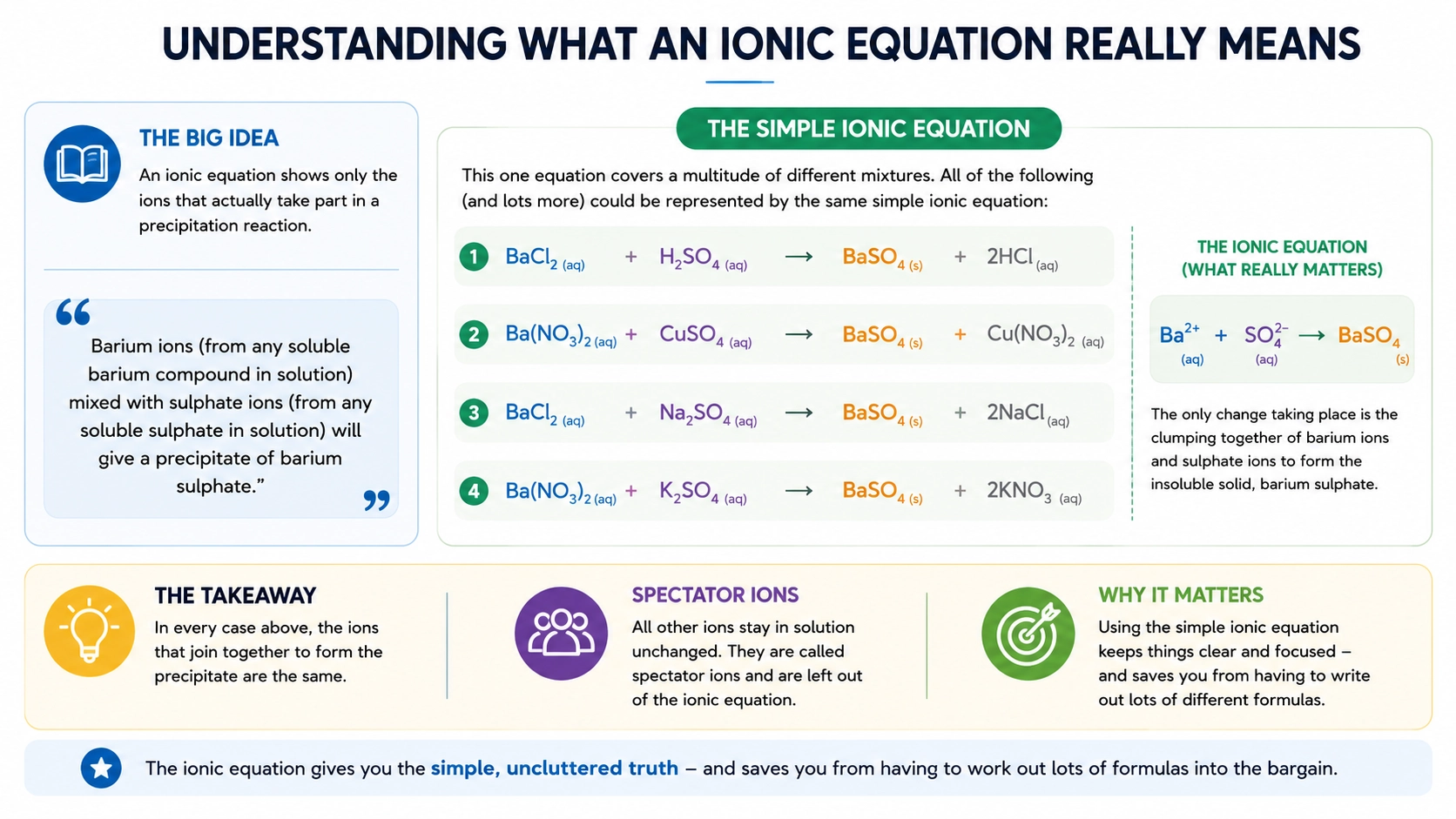
Ionic equations focus attention on the particles that react, rather than every ion present in the solution.
Ions in Aqueous Solution
When a soluble ionic compound dissolves in water, its ions separate and move around in solution. For example, sodium chloride solution contains Na+(aq) ions and Cl–(aq) ions.
The state symbol (aq) means aqueous, which means dissolved in water. It is important because ionic equations often involve dissolved ions.
| State symbol | Meaning | Use in ionic equations |
|---|---|---|
| (s) | Solid | Used for precipitates and insoluble substances. |
| (l) | Liquid | Used for pure liquids, such as water. |
| (g) | Gas | Used when a gaseous product forms. |
| (aq) | Aqueous solution | Used for ions dissolved in water. |
Exam focus: state symbols should be included in ionic equations when requested, especially for precipitates and aqueous ions.
Spectator Ions
A spectator ion is an ion that is present in the reaction mixture but does not change during the reaction. It appears unchanged on both sides of the full ionic equation.
For example, in the reaction between sodium chloride solution and silver nitrate solution, sodium ions and nitrate ions remain dissolved in solution. They do not form the precipitate.
Spectator ion: an ion that is present during a reaction but is not chemically changed.
How to spot one: if the same ion appears with the same charge and state symbol on both sides of the equation, it can be cancelled.
Precipitation Reactions
A precipitation reaction occurs when two solutions are mixed and an insoluble solid forms. The solid product is called a precipitate.
Precipitation reactions are a common context for ionic equations because the useful equation often shows only the two ions that join together to form the insoluble solid.
Precipitate: an insoluble solid formed when two solutions react.
| Reaction mixture | Observation | Ionic change |
|---|---|---|
| Sodium chloride solution and silver nitrate solution | A white precipitate forms. | Ag+(aq) and Cl–(aq) form AgCl(s). |
| Barium chloride solution and sulfate ions | A white precipitate forms. | Ba2+(aq) and SO42-(aq) form BaSO4(s). |
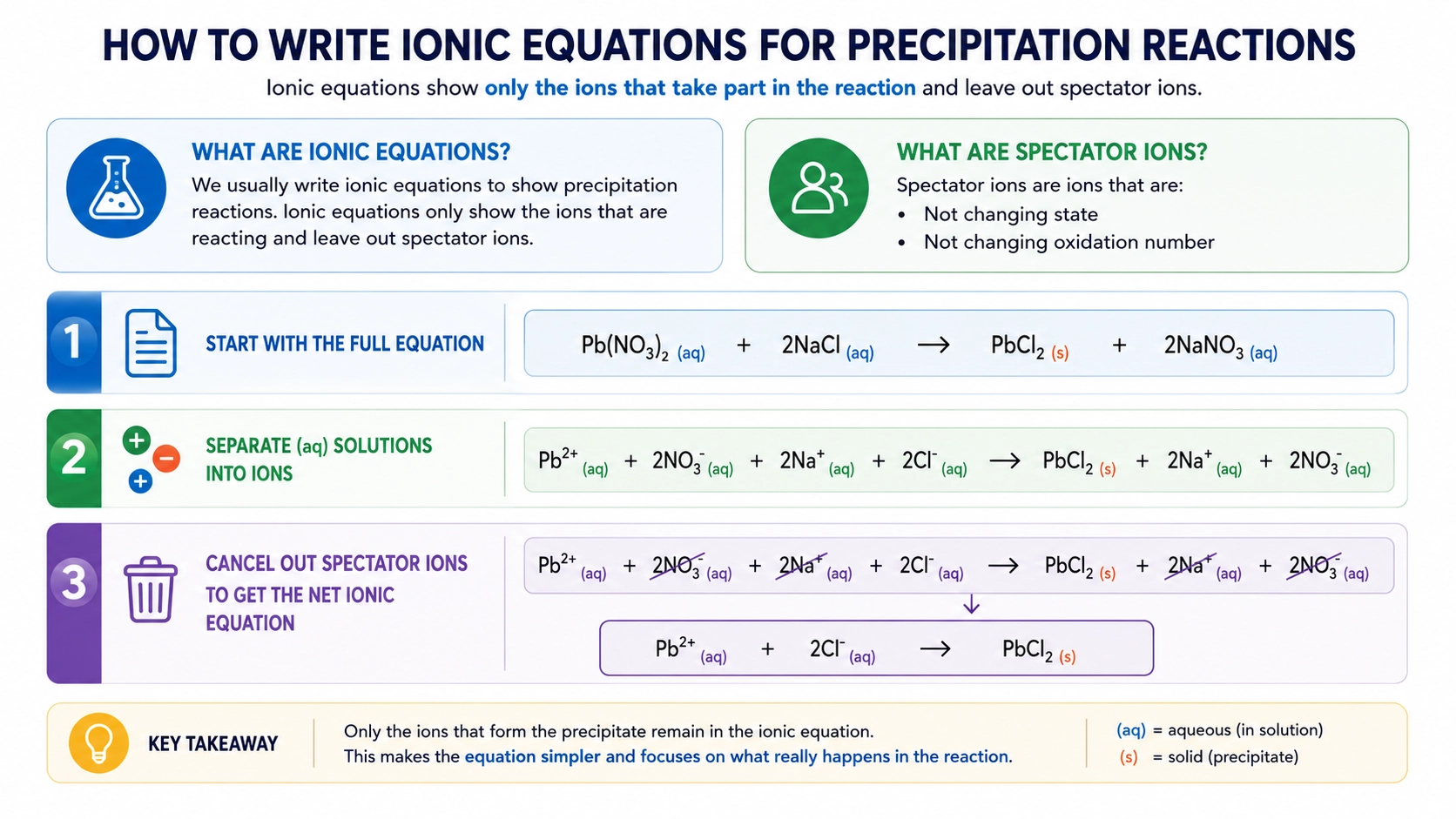
A precipitate forms when ions in solution are strongly attracted and produce an insoluble solid.
Example: Silver Chloride Precipitation
When sodium chloride solution is mixed with silver nitrate solution, a white precipitate of silver chloride forms.
Full equation: NaCl(aq) + AgNO3(aq) → AgCl(s) + NaNO3(aq)
In solution, the dissolved ionic compounds can be shown as ions:
Na+(aq) + Cl–(aq) + Ag+(aq) + NO3–(aq) → AgCl(s) + Na+(aq) + NO3–(aq)
The Na+ and NO3– ions are spectator ions. Once they are removed, the ionic equation is:
Ionic equation: Ag+(aq) + Cl–(aq) → AgCl(s)
How to Write Ionic Equations
Start with the balanced full equation, then separate aqueous ionic substances into ions. Substances with state symbols (s), (l) and (g) normally stay together.
- Write a correct balanced full equation.
- Split aqueous ionic substances into their ions.
- Keep solids, liquids, gases and covalent molecules together.
- Cancel spectator ions that appear unchanged on both sides.
- Check that atoms and charges are balanced.
| Substance type | What to do | Example |
|---|---|---|
| Aqueous ionic compound | Split into ions. | NaCl(aq) becomes Na+(aq) + Cl–(aq) |
| Solid precipitate | Keep as a formula. | AgCl(s) stays as AgCl(s) |
| Liquid water | Keep as a molecule. | H2O(l) stays as H2O(l) |
| Gas | Keep as a formula. | H2(g) stays as H2(g) |
Example: Barium Sulfate Precipitation
When barium chloride solution is added to a solution containing sulfate ions, a white precipitate of barium sulfate forms.
Full equation: BaCl2(aq) + MgSO4(aq) → BaSO4(s) + MgCl2(aq)
The ions that form the insoluble precipitate are Ba2+ and SO42-.
Ionic equation: Ba2+(aq) + SO42-(aq) → BaSO4(s)
This reaction is used as a chemical test for sulfate ions. The sample is usually acidified before barium chloride solution is added.
Ionic Equations Beyond Precipitation
Ionic equations are also useful for displacement reactions because they show the species that gain or lose electrons, or the ions that are displaced.
| Reaction type | Example full equation | Useful ionic equation |
|---|---|---|
| Metal displacement | Mg(s) + CuSO4(aq) → MgSO4(aq) + Cu(s) | Mg(s) + Cu2+(aq) → Mg2+(aq) + Cu(s) |
| Halogen displacement | Cl2(aq) + 2KBr(aq) → 2KCl(aq) + Br2(aq) | Cl2(aq) + 2Br–(aq) → 2Cl–(aq) + Br2(aq) |
Exam focus: spectator ions are not always sodium, potassium or nitrate ions, but these are very common because their compounds are usually soluble.
Common Exam Points
- Ionic equations show only the particles that actually change.
- Spectator ions appear unchanged on both sides of the equation and are cancelled.
- The state symbol (aq) means aqueous, which means dissolved in water.
- Precipitation reactions form an insoluble solid from ions in solution.
- For precipitation reactions, the precipitate is written as a solid with the state symbol (s).
- Do not split solids, liquids, gases or covalent molecules into ions.
- Always check that the final ionic equation is balanced for both atoms and charge.
- Ag+(aq) + Cl–(aq) → AgCl(s) is the ionic equation for forming silver chloride.
- Ba2+(aq) + SO42-(aq) → BaSO4(s) is the ionic equation for forming barium sulfate.
Check Your Understanding
Use this short activity to practise identifying the reacting ions and removing spectator ions from ionic equations.
Extension Questions
These are extension questions to practise applying ionic equations in different reaction contexts.
QuickSnap
This text summary condenses the page into the essential exam ideas.
- Ionic equations: show the particles that actually react.
- Spectator ions: ions that appear unchanged on both sides of the equation.
- Aqueous ions: ions in solution are shown using the state symbol (aq).
- Precipitation: two aqueous ions combine to form an insoluble solid.
- Silver chloride: Ag+(aq) + Cl–(aq) → AgCl(s).
- Barium sulfate: Ba2+(aq) + SO42-(aq) → BaSO4(s).
- Final check: atoms and overall charge must both balance.
Master Formulae, Equations and Amounts of Substance for Edexcel A Level Chemistry
Continue from these free revision notes into the full Topic 5 Formulae, Equations and Amounts of Substance course, with guided video teaching, diagnostic MCQ practice, teacher-marked short-answer questions and a specification assignment with a personalised progress report.
Guided video teaching
Learn formulae, balanced equations, ionic equations, relative masses, mole calculations, empirical formulae, reacting masses, gas volumes, percentage yield and atom economy through structured video lessons with worked examples and walkthroughs.
Instant MCQ feedback
Auto-marked MCQ quizzes provide immediate diagnostic feedback for every answer choice.
Teacher-marked SAQs
Submit written exam responses and receive chemistry specialist feedback with improvement guidance.
Progress tracking
Identify strengths and weaknesses across formulae, equations, mole calculations, concentration, empirical formulae, percentage yield, atom economy and test-tube reactions with targeted reporting.
See how the course works
Click play to start the course preview animation.
A compound contains carbon, hydrogen and oxygen only. Its percentage composition by mass is shown.
| Element | Percentage by mass |
|---|---|
| C | 40.0% |
| H | 6.7% |
| O | 53.3% |
What is the empirical formula of the compound?
Explain how the volume of hydrogen can be used to calculate the amount of magnesium that reacted.
FAQs
These questions address the most common misconceptions students have when learning ionic equations.
What is an ionic equation?
An ionic equation is an equation that shows the particles that actually take part in a reaction. Spectator ions are removed because they do not change.
What is a spectator ion?
A spectator ion is an ion that remains unchanged during a reaction. It appears on both sides of the full ionic equation with the same charge and state symbol.
Why do precipitates form?
A precipitate forms when ions in solution combine to make an insoluble solid. For example, Ag+(aq) and Cl–(aq) form AgCl(s).
Do I split every compound into ions?
No. Only aqueous ionic substances are split into ions. Solids, liquids, gases and covalent molecules are normally kept together.
How do I check my ionic equation is correct?
Check that the atoms balance and that the total charge on the left equals the total charge on the right. A chemically correct ionic equation must satisfy both checks.
Copyright notice: This OLS revision content, including the explanations, layout, diagrams, tables and embedded learning structure, is authored for Online Learning System by Dr. Mohammed Al-Fatah. It may not be copied, reproduced, redistributed or adapted without written permission.