Typical Reactions of Acids
A concise revision guide to the common reactions of acids, including acid-base neutralisation, acid-metal reactions, acid-carbonate reactions and the ionic equations that show the particles actually reacting.
- 5.6-b
- 5.15ii
What these spec points say
- 5.6-b be able to write balanced ionic equations, including state symbols, for chemical reactions
- 5.15ii be able to relate ionic and full equations, with state symbols, to observations from simple test tube reactions, to include: reactions of acids
GCSE Recap: Ions, Formulae and State Symbols
Before you start, check the GCSE ideas about ions, formulae and state symbols that this page builds on.
What Acids Do in Reactions
In aqueous solution, acids provide H+ ions. These hydrogen ions are responsible for the typical reactions of acids.
The common strong acids used in many school-level reactions are hydrochloric acid, HCl, sulfuric acid, H2SO4, and nitric acid, HNO3.
Acid reaction pattern: the acid supplies H+ ions, while the other reactant determines the type of product formed.
Key idea: acid reactions often look different as full equations, but their ionic equations can reveal the same underlying particle change.
Acids, Bases and Alkalis
A base neutralises an acid. Common bases include metal oxides, metal hydroxides and ammonia.
An alkali is a soluble base that releases OH– ions in aqueous solution. Common alkalis include sodium hydroxide, NaOH, potassium hydroxide, KOH, and aqueous ammonia, NH3.
| Term | Meaning | Examples |
|---|---|---|
| Base | A substance that neutralises an acid. | Metal oxides, metal hydroxides and ammonia. |
| Alkali | A soluble base that releases OH– ions in water. | NaOH, KOH and aqueous NH3. |
| Salt | A compound formed when the H+ ion of an acid is replaced by a metal ion or ammonium ion. | NaCl, MgSO4 and NH4Cl. |
Neutralisation Reactions Form Salts
Neutralisation is the reaction between an acid and a base. The acid is neutralised because the H+ ions are removed by reacting with basic particles such as OH– ions.
When an acid reacts with a metal hydroxide, the products are usually a salt and water.
General equation: acid + metal hydroxide → salt + water
Example: HCl(aq) + NaOH(aq) → NaCl(aq) + H2O(l)
The ionic equation for neutralisation is the same for many acid-alkali reactions because H+ ions react with OH– ions to form water.
Ionic equation: H+(aq) + OH–(aq) → H2O(l)
Quick Check: Which Substances Are Bases?
Click every substance that is a base.
Acids Reacting with Metals
Reactive metals such as magnesium react with dilute acids to form a salt and hydrogen gas. The hydrogen gas is observed as fizzing or effervescence.
General equation: acid + metal → salt + hydrogen
| Reaction | Full equation | Main observation |
|---|---|---|
| Magnesium with hydrochloric acid | Mg(s) + 2HCl(aq) → MgCl2(aq) + H2(g) | Fizzing as hydrogen gas forms. |
| Magnesium with sulfuric acid | Mg(s) + H2SO4(aq) → MgSO4(aq) + H2(g) | The metal disappears if the acid is in excess. |
The ionic equation is the same in both cases because chloride ions and sulfate ions are spectator ions. They do not change during the reaction.
Ionic equation: Mg(s) + 2H+(aq) → Mg2+(aq) + H2(g)
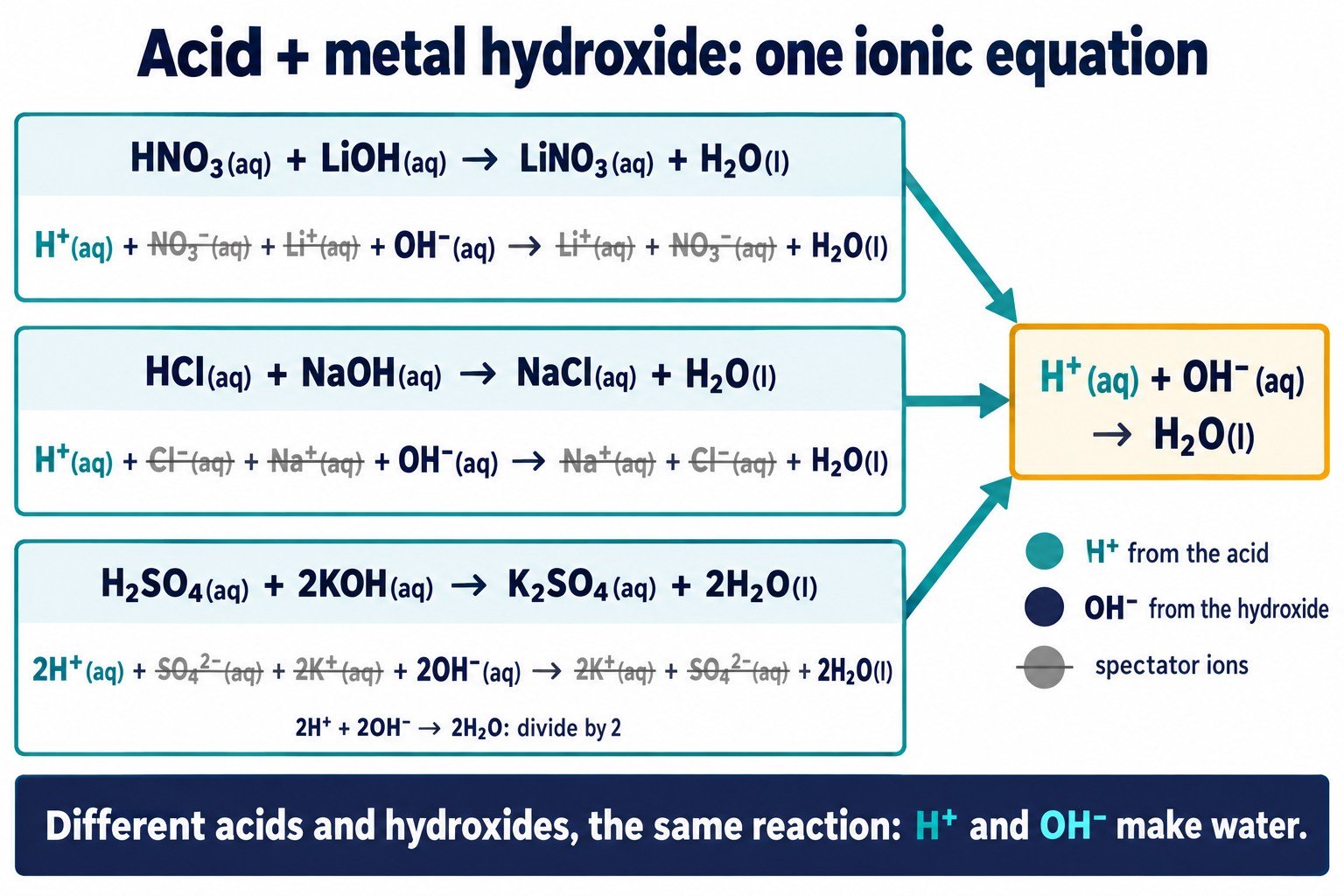
Different full equations can simplify to the same ionic equation when the spectator ions are removed.
Acids Reacting with Metal Carbonates
Metal carbonates react with dilute acids to form a salt, carbon dioxide and water. The carbon dioxide gas causes fizzing.
General equation: acid + metal carbonate → salt + carbon dioxide + water
| Reaction | Full equation |
|---|---|
| Calcium carbonate with hydrochloric acid | CaCO3(s) + 2HCl(aq) → CaCl2(aq) + CO2(g) + H2O(l) |
| Magnesium carbonate with nitric acid | MgCO3(s) + 2HNO3(aq) → Mg(NO3)2(aq) + CO2(g) + H2O(l) |
| Sodium carbonate with sulfuric acid | Na2CO3(aq) + H2SO4(aq) → Na2SO4(aq) + CO2(g) + H2O(l) |
For many acid-carbonate reactions, the useful ionic equation is:
Ionic equation: CO32-(aq) + 2H+(aq) → CO2(g) + H2O(l)
A solid carbonate is not split into ions: CaCO3(s) + 2H+(aq) → Ca2+(aq) + CO2(g) + H2O(l)
Quick Check: Acids with Metals and Carbonates
Answer each question about acids reacting with metals and carbonates.
Choosing the Correct Salt Formula
The name of the salt depends on the acid used and the positive ion supplied by the base, metal or carbonate.
| Acid used | Salt type formed | Example salt |
|---|---|---|
| Hydrochloric acid, HCl | Chloride | MgCl2 |
| Sulfuric acid, H2SO4 | Sulfate | MgSO4 |
| Nitric acid, HNO3 | Nitrate | Mg(NO3)2 |
Exam focus: do not just memorise the word equation. Use the ions present to write a correct salt formula, then balance the full equation.
Quick Check: Name That Salt
Choose the salt that forms in each reaction.
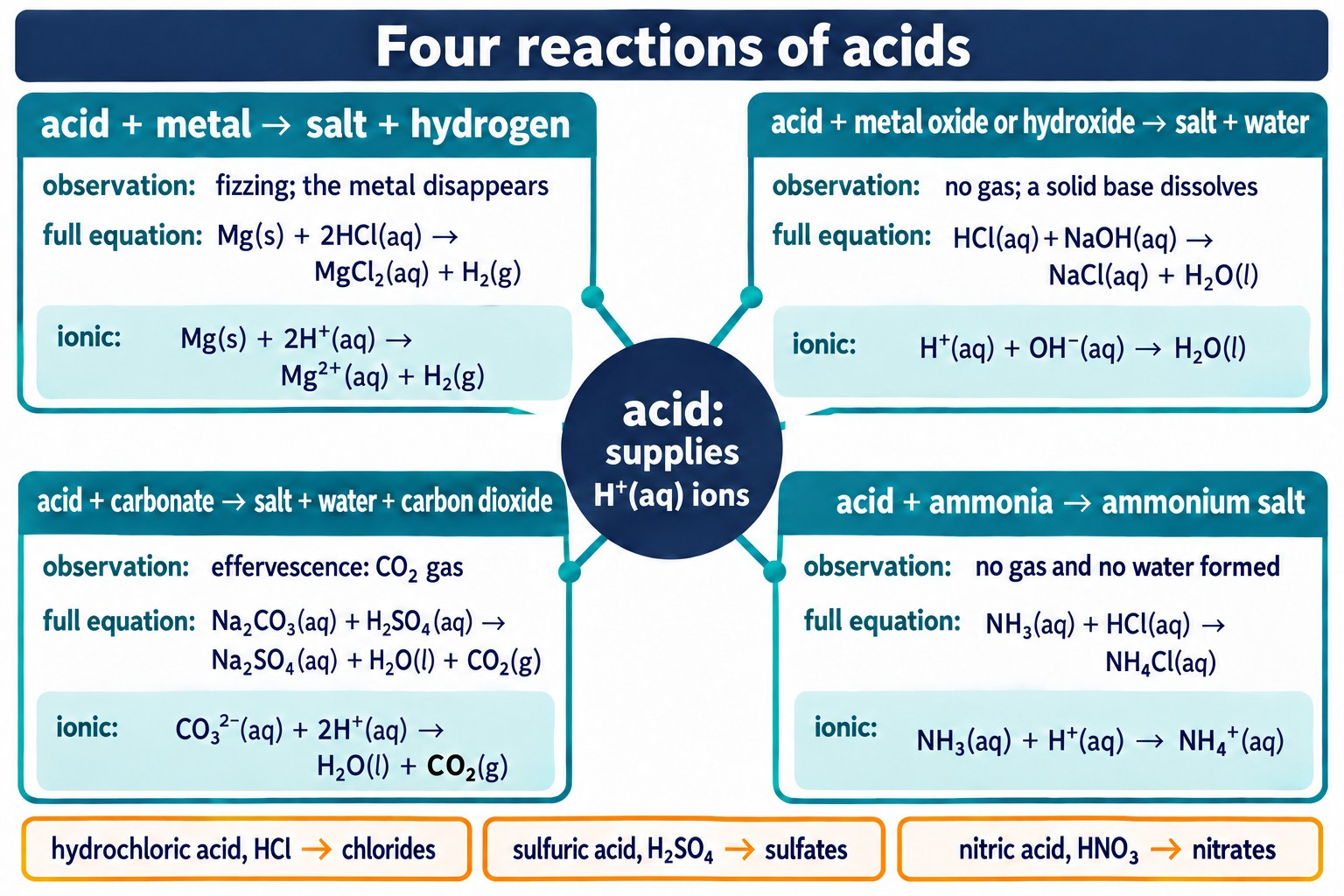
Use the acid to identify the negative ion in the salt, then use the reacting metal, base or carbonate to identify the positive ion.
How to Write Ionic Equations for Acid Reactions
To write an ionic equation, show aqueous ionic substances as their ions, then remove any ions that appear unchanged on both sides. These unchanged ions are called spectator ions.
- Start from a correct balanced full equation.
- Split aqueous acids, soluble salts and soluble alkalis into ions.
- Keep solids, liquids, gases and covalent substances together.
- Cancel spectator ions that are unchanged on both sides.
- Check that atoms and charges are balanced.
Spectator ion: an ion present in the reaction mixture that does not change during the chemical reaction.
Useful summary: acid-metal reactions often reduce to metal + H+ ions, while acid-carbonate reactions often reduce to carbonate ions + H+ ions.
Quick Check: Spot the Spectator Ions
Choose the one accurate statement about the spectator ions in each round.
Quick Check: Ionic Equations for Acid Reactions
Write each ionic equation on paper, then flip the card to check.
Common Exam Points
- A salt forms when the H+ ion of an acid is replaced by a metal ion or ammonium ion.
- Bases neutralise acids. Alkalis are soluble bases that release OH– ions in water.
- Acid + metal produces a salt and hydrogen gas.
- Acid + metal carbonate produces a salt, carbon dioxide and water.
- Acid + metal hydroxide produces a salt and water.
- Hydrochloric acid forms chlorides, sulfuric acid forms sulfates and nitric acid forms nitrates.
- Fizzing in acid-metal reactions is usually hydrogen gas.
- Fizzing in acid-carbonate reactions is carbon dioxide gas.
- When writing ionic equations, remove spectator ions that appear unchanged on both sides.
- Always check both atom balance and charge balance in an ionic equation.
QuickSnap
This text summary condenses the page into the essential exam ideas.
- Acids supply H+ ions: these ions drive typical acid reactions in aqueous solution.
- Neutralisation: H+(aq) reacts with OH–(aq) to form H2O(l).
- Metals: acid + metal → salt + hydrogen.
- Carbonates: acid + carbonate → salt + carbon dioxide + water.
- Salt names: HCl forms chlorides, H2SO4 forms sulfates and HNO3 forms nitrates.
- Ionic equations: split aqueous ionic substances into ions, then cancel spectator ions.
FAQs
These questions address the most common mistakes students make when learning typical reactions of acids.
What is formed when an acid reacts with a metal?
An acid reacts with a suitable metal to form a salt and hydrogen gas. For example, magnesium reacts with hydrochloric acid to form magnesium chloride and hydrogen.
What is formed when an acid reacts with a metal carbonate?
An acid reacts with a metal carbonate to form a salt, carbon dioxide and water. The carbon dioxide causes fizzing and can be tested using limewater.
What is the difference between a base and an alkali?
A base neutralises an acid. An alkali is a soluble base that releases OH– ions in aqueous solution.
How do I know whether a salt is a chloride, sulfate or nitrate?
The acid used determines the negative ion in the salt. Hydrochloric acid forms chlorides, sulfuric acid forms sulfates and nitric acid forms nitrates.
Why do different acid reactions sometimes have the same ionic equation?
Different full equations can contain spectator ions. When these unchanged ions are removed, the net ionic equation may be the same because the same reacting particles are involved.
Copyright notice: This OLS revision content, including the explanations, layout, diagrams, tables and embedded learning structure, is authored for Online Learning System by Dr. Mohammed Al-Fatah. It may not be copied, reproduced, redistributed or adapted without written permission.
Keep this note — free
Save your progress across every Edexcel topic. A free account remembers which topics you have covered, saves your question scores, and syncs across your phone and laptop.
- Track every topic you have finished
- Keep your practice-question scores
- No payment, no card, free forever
Already registered? Log in