Writing Chemical Equations
A concise revision guide to writing and balancing chemical equations, including the difference between small subscript numbers in formulae and large coefficient numbers placed in front of formulae.
- 5.6-a
What these spec points say
- 5.6-a be able to write balanced full equations, including state symbols, for chemical reactions
Balancing Equations: Atoms Are Conserved
Choose a step to follow every atom as methane burns, count the atoms on each side of the arrow, balance the equation, then check that mass is conserved.
© Dr. Mohammed Al-Fatah – onlinelearningsystem.net
GCSE Recap: Conservation of Mass
Before you start, check what you remember from GCSE about conservation of mass and diatomic elements.
What a Chemical Equation Shows
A chemical equation represents a chemical reaction using formulae and symbols. The substances that react are written on the left-hand side, and the substances formed are written on the right-hand side.
The arrow means reacts to form. For example, when hydrogen reacts with oxygen, water is made:
Example: 2H2 + O2 → 2H2O
When writing equations, the aim is to show the correct substances and the correct number of each type of atom on both sides.
Key idea: atoms are rearranged during a chemical reaction. They are not created or destroyed.
What Small Subscript Numbers Mean
The small subscript number inside a formula tells you how many atoms of the element immediately before it are present in one formula unit or molecule.
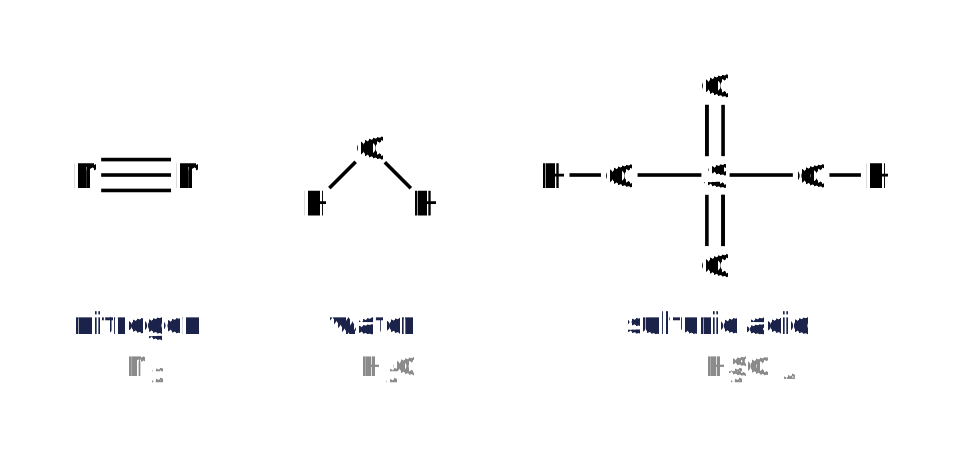
For example, in H2SO4, the 2 applies only to hydrogen and the 4 applies only to oxygen. There is no small number after sulfur, so there is one sulfur atom.
| Formula | Atom count | Meaning |
|---|---|---|
| H2SO4 | 2 H, 1 S, 4 O | The 2 applies to H only, and the 4 applies to O only. |
| CH4 | 1 C, 4 H | The 4 applies to hydrogen only. |
| Ca(OH)2 | 1 Ca, 2 O, 2 H | The 2 outside the brackets applies to everything inside the brackets. |
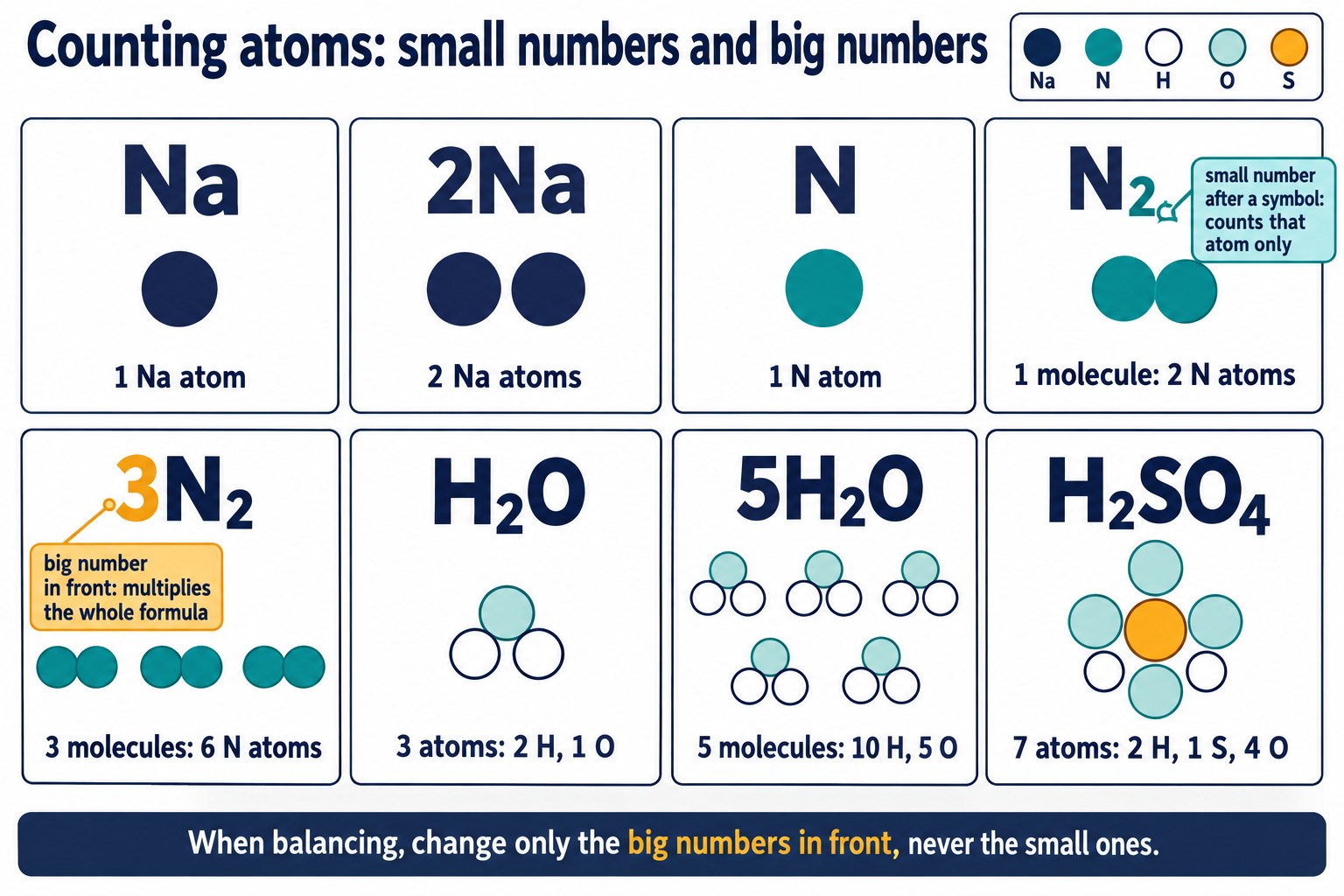
Use the position of each number carefully. A small number inside a formula applies only to the atom or bracketed group immediately before it.
What Big Numbers in Front Mean
A large number placed in front of a formula is called a coefficient. It multiplies the whole formula.
For example, 5CH4 means five molecules of CH4. Each CH4 contains one carbon atom and four hydrogen atoms, so 5CH4 contains 5 carbon atoms and 20 hydrogen atoms.
2H2O
Two water molecules. Total atoms: 4 H and 2 O.
3CO2
Three carbon dioxide molecules. Total atoms: 3 C and 6 O.
4Al2O3
Four formula units of aluminium oxide. Total atoms: 8 Al and 12 O.
Important rule: you may change coefficients when balancing an equation, but you must not alter the small subscript numbers inside a correct formula.
Quick Check: Counting Atoms in Formulae
Count the atoms in each formula on paper, then type the number.
Why Equations Must Be Balanced
A balanced equation has the same number of each type of atom on both sides. This follows the conservation of mass: atoms are not lost, gained or changed into different atoms during ordinary chemical reactions.
Balancing an equation means adjusting the coefficients in front of formulae until the atom counts match on the left-hand side and right-hand side.
Balanced equation: an equation in which the number of atoms of each element is the same on both sides of the reaction arrow.
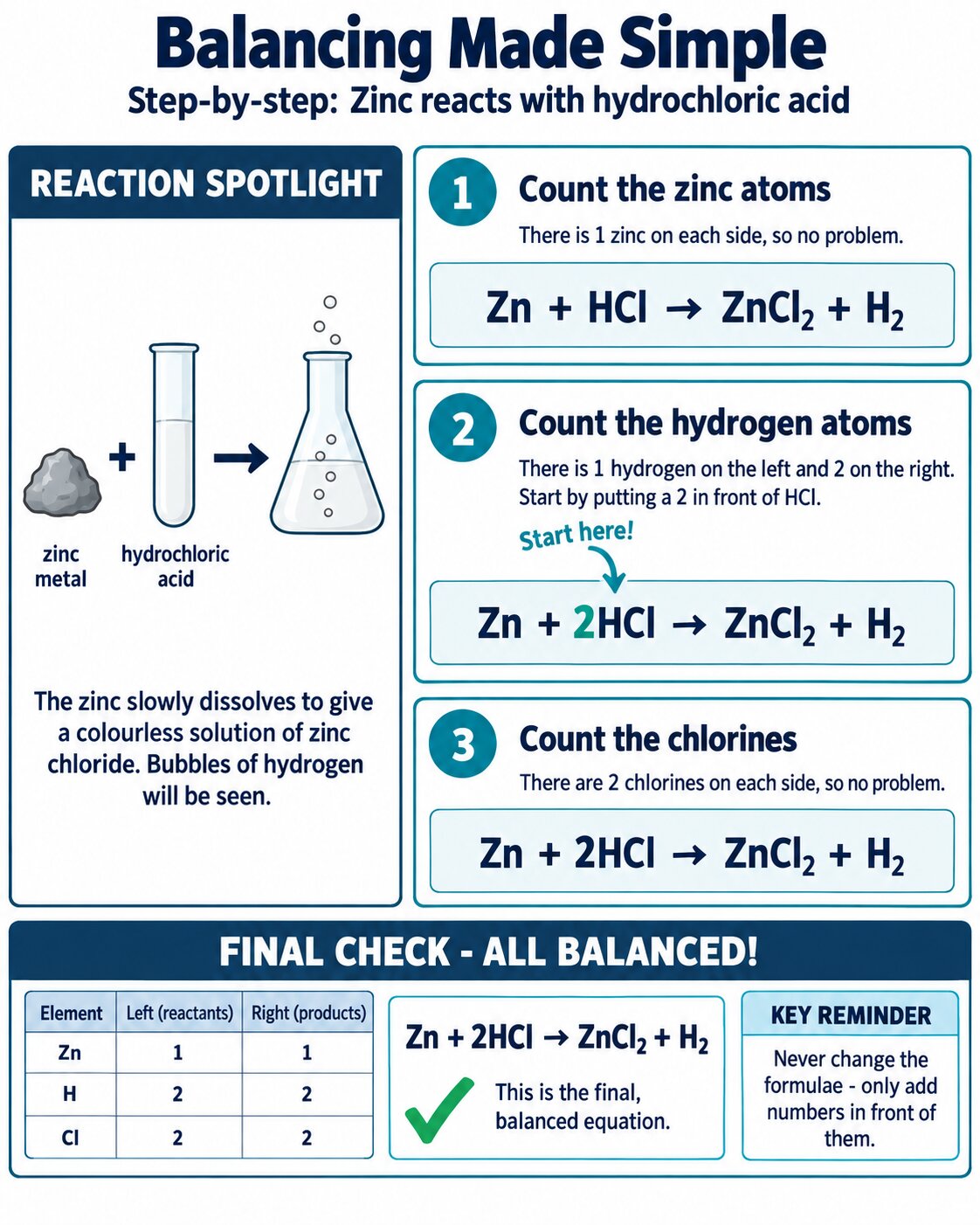
Balancing chemical equations made easy using coefficients and atom counts
Balancing is a counting process. The formulae stay fixed, while the numbers in front are adjusted to make the atom counts equal.
Quick Check: Which Change Is Allowed?
Choose the one correct balanced equation.
A Systematic Method for Balancing
Balance equations methodically. Work across the equation and check one element at a time. If an element appears in several places, leave it until later because changing one coefficient may affect more than one atom count.
- Write the correct formulae for the reactants and products.
- Count the atoms of each element on both sides.
- Add coefficients in front of formulae to balance one element at a time.
- Keep bracketed groups together if the group is unchanged on both sides.
- Check every atom count again at the end.
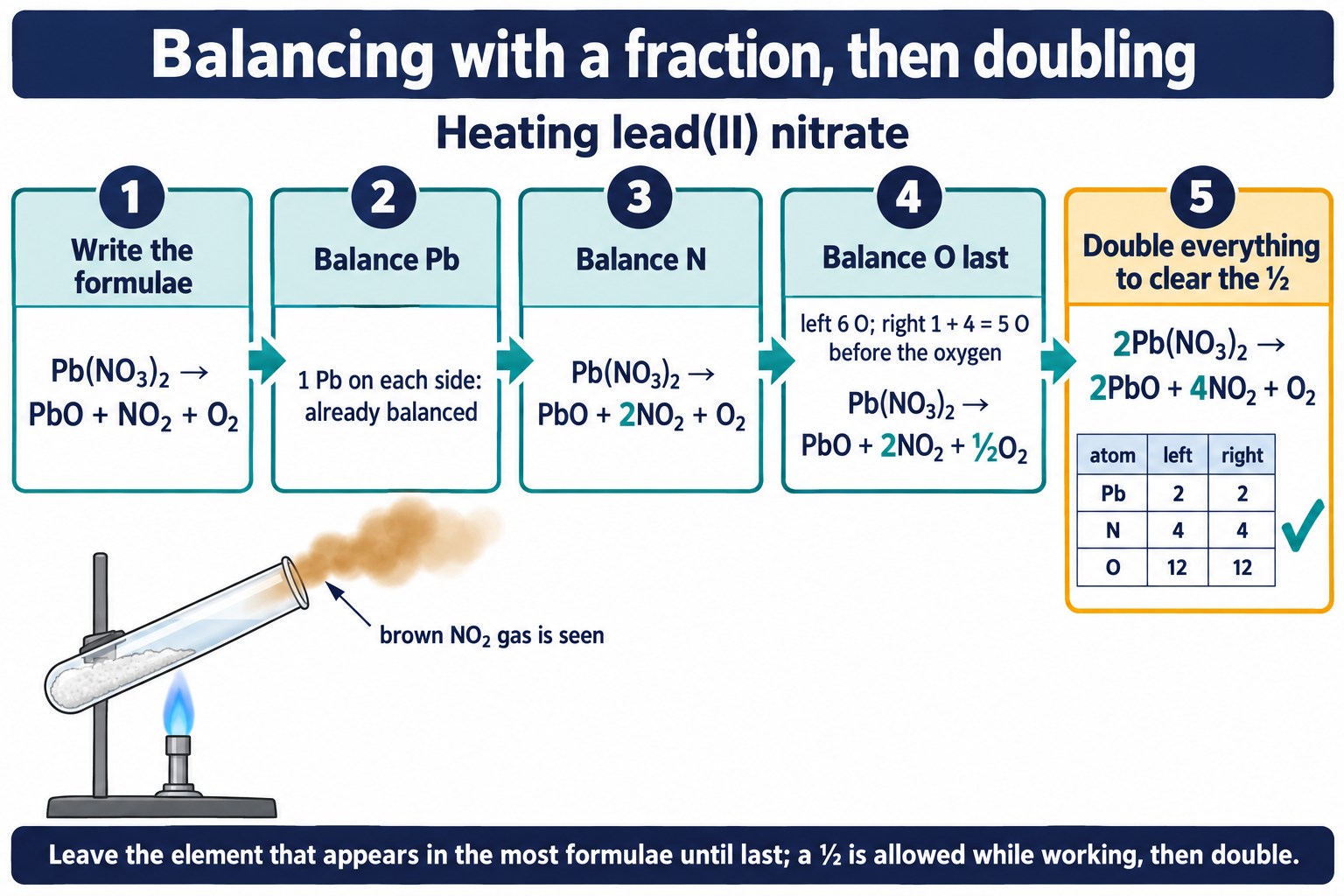
A systematic approach reduces errors, especially when several elements or bracketed groups are present.
Quick Check: Balanced or Not?
Click every equation that is already balanced.
Worked Example: Balancing an Equation
Consider the reaction between magnesium and oxygen:
Unbalanced: Mg + O2 → MgO
There are two oxygen atoms on the left because oxygen exists as O2. There is only one oxygen atom in MgO on the right. Place a 2 in front of MgO:
Step: Mg + O2 → 2MgO
This now gives two magnesium atoms on the right, so place a 2 in front of Mg:
Balanced: 2Mg + O2 → 2MgO
Check: left side = 2 Mg and 2 O. Right side = 2 Mg and 2 O. The equation is balanced.
Quick Check: Type the Coefficients
Type the smallest whole-number coefficients that balance each equation.
Using Bracketed Groups Efficiently
If a group of atoms remains unchanged on both sides of an equation, it is often quicker to count the whole group rather than each individual atom inside it.
For example, if the sulfate group, SO42-, appears unchanged on both sides, count sulfate groups first. This saves time and reduces the chance of losing track of sulfur and oxygen atoms separately.
Exam focus: bracketed groups are useful when the same group appears unchanged on both sides. If the group changes, count the individual atoms instead.
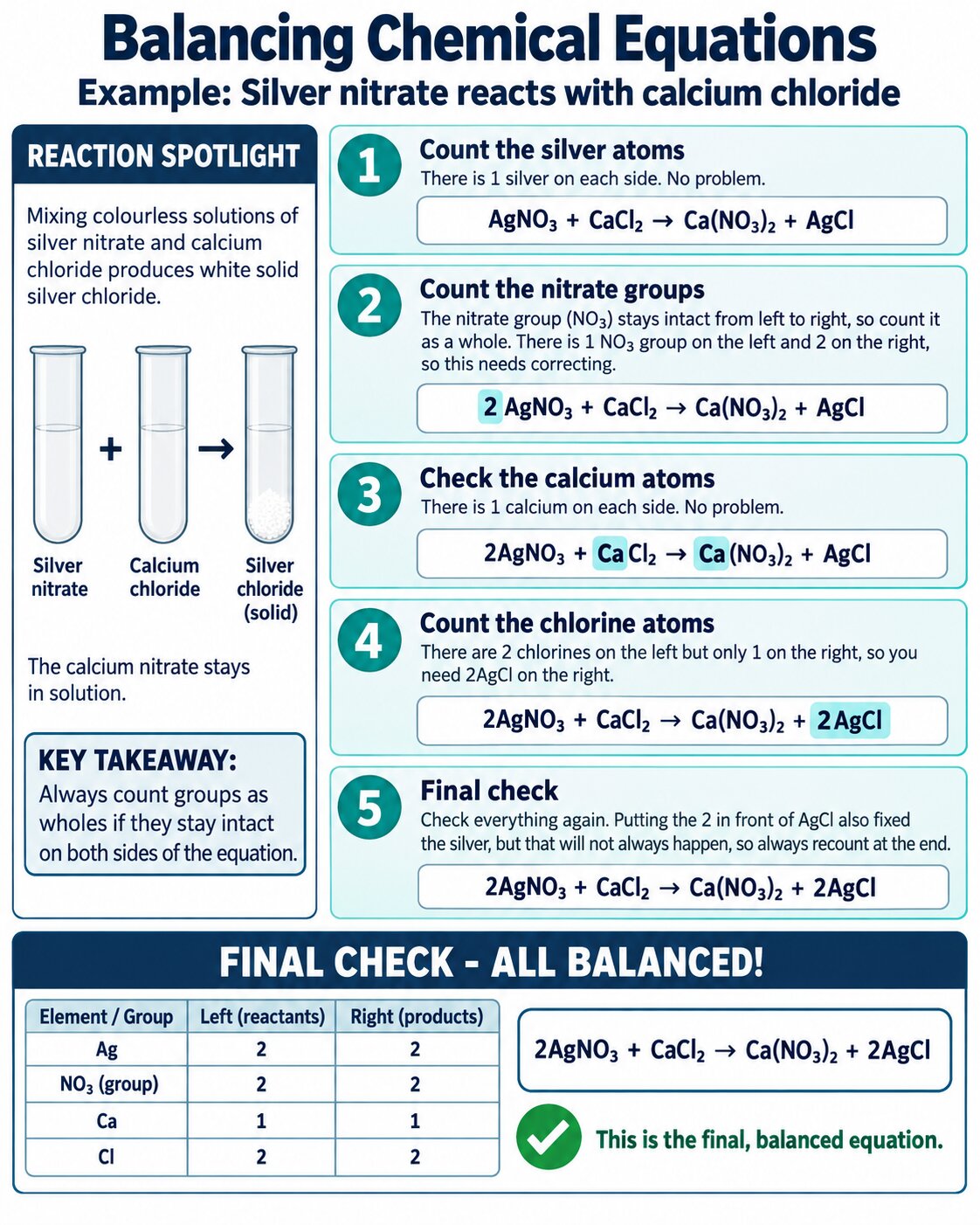
Balancing chemical equations guide showing atom counting and unchanged groups
Keep unchanged polyatomic groups together while balancing, then complete a final atom-by-atom check.
Quick Check: From Word Equation to Balanced Equation
Write each balanced symbol equation on paper, then flip the card to check.
Quick Check: Writing Equations Round-Up
Pick the one fully correct statement in each round to pull the whole page together.
Common Exam Points
- Small subscript numbers are part of the formula and must not be changed when balancing.
- A coefficient in front of a formula multiplies the whole formula.
- If there is no small subscript number after a symbol, there is one atom of that element in the formula.
- Brackets multiply everything inside them. For example, Ca(OH)2 contains two oxygen atoms and two hydrogen atoms.
- Only coefficients are changed during balancing.
- Balance one element at a time, then check the whole equation again at the end.
- Leave elements that appear in several formulae until later where possible.
- Count unchanged groups, such as sulfate or nitrate, as whole groups when this is quicker.
- A balanced equation must have the same number of each type of atom on both sides.
QuickSnap
This text summary condenses the page into the essential exam ideas.
- Subscripts: small numbers inside a formula show how many atoms of the element immediately before them are present.
- Coefficients: big numbers in front of formulae multiply the whole formula.
- Do not alter formulae: never change a small subscript to balance an equation.
- Balance with coefficients: write numbers in front of formulae until the atoms match on both sides.
- Bracketed groups: a number outside brackets multiplies everything inside the brackets.
- Final check: recount every element at the end to make sure no earlier balance has been disrupted.
FAQs
These questions address the most common mistakes students make when writing and balancing equations.
Can I change a small subscript number when balancing an equation?
No. A small subscript number is part of the chemical formula. Changing it would change the substance. Balance equations by changing only the numbers in front of formulae.
What does a number in front of a formula mean?
A coefficient multiplies the whole formula. For example, 3H2O contains six hydrogen atoms and three oxygen atoms.
Why does an equation need to be balanced?
An equation must be balanced because atoms are conserved in a chemical reaction. The same number of each type of atom must appear on both sides of the reaction arrow.
When should I count a group of atoms as a whole group?
You can count a group such as sulfate, SO4, or nitrate, NO3, as a whole group if it appears unchanged on both sides of the equation.
What should I do if an element appears in several formulae?
Leave it until later where possible. Balance simpler elements or unchanged groups first, then return to the element that appears in several places.
Copyright notice: This OLS revision content, including the explanations, layout, diagrams, tables and embedded learning structure, is authored for Online Learning System by Dr. Mohammed Al-Fatah. It may not be copied, reproduced, redistributed or adapted without written permission.
Keep this note — free
Save your progress across every Edexcel topic. A free account remembers which topics you have covered, saves your question scores, and syncs across your phone and laptop.
- Track every topic you have finished
- Keep your practice-question scores
- No payment, no card, free forever
Already registered? Log in