Calculations Using Reacting Masses
A focused revision guide to using balanced equations, mole ratios and molar masses to calculate the mass of a reactant or product in a chemical reaction.
- 5.7-a
- 5.7-e
- 5.7-f
- 5.8
What these spec points say
- 5.7-a be able to calculate amounts of substance in reactions involving mass
- 5.7-e know these calculations may involve reactants
- 5.7-f know these calculations may involve products
- 5.8 be able to calculate reacting masses from chemical equations, and vice versa, using the concepts of amount of substance and molar mass
GCSE Recap: Balanced Equations and Conservation of Mass
Before you start, check that you can balance an equation and use conservation of mass.
Why Equations Can Be Used for Mass Calculations
A balanced chemical equation tells you the mole ratio between reactants and products. Once you know how many moles of one substance are involved, the equation lets you work out how many moles of another substance react or form.
Reacting mass calculations connect three ideas: mass, amount in moles and the balanced equation.
Reacting mass calculation: a calculation that uses a balanced equation to find the mass of a reactant used or a product formed.
Key idea: the balancing numbers in the equation are mole ratios, not mass ratios.
Quick Check: What the Balancing Numbers Mean
Decide whether the statement about this equation is true or false.
The Core Formula
The most important formula for reacting mass calculations links mass, amount and molar mass.
mass = amount in mol × Mr
You usually use the first form when converting the given mass into moles, and the second form when converting the final amount in moles back into a mass.
| Quantity | Meaning | Typical unit |
|---|---|---|
| mass | The mass of the substance in the question | g, kg or tonnes |
| amount | The number of moles of particles | mol |
| Mr | Relative formula mass or relative molecular mass | g mol-1 when used as molar mass |
The Standard Method
Most reacting mass questions can be solved using the same sequence. The method is especially reliable because it keeps the mole ratio separate from the mass calculation.
Step 1: Write or check the balanced equation
The coefficients in the equation give the mole ratio between substances.
Step 2: Convert the given mass into moles
Use amount = mass ÷ Mr.
Step 3: Use the mole ratio
Use the balanced equation to convert from moles of the known substance to moles of the required substance.
Step 4: Convert moles into the required mass
Use mass = amount × Mr.
Quick Check: Order the Standard Method
Drag the steps of this reacting mass calculation into the right order.
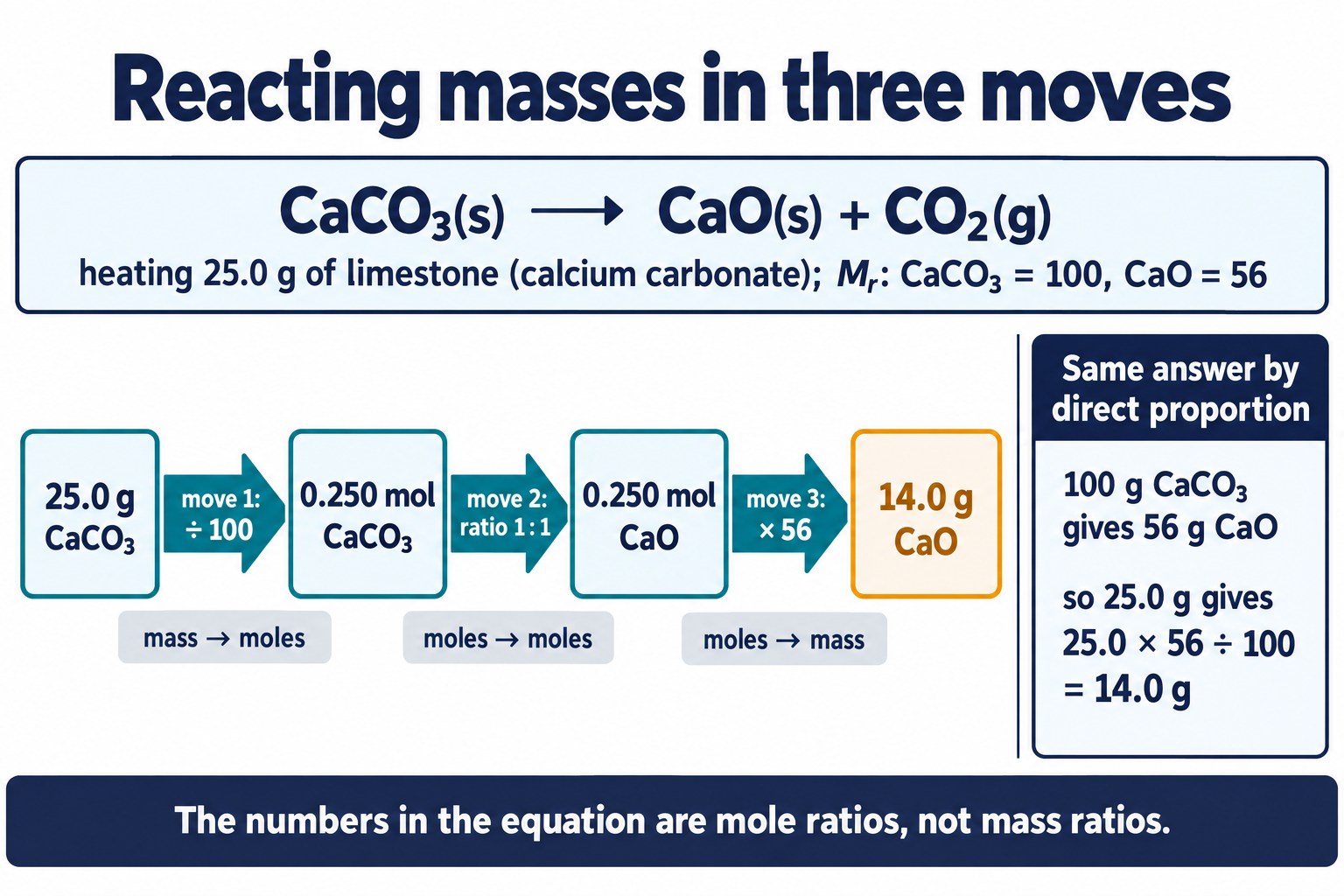
The calculation pathway is mass → moles → equation ratio → moles → mass.
Worked Example: Sodium Hydrogencarbonate
Calculate the mass of carbon dioxide produced when 5.50 g of sodium hydrogencarbonate is heated.
Step 1: Find moles of NaHCO3
Mr of NaHCO3 = 84
amount = 5.50 ÷ 84 = 0.0655 mol
Step 2: Use the equation ratio
2 mol NaHCO3 gives 1 mol CO2
0.0655 mol NaHCO3 gives 0.0328 mol CO2
Step 3: Find the mass of CO2
Mr of CO2 = 44.0
mass = 0.0328 × 44.0 = 1.44 g
Exam focus: the mass of CO2 is not found by directly comparing 84 and 44. The equation shows that 2 mol NaHCO3 forms only 1 mol CO2.
Quick Check: Reacting Masses in Grams
Work each calculation out on paper before you turn the card.
Using Direct Proportion
Some reacting mass questions can be solved by treating one formula unit or one mole ratio as a direct proportion. This is useful when the units are large, such as kilograms or tonnes.
For example, in a blast furnace, haematite is reduced to iron:
From the equation, 1 mol Fe2O3 gives 2 mol Fe. Using Ar values Fe = 56 and O = 16:
160 tonnes Fe2O3 gives 112 tonnes Fe
16 tonnes Fe2O3 gives 11.2 tonnes Fe
Key idea: if the same mass unit is used throughout, the ratio still works. Do not mix grams and tonnes in the same line unless you deliberately convert units.
Quick Check: Tonnes and Kilograms
Use direct proportion and type each answer to 3 significant figures.
Multi-Step Equation Chains
Sometimes the product of one equation is used as the reactant in the next equation. The safest approach is to follow the mole ratio through each equation before converting back to mass.
For example, nitrogen can be converted through several steps to nitric acid:
4NH3 + 5O2 → 4NO + 6H2O
2NO + O2 → 2NO2
2H2O + 4NO2 + O2 → 4HNO3
Tracing the ratios shows that 1 mol N2 eventually gives 2 mol HNO3. Since Mr of N2 = 28 and Mr of HNO3 = 63:
1 tonne N2 gives (2 × 63) ÷ 28 = 4.5 tonnes HNO3
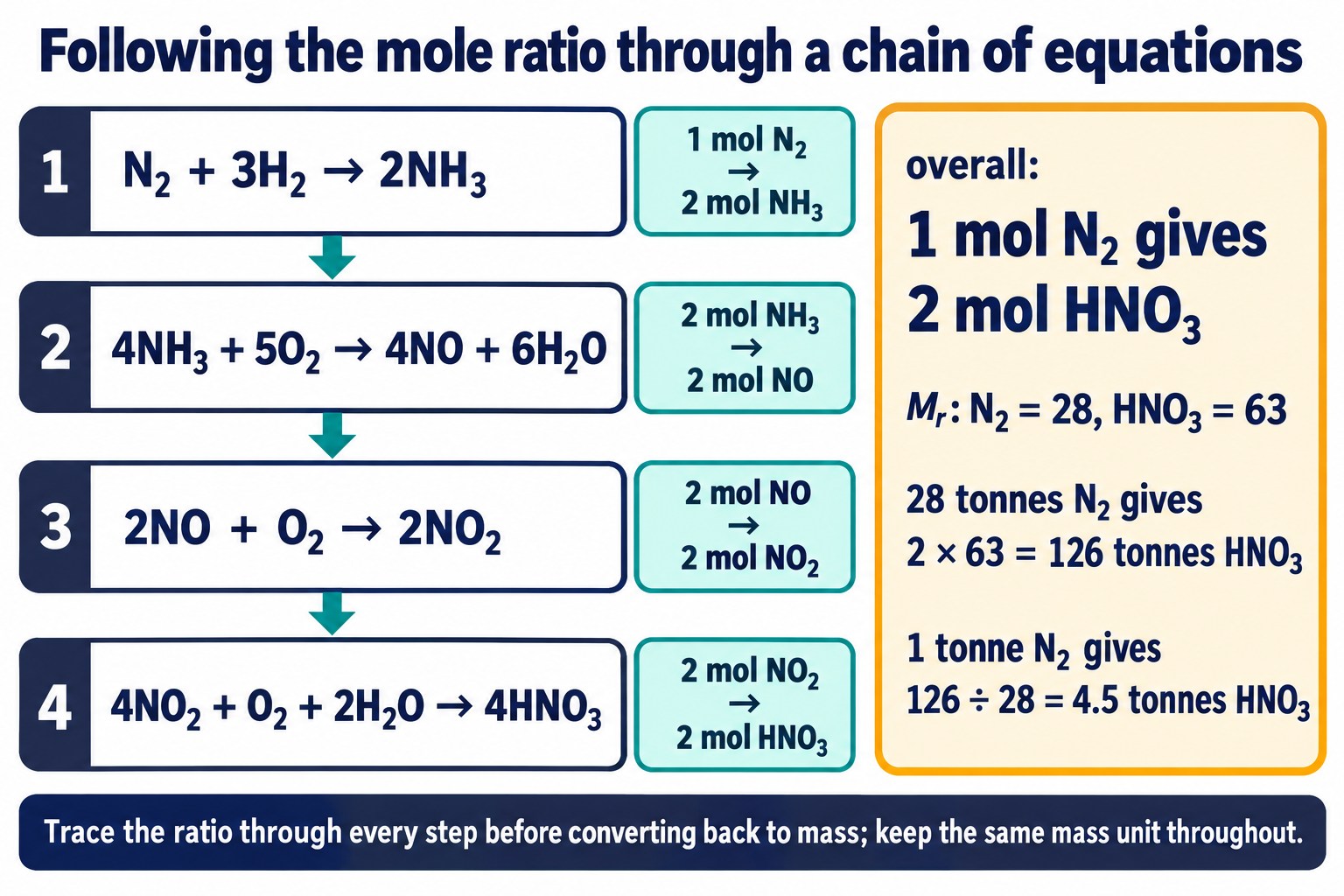
Follow the moles through every equation: 1 mol of N₂ ends up as 2 mol of HNO₃, so 1 tonne of N₂ gives 4.5 tonnes of nitric acid.
Quick Check: Follow the Chain
Trace the mole ratio through all three equations before you calculate a mass.
Units and Significant Figures
Reacting mass calculations often lose marks through unit errors rather than chemistry errors. Keep the unit consistent and present the final answer to a sensible number of significant figures.
| Issue | What to do | Example |
|---|---|---|
| Mixed units | Convert before calculating, or keep the same unit throughout a proportion. | Use all grams, all kilograms or all tonnes. |
| Premature rounding | Keep extra figures in intermediate steps. | Use 0.03275 mol before rounding the final answer. |
| Missing equation ratio | Always use the coefficients from the balanced equation. | 2NaHCO3 : 1CO2, not 1 : 1. |
Quick Check: Sound Working
In each round, choose the statement that shows sound working.
Common Exam Points
- The balancing numbers in an equation represent a mole ratio.
- Do not compare masses directly unless you have first converted through moles or built a valid proportion.
- Use amount = mass ÷ Mr to find moles from mass.
- Use mass = amount × Mr to convert moles back into mass.
- Use the balanced equation to move between the known substance and the required substance.
- Check whether the question asks for a reactant mass or a product mass.
- Keep units consistent, especially when questions use kg or tonnes.
- Show enough working so the mole ratio and formula mass steps are visible.
QuickSnap
This text summary condenses the page into the essential exam ideas.
- Balanced equations: show mole ratios between reactants and products.
- First conversion: use amount = mass ÷ Mr.
- Equation step: use the coefficients to convert from one substance to another.
- Final conversion: use mass = amount × Mr.
- Direct proportion: works when the equation ratio and units are handled consistently.
- Common mistake: treating the equation numbers as mass ratios instead of mole ratios.
FAQs
These questions address the most common points students confuse when calculating reacting masses.
What is a reacting mass calculation?
It is a calculation that uses a balanced chemical equation to work out the mass of a reactant used or a product formed.
Why do I need the balanced equation?
The balanced equation gives the mole ratio between substances. Without this ratio, the calculation may use the wrong number of moles.
Can I compare masses directly?
Not usually. The equation gives mole ratios, so you should convert through moles unless you have built a valid direct proportion from molar masses.
Does the method work with tonnes?
Yes. The same ratio works with grams, kilograms or tonnes as long as the unit is used consistently throughout the proportion.
What is the most common mistake?
The most common mistake is forgetting to use the coefficient ratio from the balanced equation, such as treating 2NaHCO3 → CO2 as a 1 : 1 mole relationship.
Copyright notice: This OLS revision content, including the explanations, layout, diagrams, tables and embedded learning structure, is authored for Online Learning System by Dr. Mohammed Al-Fatah. It may not be copied, reproduced, redistributed or adapted without written permission.
Keep this note — free
Save your progress across every Edexcel topic. A free account remembers which topics you have covered, saves your question scores, and syncs across your phone and laptop.
- Track every topic you have finished
- Keep your practice-question scores
- No payment, no card, free forever
Already registered? Log in