Measurement Uncertainty and Errors
A concise revision guide to measurement uncertainty in volumetric analysis: the uncertainty of each piece of apparatus, percentage uncertainty of a reading and of a titre, combining uncertainties, and how to reduce them.
- 5.12i
- 5.13
What these spec points say
- 5.12i be able to: calculate measurement uncertainties and measurement errors in experimental results
- 5.13 understand how to minimise the percentage error and percentage uncertainty in experiments involving measurements
Before You Start
This page builds on the GCSE titration practical and on reading measuring equipment.
- A titre is the final burette reading minus the initial reading.
- A burette is read at eye level, at the bottom of the meniscus, to the nearest 0.05 cm³.
- A pipette delivers one fixed volume, such as 25.0 cm³.
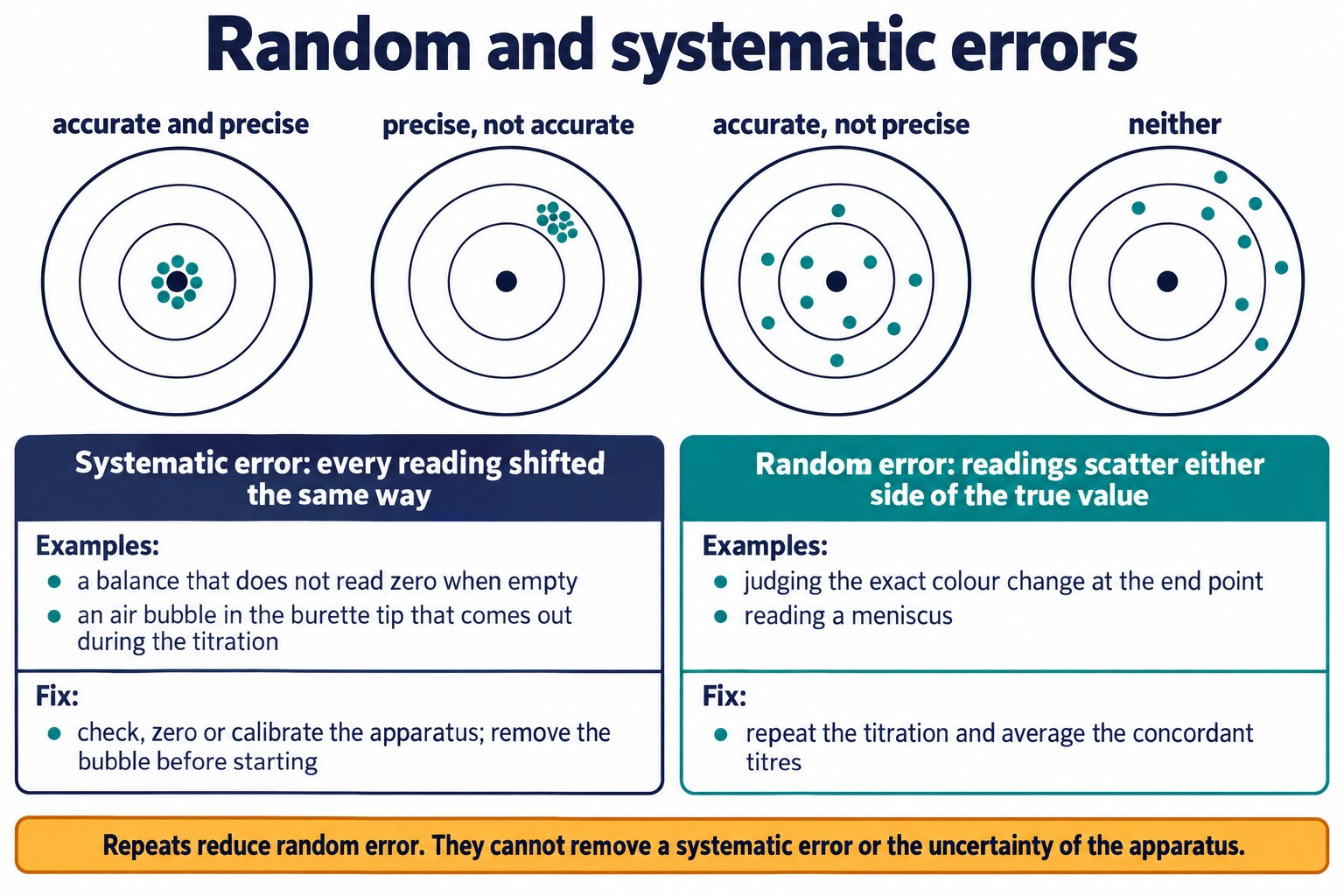
- Repeating a measurement and taking a mean reduces the effect of random errors.
GCSE Recap: Readings, Resolution and Means
Four quick GCSE questions on reading equipment and averaging repeats.
Measurement Uncertainty
Every piece of apparatus has an uncertainty, the largest amount by which a reading may differ from the true value.
A burette read to 0.05 cm³ has an uncertainty of ±0.05 cm³ per reading, and a titre is the difference of two readings, so its uncertainty is ±0.10 cm³.
The percentage uncertainty compares the uncertainty with the size of the reading:
percentage uncertainty = uncertainty ÷ measured value × 100
| Apparatus | Typical uncertainty | Reading | Percentage uncertainty |
|---|---|---|---|
| Burette (two readings) | ±0.10 cm³ | 22.30 cm³ | 0.10 ÷ 22.30 × 100 = 0.45% |
| 25 cm³ pipette | ±0.06 cm³ | 25.0 cm³ | 0.24% |
| 250 cm³ volumetric flask | ±0.30 cm³ | 250 cm³ | 0.12% |
| Balance (2 d.p.) | ±0.005 g per reading | 2.65 g | 0.19% (0.38% if weighed by difference) |
When a result is calculated from several measurements, the percentage uncertainties are added to give the overall percentage uncertainty of the result. For the worked example above, the burette, pipette and the concentration of the standard solution all contribute.
Each reading contributes its own percentage; the percentages add to give the uncertainty in the final concentration.
Key idea: A small titre gives a large percentage uncertainty. Aim for a titre of 20 to 25 cm³ by choosing sensible concentrations.
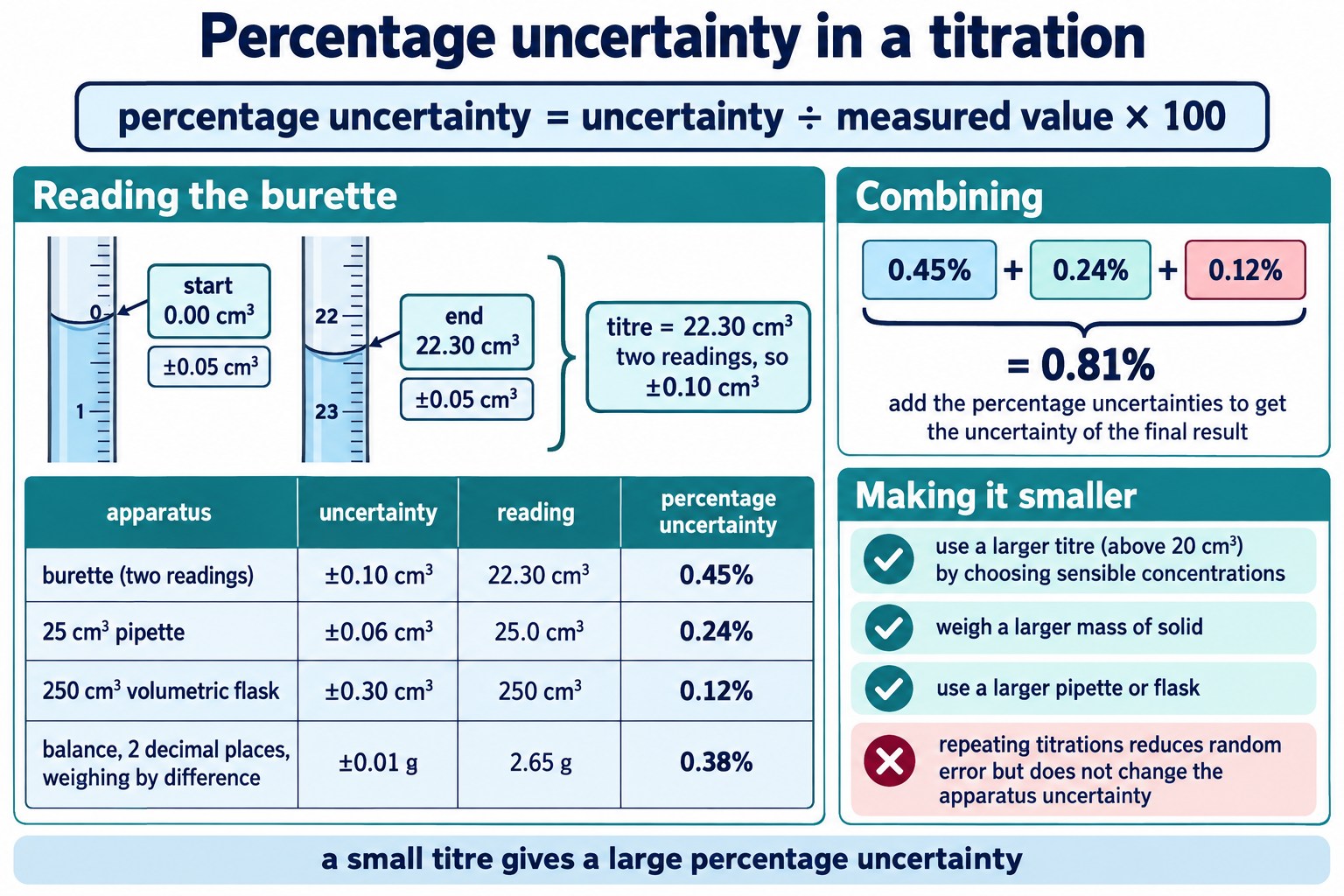
Percentage uncertainty for each piece of titration apparatus, how the percentages combine, and how to make the uncertainty smaller.
Quick Check: Rank the Measurements
Work out each percentage uncertainty, then put the measurements in order.
Reducing the Uncertainty
The percentage uncertainty falls when the measured value is larger or the uncertainty is smaller.
Practical ways to reduce it include weighing a larger mass of solid, using a larger volume pipette, choosing concentrations that give a titre above 20 cm³, and reading the burette to the nearest 0.05 cm³ at eye level.
Remember: Repeating titrations and averaging concordant results reduces random error but does not change the apparatus uncertainty.
CP 3 Concentration of HCl by Titration and CP 2 Prepare a Standard Solution are the practicals in which these calculations and uncertainties are put to work.
Exam wording: A question asking how to reduce the uncertainty wants a change to the measurement, for example “use a larger titre by diluting the acid”, not “be more careful”.
Quick Check: Uncertainty Calculations
Calculate percentage uncertainties for readings not in the table and decide which change reduces the overall uncertainty most.
Quick Check: Uncertainty in Five Rounds
Pick the one accurate statement in each round to pull the page together.
Common Exam Points
Calculate a concentration from a titration
Equation, moles of the known solution, ratio, divide by volume in dm³, then convert units if g dm⁻³ is asked for.
Calculate the percentage uncertainty in a titre
The titre is two readings, so the uncertainty is 2 × 0.05 = 0.10 cm³; divide by the titre and multiply by 100.
Suggest how to reduce the uncertainty
Increase the measured quantity: a larger mass, a larger volume, or a larger titre.
Do not say
“Uncertainty of a burette reading is 0.1 cm³” for a single reading; “repeat the experiment” as a way of reducing apparatus uncertainty; “use a more accurate burette” without saying how.
FAQs
Use these quick answers to check the uncertainty ideas.
Why is the uncertainty of a titre 0.10 cm³ when the burette reads to 0.05 cm³?
A titre is the difference between two burette readings, and each reading carries ±0.05 cm³, so the uncertainties add.
How do I find the overall percentage uncertainty?
Work out the percentage uncertainty of each measurement and add them together.
How can I reduce the percentage uncertainty?
Make the measured value larger: weigh more solid, use a larger pipette, or adjust concentrations so the titre is above 20 cm³.
Why does a small titre give a large percentage uncertainty?
The ±0.10 cm³ stays the same whatever the titre, so dividing by a smaller titre gives a bigger percentage. A 10.00 cm³ titre gives 1.0%, more than double the 0.45% for 22.30 cm³.
What is the overall percentage uncertainty in the worked example?
Add the burette, pipette and volumetric flask values: 0.45% + 0.24% + 0.12% = 0.81%. A larger titre or a larger pipette would lower this total.
Copyright notice: This OLS revision content, including the explanations, layout, diagrams, tables and embedded learning structure, is authored for Online Learning System by Dr. Mohammed Al-Fatah. It may not be copied, reproduced, redistributed or adapted without written permission.
Keep this note — free
Save your progress across every Edexcel topic. A free account remembers which topics you have covered, saves your question scores, and syncs across your phone and laptop.
- Track every topic you have finished
- Keep your practice-question scores
- No payment, no card, free forever
Already registered? Log in