Concentrations of Solutions
A focused revision guide to concentrations of solutions for Edexcel A Level Chemistry Topic 5. This page covers the concentration formula, unit and volume conversions, ion concentrations from dissociation, solution calculations from balanced equations and dilution problems with full worked examples.
- 5.7-c
- 5.7-d
- 5.11-a
- 5.11-b
What these spec points say
- 5.7-c be able to calculate amounts of substance in reactions involving volume of solution
- 5.7-d be able to calculate amounts of substance in reactions involving concentration
- 5.11-a be able to calculate solution concentrations in mol dm-3
- 5.11-b be able to calculate solution concentrations in g dm-3
Making a Standard Solution and Diluting It
Choose a step to watch how 2.65 g of sodium carbonate becomes 250 cm³ of 0.100 mol dm⁻³ solution, then a ten-fold dilution.
© Dr. Mohammed Al-Fatah – onlinelearningsystem.net
GCSE Recap: Concentration in g dm⁻³
Before you start, check what you remember from GCSE about concentration in grams per dm³.
How to Work With Solution Concentrations
The concentration of a solution tells you how much solute is dissolved in a given volume of solution. In chemistry, it is usually expressed as the amount of solute (in moles) per unit volume (in dm3).
The standard units you need to know are:
| Quantity | Symbol | Standard unit | Alternative |
|---|---|---|---|
| Concentration | c | mol dm−3 | M (molar) is the same value |
| Amount | n | mol | Use mol directly |
| Volume | V | dm3 | Convert cm3 and m3 as needed |
Volume conversions you must memorise:
cm3 → dm3: divide by 1000
cm3 → m3: divide by 1 000 000
dm3 → m3: divide by 1000
Why dm3 matters: the unit mol dm−3 means moles per dm3. If your volume is given in cm3, you must convert it before substituting, or your concentration will be 1000 times too large or too small.
Quick Check: Units and Volume Conversions
Choose the correct unit or conversion in each question.
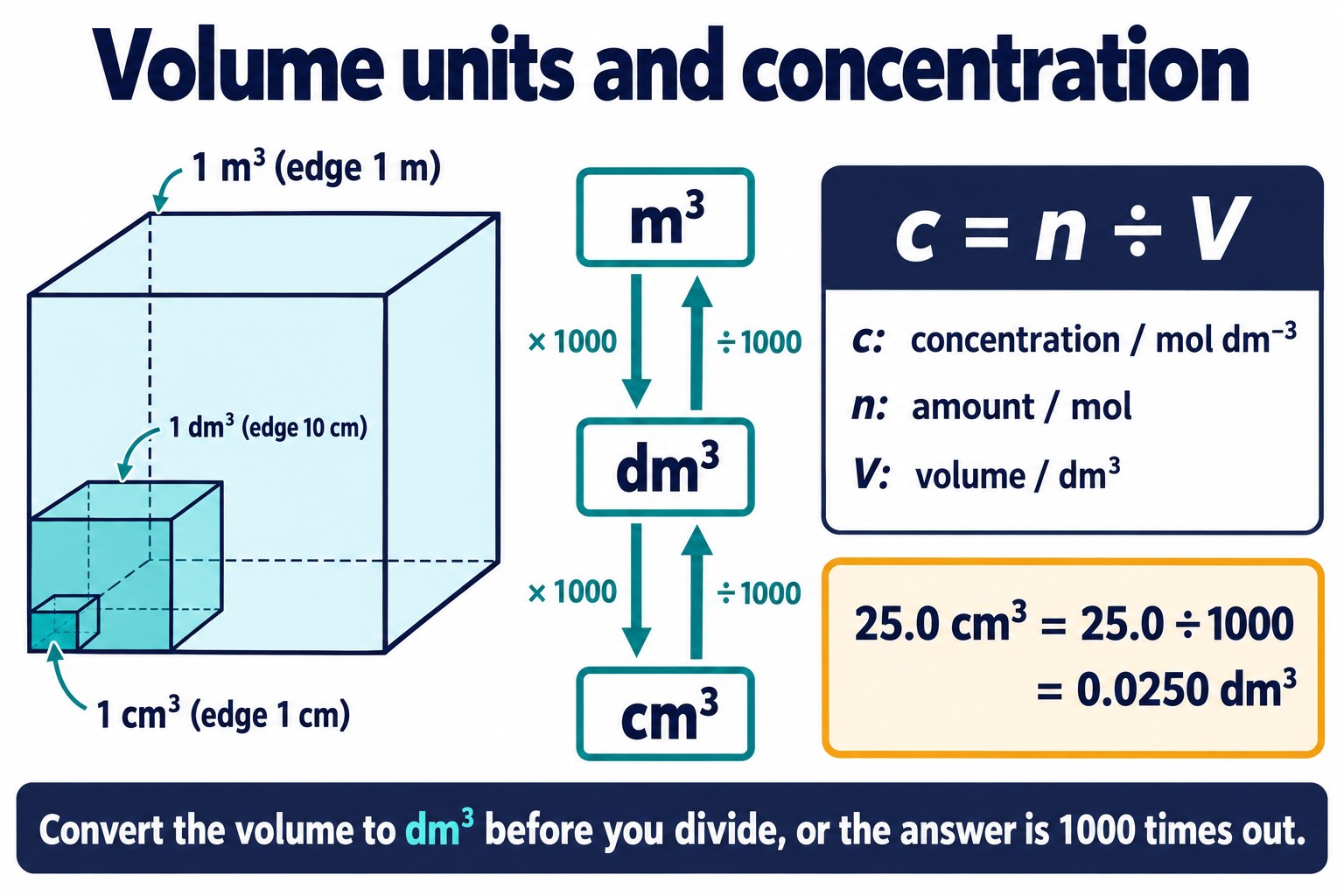
The concentration formula is short to write and easy to misuse; the real test is whether you can convert the volume to dm3 cleanly every time.
Calculating Concentration From a Known Mass
Most concentration questions give you a mass of solute and a volume of solution. The strategy is always the same: convert the mass to moles first, then divide by the volume in dm3.
Example A – Small-scale solution
Calculate the concentration of the solution made by dissolving 5.00 g of Na2CO3 in water and making the solution up to 250 cm3.
Mr(Na2CO3) = (23.0 × 2) + 12 + (16 × 3) = 106
Example B – Large-scale solution
Calculate the concentration of the solution made by dissolving 10 kg of Na2CO3 in water and making the solution up to 0.50 m3.
Sense check: the two solutions above have almost identical concentrations because the ratio of solute to volume is roughly the same. The actual scale of the solution does not change the concentration; only the ratio does.
Mass Concentration in g dm−3
Concentration can also be given as a mass concentration, which is the mass of solute in grams per dm3 of solution. The unit is g dm−3.
The two types of concentration are linked by Mr, because the mass of 1 mol of solute is Mr in grams.
Worked example: the Na2CO3 solution from Example A
The solution contains 5.00 g of Na2CO3 (Mr = 106) in 250 cm3 of solution.
This matches the answer to Example A, so both routes give the same concentration.
Remember: multiply by Mr to go from mol dm−3 to g dm−3. Divide by Mr to go from g dm−3 to mol dm−3.
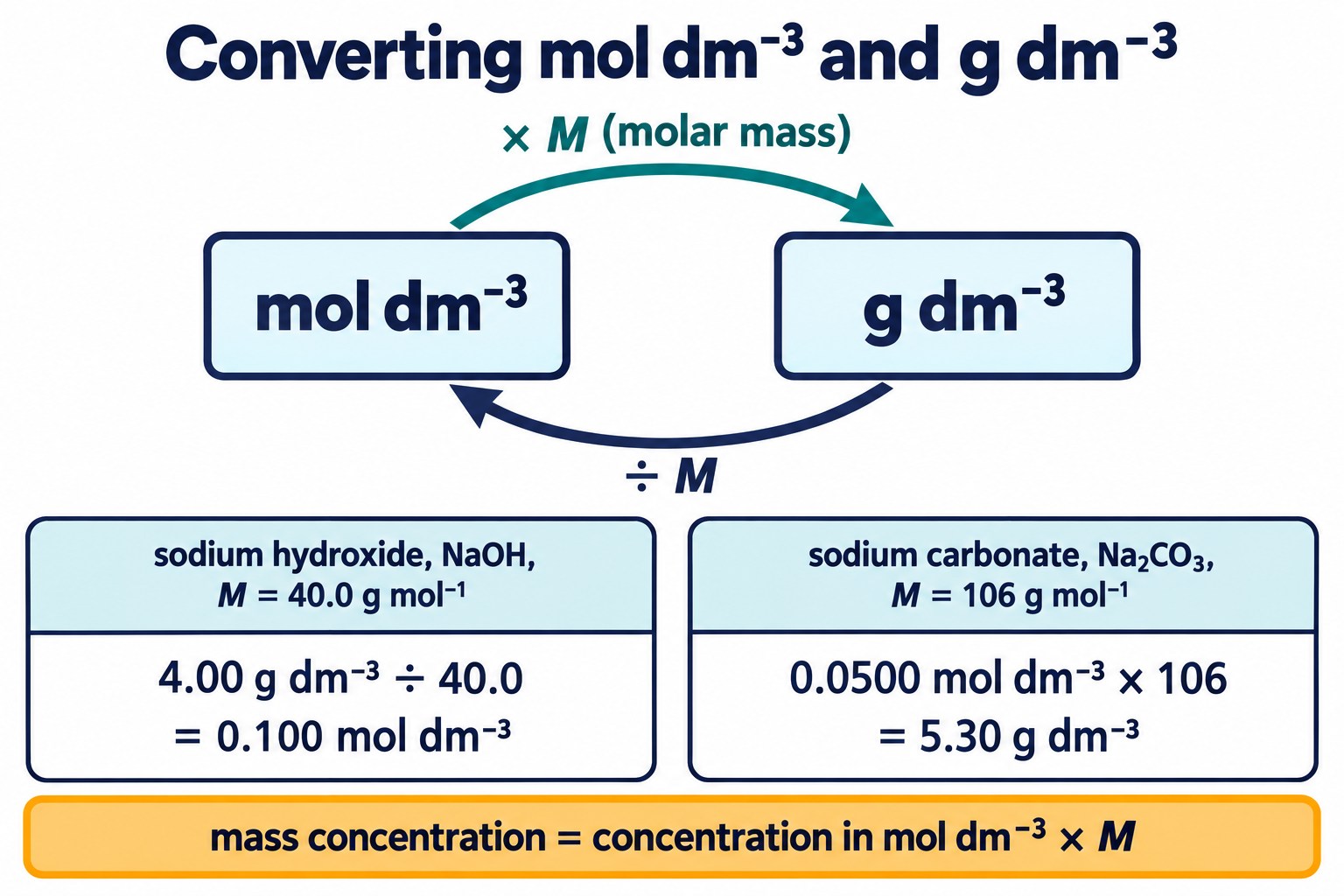
Whether the sample is grams in a beaker or kilograms in an industrial tank, the calculation reduces to the same two numbers: moles of solute and volume in dm3.
Alternative Method: Scaling to 1 dm3
Some questions are easier to handle by first scaling the data up to a full 1 dm3 (1000 cm3) of solution, then converting the resulting mass into moles. This is a useful sanity check when the numbers feel awkward.
Example C – Scaling NaHCO3 to 1 dm3
What is the concentration in mol dm−3 of a solution containing 2.10 g of NaHCO3 in 250 cm3 of solution? (H = 1, C = 12, O = 16, Na = 23)
250 cm3 is one quarter of 1000 cm3 (1 dm3). So a solution with the same concentration in 1000 cm3 would contain four times as much solute.
The concentration is therefore 0.100 mol dm−3, which matches the standard amount ÷ volume method.
Choose the method that suits you: the direct amount ÷ volume method is more reliable under exam pressure, but the scaling-to-1-dm3 method is a useful way to check that your answer makes sense.
Quick Check: Concentration From a Mass
Work each concentration out on paper, then flip the card to check.
Ion Concentrations From Dissociation
When an ionic compound dissolves in water, it dissociates into its component ions. The concentration of each ion depends on the stoichiometry of the dissociation, not just on the concentration of the original compound.
Example D – Ion concentrations in MgCl2(aq)
If 9.53 g (0.1 mol) of magnesium chloride (MgCl2) is dissolved in water and made up to 1 dm3 of solution, the concentration of magnesium chloride solution would be 0.1 mol dm−3.
However, MgCl2 dissociates fully on dissolving:
MgCl2(s) + aq → Mg2+(aq) + 2Cl−(aq)
So 0.1 mol of MgCl2 produces 0.1 mol of Mg2+ ions and 0.2 mol of Cl− ions.
Rule: the concentration of each ion equals the concentration of the dissolved compound multiplied by the number of those ions in one formula unit. Square brackets, such as [Cl−], are the standard shorthand for “concentration of…”.
Quick Check: Ion Concentrations
Write each dissociation on paper, then type the ion concentration.
An Ionic Solid Dissolving
Choose a step to watch polar water molecules pull ions out of a sodium chloride lattice, count the ions, then try a non-polar solvent.
© Dr. Mohammed Al-Fatah – onlinelearningsystem.net
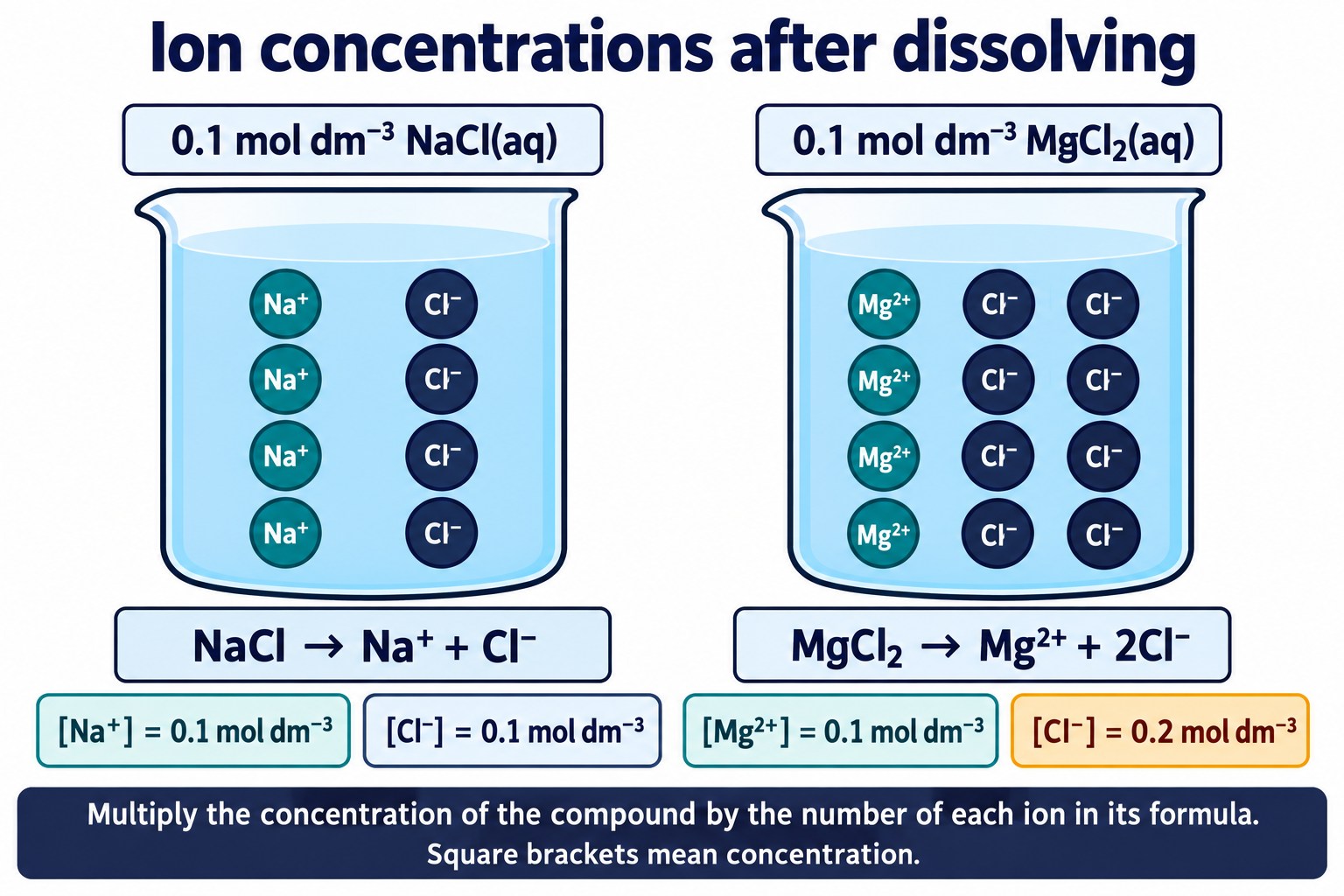
One mole of dissolved salt does not always equal one mole of every ion in solution; the dissociation equation is what determines each individual ion concentration.
Basic Calculations From Equations Involving Solutions
When a balanced equation involves a solution, you often need to combine the concentration formula with the mole ratio from the equation. The strategy follows three steps:
Step 1 – Find moles of the known substance
For a solution: amount (mol) = concentration (mol dm−3) × volume (dm3). For a solid: amount (mol) = mass ÷ Mr.
Step 2 – Apply the mole ratio
Use the balancing numbers in the equation to convert moles of the known substance into moles of the substance you need.
Step 3 – Convert moles to the required answer
Convert back into mass, volume of solution or concentration depending on what the question asks for.
Example E – Mass of solid reacting with a solution
What is the maximum mass of calcium carbonate that will react with 25.0 cm3 of 2.00 mol dm−3 hydrochloric acid? (C = 12, O = 16, Ca = 40)
Balanced equation: CaCO3 + 2HCl → CaCl2 + H2O + CO2
1 mol of CaCO3 weighs 100 g, so 0.0250 mol weighs 0.0250 × 100 = 2.50 g.
The maximum mass of calcium carbonate is therefore 2.50 g.
Exam tip: in any question where one reactant is given as a volume and concentration of solution, always start by finding the moles of that substance. It is almost always the best starting point.
Quick Check: Reactions Involving Solutions
Work through each calculation, then flip the card to check.
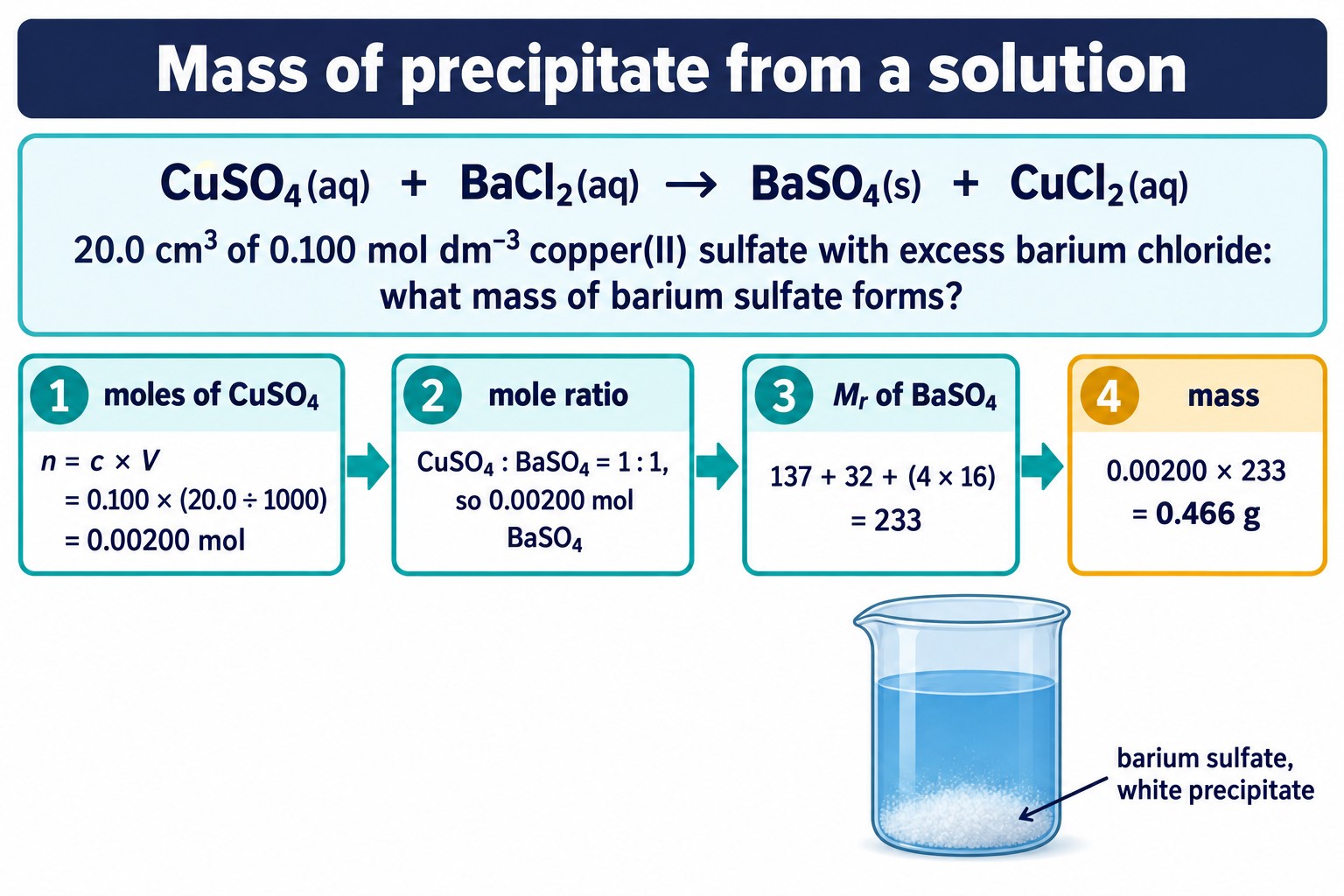
Combining concentration with the mole ratio is the workhorse calculation for titration questions and reactant mass questions alike.
Calculating the Volume of a Solution
The concentration formula can be rearranged to find any of the three quantities; concentration, amount or volume.
Use this form whenever you know how many moles of a solute you need and the concentration you are working with.
Example F – Volume needed to deliver a known mass
What volume of 0.500 mol dm−3 NaOH contains 4.00 g of sodium hydroxide? (Na = 23, O = 16, H = 1, so Mr = 40)
Common error: forgetting to convert the final volume to cm3 when the question asks for it. Read the units in the question stem before writing your final answer.
Quick Check: Rearranging the Concentration Formula
Find the volume or mass needed for each required amount.
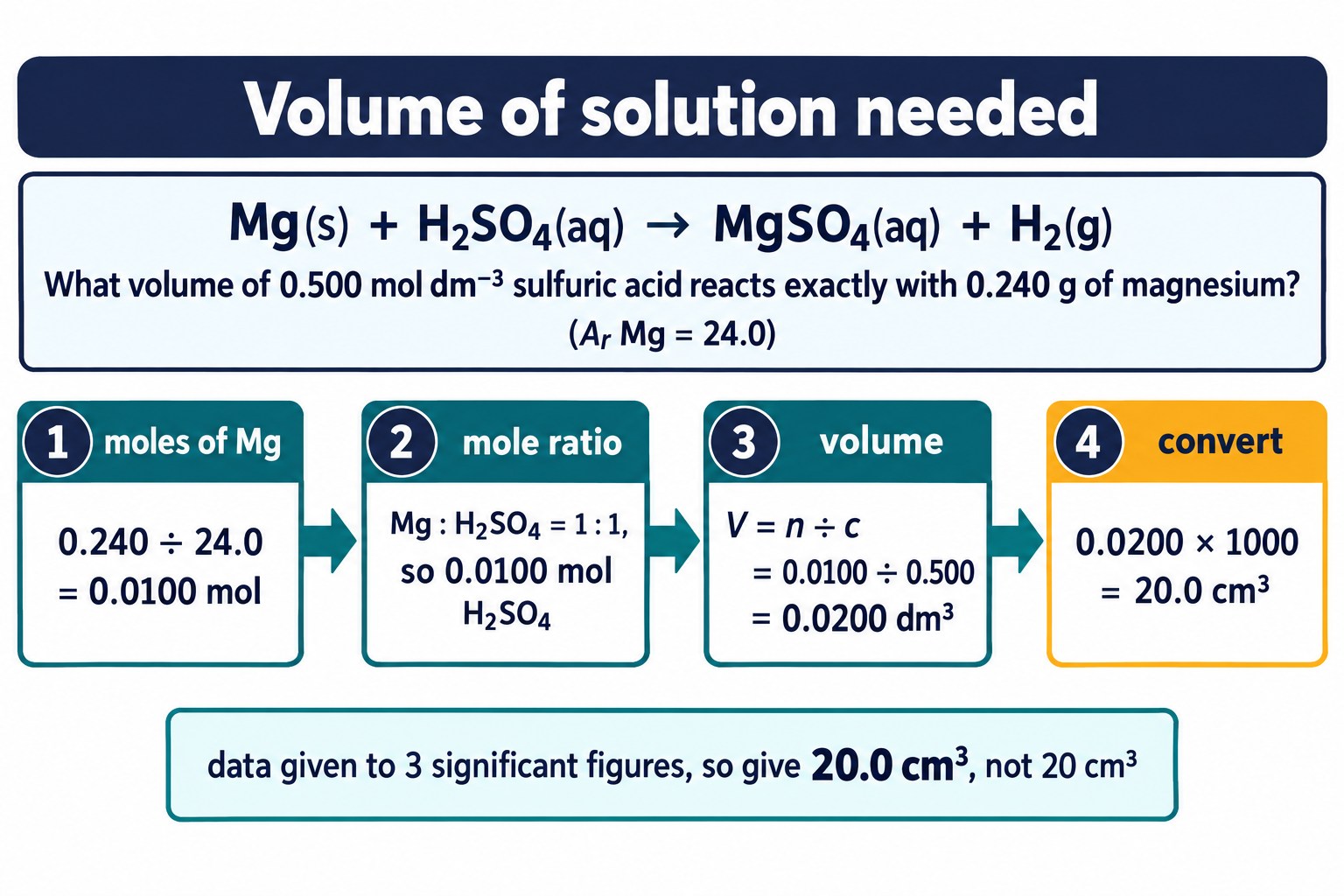
Rearranging the same single formula is enough to handle nearly every concentration-based question on the paper, provided the units are consistent.
Dilution Calculations
When water is added to a solution, the moles of solute do not change, but the volume increases, so the concentration falls. This is the principle behind every dilution calculation.
Here c1 and V1 are the concentration and volume of the original solution, and c2 and V2 are the concentration and volume of the diluted solution.
The units must match on both sides, but they can be in any consistent volume unit (cm3 works fine on both sides).
Example G – Volume of water to add
What volume of water in cm3 must be added to dilute 5.00 cm3 of 1.00 mol dm−3 hydrochloric acid so that it has a concentration of 0.050 mol dm−3?
Critical distinction: the question asks for the volume of water added, not the final total volume. Always subtract the starting volume of solution from the final volume to find the water added.
Quick Check: Dilutions
Answer each question about diluting a solution.
Quick Check: Solution Concentrations Round-Up
Pick the one fully correct statement in each round to pull the whole page together.
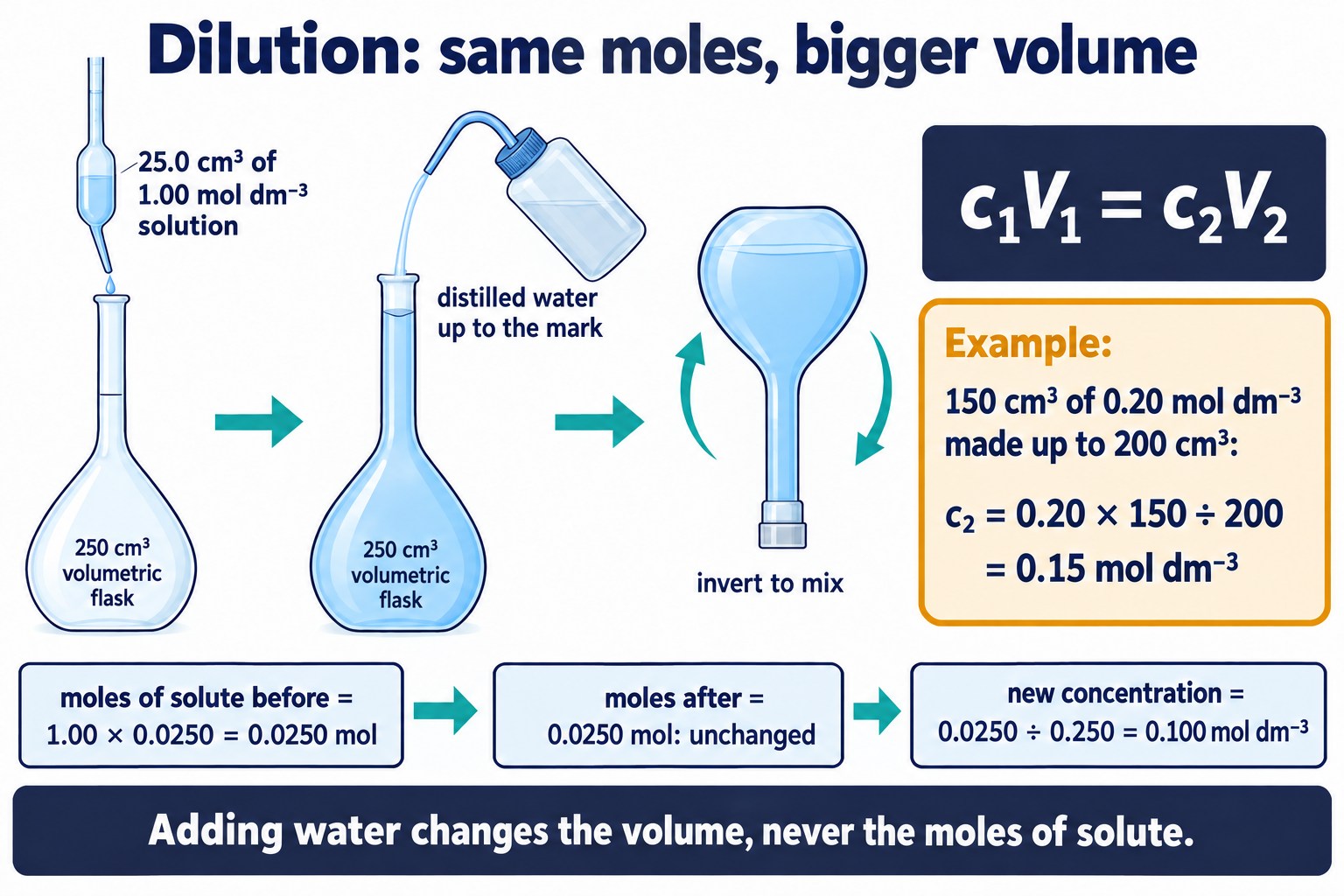
Practically, dilutions are performed in a volumetric flask: a measured volume of stock solution is added, then made up with water to the calibration mark.
Common Exam Points
- Concentration is amount ÷ volume, where amount is in mol and volume is in dm3.
- The unit mol dm−3 is the same as M (molar). Both are acceptable.
- Always convert cm3 to dm3 by dividing by 1000 before substituting into the formula.
- For solutions, moles = concentration × volume in dm3; for solids, moles = mass ÷ Mr. Identify which one applies to each substance in the question.
- Ion concentrations depend on the dissociation. For example, in 0.1 mol dm−3 MgCl2, [Mg2+] = 0.1 mol dm−3 and [Cl−] = 0.2 mol dm−3.
- Square brackets, such as [HCl], mean “concentration of HCl” and have units of mol dm−3.
- For reactions involving a solution and a solid, always start by finding the moles of the substance you have the most information about.
- For dilutions, use c1V1 = c2V2. Read carefully whether the question asks for the final volume or the volume of water added.
- Show every unit conversion clearly on your script; markers award method marks even if the final number is wrong.
QuickSnap
This text summary condenses the page into the essential exam ideas.
- Concentration formula: concentration = amount ÷ volume, in mol dm−3.
- Volume conversions: cm3 → dm3 divide by 1000; dm3 → m3 divide by 1000; cm3 → m3 divide by 1 000 000.
- Moles in a solution: moles = concentration × volume in dm3.
- From mass: moles = mass ÷ Mr, then divide by volume in dm3.
- Mass concentration: concentration in g dm−3 = concentration in mol dm−3 × Mr.
- Ion concentrations: determined by the dissociation equation; multiply by the number of those ions per formula unit.
- Square brackets: [X] means concentration of X in mol dm−3.
- Reactions with solutions: use the mole ratio from the balanced equation, after finding moles of the substance you know the most about.
- Dilutions: c1V1 = c2V2. The moles of solute do not change; only the volume.
- Volume of water added: final total volume minus starting volume of solution.
FAQs
These questions address the most common points of confusion students encounter when working with solution concentrations.
What is the difference between mol dm−3 and M?
There is no difference; they are two ways of writing the same unit. Both mean moles of solute per dm3 of solution. M is read as “molar” (so 0.5 M is “0.5 molar”), and mol dm−3 is the SI-style notation.
Why do I have to convert cm3 to dm3?
Because the standard unit of concentration is mol dm−3. If you leave the volume in cm3, your concentration will be 1000 times too small. Divide every cm3 value by 1000 before substituting into the concentration formula.
How do I find the concentration of individual ions in a solution?
Write the dissociation equation for the dissolved compound. The concentration of each ion equals the concentration of the original compound multiplied by the number of those ions in one formula unit.
For example, 0.1 mol dm−3 Na2SO4 gives [Na+] = 0.2 mol dm−3 and [SO42−] = 0.1 mol dm−3.
What does c1V1 = c2V2 actually mean?
It states that the moles of solute do not change when a solution is diluted with water. The product of concentration and volume is the number of moles, so if you multiply concentration by volume before and after, the answers must be equal.
For a reaction involving a solid and a solution, where should I start?
Start with the substance for which you can directly calculate moles. Usually, that is the solution, because you are given both its volume and its concentration.
Once you have moles of the solution, use the mole ratio from the balanced equation to find moles of the solid, then convert to mass.
Does the volume of a dilution include the original solution?
Yes. In c1V1 = c2V2, V2 is the total final volume of the diluted solution, which includes the original solution plus the added water. The volume of water added is V2 − V1.
Copyright notice: This OLS revision content, including the explanations, layout, diagrams, tables and embedded learning structure, is authored for Online Learning System by Dr. Mohammed Al-Fatah. It may not be copied, reproduced, redistributed or adapted without written permission.
Keep this note — free
Save your progress across every Edexcel topic. A free account remembers which topics you have covered, saves your question scores, and syncs across your phone and laptop.
- Track every topic you have finished
- Keep your practice-question scores
- No payment, no card, free forever
Already registered? Log in